Thinking about getting myself a welder, but...

   / Thinking about getting myself a welder, but... #21  
I like my Hobart Handler 140 (110 v). I like to be able to go plug it in anywhere and I think it's the most powerful 110 unit you can get. I don't use gas with it (but the regulators are included if I decide to) and have no problem welding thick or thin. Got my auto-dimming face shield at Harbor Freight for like $39. It works fine for the amount I use it and I can buy several replacements and still be ahead of buying a more expensive one.
 
   / Thinking about getting myself a welder, but... #22  
thick? like 1/2" in single pass?
 
   / Thinking about getting myself a welder, but... #23  
thick? like 1/2" in single pass?

i'd like a good explanation of what that really means, other than someone read it off the manufacturer's literature.

the amount of weld applied to a particular joint has a minimal amount to do with the thickness of the material, aside from needing to be hot enough to to create proper fusion. the amount of weld required should be based on the load that the connection is required to take. many times the material thickness is driven by a bending consideration, or shear / tearout through a hole pattern. obviously, for most simple home shop weldments you don't know the exact load required, but you should know from observation that only in very specific cases do you need a weld that is capable of carrying the full tensile capacity of the material.

i've designed and drawn literally thousands of connections that use 1/2" material, and as a minimum they only require a 3/16" single pass fillet weld, unless the actual load on the connection dictates otherwise. aside from specific processes, such as submerged arc, a fillet weld is generally not allowed to be larger than 5/16" in a single pass, regardless of the size of the machine.

in actual practice, i built a skidding winch a couple years ago, and for the ears to connect to the 3ph lower arms i used 1/2" plate, because it was what i had around. i made them so they fit up with a slight gap between the ears and the channel frame, and used a small 120v wire feed welder to attach them. it was certainly pushing the limit of what it could do, but it did work fine. the very start of the weld was slightly cold, but once the arc heated the metal it went fine. very little welding actually requires 100% penetration. in my industry we try to redesign so we can avoid complete penetration, as it just adds a lot more work that isn't always necessary.
 
   / Thinking about getting myself a welder, but... #24  
I have a hobart handler 187, 220 volt setup, with the tank I have about 1k invested, and I absolutely love it, I have built a tree spade for $100 all from drop steel @30 cents a pound, a pallet fork frame from mostly scrap plus $100 dollar auction forks, and most recently a log splitter. if you are going to buy a welder then you will need a chop saw and angle grinder at least. But once I got it I wondered how I ever lived without it. I did fight it out with an old century with flux core for about a year before I had enough of it and upgraded.
 
   / Thinking about getting myself a welder, but... #25  
i'd like a good explanation of what that really means, other than someone read it off the manufacturer's literature.
I would too! :confused:
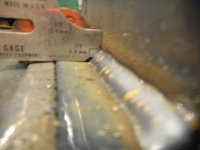
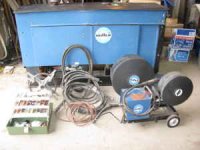
This subject came up a few days ago, either here or another site. It has to boil down to joint design! If splicing 1/2 thick plate with 22 1/2 degree bevels I'm not sure I've ever run a machine that can do that in a single pass. 1/2 inch thick material with a fillet weld on each side, sure. Good rule of thumb is, the weld should be half the thickness of the material. So that would be a 1/4 inch weld on each side. Here is a picture of an honest 1/4 inch Mig weld. I remember when I first bought my Trailblazer 55D, I was working in a beam splicing yard. I had to weld 3/4 inch thick plates to the flanges of the beams. The drawing required 3/8 inch fillet welds all the way around the plates. I had an on site inspector who was a royal PITA! I think he put a weld gauge on every weld. To keep production up I was running 5/64 inch Innershield at 400 + amps. Hard to remember every detail because this was 1983 I could get either 12 or 18 inches of honest 3/8 inch fillet weld in under 60 seconds. One thing I do remember like it was yesterday, every morning I had to replace the Tweco lead fittings at the machine. The rubber would get so hot it would melt, and drip onto the bed of the truck. Here is a picture of the Trailblazer.
 

Attachments

  • Weld.jpg
    Weld.jpg
    203.6 KB · Views: 295
  • 250.jpg
    250.jpg
    129.2 KB · Views: 452
  • Feeder.jpg
    Feeder.jpg
    8.8 KB · Views: 256
   / Thinking about getting myself a welder, but... #26  
While there may be only a few things that you absolutely have to have welded, I think being able to weld opens up more things that you could do but were not worth hauling to a weld shop to have done. I'm just starting out myself. The other night, just for learning, I made a "saw horse" out of old fence t posts. My wife took one look at it and said "Oh great, a bean kettle support for over the campfire!" I guess I have to make a few more:laughing:

I know there are other things that I will be making (like equipment stands) that would never get done if I had to have a weld shop make them.

As for the 220 issue, here are a few possibilities:
1) go oxy/acetylene. No electricity required, field portable. It can also be used for cutting. Some people say that it is the best way to start learning welding although it is not the easiest.
2) instead of burying new cable, run it overhead, or have the utility install a separate line/meter to the workshed
3) get a welder/generator or get a generator big enough to run a 220 welder. Either would provide backup power for utility outages.
4) change your plans and work from the garage instead of the barn. Or, get a 110/220 unit and use it on 110 from the barn but be able to use it on 220 close to the house if you run into a situation where you need the extra capacity.

Ken
 
   / Thinking about getting myself a welder, but... #27  
If I were in the OP's shoes, I'd go the route he is thinking of already, with a brand-name 120 v wire feeder. It will definitely weld up to 1/4" steel reliably, is easy for a beginner to use.

It may not be a "forever" welder that he can build heavy equipment with, but it'll get him started without re-wiring and spending a fortune on infra-structure simply to repair a mower deck once a year. If he finds he's welding more than the original plan, then is the time to upgrade.

Money is easy to spend, particularly if you become convinced you need to buy a sledgehammer to drive finish nails, just in case you might ever want to drive fenceposts.

It's the same route I took, with a Miller 135. I built a lot of gear with that machine, then won a Miller 180 and sold the 135 since I thought I wouldn't use it again. I wish I had it back now, the money I got for it is long gone but the use for true 120V portability is still there.

I picked up a used AC/DC stick welder a couple years ago for cheap. It does at least 50% of my work these days, but I already have an existing garage that was built with 220 power for welding in mind.

Sean
 
   / Thinking about getting myself a welder, but...
  • Thread Starter
#28  
Ken45101....Jeeze, you make me feel so DUMB with your suggestion that I buy a generator...here I have a Coleman with a 5000 watt rating/6250 surge watts it has 20.8 amps at 220...

Go ahead and laugh at me, I deserve it !!!
 
   / Thinking about getting myself a welder, but... #29  
Ken45101....Jeeze, you make me feel so DUMB with your suggestion that I buy a generator...here I have a Coleman with a 5000 watt rating/6250 surge watts it has 20.8 amps at 220...

Go ahead and laugh at me, I deserve it !!!

I have a 5000 watt genny too, and it will run the mig up to about 80% power, then will pop the breaker. The weld quality using the genny as a power source isn't as good as line power either at least in my case, so keep that in mind. It may be the "unclean" power the generator puts out affecting the circuit cards in the welder.

I haven't tried using it to run the stick welder, so I can't comment on that.

Sean
 
   / Thinking about getting myself a welder, but... #30  
Ken45101....Jeeze, you make me feel so DUMB with your suggestion that I buy a generator...here I have a Coleman with a 5000 watt rating/6250 surge watts it has 20.8 amps at 220...

Go ahead and laugh at me, I deserve it !!!

LOL. Well, I don't know but that may or may not be marginal but may still work for you in some cases. If I were you, I would go with a 120/220 welder that you can run on your 120 most of the time, on the gen sometimes when you need a bit more, and move it to the garage if you need full power.

That gives you the most flexibility without any major modifications.

Ken
 
   / Thinking about getting myself a welder, but... #31  
LOL. Well, I don't know but that may or may not be marginal but may still work for you in some cases. If I were you, I would go with a 120/220 welder that you can run on your 120 most of the time, on the gen sometimes when you need a bit more, and move it to the garage if you need full power.

That gives you the most flexibility without any major modifications.

Ken

Sounds like a plan to me:thumbsup:

James K0UA
 
   / Thinking about getting myself a welder, but... #32  
I would too! :confused:
This subject came up a few days ago, either here or another site. It has to boil down to joint design! If splicing 1/2 thick plate with 22 1/2 degree bevels I'm not sure I've ever run a machine that can do that in a single pass. 1/2 inch thick material with a fillet weld on each side, sure. Good rule of thumb is, the weld should be half the thickness of the material. So that would be a 1/4 inch weld on each side.

Help me understand, if you will please, about capability and when beveling is needed.

My Millermatic 211 is supposed to weld up to 3/8" in a single pass (not that I mind multiple passes). If I'm trying to weld a butt joint on 1/4", do I need to bevel the edges? Is it too much to expect full penetration without bevelling? Can I make an adequately strong weld by doing both sides without full penetration? How much penetration do I need for a good joint?

What do they mean by "welding up to 3/8" in a single pass?" A 3/16" fillet on both sides of a tee joint or lap joint?

Thanks,
Ken
 
   / Thinking about getting myself a welder, but... #33  
Help me understand, if you will please, about capability and when beveling is needed.

My Millermatic 211 is supposed to weld up to 3/8" in a single pass (not that I mind multiple passes). If I'm trying to weld a butt joint on 1/4", do I need to bevel the edges? Is it too much to expect full penetration without bevelling? Can I make an adequately strong weld by doing both sides without full penetration? How much penetration do I need for a good joint?

What do they mean by "welding up to 3/8" in a single pass?" A 3/16" fillet on both sides of a tee joint or lap joint?

Thanks,
Ken

i'd like to throw a little more information at this one. hopefully it will be simple enough to understand and not muddy things up too much...

i'm going to quote information and pages out of the american institute of steel construction 9th edition allowable stress manual which i know most of you won't have access too, so i'll try to paraphrase the gist of the information. sadly, this is an out of date spec for virtually all construction now, but it was the current one when i started in this industry a little over 20 years ago so i can still instantly flip to the page i need. as newer specifications have come out, most of my work was done on computer and i've had far fewer occasions where i needed to look up something in a printed text, therefore it would take me a lot more time to assemble this information. no matter which spec is used, the general information is the same.

in the welded joints section, starting on page 4-152 there is discussion of complete penetration joints. they show examples of the most commonly used complete penetration joint conditions, and consider these types prequalified. by that they mean that assuming these joints are made with proper material under the proper conditions, then they may be exempt from testing, though i find that is often not the case. still, the pictures of the joints show the suggested/required welding.

for your example of splicing two plates, here is the information:

joint designation B-L1b allows material up to 1/4" to be spliced with no beveling, provided that a 1/8" gap is left between the pieces of material. this joint is made by welding one side of the connection then gouging the back side of the weld, generally with a carbon gouging rod. after any impurities have been removed by gouging the back side is then welded. this joint is for the smaw (stick welding) process.

joint B-L1b-GF allows up to 3/8" thick material to be joined with no beveling and a gap of 0" to 1/8". this still requires the same weld/gouge/weld procedure and is allowable for gmaw (mig) and fcaw (flux core) wire feeders, though short circuit transfer is specifically excluded from this and all other prequalified welds that do not use a backer. short circuit transfer is what most of us are using with our light duty welders.

processes B-U2/B-U2-GF and B-U4b/B-U4b-GF are for splicing material while beveling one (45 degrees) or both (30 degrees each) pieces with a gap of 0" to 1/8". these can be done with smaw. gmaw, or fcaw welding on any thickness material. thick material will require multiple passes of weld. these are still accomplished with a weld/gouge/weld procedure and short circuit transfer is still excluded as a prequalified solution.

the thing to remember is that these are what is used for building and bridge construction by large fab shops. what we do in our homes very rarely mimics this. as you can see, to achieve complete penetration all of these welds are done from both sides and require backgouging. this is not to say that you can't achieve complete penetration from a single side welding, because some industries such as pipeline welding don't have the luxury of being able to weld from the back side, but these two sided welds are done on a daily basis by many large fab shops.

the question of when you need a full penetration weld is one that is virtually impossible to answer. every condition is different but your best friends are experience and observation. look at other similar commercially made products and see how they are done. short of a complete structural analysis you'll never know exactly what you need. the most likely needs for complete penetration are for repairing a piece of metal that broke (not a broken weld) or when you need to splice a piece of metal because you don't have one full piece that is big enough.

on the issue of 3/8" in a single pass... that's so vague you have to make assumptions everywhere. does that mean for 70ksi filler metal? is it for tension or shear? is it for a single sided or double sided weld? is it for 36ksi yeild/58ksi tensile steel? one thing i am pretty sure of is that it isn't a complete penetration weld of 3/8" material in a single pass.

because of the nature of what i do, i find that i look at how literally everything is built - it's just how i am wired. i notice bolts, welds, material thicknesses and so on. i find that very little actually needs to be done with a complete penetration weld.
 
   / Thinking about getting myself a welder, but... #34  
lostcause:

Thanks! VERY helpful. I'll be saving your message.

Ken
 
   / Thinking about getting myself a welder, but... #35  
Help me understand, if you will please, about capability and when beveling is needed.

Ken I don't hardly ever weld anything 1/4 inch and above without a bevel or gap. When you use a 9-inch angle grinder it only takes a few seconds to put a bevel on something. But as lostcause says, it all depends on the application.

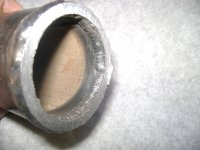
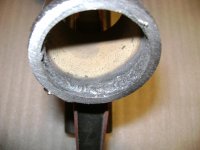
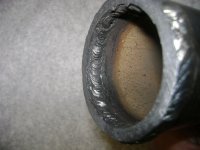
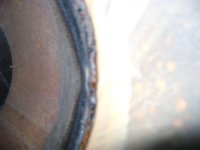
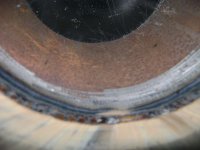
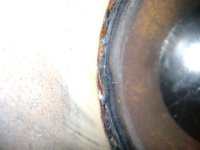
Here are some full penetration welds on pipe with SMAW, (stick) and Tig. If you are interested I can post some pictures of AutoCad drawings of joint designs I use.
 

Attachments

  • 3A.jpg
    3A.jpg
    201.1 KB · Views: 271
  • 6A.jpg
    6A.jpg
    195 KB · Views: 231
  • 9A.jpg
    9A.jpg
    192.4 KB · Views: 325
  • 3.jpg
    3.jpg
    96.3 KB · Views: 230
  • 6.jpg
    6.jpg
    130.7 KB · Views: 259
  • 9.jpg
    9.jpg
    117.8 KB · Views: 249
  • 12.jpg
    12.jpg
    135.8 KB · Views: 239
   / Thinking about getting myself a welder, but... #36  
I have saved thousands with my welder from fixing broken FEL to building underground duck pits to underground tornado shelters I won't go without one as long as I have food on the table
 
   / Thinking about getting myself a welder, but... #37  
very first arc I struck with my 220v stick welder MORE than paid for it, repairing a batwing mower I had, vs calling a mobile service out to the farm ... good tool to have..


soundguy
 
   / Thinking about getting myself a welder, but... #38  
I like my Hobart Handler 140 (110 v). I like to be able to go plug it in anywhere and I think it's the most powerful 110 unit you can get. I don't use gas with it (but the regulators are included if I decide to) and have no problem welding thick or thin. Got my auto-dimming face shield at Harbor Freight for like $39. It works fine for the amount I use it and I can buy several replacements and still be ahead of buying a more expensive one.

I have one of those too...bought it a couple years ago at TS, came with a "free" auto-dimming helmet. Bought a tank, do mostly MIG welding with it. Will I ever do enough welding for it to "pay for itself"? Probably not, but I like the convenience of having it there if I need to fab/repair something...most of the time I use it is evenings/weekends when a welding shop would be closed. I don't see myself ever needing to weld something heavier than this will handle.

I keep a spool of flux core wire too in case I need to work outside.
 
   / Thinking about getting myself a welder, but... #39  
My collection of welders started out because I had a hand truck (dolly) that lost a "fender" while moving into a house. Friendly neighbor used a Lincoln mig unit (120 volt) to fix it. I was hooked. Bought my first welder, a Lincoln 175 SP Mig with tank and cart. Then bought a Lincoln Pow'r Arc 4000 gas powered welder/generator.... started burning some rod. Next it was a Oxy/Act set for cutting, heating, welding, brazing, sodering. How handy! Then I bought my Millermatic Pulsar 220 volt mig unit. Has both a steel and aluminum gun, dual tanks etc. Love them all! It is addictive. Using them to rebuild my hiller/bedder. I loved doing woodworking, but metalworking is also a blast if you have the right tools.
 

Tractor & Equipment Auctions

gps trailers (A56859)
Caterpillar 906M (A53317)
Caterpillar 906M...
2010 BOBCAT TOOLCAT 5610 UTILITY WORK MACHINE (A59823)
2010 BOBCAT...
1992 Norris Long Basket Trailer (A60460)
1992 Norris Long...
2017 GENIE S-45 TELESCOPIC BOOM LIFT (A60429)
2017 GENIE S-45...
Flatbed Truck (A55973)
 
Top