Geothermal heat pump install with crawlspace encapsulation

   / Geothermal heat pump install with crawlspace encapsulation #41  
It's silly.

With no disrespect, it is not silly, it is thermodynamics and math.

Your area has an average ground temp of 50 deg. At 10' depth, there is a +/- 10 deg seasonal variation which would mean that you would see 45 deg at the loop without pulling any heat during winter. Now assume something like 25,000 BTUs average demand in the winter, for typical soils you would see 25000/600 feet* 5 loops is another 8 deg colder. This will bring you down to 37 deg in the winter with a single linear pipe. If the pipe density is higher, as in a slinky, you can have 2 or three times temperature differential, bringing you into the mid 20's or lower. Factors that mitigate that are soil types, or as you stated moisture.

Slinkies are preferred due to a smaller overall area is required and/or reduced digging time and cost.
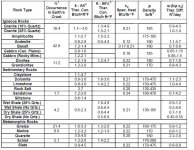
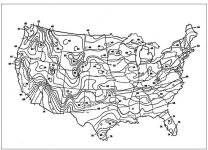
Soils.jpgGnd temp.jpgGnd Season.jpg

Paul
 
   / Geothermal heat pump install with crawlspace encapsulation #42  
I know that wells are more expensive than trenches but wouldn't they be more efficient?
If your well went down a couple of hundred feet, you would almost certainly have water running by your pipes carrying heat away.
 
   / Geothermal heat pump install with crawlspace encapsulation #43  
I know that wells are more expensive than trenches but wouldn't they be more efficient?
If your well went down a couple of hundred feet, you would almost certainly have water running by your pipes carrying heat away.

Yes. Wells are generally more efficient due to moisture. You can have a dry well, which would have less efficiency, but still benefits from being deep enough to not have any seasonal influences. In that case you still have the "heat flow" issue which will cause temp variations around the drill hole. If you have a moist, or even better a well in water, than the efficiency can be quite a bit higher. Moist or barely wet can also experience ground freezing around the well hole when under high demand. The most common reason for bore holes is available land area. Smaller lots usually require drilling. the down side is that drilling will cost many times what a trench system would cost.

Paul
 
   / Geothermal heat pump install with crawlspace encapsulation #44  
With no disrespect, it is not silly, it is thermodynamics and math.

Your area has an average ground temp of 50 deg. At 10' depth, there is a +/- 10 deg seasonal variation which would mean that you would see 45 deg at the loop without pulling any heat during winter. Now assume something like 25,000 BTUs average demand in the winter, for typical soils you would see 25000/600 feet* 5 loops is another 8 deg colder. This will bring you down to 37 deg in the winter with a single linear pipe. If the pipe density is higher, as in a slinky, you can have 2 or three times temperature differential, bringing you into the mid 20's or lower. Factors that mitigate that are soil types, or as you stated moisture.

Slinkies are preferred due to a smaller overall area is required and/or reduced digging time and cost.
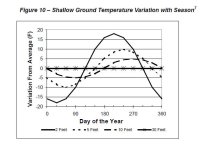
View attachment 391896View attachment 391895View attachment 391894

Paul
With all due respect please read my entire post. It's silly to move that much dirt for a 2 or 4 pipe system. The same could have been accomplished using a small bucket or trencher or using 5-6 slinkies. It could have saved the homeowner $2000 and had the same water temperatures.
 
   / Geothermal heat pump install with crawlspace encapsulation #45  
I know that wells are more expensive than trenches but wouldn't they be more efficient?
If your well went down a couple of hundred feet, you would almost certainly have water running by your pipes carrying heat away.

Wells are good when you have rock, sandy dry soil, steep river bluffs or not enough space. Wells might be more "efficient" using 1200 feet of pipe on a 3 ton system at $6,000, but you can obtain the same water temperatures using more pipe with trenching, slinkies, or pond loops for $3,000. To me water temps being equal, "efficiency" is what costs the homeowner the least amount of money, but performs. For horizontal you don't gain a whole lot unless you go below 25 feet.
 
   / Geothermal heat pump install with crawlspace encapsulation #46  
It is interesting to read about contact area of the geo field pipes. Contact area is nearly the same in any configuration. The big variable is the amount of area between pipes. The heat flow through soil is relatively poor. For most soils it is about 1 deg F/foot/BTU. If pipes are closer together, like in a slinky, the soil around the pipes will chill (or heat) more due to the pipe density and given heat flow. This results in a lower overall efficiency due to the chilling of the soil. One or two pipes in a trench, with trenches 8' apart is ideal, but impractical in some installations. It is documented, and I have also seen up to 20 deg swing in the trench (pipe) temps over seasonal changes. Some of that is ground/depth effects and the rest is low heat flow. My system reaches its lowest efficiency around march, when the incoming water temps are in the upper 20's. Last year was interesting as we had a good layer of snow from December onwards. The snow provided some insulation from the surface temps, and even though it was a much colder winter than usual, the incoming water temps were about 5 deg F warmer than other winters.

paul
Water temps in the 20's is pretty low isn't? What did you take into account when sizing your loop field and units for your home? What anti-freeze and percentage are you running? Most loops here are around 37 degrees at their lowest temperatures, but the poorly designed undersized ones can get much lower or very hot in the summers.

Loop design is extremely important and will save you the most money for operating efficiencies. Just round figures say if you have a 5 ton unit at 32 degree entering water temperature you will get around 49,000 BTU's of output. If that water temp is 50 degrees then you're looking at 64,000 BTU's of output running on 2nd stage. It is equally as dramatic for EER ratings too.
 
   / Geothermal heat pump install with crawlspace encapsulation #47  
We have reversible Waterfurnace geothermal with floor heating and high pressure fan coil for AC installed since 2004. We have two propane fireplaces as heat backup and sometime for ambiance. So far our geo works very well but if I build our house today I would use mini-split units and I would invest saved money in PV panels and there would be money left to buy a tractor stuff. The modern mini splits are very quiet inside and outside as well, phenomenally efficient, easy and fast to install and replace, they are way cheaper than Geo and you get a zone for every room in the house and redundant sources of heat and AC as well. We have one in my shop office and one in a guest room for about two years. They are Fujitsu Halcyon but there are other brands that are as good or perhaps even better. Another advantage is that you can get by with much smaller generator because all modern one have "soft" start and you can turn some completely off during outage while maintaining comfort in at least in some areas.

Wow, red, I wouldn't have thought that! We lived in Japan about 30 years using those so called mini split systems, so I know them well. A huge problem with them is you need one for every room! Or at least one outside unit that can handle maybe 2-3 inside wall mount units. We never used that kind in Japan. We had five in our last house in Japan. At $1,000-$2,000 or so per unit, and our house here would need at least 8 inside units, I don't see how they could be cheaper than geothermal. Our house is small, only about 1,500 square feet now, but duct vents even in walk in closet! Could not do that with Japanese heat pumps (that's what we call them there, just heat pumps).
 
   / Geothermal heat pump install with crawlspace encapsulation #48  
I would not trade my antique janitrol condensing unit for installed free mini splits.
 
   / Geothermal heat pump install with crawlspace encapsulation #49  
Geo systems in my area are almost all done with wells. Our system has 4 wells drilled 15-20 feet apart, each going down about 150 ft and grouted with bentonite. The wells were all drilled & grouted, and all lines run and installed to the geo-unit, in a single day (plus a couple hours the night before and a couple hours the morning after to move equipment). Cost wise, it was almost even with trenching but with a whole lot less land disturbance. I am sure that would not be the case in an area where the earth was not as amenable to drilling.
 
   / Geothermal heat pump install with crawlspace encapsulation
  • Thread Starter
#50  
Just a quick update, a few days of rainy weather have put trenching on hold until it all dries out.
 
   / Geothermal heat pump install with crawlspace encapsulation #51  
My design came out to 500' per ton which created a 62' slinky. I have an extra 100' each way to get to where the slinky is buried, so I actually have 200' straight into a 500' slinky, per ton. The design software lets you easily change type of loop, and it automatically calculates it for you. you use less total pipe for straight loops, but you dig a lot of trench. A slinky uses just a little bit more pipe, but pipe is cheap, and the digging for slinkies is much much less.
 
   / Geothermal heat pump install with crawlspace encapsulation #52  
My design came out to 500' per ton which created a 62' slinky. I have an extra 100' each way to get to where the slinky is buried, so I actually have 200' straight into a 500' slinky, per ton. The design software lets you easily change type of loop, and it automatically calculates it for you. you use less total pipe for straight loops, but you dig a lot of trench. A slinky uses just a little bit more pipe, but pipe is cheap, and the digging for slinkies is much much less.

My builder had a time getting all of the air out of a slinky (not at my house). He had to bring in temporary bigger pumps to push all the air out.
 
   / Geothermal heat pump install with crawlspace encapsulation #53  
My builder had a time getting all of the air out of a slinky (not at my house). He had to bring in temporary bigger pumps to push all the air out.
That's normal with loops with an underground manifold. On commercial jobs large pump trucks have to be used to purge and fill them. If you do an inside manifold with a non-pressurized flow center then you can purge and fill your loop field using the standard system's circulating pumps.
 
   / Geothermal heat pump install with crawlspace encapsulation #54  
My design came out to 500' per ton which created a 62' slinky. I have an extra 100' each way to get to where the slinky is buried, so I actually have 200' straight into a 500' slinky, per ton. The design software lets you easily change type of loop, and it automatically calculates it for you. you use less total pipe for straight loops, but you dig a lot of trench. A slinky uses just a little bit more pipe, but pipe is cheap, and the digging for slinkies is much much less.
Some of the design software can be a little scary. Engineers and software designers can be brilliant in certain areas and naive in others. Quality contractors typically know what works and what does not in the area for feet of pipe per ton. Homeowners should never be afraid to ask the contractor for references on previous jobs. It never hurts to have extra pipe in the ground. I would error on extra pipe than too little especially for super cold or super hot summers that aren't normal. The larger the loop the better water temperatures you will have which will save you more money on operating costs. Extra pipe within reason won't hurt with pumping efficiencies and Reynold's numbers.
 
   / Geothermal heat pump install with crawlspace encapsulation #55  
Sorry if this seems like a hijack and I do not mean it to. I am enjoying this thread as I want to consider geothermal in a year or two. Wells would be most likely given the amount of trees we have. Has anyone heard about Agreenability's Twister piping? They claim that you get more BTU exchange per hole due to 4 loops in a single bore, thereby cutting down on the number of well holes needed.

I have no stake in the company. I am interested as 3 wells 300' are about $6,000. If I could cut down on the number or depth, it would be a savings. Of course, if the pipe is that much more, it could easily offset the well savings.
 
   / Geothermal heat pump install with crawlspace encapsulation #56  
That twisted pipe stuff looks good Tom! I've never heard of it, so in a few years when I plan to install geothermal, I'll show it to my installer. This is not an easy decision!
 
   / Geothermal heat pump install with crawlspace encapsulation #57  
Wow, red, I wouldn't have thought that! We lived in Japan about 30 years using those so called mini split systems, so I know them well. A huge problem with them is you need one for every room! Or at least one outside unit that can handle maybe 2-3 inside wall mount units. We never used that kind in Japan. We had five in our last house in Japan. At $1,000-$2,000 or so per unit, and our house here would need at least 8 inside units, I don't see how they could be cheaper than geothermal. Our house is small, only about 1,500 square feet now, but duct vents even in walk in closet! Could not do that with Japanese heat pumps (that's what we call them there, just heat pumps).

We spent close to 40000 for our geothermal system with heat exchanger in the pond. The Halcyon unit for two rooms was 2000 plus 1000 for installation. Looking at the guys who installed it is easy DIY job. The single room unit were about 1500 USD plus about 150 for baseboard electric heater as backup. I am not saying splits are for everybody but it is an alternative.
 
   / Geothermal heat pump install with crawlspace encapsulation #58  
I put in a 2.5 ton WaterFurnace geo unit when I built my home in 2001. I'm in the middle of my 120 acre farm, so we just buried the pipe in trenches outside - random pattern. Now wish I had added another half-ton - failed to account for the big windows my wife put it the design. But overall it works like a champ, and for a lot less power than I used with a much larger house earlier with a high efficiency conventional HP. I did encapsulate the crawlspace, although my contractor thought I was nuts. That works too. Floors are warm. The crawlspace floor is just a few layers of plastic over the dirt - with a vent under the plastic to vent any radon gas. I think the geothermal unit has paid for itself already. Maintenance has been minimal. I made sure I had a really strong dealer before I even went with geo. It's too complicated for some.
 
   / Geothermal heat pump install with crawlspace encapsulation
  • Thread Starter
#59  
Not much happened for a few days because of rainy weather. However they attempted to resume digging trenches on Friday and had to give up after about a half of day. There are two main problems that they are encountering:

1. Cave-ins: the trenches have been caving in. This is mainly because of the wet weather combined with my soil composition. Understandably, a man doesn't want to get down into a six foot trench to put in piping if it might cave in. The first trench had a few minor cave-ins and they were able to complete it. They had hoped that was only a problem for that corner of the pasture, but the second trench was much worse so they stopped.

2. Buried junk: in probably the worst decision I ever made, 15 years ago I allowed my grading contractor to bury the stumps of the trees that were cleared for the pasture, in my pasture. I thought I knew were all the burial sites were and had helped them lay out the trenches to avoid those sites, but they have run into more and also found some buried stuff (like old plastic barrels and just plain brush that was supposed to have been burned) that I did not authorize to be buried. The original plan was to detour around any of these if they were found, but combining that with the cave-ins has just been too much. Btw I should be angry about what the grading contractor did, but I can't because he died of cancer about 10 years ago.

So today plan B starts: The rest of the piping will be put in using horizontal boring. They have brought in the boring machine and are currently digging two shallow trenches, one at each end of the pasture, which they will bore between. The pipes will be bored in 10 feet deep, to get under any other bury pits that have yet been found, and as an added bonus deeper means more constant soil temp.

The good news is that a lot less of the surface of the pasture will be disturbed. My horse will appreciate that. Looking back on it this is probably what I should have done in the first place.

No pictures yet but I'll have some in a few days.
 
   / Geothermal heat pump install with crawlspace encapsulation #60  
Sounds expensive. Make sure they grout or you won't have good contact with the soil for heat transfer.

Are they tying the original two trenches into the bored ones? If so make sure each circuit is within 5% of the total length or you won't have a balanced flow.

That's what's nice about a pre made slinky, you bench out the header pit then you drop the slinky in the trenches and don't have to be in them.
 

Tractor & Equipment Auctions

2018 Toro Groundsmaster 4000D Batwing Commercial Rotary Mower (A59228)
2018 Toro...
2024 JOHN DEERE 250P EXCAVATOR (A60429)
2024 JOHN DEERE...
LIMA MAC 30KW GENERATOR (A58214)
LIMA MAC 30KW...
2008 JCB 190 ROBOT SKID STEER (A60429)
2008 JCB 190 ROBOT...
2020 KENWORTH T680 TANDEM AXLE SLEEPER (A59905)
2020 KENWORTH T680...
Deere 310SK (A57148)
 
Top
