mikefromnh
Gold Member
- Joined
- Mar 7, 2009
- Messages
- 465


Last edited:

I refer you to Post #72 where Eric states:
Perhaps I should have explained earlier that I had to get the water up a small hill, across the top and down the other side before gravity would become my friend. For the first 100 yds it is on a constant rise.
You better be in really good shape to make the football field-long trek up that slope numerous times while wrestling with a pipe. :laughing:
But seriously, if you managed to fill the far end down slope pipe with water one slug at a time without an EMS call, once you start to fill the uphill running pond end, you have a gravity problem. The water in the pipe will have enough head to flow out when you dip the open end into the water. It's like you are expecting water to run uphill in order to fill the pipe.
If the pipe was a bit flexible and somewhat durable, it could be flooded end to end in the pond, close a valve at each end and drag one end over the rise with a tractor.

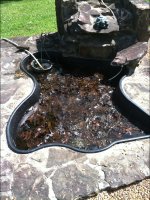
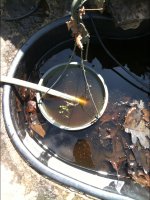
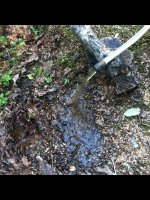
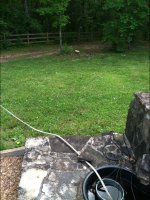
Here's a nice video of a guy starting a siphon with solid pipe, a tee at the top, a shutoff valve at the discharge end, no valve at the inlet, and a 5 gallon bucket to fill the downhill side of the pipe. You don't have to fill the uphill side!
https://www.youtube.com/watch?v=8rgpRJ1xCeM
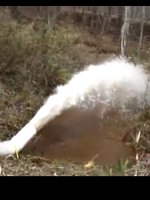
It depends. If the downhill side runs out of water before the uphill side fills, you will have nothing but water running back into the pond that made it partway uphill. He may have explained that in the video but listening to those is torture for my hearing.
A bigger siphon would do the trick.
View attachment 426831

Here's a nice video of a guy starting a siphon with solid pipe, a tee at the top, a shutoff valve at the discharge end, no valve at the inlet, and a 5 gallon bucket to fill the downhill side of the pipe. You don't have to fill the uphill side!
https://www.youtube.com/watch?v=8rgpRJ1xCeM
Yeah, I saw that video, too. Pretty neat. :thumbsup:
Several folks mentioned putting an upturn at the end to prevent air bubbles from percolating up the pipe to the top and killing the siphon, but with that amount of flow, it would seem pretty hard for any air bubbles to fight that stream.
It depends what is the length of each leg. If the pond side is long relative to downhill side you have to fill both.


It depends. If the downhill side runs out of water before the uphill side fills, you will have nothing but water running back into the pond that made it partway uphill. He may have explained that in the video but listening to those is torture for my hearing.
It doesn't depend. I don't think you understand how siphons work.
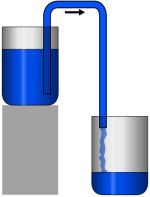
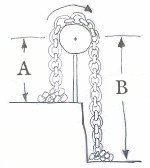
It is the water--under the pull of gravity--in the downhill side that will pull the pond side water up the pipe. If the downhill side is not long enough (contains enough water) to pull the pond water over the top of the rise and far enough down the downhill side to have the mass required to continue lifting the pond water, the siphon will fail. It does depend, just like the example you posted later.
Moss, that is interesting - I just thought one side had to be lower not necessary longer, the chain example clarifies that.
Well described.It is the water--under the pull of gravity--in the downhill side that will pull the pond side water up the pipe. If the downhill side is not long enough (contains enough water) to pull the pond water over the top of the rise and far enough down the downhill side to have the mass required to continue lifting the pond water, the siphon will fail. It does depend, just like the example you posted later.
Ignores differing slopes and pipe sizes. In large tubes on a slope the water will not necessarily flow as a slug, but as a stream. Water coming over the hi point with an air bubble ahead can go into this mode thwarting the start of siphon.We already talked about filling the downhill side with enough water to compensate for the length of the uphill side.
Chains have nothing analogous to air voids or bubbles in fluid. Fluids next to air in a large tube can seek their own level allowing air above the flow. The downhill side does not have to be longer, only to outlet at a lower level.Yeah, that's about as good a visual I could find. Pretty much everyone has had a piece of rope, Christmas lights, extension cord, string, etc... in their hands at some time and have seen how if you drape it over something and one side has more than the other, it pulls it down on its own. Siphon works the same way.
The downhill side always has to be longer than the uphill side AND the discharge always has to be lower than the inlet. If its not, it will try to flow the wrong way.
Well described.Fluids next to air in a large tube can seek their own level allowing air above the flow. The downhill side does not have to be longer, only to outlet at a lower level.
,,,larry
Well described.
Ignores differing slopes and pipe sizes. In large tubes on a slope the water will not necessarily flow as a slug, but as a stream. Water coming over the hi point with an air bubble ahead can go into this mode thwarting the start of siphon.
Chains have nothing analogous to air voids or bubbles in fluid. Fluids next to air in a large tube can seek their own level allowing air above the flow. The downhill side does not have to be longer, only to outlet at a lower level.
,,,larry
