dave1949
Super Star Member
A syphon satyr?! Oh crap! With syphon chains? Not sure if one end of chain has to be longer though.
:laughing:
A syphon satyr?! Oh crap! With syphon chains? Not sure if one end of chain has to be longer though.


What is going to pull water up the hill? There is more weight on the uphill side than the down hill side. It absolutely will not work.
Ok, that vacuum video WAS very cool!
So tell me if either of these posits should be true:
Assumption 1 & 2: identical cohesion and viscosity of two liquids of different densities... (maybe neither matter?)
Posit 1) If gravity is the primary outside force acting on a siphon... A more dense liquid should flow through a given siphon faster than a less dense liquid.
Posit 2) If atmospheric pressure were the primary outside force... The less dense liquid would flow faster. (Or density makes no difference?)
I have some confidence that posit 1 is true. Less confident about posit 2.
I also think viscosity would change rate of flow but cohesion probably only has to exceed some minimum requirement for a given atmospheric pressure (to prevent cavitation and bubbles forming.
Thoughts? Hopefully that made at least some sense.

Seriously, although an infestation of hippies is a concern for anyone, I believe that Eric has given the game away by mentioning the influx of critters to the newly uncovered environment.
Eventually the rare & endangered "Flame Spotted Newt" or "Purple Ringed Coot" will take up residence... the bloody environmentalists and busybody 'Greens' will declare that area (+ a surrounding 40 metres) a No-Go-Zone.
 Click to see them in action

Ok, that vacuum video WAS very cool!
So tell me if either of these posits should be true:
Assumption 1 & 2: identical cohesion and viscosity of two liquids of different densities... (maybe neither matter?)
Posit 1) If gravity is the primary outside force acting on a siphon... A more dense liquid should flow through a given siphon faster than a less dense liquid.
Posit 2) If atmospheric pressure were the primary outside force... The less dense liquid would flow faster. (Or density makes no difference?)
I have some confidence that posit 1 is true. Less confident about posit 2.
I also think viscosity would change rate of flow but cohesion probably only has to exceed some minimum requirement for a given atmospheric pressure (to prevent cavitation and bubbles forming.
Thoughts? Hopefully that made at least some sense.
The long rise side is like an ideal inclined plane - frictionless. Gravity acts proportional to the sine of the angle. ... Less than 1 on the rise, but 1 on the vertical fall.What is going to pull water up the hill? There is more weight on the uphill side than the down hill side. It absolutely will not work.
Interesting video but it doesn't prove that a siphon will work in a vacuum in my opinion. They are not using 'water'. They are using an ionic liquid, a type of 'liquid magnet' as they explain it. So its more akin to using a chain in a vacuum, and of course a chain will respond to gravity. They are not really creating a siphon at all.
My guess is that a true siphon really does use air pressure to push water up the tube. The air pressure at the lower end is not important. The low pressure is created by gravity INSIDE the tube as the water tries to separate from itself, hence creating a vacuum or suction inside the tube. So a true siphon requires atmospheric pressure AND gravity.
Ok, that vacuum video WAS very cool!
So tell me if either of these posits should be true:
Assumption 1 & 2: identical cohesion and viscosity of two liquids of different densities... (maybe neither matter?)
Posit 1) If gravity is the primary outside force acting on a siphon... A more dense liquid should flow through a given siphon faster than a less dense liquid.
Posit 2) If atmospheric pressure were the primary outside force... The less dense liquid would flow faster. (Or density makes no difference?)
I have some confidence that posit 1 is true. Less confident about posit 2.
I also think viscosity would change rate of flow but cohesion probably only has to exceed some minimum requirement for a given atmospheric pressure (to prevent cavitation and bubbles forming.
Thoughts? Hopefully that made at least some sense.
Interesting video but it doesn't prove that a siphon will work in a vacuum in my opinion. They are not using 'water'. They are using an ionic liquid, a type of 'liquid magnet' as they explain it. So its more akin to using a chain in a vacuum, and of course a chain will respond to gravity. They are not really creating a siphon at all.
My guess is that a true siphon really does use air pressure to push water up the tube. The air pressure at the lower end is not important. The low pressure is created by gravity INSIDE the tube as the water tries to separate from itself, hence creating a vacuum or suction inside the tube. So a true siphon requires atmospheric pressure AND gravity.
Petrol is less dense than water. Siphoning a jerry can of petrol into my boat tank seems to work reasonably quickly. My intuition is that its faster than water.
I think these posts are mostly cohesive.Unfortunately, the viscosity of gas is much less than H2O. Viscosity should be the main determining factor of 'resistance' (not density).
The other factor would be adhesion between the fluid and the tube. But I think adhesion would be a very small effect with any tube diameter over a few millimeters.

Capillary attraction ... like a wick.A siphon doesn't have to be in a tube or pipe.
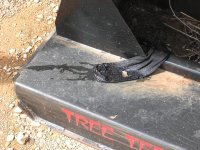
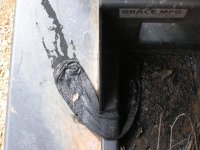
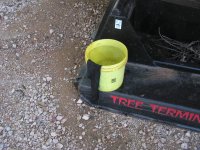
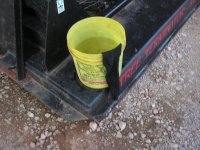
Here is my Siphon Sock to remove rain water from the brush hog deck. I have used rags on things like this for many years.


Capillary attraction ... like a wick.
Capillary attraction ... like a wick.
Yep, but slow.Capillary action is a very strong force.