Building a covered work area with a 40' span, will this work?

   / Building a covered work area with a 40' span, will this work? #21  
I would copy what has been proven to work and not invent something new. From what I've heard about drill stem pipe, you never know what you are getting. Somewhere in that pipe there is going to be a thin area. A weak point. For that reason alone, I wouldn't trust it for anything other then fence posts.

I would seriously price out angle iron and then copy the designs you posted. There is a reason that people make a living selling those designs. They don't fail and they don't get their butts sued. Even though it's for you, you will still have a lot of money into it no matter what you use. Spending a little more for better quality is always cheaper then going cheap.

If you decided to go with pipe, do not use your original design. A truss is basically a bridge over a given span. The bigger the span, the more it wants to collapse on itself. A properly designed truss uses gravity to push itself together to lock it in place. The triangular shapes all lock each other together forming a very strong structure. Your design lacks any engineering to support itself. It relies totally on the integrity of the pipe you are using. You are also using small pipe that will bend and flex over short distances.

Angle Iron and square tubing both have sharp edges. Those bends in the metal give it additional rigidity that you do not find in round pipe. DO NO USE ROUND PIPE to build a truss with this big of a span!!!!!
 
   / Building a covered work area with a 40' span, will this work?
  • Thread Starter
#22  
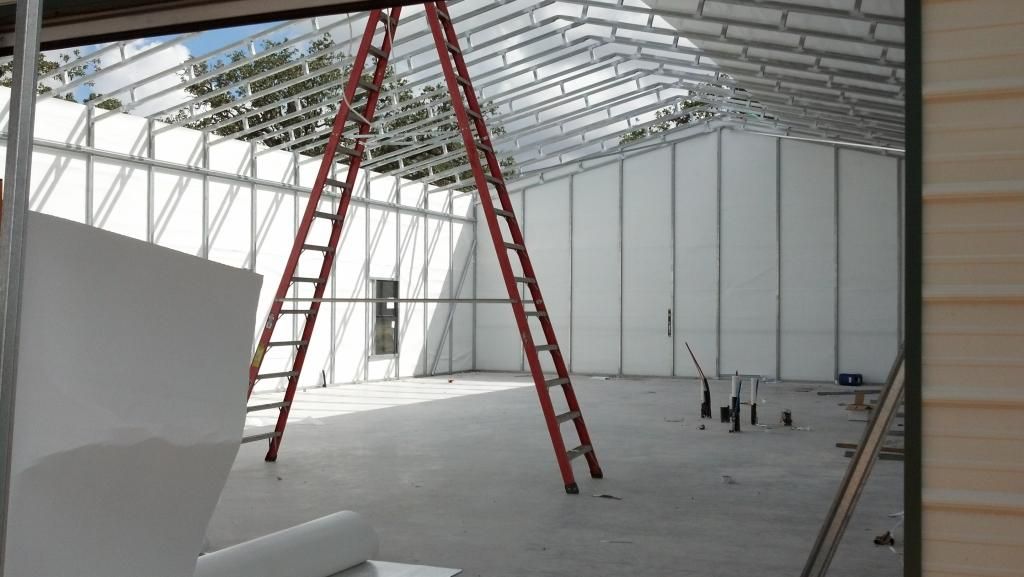
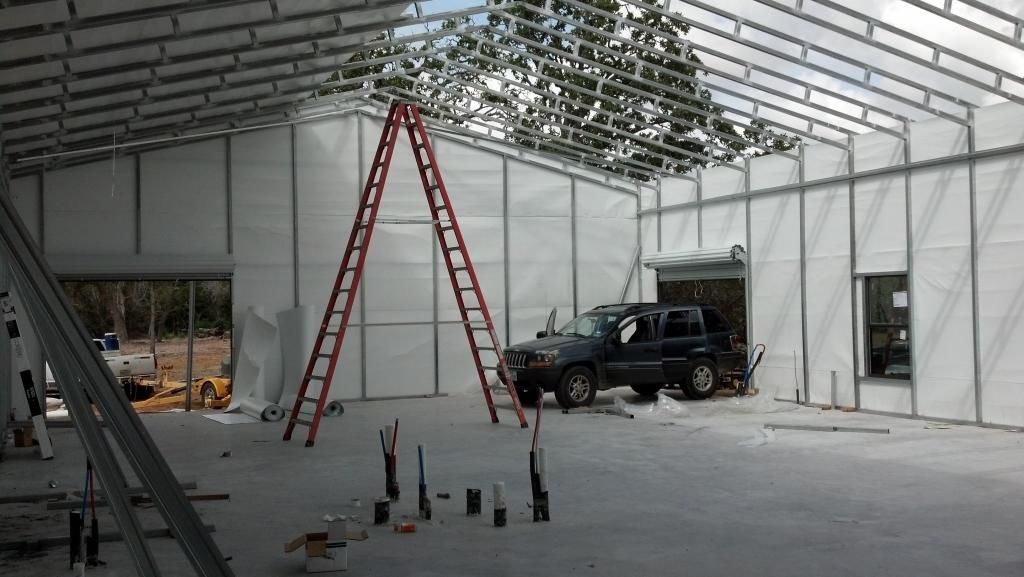
Our 40' span is like the one in the first pic, but improved upon. 2-1/2" square tubing. If you follow this design, it will be plenty strong. Our building got hit with 50 mph winds last Spring and even with 14' walls it held just fine.

Thanks, those pictures are VERY helpful. What is the spacing on your posts? IF I don't actually need to put my rafters/trusses at 4' and can stretch them to 10', I can build a much larger structure. In that case, I would beef my posts up to 2 7/8" OD and a 2 3/8" OD pipe joined similar to your trusses, sort of like this:
__
\-|
 
   / Building a covered work area with a 40' span, will this work? #23  
For a structure with 40 ft span, I'd consider a red iron frame. Put your money in something that's structurally sound. Don't waste time and money on a DIY design that you'll regret later.

Buy the red iron frame (the big parts) first and then DIY the purlins, sheet metal, doors, wiring, etc. as your budget allows.

Google "red iron building", "red steel building" for more info. Here's an example.

Metal Building Supply, Inc.

Good luck
 
   / Building a covered work area with a 40' span, will this work?
  • Thread Starter
#24  
I would copy what has been proven to work and not invent something new. From what I've heard about drill stem pipe, you never know what you are getting. Somewhere in that pipe there is going to be a thin area. A weak point. For that reason alone, I wouldn't trust it for anything other then fence posts.

I would seriously price out angle iron and then copy the designs you posted. There is a reason that people make a living selling those designs. They don't fail and they don't get their butts sued. Even though it's for you, you will still have a lot of money into it no matter what you use. Spending a little more for better quality is always cheaper then going cheap.

If you decided to go with pipe, do not use your original design. A truss is basically a bridge over a given span. The bigger the span, the more it wants to collapse on itself. A properly designed truss uses gravity to push itself together to lock it in place. The triangular shapes all lock each other together forming a very strong structure. Your design lacks any engineering to support itself. It relies totally on the integrity of the pipe you are using. You are also using small pipe that will bend and flex over short distances.

Angle Iron and square tubing both have sharp edges. Those bends in the metal give it additional rigidity that you do not find in round pipe. DO NO USE ROUND PIPE to build a truss with this big of a span!!!!!

I can get new structural pipe for about .19/ft more than the drill stem and it comes in 24' joints so I'd have less waste. 2"x11ga sq tube will run me another .22/ft above that. Jumping to 3"x11ga sq tube bumps me up another .73/ft (1.14/ft over the drill stem) so that gets out of my budget. I could probably do the 2"x11ga sq tube if I could stretch my trusses to 6' on center.

Angle iron is dirt cheap, like .65/ft for 1.5"x 3/16" called for in the design I already posted but I just can't believe that it would be stronger than 2 3/8 OD pipe, whether that came from used drill stem even with the thin spots, or from new structural pipe.
 
   / Building a covered work area with a 40' span, will this work? #25  
Thanks, those pictures are VERY helpful. What is the spacing on your posts? IF I don't actually need to put my rafters/trusses at 4' and can stretch them to 10', I can build a much larger structure. In that case, I would beef my posts up to 2 7/8" OD and a 2 3/8" OD pipe joined similar to your trusses, sort of like this:
__
\-|


Ours are set at 4', except over the garage door on the left side where it is about 5'. The posts (studs) are doubled pipe for the garage opening and the tall peak sections and the joints and bent peak on the trusses are doubled as well. I am not sure I would want to space them any further than 4'. The company that built ours is local, has been doing it for 20+ years.
 
   / Building a covered work area with a 40' span, will this work? #26  
Sir real
What is the thickness of your tubing.
Your structure is modified beam verses a truss

In most truss applications ,angle or wide beam shapes are used for ease of connection.
Truss are designed for axial stress and the shape is consideration for buckling of compression area of truss

Eddie
There have been numerous pedestrian bridges built with tubular steel trusses. The tubes are used for architectural reasons typically
 
Last edited:
   / Building a covered work area with a 40' span, will this work?
  • Thread Starter
#27  
Ours are set at 4', except over the garage door on the left side where it is about 5'. The posts (studs) are doubled pipe for the garage opening and the tall peak sections and the joints and bent peak on the trusses are doubled as well. I am not sure I would want to space them any further than 4'. The company that built ours is local, has been doing it for 20+ years.

So the pictures you posted were in construction progress and they added the extras after putting up the posts? Do you have any finished photos of the framing?

Never mind, I looked at the photos again and see that towards the back the spacing gets closer together. How did they cover the wider spacing in the front of the photo?

One last question, what's the measurement between the 2 pieces of square tube?
 
   / Building a covered work area with a 40' span, will this work? #28  
The biggest factor for truss spacing is what you will use for purlins on top. There is also some math on how much weight each truss can support and what you have under the truss holding it in the are. Ideally you want each truss resting on top of a post.

At 4 foot spacing, you can use 2x4's on the flat. This is the easiest to install the metal roof since you have such a big target to hit. I personally like this on smaller buildings with my 2x4 purlins being at least 12 feet long so they are attached to three trusses. 16 feet long is even better.

At 6 feet apart, you have to turn the 2x4 on it's edge. I've never actually seen this done. The waste and extra material for headers makes this inpractical.

8 foot spacing is very common and doesn't require a lot of thinking. 2x6's on edge, posts in the ground every 8 feet and you are about as solid as you can get. You can get 2x6's 24 feet long that will allow you to attach them to three trusses. I also stagger my ends, so the purlin above starts on a different truss.

12 foot spacing is also very common. Posts every 12 feet and you jump up to 2x10's for purlins. Those get heavy, and the savings isn't really significant over 8 foot spacing.

I think you mentioned bolting your purlins to your trusses. Adding holes to your trusses may or may not affect their integrity. I wouldn't do it. The common method is the weld on a piece of angle iron or U channel to set the purlin in. Then drill a hole through the tab and run screw through the hole into the wood.

How you attach and hold your purlins in place is going to be VERY IMPORTANT.
 
   / Building a covered work area with a 40' span, will this work?
  • Thread Starter
#29  
The biggest factor for truss spacing is what you will use for purlins on top. There is also some math on how much weight each truss can support and what you have under the truss holding it in the are. Ideally you want each truss resting on top of a post.

At 4 foot spacing, you can use 2x4's on the flat. This is the easiest to install the metal roof since you have such a big target to hit. I personally like this on smaller buildings with my 2x4 purlins being at least 12 feet long so they are attached to three trusses. 16 feet long is even better.

At 6 feet apart, you have to turn the 2x4 on it's edge. I've never actually seen this done. The waste and extra material for headers makes this inpractical.

8 foot spacing is very common and doesn't require a lot of thinking. 2x6's on edge, posts in the ground every 8 feet and you are about as solid as you can get. You can get 2x6's 24 feet long that will allow you to attach them to three trusses. I also stagger my ends, so the purlin above starts on a different truss.

12 foot spacing is also very common. Posts every 12 feet and you jump up to 2x10's for purlins. Those get heavy, and the savings isn't really significant over 8 foot spacing.

I think you mentioned bolting your purlins to your trusses. Adding holes to your trusses may or may not affect their integrity. I wouldn't do it. The common method is the weld on a piece of angle iron or U channel to set the purlin in. Then drill a hole through the tab and run screw through the hole into the wood.

How you attach and hold your purlins in place is going to be VERY IMPORTANT.

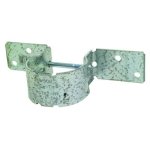
I plan to use these to attach the purlins if I use pipe. If I use square tube, I'd have to come up with a different plan, along the lines of what you described. These are made to attach the 2x4's to galvanized fence posts, which just so happen to also be 2 3/8" OD, which is why I like that pipe diameter so much. I also have bender dies and notcher saws for that diameter so I don't have to buy any tools to use it.
 

Attachments

  • Tie.jpg
    Tie.jpg
    11.6 KB · Views: 188
   / Building a covered work area with a 40' span, will this work? #30  
I totally agree with you about going DIY and saving $$ on materials. But a roof isn't something I'd fool around with unless I had a proven design.

One of the main advantages of a steel roof is having the trusses line up with posts on 8' or 10' centers. The purlins take the roof load and transfer it to the trusses. I think your design has the trusses too close together because you're using smaller diameter material. IMO, you'll end up using too much material and time, all for an unproven design.

You said angle iron is cheap, and you've found designs for it already - why not just use it? I'm not trying to get in your face about this, so I'm sorry if it sounds that way... I really respect you for building this yourself , so I'm just trying to help you choose the best option that combines strength with economy.

Have you checked out the garage journal forum? They also have a lot of knowledgeable members, and people post about new building designs all the time over there.
 
   / Building a covered work area with a 40' span, will this work? #31  
I plan to use these to attach the purlins if I use pipe. If I use square tube, I'd have to come up with a different plan, along the lines of what you described. These are made to attach the 2x4's to galvanized fence posts, which just so happen to also be 2 3/8" OD, which is why I like that pipe diameter so much. I also have bender dies and notcher saws for that diameter so I don't have to buy any tools to use it.

I understand your thinking, but wonder if you are pigeon holing yourself into a design using the wrong material because it's familiar to you and it's what you want to use instead of going with another material that would be better suited for what you are going to build?

I like the idea of those brackets, but when pricing out your materials, are they cost effective? Wouldn't cutting 2 inch piece of angle iron and welding it to the top of your truss be a lot cheaper?
 
   / Building a covered work area with a 40' span, will this work?
  • Thread Starter
#32  
I totally agree with you about going DIY and saving $$ on materials. But a roof isn't something I'd fool around with unless I had a proven design.

One of the main advantages of a steel roof is having the trusses line up with posts on 8' or 10' centers. The purlins take the roof load and transfer it to the trusses. I think your design has the trusses too close together because you're using smaller diameter material. IMO, you'll end up using too much material and time, all for an unproven design.

You said angle iron is cheap, and you've found designs for it already - why not just use it? I'm not trying to get in your face about this, so I'm sorry if it sounds that way... I really respect you for building this yourself , so I'm just trying to help you choose the best option that combines strength with economy.

Have you checked out the garage journal forum? They also have a lot of knowledgeable members, and people post about new building designs all the time over there.

That's a fair question. Partially because I'm stubborn and don't want to use angle iron (it's not just cheap but it really isn't very strong) and partially (mainly) because those designs all include a horizontal brace right at the top of the posts that I really want to avoid.
 
   / Building a covered work area with a 40' span, will this work? #33  
So the pictures you posted were in construction progress and they added the extras after putting up the posts? Do you have any finished photos of the framing?

Never mind, I looked at the photos again and see that towards the back the spacing gets closer together. How did they cover the wider spacing in the front of the photo?

One last question, what's the measurement between the 2 pieces of square tube?

I have no idea what the gauge is.

Maybe these pics will help with your questions. Let me go measure the actual height of the truss/beam, I think it is 12" total.
IMG_20140917_110936_509_zpsvkpatsyd.jpg

IMG_20140917_111017_488_zpsc2kcfana.jpg


The building is our Barndo that I am framing out, 40x70 with an 18' shop on the end where the roll up doors are. Our initial concern was the metal structure before the interior got framed in, as the interior framing will help support the metal building. Last Spring we had a few tornadoes in the immediate area and with the crazy wind it held perfectly fine. The roof structure is very solid, surprisingly so. I have stepped on the roofs of some metal buildings that left me with an uneasy feeling, this one does not.
 
   / Building a covered work area with a 40' span, will this work? #34  
I think your roof is going to be floppy. Take a look at a standard truss. Everyone focuses on the top shape, but the bottom chord all the way across the bottom is what holds the building together and keeps the walls from pushing outwards. I think you need to have a continuous chord from wall to wall and some stiffened legs to hold the top chord.

Fwiw, I'm a civil engineer by trade.
Yes. ... OP - To save on head space you could run that chord to the rafter joints on the 4.5' side braces. The chord is a tension member primarily but wind dynamics will cause some load fluctuations on the steady state. ... Perhaps every other chord could be cable.
 
   / Building a covered work area with a 40' span, will this work?
  • Thread Starter
#35  
I understand your thinking, but wonder if you are pigeon holing yourself into a design using the wrong material because it's familiar to you and it's what you want to use instead of going with another material that would be better suited for what you are going to build?

I like the idea of those brackets, but when pricing out your materials, are they cost effective? Wouldn't cutting 2 inch piece of angle iron and welding it to the top of your truss be a lot cheaper?

I hear you and I'm trying to stay open minded. I don't mind using sq tube instead, I build with it a lot as well. It would speed construction because I don't have to notch everything but the die to bend it if needed is $500.

The brackets come to $250 total if I put the 2x4's 4' apart. Welding angle iron ears on would be cheaper, I'm not really sure which is better. They're probably equal.

Mainly, I'd prefer building with steel instead of wood because I can do it cheaper and faster. I don't really want to get into red steel beams if I can avoid it because I don't have the equipment to lift it into place, so that adds a lot of expense. Smaller structural steel that I can move around with what I have should be able to do this and I do want to do it right so I don't have to do it twice. I know that using bigger stuff is the proven method but, that method includes budgets I just don't have for material. I think using smaller material isn't common because the labor gets expensive, not because it can't be built strongly. I have the time to do the labor though, what I don't have is the money to go larger on the material and I need the structure to start earning again, so...
 
   / Building a covered work area with a 40' span, will this work?
  • Thread Starter
#36  
I have no idea what the gauge is.

Maybe these pics will help with your questions. Let me go measure the actual height of the truss/beam, I think it is 12" total.

The building is our Barndo that I am framing out, 40x70 with an 18' shop on the end where the roll up doors are. Our initial concern was the metal structure before the interior got framed in, as the interior framing will help support the metal building. Last Spring we had a few tornadoes in the immediate area and with the crazy wind it held perfectly fine. The roof structure is very solid, surprisingly so. I have stepped on the roofs of some metal buildings that left me with an uneasy feeling, this one does not.

That is a great looking building, lots of open space overhead. It's interesting to see that they didn't use any purlins for the roof and yet you still have a very strong building that's already been wind tested.
 
   / Building a covered work area with a 40' span, will this work? #37  
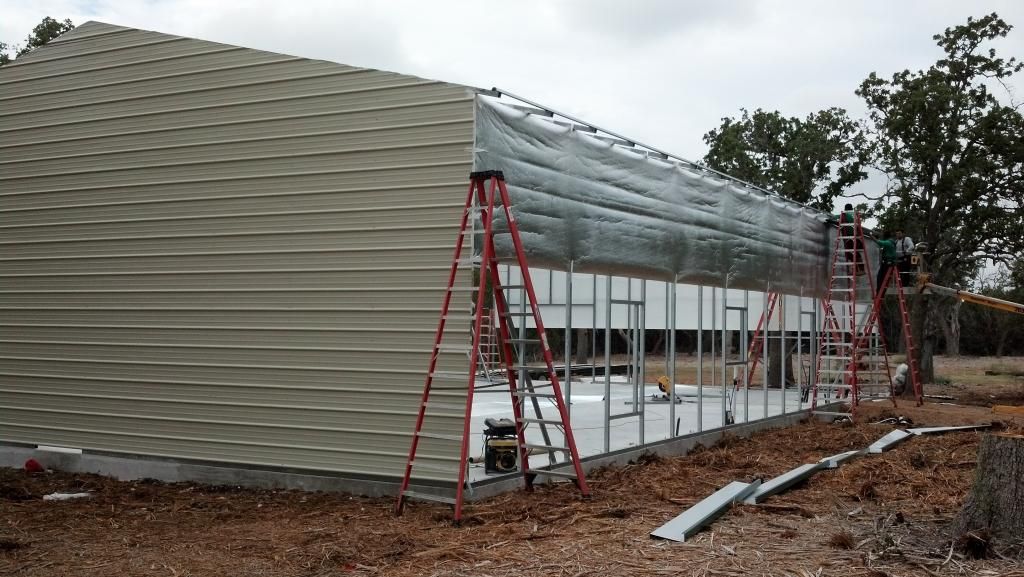
They actually did use purlins to tie it together and to give a surface to attach the metal roof to, it doesn't show in those pics because the purlins are on top of the bubble wrap insulation. You can see it here on the right side, they ran these every 3'.

IMG_20140915_101401_567_zpscdroll5c.jpg


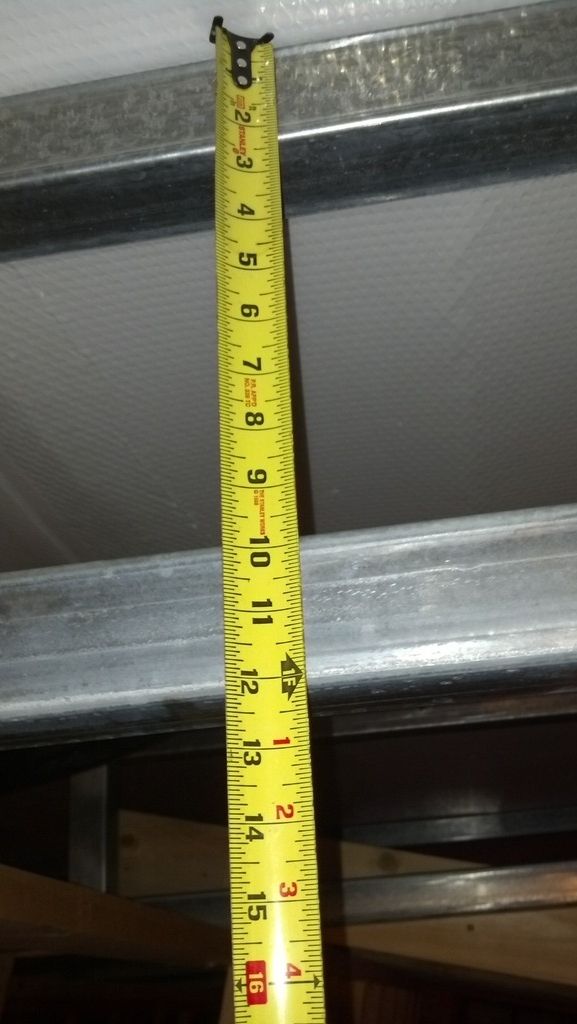
The height of the beams/truss is 12" and the uprights between the cords are spaced at 40".
IMG_20160403_091927_300_zps86ww6nfs.jpg


It is getting hard to take pics now, the interior framing is at about 99%. It fills up fast once interior walls are up. :D
 
   / Building a covered work area with a 40' span, will this work?
  • Thread Starter
#38  
They actually did use purlins to tie it together and to give a surface to attach the metal roof to, it doesn't show in those pics because the purlins are on top of the bubble wrap insulation. You can see it here on the right side, they ran these every 3'.

The height of the beams/truss is 12" and the uprights between the cords are spaced at 40".

It is getting hard to take pics now, the interior framing is at about 99%. It fills up fast once interior walls are up. :D

Thank you again for the photos, they are a huge help. If nothing else, they prove that I'm not entirely crazy. :)
 
   / Building a covered work area with a 40' span, will this work? #39  
I will PM you the link to my photobucket page where the rest of the pics are. I didn't use all of them on my build thread and maybe it will help. There are two buildings there, the 40x70 and the 24x24 guest house, they used a different technique for the guest house roof, but it was only spanning 24', I didn't like it but it too has held up through the same weather.
 
   / Building a covered work area with a 40' span, will this work? #40  
My chicken barns are 40' spans. They are steel trussed with angle iron web style trusses. They are a scissor style truss. 10 foot truss spacing with 2x6 purlins. There are U shaped pieces of about sheet metal welded to the trusses. The purlins are set edge ways in the U brackets and nailed in through drilled holes with 6 penny nails.
 

Tractor & Equipment Auctions

2021 CATERPILLAR 299D3 SKID STEER (A60429)
2021 CATERPILLAR...
208320 (A58375)
208320 (A58375)
Kubota M5-111 (A53317)
2007 Ford F550 Superduty. 6.0 Powerstroke - 90k Miles (A56438)
2007 Ford F550...
2008 KENWORTH T300 FLATBED FUEL TRANSPORT TRUCK (A58214)
2008 KENWORTH T300...
iDrive TDS-2010H ProJack M2 Electric Trailer Dolly (A59230)
iDrive TDS-2010H...
 
Top