Tractor Sizing GUIDE: Shopping/Sizing A Tractor (Development version)

   / GUIDE: Shopping/Sizing A Tractor (Development version) #61  
For most tractor tasks greater chassis weight is more important than tractor horsepower. This tractor fundamental is difficult for people new to tractors to comprehend. In sub-compact and compact tractor classes it takes a 50% increase in bare tractor weight before you notice a significant tractor capability increase. It takes a 100% increase in bare tractor weight to elicit MY-OH-MY!

Got any science to back those statements up? Any head-to-head comparisons?
 
   / GUIDE: Shopping/Sizing A Tractor (Development version) #62  
...In sub-compact and compact tractor classes it takes a 50% increase in bare tractor weight before you notice a significant tractor capability increase....

Just shifting from 2 wheel to 4 wheel drive increases the capabilities of my tractor by about 100% IMO...
Just loading the rears added about 50% capability...
 
   / GUIDE: Shopping/Sizing A Tractor (Development version) #63  
Just shifting from 2 wheel to 4 wheel drive increases the capabilities of my tractor by about 100% IMO...
Just loading the rears added about 50% capability...

Yep. The advent of 4wd in small tractors rendered a lot of larger tractors that were actually heavier obsolete. That's why I have trouble agreeing with the statements about weight all the time. I had an 8000# 2wd tractor. There are plenty of lighter 4wd tractors that could outwork it.
 
   / GUIDE: Shopping/Sizing A Tractor (Development version) #64  
I've seen the guidance of "figure out what you need, then buy one size larger" a few times now.

I wish I'd seen that BEFORE I purchased my BX2370. I would have purchased a B2601.

That said, adding rear ballast to the BX2370 has made a night-and-day difference.

I wish I had understood the importance sooner.

Buy once, cry once.
--
 
   / GUIDE: Shopping/Sizing A Tractor (Development version)
  • Thread Starter
#65  
Just shifting from 2 wheel to 4 wheel drive increases the capabilities of my tractor by about 100% IMO...
Just loading the rears added about 50% capability...

More or less. Standard bare tractor weight is distributed 40% front/60% rear.

Harry Ferguson ascertained 40/60 weight distribution to be base-optimal for Three Point Hitch applications in diverse conditions. In 1938 when Ferguson shipped his two prototype tractors from England to Dearborn, Michigan to demonstrate his internationally patented Three Point Hitch to Henry Ford, the rear tires were ballasted. Ford licensed Ferguson's Three Pint Hitch to produce Ford 9N/2N/8N model tractors, slightly modified versions of Ferguson's prototypes.

I cannot think of a current model subcompact tractor without 4-WD. Almost all compact tractors are sold with 4-WD standard or as an option selected by most customers, I speculate 85%.

At my local Kubota dealer in FLAT Florida one exception is Kubota's L2501 model. My local Kubota dealer sells a fair proportion of sparely equipped L2501s exclusively for pasture mowing, without an FEL and without 4-WD.

I have tentatively made a couple revisions in Post #60.

I will consider any concise suggestion you wish to make. See Post #5.
 
Last edited:
   / GUIDE: Shopping/Sizing A Tractor (Development version)
  • Thread Starter
#66  
Got any science to back those statements up? Any head-to-head comparisons?

No.

My opinion is based on owning a Deere 750, Kubota B3300SU, and a Kubota L3560 plus operating two 50-horsepower, 2-WD John Deere's, one a Deere/Georgia shuttle shift the second a Deere/India clutch and gear. A fairly diverse universe of tractors, in weights often discussed on this site.

I suppose the Nebraska state tractor tests would provide head-to-head comparisons but Nebraska data is seldom referenced here.

I am authoring a guide, not a treatise dealing formally and systematically with sizing tractors.
 
Last edited:
   / GUIDE: Shopping/Sizing A Tractor (Development version)
  • Thread Starter
#67  
The advent of 4wd in small tractors rendered a lot of larger tractors that were actually heavier obsolete. That's why I have trouble agreeing with the statements about weight all the time. I had an 8000# 2wd tractor. There are plenty of lighter 4wd tractors that could outwork it.

Heavy 2-WD tractors consume more fuel than capable 4-WD tractors. Buyer only pays for 4-WD at time of tractor purchase. Fuel is a recurring expense. Manhandling five gallon fuel cans is a pain.
 
Last edited:
   / GUIDE: Shopping/Sizing A Tractor (Development version) #68  
Re: GUIDE: Shopping/Sizing A Tractor (development version)

I can tell you this, I had a BX25D and put about 100 hard hours on it, all digging/excavation/rear blade work. It was a base of 1450 pounds I believe.

I now have a B2650 with a base weight of around 1850 pounds I believe. I've got just about 60 hours on it in the last 3.5 months doing similar work.

The difference in the ability to do work with the B2650 is immeasurably greater compared to the BX.

That 400 base weight increase in the B2650 elicits a massive wow factor, if that in and of itself is what one wishes to attribute this performance gain to...

Maybe it's the much bigger tires? The additional fluid fill weight? The heavier loader assembly? The combination of all of those things?

But on paper, a B2650 is a small increase in weight, but holy cow! It's in a different universe of work performance.

The doubled weight gain thing, it may hold some amount of truth. But I think that it is just one piece of a much larger puzzle.
 
   / GUIDE: Shopping/Sizing A Tractor (Development version)
  • Thread Starter
#69  
The ability to do work with the B2650 is immeasurably greater compared to the BX.

The doubled weight gain thing, it may hold some amount of truth. But I think that it is just one piece of a much larger puzzle.

I hope to read another post when you have accumulated 1,000 engine hours of tractor experience, including some operating hours on a tractor that weighs at least 3,000 pounds bare, ballpark double weight of the BX25D.

"MY-OH-MY" may be elicited less frequently at seventy years of age.

:):):)
 
Last edited:
   / GUIDE: Shopping/Sizing A Tractor (Development version)
  • Thread Starter
#70  
I've seen the guidance of "figure out what you need, then buy one size larger" a few times now.

I wish I'd seen that BEFORE I purchased my BX2370. I would have purchased a B2601.

That said, adding rear ballast to the BX2370 has made a night-and-day difference.

I wish I had understood the importance of weight sooner.

THANK YOU. Consider yourself baptized.
 
Last edited:
   / GUIDE: Shopping/Sizing A Tractor (Development version) #71  
I went from a 34hp New Holland to a 40hp New Holland. The extra weight and larger diameter tires made a huge difference in traction and overall ability to do grunt work. CUTs are generally lighter weight to make them maneuverable, suitable for turf, and to keep the cost down. CUTs are generally 4wd because they are light.

Real working AG tractors are HEAVY for a reason - traction and durability. Hook a chain between a 25hp SCUT and a 25hp mid-frame CUT, and see which one gets pulled all around the field.
 
   / GUIDE: Shopping/Sizing A Tractor (Development version)
  • Thread Starter
#72  
I went from a 34hp New Holland to a 40hp New Holland. The extra weight and larger diameter tires made a huge difference in traction and overall ability to do grunt work.

Wheels/tires are sized by tractor engineers in proportion to tractor weight.


Heavier tractors have more tractive power pulling ground contact implements.

Heavier tractors have larger wheels and tires.
 
Last edited:
   / GUIDE: Shopping/Sizing A Tractor (Development version) #73  
We are in violent agreement!
 
   / GUIDE: Shopping/Sizing A Tractor (Development version) #74  
Wheels/tires are sized by tractor engineers in proportion to tractor weight.


Heavier tractors have larger wheels and tires.
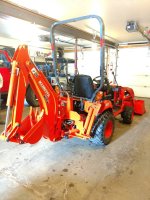
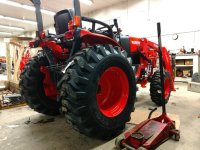
So my 400 lb increase required garden tractor sized tires on a BX to change to 41" tall monster tires based on the weight?

And if I move up 800 more pounds to an L2501, it requires no increase in tire size based on engineering and weight. That pretty much blows your opinion away.

Pictured are 2 machines, a 1450 pound BX and a 1850 pound B. That is a 22% weight increase. If you chained a BX to my B I would go about my day and not acknowledge that I was dragging a lawnmower behind me. The BX is not close to the machine a B2650 even though on paper the weight is 400 pounds different.

That's my rub with your blanket statement, it doesn't stand up to real life as a statement that tells the whole story. To me, you are taking a snippet of truth from a broader subject and calling the snippet the most prominent part. While your weight absolutely means something, obviously there is a lot more to the story. Tire size alone makes a big change in the ability of a machine. Weight makes a big difference as well. Both together are shocking. IMG_20180107_143248960.jpgIMG_20180109_170118299.jpg
 
   / GUIDE: Shopping/Sizing A Tractor (Development version) #75  
...I cannot think of a current model subcompact tractor without 4-WD. Almost all compact tractors are sold with 4-WD standard or as an option selected by most customers, I speculate 85%...

Any speculation on the percentage of first time tractor buyers that buy used rather than new?
Many older CUTS, SCUTS etc. are worthy and still in great shape and not all are 4 wheel drive...
 
   / GUIDE: Shopping/Sizing A Tractor (Development version) #76  
No.

My opinion is based on owning a Deere 750, Kubota B3300SU, and a Kubota L3560 plus operating two 50-horsepower, 2-WD John Deere's, one a Deere/Georgia shuttle shift the second a Deere/India clutch and gear. A fairly diverse universe of tractors, in weights often discussed on this site.

I suppose the Nebraska state tractor tests would provide head-to-head comparisons but Nebraska data is seldom referenced here.

I am authoring a guide, not a treatise dealing formally and systematically with sizing tractors.

If you're authoring a guide, it would be more credible with proven, measurable facts. Dig up some specifications, get some friends, do some head-to-heads, etc... the way your guide is worded now, it comes across as fact, when, it's actually just opinion. While many of us agree with most of that opinion, it doesn't make it fact and may do a disservice to someone that takes it as fact.
 
   / GUIDE: Shopping/Sizing A Tractor (Development version)
  • Thread Starter
#77  
Selling a used tractor is easy. Selling light implements in order to buy heavier, wider, implements for a heavier tractor you take a greater depreciation hit on the implements than you do on the tractor. Passing time with multiple implement browsers is a pain. ((Ask me how I know.))
 
   / GUIDE: Shopping/Sizing A Tractor (Development version) #78  
As someone who recently went through tractor shopping I see a lot of value in this type of guide. For someone new to tractors just being able to compare models across manufactures to get a relative place to start is a great timesaver. The other factor echoed across so many comments is the importance of weight. That was not my first consideration when going about my tractor search, but fortunately i read enough and received enough good advice that weight became an important driver in my selection. I ended up with an RX6620, and while it is heavier than the ones in the table the same concept holds true. This weekend i pulled/dragged an 8300 pound RV trailer up a steep hill in the mud. I definitely did not need 66hp to pull that trailer, but what got me up the drive in bad conditions was weigh/traction. While the tire choices exist for all manufacturers a lighter tractor with R1s (especially filled) will out pull a somewhat heavier tractor with R4s. If i had R4s instead of R1s on my tractor i don't think i would have made it up the hill in spite of my weight. Not sure how best to convey that in a guide, but tire choice is also important when comparing configurations (especially when shopping packaged deals)
 
   / GUIDE: Shopping/Sizing A Tractor (Development version)
  • Thread Starter
#79  
Good points.

I do not have space to cover tractor configuration in a thread on tractor selection by weight. Horsepower for powering up slopes is another topic I forgo.

Consider authoring a guide to New Tractor Tire Selection yourself.

In one of Messick's well regarded tractor videos on U-tube, subject tires, Neal states 90% of the tractors Messick's sells are delivered with R4/industrial tires. I believe my local Kubota dealer shares Messick's experience in ordering new tractors with R4 tires. High proportion of R4s is probably influenced by high proportion of new tractors sold with FELs. Also, around me in flat Florida, due to our sandy soils, we NEVER have to tractor in mud.

LINK: Kubota Tire Choices: Why it Matters - YouTube
 
Last edited:
   / GUIDE: Shopping/Sizing A Tractor (Development version)
  • Thread Starter
#80  
WORKING DRAFT (5)


The optimal way to shop for tractors is to list your tasks first, then determine bare tractor weight you need to SAFELY accomplish your tasks. Bare tractor weight is a tractor specification easily found in sales brochures and web sites, readily comparable across tractor brands and tractor models.

For most tractor tasks greater chassis weight is more important than tractor horsepower. This tractor fundamental is difficult for people new to tractors to comprehend. In subcompact and compact tractor categories it requires a 50% increase in bare tractor weight before you notice a significant tractor capability increase. It takes a 100% increase in bare tractor weight to elicit MY-OH-MY!

Heavier tractors are built on larger frames with larger wheels/tires. Heavier tractors with large diameter tires have more tractive power pulling ground contact implements, pushing a loader bucket into dirt and pushing snow. Larger wheels and tires mean more ground clearance, enabling a heavier tractor to bridge holes, ruts and downed tree limbs with less bucking, yielding a less disturbing passage over rough ground.

Safe hillside operation demands more tractor weight than flat land operation and requires four wheel drive (4-WD). Greater mass of heavy-chassis tractors increases tractor stability when transporting loads in the FEL bucket, the most rollover prone of routine tractor tasks. Heavier tractors have adjustable rear wheel spreads; wide rear wheel spreads reduce tractor lateral instability.

Shop your weight range within tractor brands. Budget will eliminate some choices. Collect a dealer brochure for each tractor model in your weight range. I spreadsheet tractor and implement specs, often a revealing exercise. I have a column for cost per pound.

Tractors under 3,000 pounds bare weight are offered in one configuration. Most, such as the high volume kubota standard L series, are sparely equipped to hit competitive price points. Others, such as the Yanmar YT235 and Kubota B2650/B3350 series, include enhanced productivity and comfort components.

Most tractors under 3,000 pounds bare weight operate in residential applications on one to five fairly flat acres. These "residential tractors" fit in a typical garage.

Tractors over 3,000 pounds bare weight are generally offered in a utilitarian configuration and a deluxe configuration, on a common chassis. Deluxe kit enhances productivity and operating comfort ~~~ but you have to pay. Many tractors over 3,000 pounds bare weight are too tall to fit in a typical garage, even with ROPS folded.

Selling a used tractor is easy. Selling light implements in order to buy heavier, wider, implements for a heavier tractor you eat more depreciation on the implements than on the tractor. Passing time with multiple implement browsers is a pain. ((Ask me how I know.))

For most new to tractors a quality dealer, reasonably close, available for coaching, is important. Almost every new tractor is delivered with a minor glitch or two that requires correction. My Kubota dealer is six miles away. I feel my local dealer continues to add value to my equipment. Dealer proximity is less important to others, well experienced with tractors, who perform their own maintenance.

BUY ENOUGH TRACTOR.
 
Last edited:

Marketplace Items

2020 ASV RT65 (A60462)
2021 Ford F350 XL (A57148)
2021 Ford F350 XL...
2024 COLEMAN MINI BIKE (A58375)
2024 COLEMAN MINI...
2012 Ram 2500 4x4 Crew Cab Pickup Truck (A59230)
2012 Ram 2500 4x4...
2000 Kenworth W900 - 3406E CAT Engine - 78,980 Miles (A55302)
2000 Kenworth W900...
2018 INTERNATIONAL 4300 NON CDL 26FT BOX TRUCK (A59904)
2018 INTERNATIONAL...
 
Top