
Luke'sScreenName
Elite Member
- Joined
- Mar 1, 2015
- Messages
- 3,710
- Location
- Lakes Region, NH
- Tractor
- Kubota MX4800 with BH-90X hoe; Hustler FastTrack 48; B3300SU (sold); 1969 Case 680B CK (sold)
1300lbs...
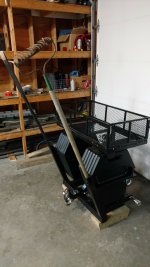
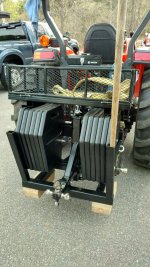
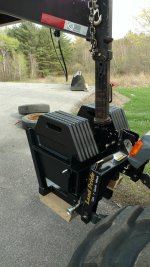
Thanks, FSM5065
That's an impressive framework.
A few more questions, if I may....
36 x 60 lb bags of concrete = 2,160 lbs plus the weight of the steel! That's a heavy block! What are its dimensions?
What is the perpendicular distance between the centres of the upper holes and the lower holes?
I am still a bit confused about the bolts. I can see that the bolts are holding the framework to the ply, which would provide the stability required for the pour (although there seems to be more bolts than would be required to simply stabilise the ply.
In the final product, the ply has been removed. But there are still bolts. Did you replace the bolts for pure aesthetic reasons or was there some other reason?
Interestingly, while awaiting your reply, I did a bit of research about the feasibility of simply bolting a framework to a concrete block. A 1/2" sleeve anchor (3/8"bolt) has a tensile strength ranging from 2,200 lbs to 4,400 lbs, depending on the compressive strength of the concrete. I assume these figures are for a static load. Perhaps, a concrete block bouncing up and down subjects the anchors to different forces and the tensile figures can't be extrapolated from static to dynamic loads.
Even if one used only 25% of the tensile strength figure, by simply adding a sufficient number of anchors one should easily be able to support the block on a frame that is bolted to it.
I aim to get my block up to somewhere around 800kg (1,760 lbs) (after seeing your numbers I am inspired to go even higher) using as many brake rotors and other bits of steel I can encase in it. If one uses the 2,200 lb figure for low compression strength concrete, and divides that by four, that means one anchor can support 550 lbs. That, in turn, means three anchors should suffice for a 1,760 lb block. With six or eight anchors one should easily be able to support the block.
Am I missing something here?
As a newbie tractor owner, I don't quite follow this. Is this about the distance between the arms or about the hole sizes?
Cat I=7/8"(22mm) and Cat II=1 1/8" (29mm). If you put the Cat II balls in the outer slot, the pin diameter has to be 1 1/8". That means the holes in the outer and the middle plates have to be 1 1/8". If you put the Cat I balls in the inner slot, the pin diameter has to be 7/8". This means that the hole in the inner plate has to be 7/8". Does the pin you are using have two diameters - 1 1/8" between the handle and the inner plate position and 7/8" between the inner plate and the end?
Did you bevel the corners for aesthetics or for some functional reason?
Ken
Ken, the block is 45背 x 20 d x 32 h, the corners were beveled to reduce the chance of chipping and cracking. The height between the lower pin and the top pin is 14? The bolts that held the plywood on, were replaced with shorter bolts to keep water out and may later be used to attach hooks to hold chains.
The strength of concrete anchors assumes fully cured concrete. A block of concrete bouncing around there may well exceed the strength of the concrete and the anchors. To fully cure, a block of concrete that size may take several months.
For my tractor, an extra 400 lbs wouldn't hurt. Hope this all helps.
Bevelling edges make sense.
Good idea to use the bolt holes for hooks, etc.
Several months? I didn't realise it takes that long.
It definitely does help. What tractor do you have?
Cheers
Ken
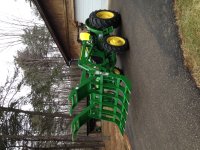
Here ya go. 1600+ pounds

It's a total of 10 cubic feet. 24" square X 30" tall. The distance from lower links to upper link is 24".
I made it so the lower links could be all the way down and leave the bottom of the ballast box 3-4" off the ground.
 ) involves threaded rods passing right through the block and projecting through the formwork. If I run nuts on the rods snugged up against the formwork, I think this will be adequate to prevent bulging, or does one still need to built a frame out of 2x4s or similar?
A few questions about casting a concrete block...
1. When using regular plywood for the formwork, do you apply some sort of release agent to prevent adhesion between the concrete and the ply? I assume this isn't a problem if one uses Formply?
2. From what I have read, concrete cures to maximum strength if cured wet, and takes 28 days to achieve in the high 90s percentage of its maximum strength. Does this mean that all one has to do is leave the formwork in place for 28 days while ensuring that the top of the block is covered to prevent evaporation of any water?
3. My design (at the moment - it keeps changing as I read more TBN
Thanks
Ken
1. Diesel spray.
2. Form can come off or not. Obviously, more covered is better. Letting it cure for for a month is overkill IMO. The Two concrete ballast boxes I have built I waited a week. YMMV.
3. Yes, you probably still need an "exoskeleton." (At least I would). Cheap insurance.
Also, when you pour, make sure you are on a level spot.
^^^^^
What he said. Except I used old motor oil to coat the forms.
I removed the forms the day after I poured it. Moved it into the barn after about 5 days. Then let it sit for about 3 weeks while I painted it. There are no cracks or anything that I can see.

Looking for ideas to make my own 3 point ballast. I'd love to see what you've made for yours.
Good idea! You can shift the ballast to wherever it's needed. :laughing:


