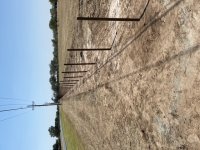
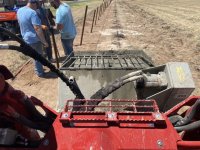
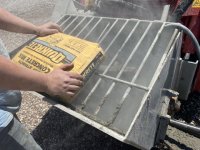
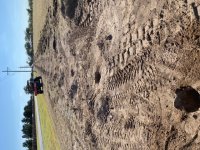
We've never dug down below the frostline for fence posts set in concrete. That would be 4' for a 4' post here. We just don't do it. We dig 2' for a 4' post. 3' for a 6' post and 4' for an 8' post. We use an inverted V shaped hole that is wider at the bottom than it is at the top.
What seems to happen with frost heave on fence posts with a V-shaped blob of concrete that is wider at the top than it is at the bottom, is the frost lifts the post and concrete, the dirt settles in the voids all the way down the sides of the V, and the post is a little higher each year. If it's wider at the bottom, there's an extremely smaller footprint for the frost to lift. Think about it.
A cylinder that's 8" in diameter by 24" deep is around 180 square inches of surface area on the sides of the cylinder, if it's a V-shaped tapered hole, plus the bottom of the cylinder. Say 6" at the bottom. 3x3x3.14= 28.26.
So, about 180 + about 28 = about 200 square inches for the frost to grip.
Now make that hole an inverted V shape. 8" at the bottom and 6" at the top.
4x4x3.14 = 50.24 square inches for the frost to grip on the bottom of the hole.
So you have about 200 square inches of frost grippable surface VS about 50 square inches of frost grippable surface. That's about 4 times the surface area.
It won't grip the side of the slope very well on an inverted V shape.
Also, an inverted V-shaped hole that's wider at the bottom puts more mass around the post lower, which helps keep the posts from tipping or pulling out once the dirt is filled back on them.
So there you go. Hope that helps some folks.