alpacalips
Member
Send some of that hay to northeast WA, the drought has pushed grass hay to $400/ton here!

You are thinking of the smaller, 75-100 lb. bales that most people handled by hand. Usually a 3 man crew, driver, bucker and stacker, sometimes me and my brother alone would do it, put the pickup in Granny gear and let it crawl along and I'd reach in occasionally to steer it between the bales while we both bucked and stacked from each side. Once we got to the 4th row we'd stop and have to climb up to stack properly.I thought square bailing was a thing of the past. Labor intensive and a great deal of storage needed, plus danger of burning barn to ground if hay is too green. Really good pictures though.
Send a freaking truck! 5-800# rounds here are $25-35 right now for cow hay because no one wants first cut, especially while all the pastures are green for grazing.Send some of that hay to northeast WA, the drought has pushed grass hay to $400/ton here!
That looks like the same rake we had, a New Holland 256 IIRC. We also used an old H a few years but most of my raking was with a IH 464.Raking hay that had been rained on in 1972:
View attachment 709723
Chopping corn in 1969...my brother was riding shotgun on the chopper because a lot of the corn had been blown down in a storm and he had to clear the throat of the chopper whenever it plugged.
Even the smaller 70# bales are now managed by equipment. The most common buyer around here are people with horses. The baler can be followed by an accumulator that organizes them into a single layer group of 8 to 12 bales and lays them on the ground, then that group can be picked up by tractor with FEL and hay grapple which lays over the group and picks them all up in unison, then places the group on a trailer/truck.I thought square bailing was a thing of the past. Labor intensive and a great deal of storage needed, plus danger of burning barn to ground if hay is too green. Really good pictures though.
Around here, Houston Texas, if you want higher quality over a period of time, fertilizing is essential. If conditions are right, I apply a moderate amount between cuttings. Richer green, denser and faster growing. If I neglect to fertilize, after 3 years the harvest gets skimpy and does not shade out weed competition. That's what I do because I hay land that I own. Few who lease land put in the money because if the lease is lost, someone else profits.Do you have to fertilize those fields once in a while?
WOW! And around here (Houston Texas), the first two counties off the Gulf have had so much rain over the past 3-4 months that nothing can get baled. We are now in the middle of August and I have not been able to get my first cutting.Send some of that hay to northeast WA, the drought has pushed grass hay to $400/ton here!

Love the photo!Attachments
Yep... memories for sure and where my love of tractors began... family dairy farm in the family for generations...
A wonderful experience spending summers with my Grandparents and cousins and a window into another way of life...
That tractor was part of the family and my Grandfather sold timber over several years to raise the money to buy and opted to go hand crank because the electric start was a costly upgrade...
Single Cylinder diesel with a glow plug lit with a match...
Still remember the sound of the motor as it started...
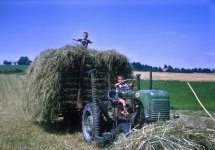
The drive belt was used a lot... moving hay with a blower, buzz saw, pumping the manure pit.. etc.
We had a McCormick also - and it had the same problem. I believe all the baling we did with that unit was done with a kid sitting on the twine box, checking each bale to make sure it was properly tied.We used a McCormick baler and I remember when I was a kid about 10, my dad taught me how to tie a square knot and I sat on the twine storage area as we baled. When a bale did not tie, I would tie the twine while we were moving. That baler had a knotter problem, but we still used it for about 30 years. The picture below was taken in 1954, pulled by an Oliver 77.
My hay is baled and collected that way, unfortunately my barn is not set up to be stacked with the grapple. You guessed it this old fart is still stacking hay in my barn. I've got 200 bales on my trailer waiting to be unloaded and stacked by hand.Even the smaller 70# bales are now managed by equipment. The most common buyer around here are people with horses. The baler can be followed by an accumulator that organizes them into a single layer group of 8 to 12 bales and lays them on the ground, then that group can be picked up by tractor with FEL and hay grapple which lays over the group and picks them all up in unison, then places the group on a trailer/truck.
There is a science involved in stacking hay bales. It has been my limited experience that a 70# bale actually weights 100# after lunch. So the science of stacking tells us it should be done in the morning, before lunch, not in the afternoon. Hope that helps! Best wishes, LarryMy hay is baled and collected that way, unfortunately my barn is not set up to be stacked with the grapple. You guessed it this old fart is still stacking hay in my barn. I've got 200 bales on my trailer waiting to be unloaded and stacked by hand.
Anybody want to buy some horses. My wife has a 37 year old horse and I think it's just about history.
Oh, I guess it's too late today then. There's always tomorrow. I've got to work at a real job Wed.-Fri. so I can recover then.There is a science involved in stacking hay bales. It has been my limited experience that a 70# bale actually weights 100# after lunch. So the science of stacking tells us it should be done in the morning, before lunch, not in the afternoon. Hope that helps! Best wishes, Larry

Many a dump rake was converted to tractor pull configuration as the horses were phased out !! We did exactly as pictured here using a MH Pacer to pull with in the 1950's. I was riding the 10ft rake at age 10 when we ran over the biggest black snake I ever saw with both rake wheels... i.e. more than 10ft long ! I was perched up on top of the seat with both feet by that time. The good old days ! I still have the Pacer AND the crank handle if I can still find the handle...I grew up on a Pennsylvania farm; haying every summer is still something I have fond memories of to this day. Probably would have farmed all my life if I hadn't been drafted and ended up in Vietnam. Here's a faded photograph from the early 50s...note the crank in the front of the Oliver. My dad on the Oliver and my cousin on the dump rake.
View attachment 709564
I have lost several friends who died from a tractor rolling over on them while bush hogging -- Bob Mendez, Tommy Stout to name a couple. Another was crushed underneath a baler he had crawled under to work on. Another friend who was big in FFA in the 1950's (Worthy Hall) lost an arm reaching into what was then a new tech hay baler. They sewed his arm back on and he is using it today in his 80's. You better betcha farming is inherently hazzardous ! I won't quite say "dangerous" because if you stay alert and avoid doing stupid things you convert "hazardous" away from "dangerous" to "almost safe."It can get dicey when 2 tractors are passing nearby in fields (collision), connecting/disconnecting PTO shafts, hot/sharp metals, fall from baler, eye injuries, etc. I know a guy who fell off a square baler and broke his back. Plenty of families around here with dead sons or fathers.
Farming is incredibly dangerous career and sometimes I think I should quit.
Ha Ha still laughing! Great! And, if the forecast is for rain in the next 3 days, You won't have to cover it because past experience has also shown us, that rain will not happen. You should have 2 weeks to wait for a good morning.Oh, I guess it's too late today then. There's always tomorrow. I've got to work at a real job Wed.-Fri. so I can recover then.
I was just going to ask what those big square bales weigh ! I tossed a lot of hay bales as a teenager but not 1500lb ones ! Also I note the power lines cohabitate with your work. I just had 1/2 mile of 140 ft wide right of way put across the middle of my farm a few years back -- 138,000 volt lines on 100ft tall twin wooden braced together poles. In WV.Post up more pics!
Here’s some feed hay in one of my many leaky, creaky condemned hay sheds. I swear by plastic pallets to reduce bottom spoilage.
View attachment 709692
Here we are making some 4x4x8 big squares and some 4x5 round bales in the background
View attachment 709697
Typical 1500 pound bales
View attachment 709699
Setting up to bale another field
View attachment 709700
Let’s just say 30 years ago when hay season rolled around and small square bales were the norm the anticipation of a barn full of green sweet smelling hay was almost as good as making love ( note the term almost), we had an inventory of willing young Teenagers mostly striking for that first string football team And willing to flex their muscles in completion with one another to get the crop under cover and beat the rain.I do miss haying but in a way I don't must be age thing,