Towing capacity

   / Towing capacity
  • Thread Starter
#81  
That works well. I started using meta tabs screwed to the deck for different loads. Works ok, but I forget which one is for what. It's not rocket science, you would think I could remember. But sometimes I don't.
If you have a wood deck, use a wood burning tool to write what each stop is for...or at least a code you will remember.
 
   / Towing capacity #82  
If you have a wood deck, use a wood burning tool to write what each stop is for...or at least a code you will remember.
Great Idea. Think I will burn some names in it. Thanks. Larry
 
   / Towing capacity #83  
Some things to think about.
If your proposed tractor is 3300lb. then add another 1000 for a loader so now 4300lb. Add the minimum trailer weight of 2500lb. and you're up to 6800lb or about maximum for a 7K trailer. Plus any 3pt. attachments and a cab will also add weight so a 7K may not be ideal as you'll probably be over loaded. If you load the tires then there is more added weight.
Next concern is a 16' trailer long enough for a tractor with loader and maybe a 3 pt. attachment? You may need wiggle room to move the tractor to get proper balance and tongue weight. I would suggest at least a 20' 9 or 10,000lb. trailer.
Lastly, if your combined weight of loaded trailer is truly around 7K or even up to 10k then most any newer 1/2T pickups properly equiped will easily haul that kind of load.
This is all fine but what you have to think about is the stopping. 3/4 ton has bigger brakes tires and the weight class of the truck.1/2 ton truck not legal to pull 10,000 lb trailer? Be safe go 3/4 ton. Just my opinion. Nothing May be said until there is an accident!
 
   / Towing capacity #84  
If I went strictly by recommendations by the manufacturer, I wouldn't be doing what I do.
I haul household water for cisterns in both of our houses on the property. I have a 1000 Imp. Gal. tank on a gooseneck trailer that itself weighs about 2750 lbs. That's a total weight of about 12 000 lbs. I have an old '92 F150 4x4 with an extended cab and 8' box, and a 5 l engine.
The thing is that I live in Saskatchewan. The closest I come to having to climb a hill is when I pull onto the road after filling up. The rest of the 16 km home is all pretty flat and level. I have to make two turns. On a real busy day I might meet 3 vehicles. I rarely travel more than 80 km/hr. During full load testing, I was able to lock up the trailer brakes.
If I was going to be hauling in heavy traffic, with hills and traffic lights, I wouldn't consider doing that, but under the circumstances, I don't see much of a problem with it.
 
   / Towing capacity #85  
This is all fine but what you have to think about is the stopping. 3/4 ton has bigger brakes tires and the weight class of the truck.1/2 ton truck not legal to pull 10,000 lb trailer? Be safe go 3/4 ton. Just my opinion. Nothing May be said until there is an accident!
It is always better to use a bigger tow vehicle. I am careful about classifing trucks as 1500 (or 1/2 ton). There are several different tow ratings of the same truck based on the powertrain, weight, suspension. I do agree that a 2500 is safer than a 1500. But I also know if you only rarely tow heavy, the bigger truck may be hard to live with the rest of the year. My 1500 will not fit in most parking spaces as it is. But all 1500 are not the same. For example, a Ram big horn, standard truck with 5.7 hemi and a 3.21 drive train is rated to tow 8000. And that would not be legal. But the 1500 Larime, with the same 5.7 hemi with the heavy 3.92 drive train is rated at 11303.9 # (2021). So that is legal to tow 10000.
But there is a lot to agree with in your post. I would LOVE to have a 2500 with diesel when towing. It IS safer and better equipped to handle heavy loads. You are right. If there is an accident, then the numbers become important. That is why I stay within all the specs of my truck and trailer weights. And that is why I use a CAT scale if I am unsure. Nice post. Best wishes, Larry
 
   / Towing capacity #86  
That works well. I started using meta tabs screwed to the deck for different loads. Works ok, but I forget which one is for what. It's not rocket science, you would think I could remember. But sometimes I don't.
May we assume you have a cell phone with picture capability? Next time you load the trailer and get it set up as you like it, snap a picture.
 
   / Towing capacity #87  
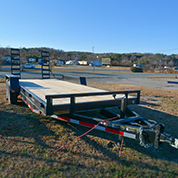
I did a quick search for trailers, and found this one. It might be slightly larger than your absolute minimum.
 
   / Towing capacity #88  
Not to get off what he is asking about, it is good to get set up right for sure ! I have a question i to tow a 3940 with loader an usually a box scraper or mower. How do you know where to locate your load on the trailer? Say like more tongue weight, less? And if it sways what is that telling you?
I mentioned in an earlier post, but I use a Weigh-Safe hitch which has a built-in scale in the hitch. It gives me peace of mind. Here is one of their videos demoing load distribution vs stability. You can search youtube for other examples showing the same.
 
   / Towing capacity #89  
I am trying to build out parameters for a truck and trailer I will need to transport my tractor. I can get specific weights on tractors and equipment. I am trying to determine how much 'wiggle room' I need to build in to my calculations. So if I get a medium-sized CUT with ROPs, that is about 3300 lbs. 16 ft trailer with about 7000 lb capacity is 2500-3000 lbs. Cab is a maybe right now. FEL is a definite yes, so I will have to add in weight for that. Also likely to have med-hvy duty RC on 3pt. What other factors do I need to consider? Like, how heavy would loaded tires be? At this point, I don't know what I don't know. I don't want to buy too small a truck, but I also have no interest in a behemoth.
I haul my B2601 compact tractor with FEL and implement on the back. I can load on 14' trailer but mine is 16'. 2 3500 pound axles with no brakes. I pull with an F150 regular duty. I am the only one who drives it.
If the implement was a bush hog, I might not be able to fit on the 16' I'm comfortable driving it. Last November I carried this rig from Texas to Georgia.

What would make me more comfortable would be brakes! Your needs suggest a pair of 5000 axles and 4 wheel brakes with appropriate tires. Right tires are important because trailers like to shred tires. A good brand of trailer like Hudson is well engineered and fully compliant.
Most trailers are not fully compliant. If you buy a heavy duty 3/4 ton truck, you will have to go through the scales. The Highway Patrolman will let you know if you are non-compliant. That's all I got. Kudos to you for figuring this stuff out before shopping!

 
   / Towing capacity #90  
May we assume you have a cell phone with picture capability? Next time you load the trailer and get it set up as you like it, snap a picture.
I guess it should read METAL TABS. Good suggestion, and I will do that when I get back to the trailer. Thanks, Larry
 
   / Towing capacity #91  
If you buy a heavy duty 3/4 ton truck, you will have to go through the scales. The Highway Patrolman will let you know if you are non-compliant.
Not true where I have traveled with the 22', 14K:
P1260001.JPG
 
   / Towing capacity #92  
WoW!!! Am I ever glad that I DO NOT need a trailer. I only work here on my own property.
 
   / Towing capacity #93  
How do you know where to locate your load on the trailer? Say like more tongue weight, less?
The previous posts to answer this are good. However, I have a challenge with mine because of the size and weight of the implements make it so I have to load the tractor differently with each implement. (I.e. sometimes forward, sometimes backward, different locations on the trailer.) What I did was to get a scale (the 4x1 bathroom scale works) and figure out how much sag the hitch would under go for 10% of max weight, which for me was about 1". That way as long as I have that 1", the load is properly balanced.
 
   / Towing capacity #94  
I am trying to build out parameters for a truck and trailer I will need to transport my tractor. I can get specific weights on tractors and equipment. I am trying to determine how much 'wiggle room' I need to build in to my calculations. So if I get a medium-sized CUT with ROPs, that is about 3300 lbs. 16 ft trailer with about 7000 lb capacity is 2500-3000 lbs. Cab is a maybe right now. FEL is a definite yes, so I will have to add in weight for that. Also likely to have med-hvy duty RC on 3pt. What other factors do I need to consider? Like, how heavy would loaded tires be? At this point, I don't know what I don't know. I don't want to buy too small a truck, but I also have no interest in a behemoth.
As 20 posts and 5 pages prove nearly everyone has something to say on your question and scenario. Way more than enough already said but here I go anyway: This is grossly simple. Very common and very vanilla.
  1. As George said, any current half ton pickup is fine for your stated case. A 4WD is always better with more beefy springs AND keeping you from being stuck (which you will be with 2WD.)
  2. As for the trailer an 18' bed length is about right. Just get a well-made one such as Pequea, Corn Pro, Big Tex or others. Two 7K axles. 10,000lb capacity listed is fine. Listing is often kept just below 10K to avoid PITA licensing and dumb stuff. No need for deck-over unless you need to haul something wider than what you describe. Yes, get brakes on the trailer.
p.s. Significant variables include whether you plan to tow in steep mountain areas, or just routine farm-to-farm, farm to shop, job-to-job etc. Go for more HP if mountains. And the heavier the truck, the more stable the towing will be esp. when most fully loaded (all your toys on at once.) For what you describe and not mountain areas most any 4WD half ton pickup is fine.
 
   / Towing capacity #95  
Torvy,

To give you a real-world comparison. I pulled my old (2018) Kioti CK3510 with FEL and either BB and/or RC (depending on the job) on a 20-ft trailer w 7k axles under it. Pulled it with an old Nissan Titan 4WD 1/2 ton and had no problems whatsoever. Keeping in mind that the truck has limitations so on the highway I kept it in 4th gear instead of OD to save wear on the tranny. Note that with this setup I ONLY pulled it to/from dealer for svc (about 30 miles away) and for work near the farm - usually no further than 25-30 miles from home - I definitely would not recommend going across the country or even the state with that setup. If you're keeping it in NE Texas, it's relatively flat so shouldn't be an issue as long as you're respectful of what you're pulling and pulling with.

The most important thing to remember regardless of how heavy-duty of a truck/trailer combo you get is to make ABSOLUTELY SURE the trailer load is balanced or the truck/trailer can sway which is very scary if you've ever experienced it. Any trailer should be balanced or this can happen, especially on a bumper-pull trailer, so un-balanced load would be more "human error" than a limitation issue, but not something to be taken lightly if your front or rear wheels start skipping out of control and you've got 8000+ pounds of weight behind you! If you only need to haul short distance and you're not comfortable or feel you are stretching the limits of your setup, just turn on the flashers and SLOW DOWN! You're far less likely to go into an uncontrollable "death wobble" at slow speeds.

With that being said, I'm NE Texas so if you need a good 20 ft trailer - I may consider selling or trading the one I've got for a 10k+ trailer because I have since upgraded my tractor from a 35hp to a 75HP that won't even fit on my current 20 footer so I'm now in need of a bigger truck and a bigger trailer with minimum of 10k axles under it. Either way, if you're sticking with a CUT, I wouldn't go any shorter than a 18ft 7k rated but you would appreciate the extra 2 foot if you go 20.

Moral of the story - when in doubt.. go bigger!
 
   / Towing capacity #96  
TexasDigger is right on the money above in post # 96 (96 for gawd's sake !) but anyway what he is saying in ALL CAPS about balancing has to to do, really, with tongue weight. There are all kinds of rules and guidance out about tongue weight. You, the OP, have not really revealed your level of knowledge and experience regarding trailers so pardon me if I am insulting your intel.

TxDigger is right about the nasty effects of wobble/fishtailing/imbalance with any trailer and load. You need to make sure you have plenty of downward force on the hitch at the tongue -- e.g. tongue weight. My rule of thumb is to measure the height of the ball/tongue from the ground empty. Then load the machinery forward until the tongue drops by about 5". This guarantees several things. You definitely have positive tongue weight (negative being a disaster.) Secondly with 'most' 4WD trucks a 5" drop due to tongue weight means you have enough to be stable. There are all sort of variables but you can cut and try from that point with reasonable safety/sanity. You will learn what is best for your specific equipment. Accuracy is not the issue, overall "good" behavior of the truck/trailer is all that matters.

If you have reasonable tongue weight you will not get fishtailing and what he called wobble. Speed DOES matter as he said but with good setup you can run 70 or 80 on the interstates with no problem. My scares over the last 30 years have all been related to lack of tongue weight, too light a towing vehicle or speed downhill (!!) Came very close to losing the entire rig (and probably my life) once, thinking I could speed up and straighten out a fishtailing load on a long steep downhill. Manual application of the trailer brakes saved my butt but left me cleaning my drawers...

I got a neat gadget for Xmas a few years ago that plugs into the truck harness under the steering wheel (F-150 and most others) and do the setup with your smart phone. It will (amazingly) provide you with many things including tongue weight, total vehicle and trailer weight, trailer weight by itself, weight of load on the trailer, etc. Just follow their instructions. The phone app is now called "Better Weigh" and the device was called something else. Newer one is Curt Better Weigh which is sold on Amazon for $99.
 
   / Towing capacity #97  
Well, my F150 with a 5.0 V8 only tows 9,000 lbs., so you have to get a “properly equipped” half/ton.
Very true. My half-ton towable 5th wheel can only be towed safely by a select few half-ton pickups.

On another note, you live in Texas so there's another factor to consider. If the combined gross vehicle weight of the trailer and the tow vehicle exceeds 26,000 pounds you'll need a class A non-commercial license.

This isn't enforced much as far as I've seen, but...
 
   / Towing capacity #98  
Very true. My half-ton towable 5th wheel can only be towed safely by a select few half-ton pickups.

On another note, you live in Texas so there's another factor to consider. If the combined gross vehicle weight of the trailer and the tow vehicle exceeds 26,000 pounds you'll need a class A non-commercial license.

This isn't enforced much as far as I've seen, but...
His described need and equipment stand no chance of nearing the 26,000 lb GVWR.
 
   / Towing capacity #99  
The most important thing to remember regardless of how heavy-duty of a truck/trailer combo you get is to make ABSOLUTELY SURE the trailer load is balanced or the truck/trailer can sway which is very scary if you've ever

sure you have plenty of downward force on the hitch at the tongue -- e.g. tongue weight. My rule of thumb is to measure the height of the ball/tongue from the ground empty. Then load the machinery forward until the tongue drops by about 5". This guarantees several things. You definitely have positive tongue weight (negative being a disaster.) Secondly with 'most' 4WD trucks a 5" drop due to tongue weight means you have enough to be stable. There are all sort of variables but

Please note that this isn't a call-out post as I'm certain the above know what they're talking about, just that it could be clarified:

You always want 10-15% tongue weight on a bumper pull (numbers are very different on a gooseneck or 5th wheel) to ensure trailering stability. If your load + trailer weighs 5,000 pounds, the weight on the ball should be somewhere between 500-750 pounds. This is the "balance" needed - it's not actually balancing the load 50/50 on the trailer so that it's teetering back and forth. You can roughly guess at this by getting the load perfectly balanced on the trailer so that there's barely any weight on the ball at all, and then move the load towards the truck "a bit" but how much you have to move it depends on the trailer weight and length and the load weight. When in doubt, weigh it (a previous post mentioned the 4:1 bathroom scale method).

How much this 10-15% tongue weight will compress your truck's suspension depends entirely on the suspension of the truck and how much this 10-15% weight is - and that will vary considerably depending on what the load is.
 
   / Towing capacity #100  
You can roughly guess at this by getting the load perfectly balanced on the trailer so that there's barely any weight on the ball at all, and then move the load towards the truck "a bit"
Agreed. I take for granted that most people pulling a trailer should know the basics. Trailer load should be just barely offset with a smidge more weight to front of trailer (closer to vehicle's hitch) so that trailer isn't pogo-sticking on the ball/hitch as the weight shifts back & forth. I wasn't aware of the exact %'s but have always done the "just a bit" method ning referenced - it doesn't take much to see the visual weight distribution difference when you pull the tractor on to the trailer! Too far to the rear of trailer and you risk rear wheels of truck losing stability/traction thanks to the physics of fulcrums and levers - that's another subject! Too far fwd, and you risk the front wheels of truck losing traction (I've even heard horror stories about them coming completely off the ground!) ...also due to the fulcrum being the rear wheels of your truck and WAY too much weight on the tongue! If load is perfectly 50/50 on the trailer axles, at the least it's really noisy rattling on your ball/hitch, but also risks coming off the hitch and/or potentially putting you in a very dangerous situation. Are we still talking about trailer weight distribution because it's starting to feel like Goldilocks and the Three Bears! ....You want the load to be JUST RIGHT! ..or just get a 1 ton diesel and a gooseneck and be done with it! Pulling a CUT on that kind of rig would feel like pulling a single jet-ski behind a V8 F150! See my go-to rule #1: When in doubt, GO BIGGER!

All kidding aside and back to the original topic: Any v8 truck and a standard 16+ ft tandem-axle trailer (w 7000 lb axles) that the tractor will fit on SHOULD do the job as long as you keep an eye on weights and know what you're doing. Again, you'd probably want to go closer to 18-20 ft on the trailer but since Torvy originally asked about "wiggle room" and "parameters" to trailer a CUT (assuming sub-4500 lb range including loader): THE bare minimum to get the job done safely and legally would be any V8 truck and a 16ft tandem axle with enough axle to handle the weight of trailer+tractor+loader+????. IE: If going bare minimum, pay attention to axle rating and keep an eye on the stated gvw of trailer and also the tractor + FEL + account for at least 500-600 lbs wiggle room for ONE implement (avg 6ft RC will weigh about 500-600 lbs).. - Keep in mind that ONE pound over the limit of the trailer OR your truck's stated towing capacity and the Texas D.O.T. can slap it to ya for being over-loaded! Based on my current experience, I would recommend getting a trailer strapped with the 10,000 lb axles and not just chinching out on the 7k units since you'd be very close to legal limits on 7k axles when all is accounted for. Most newer V8 trucks are rated around 9k lbs tow capacity so your trailer would then exceed the limits of the truck & give you some breathing room.

EDIT - whatever you get - make sure trailer has brakes!
 
Last edited:

Tractor & Equipment Auctions

New/Unused Quick Attach Bale Spear (A57454)
New/Unused Quick...
YANMAR VIO35-6A EXCAVATOR (A59823)
YANMAR VIO35-6A...
2020 Ram Promaster City 1500 Cargo Van (A59230)
2020 Ram Promaster...
KUBOTA SVL75 ENCLOSED CAB (A52706)
KUBOTA SVL75...
2012 UNVERFERTH 13-INCH REAR SPACERS FOR 10 BOLT HUB (A55315)
2012 UNVERFERTH...
GRID SHAPED BUCKET FOR MINI EXCAVATOR (A58214)
GRID SHAPED BUCKET...
 
Top