Sizing attachments (FEL)

   / Sizing attachments (FEL) #1  
Joined
Nov 14, 2023
Messages
45
Tractor
2023KIOTI NS 4710
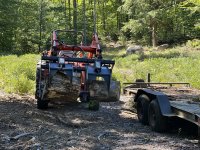
Would there ever be a time where I would want to buy a grapple (or any attachment) that is smaller than my footprint? What kinds of situations (other than being able to lift more because of a smaller/lighter implement) would it be advantageous? Any? or is it in absolute that you should buy to match the tractor.

TIA
 
   / Sizing attachments (FEL) #2  
When I was thinking about a grapple I arrived at the conclusion that a grapple is not sized to the tractor width. My L4060 has a 6' wide footprint, and a 6' grapple would be too large. Since you're not driving through the work like a plow, rake, or bucket, an overly wide grapple just reduces lifting capacity.
That all said, I decided against a grapple and get by with pallet forks.
 
   / Sizing attachments (FEL) #3  
grapple selection depends on your use and tractor capabilities. If just moving brush then in theory a wider grapple would haul more. If lifting logs then grapple weight would be a consideration.
 
   / Sizing attachments (FEL) #4  
On bigger tractors the size and weight of the implements is a little less critical because they have a lot of lift capacity. On smaller tractors if you have a 600 pound lift capacity and put a 400 pound grapple on it you can’t do much with it. With blades and graders is where you want the implements wider than your tractor.
 
   / Sizing attachments (FEL) #5  
I chose my grapple based upon implement strength. Consequently I have a 60 inch grapple that weighs 820 pounds. I've had a few "lesser" implements and in a short time they seem to crumple - quite easily.

I've never found that I need/want any grapple wider than the 60" one I have. My rear tires are 80 inches - outside to outside. I've never found that the 60 inch grapple - in any way - limits what I can do.

It is a true beast and has served me well for over ten years. Yes - because it weighs 820# I did loose some lifting ability. But - I can still lift 3200# - carefully. My "normal" maximum lift is - 2000 to 2500 pounds. I lift large chunks of pine tree trunk and large rocks. This is my Land Pride 1560 grapple.
IMG_0011.jpeg
 
   / Sizing attachments (FEL) #6  
I think there is probably a bit too much emphasis on this. I'd need 72" implements for everything. It makes sense in some cases, not always. Probably makes the most sense with snow plows/blowers.

Some manufacturers kick up the duty rating at 72" or so. This makes things disproportionately heavy and expensive. You may need the weight, maybe not.

I'm looking for a grapple. 55-66". I have a lot of trees and brush to handle. The few inches more don't matter enough for that purpose.
 
   / Sizing attachments (FEL) #7  
My thinking exactly - Torvy. I've found that my 60" grapple will gather trash of any size.
Backdrag - like a garden rake and clamp shut for the smaller stuff. Go forward - with lower lip low - for all the big stuff and limbs.

Unfortunately - my choices were somewhat limited. I'm sure there are grapples out there - just as strong as what I have and are lighter. Problem being - I want to "lay hands" on any purchase that expensive. The best grapple in the world may be in New Jersey - I'll never get to see it.

The one exception is my heavy duty Rhino rear blade. It's 1000# and 96" wide. Folks tend to forget - when you angle a rear blade to move snow - you loose width. I offset and angle the rear blade to move snow. Keeps the tractor a safe distance from the edge of my driveway. A couple spots on my mile long driveway have a 20 foot or greater drop off.

My basic feeling - I do not want to have to limit what I can do with any attachment because of the deficiencies in manufacturing or attempts to sell a cheaper product.
 
Last edited:
   / Sizing attachments (FEL) #8  
Since I planned on using my grapple almost exclusively for logging I got a Frostbite bypass grapple. It does pickup brush and the like but logs are its strong suit. It is only 29” wide and weighs about 360#
 
   / Sizing attachments (FEL) #9  
It depends a lot on your uses, but keep in mind that once you have one you'll find uses for everything you didn't think of. People put a LOT of emphasis on the weight of the wider grapples (apples to apples construction) and really it is very minimal. I think my 66" WR Long grapple weighs about 100lbs more than the 48". I can tell you that I've never been within a 100lb deficit on my lift capacity. If the rock or log was too big to lift with my grapple, it was too big to lift with any 4' grapple as well.

Another argument becomes digging. Again, I've never found that I couldn't dig something up because of an extra foot and half or so. Pretty much all the arguments you see, one way or another, are really just people over thinking it and not having experience with both. There are some huge proponents of one specific size, and I caution you that if something is diehard one way or another, take their advice with a grain of salt because they are likely overly biased.

I bought my WR Long OBG2-66 about 10 years ago. It's been the best investment I've ever made, literally the best purchase I can think of. I almost never buy new, but I had no choice and bought new with this grapple. My father has used it many times as well. He ended up buying a smaller tractor and I recommended a 48" grapple for him because his lift capacity is in the 1,000lb range.
He's had that grapple now for about 2 years. Both him and I much prefer the wider grapple for various reasons. He still jokes around about me 'screwing' him over by getting him the 4' grapple lol.

Scroll through some of the pics in this thread: Grappling fun - A Picture Thread....
I think you'll find various grapples of all sizes on there, and likely every single thing that someone did, could have been done with either or....

My main recommendation would be don't buy something meant for a skidsteer. You definitely do NOT want one of those 800lb+ grapples. There is simply zero advantage there. If your talking about 3 point implements then yes, the heavier the better, but for the FEL, something that heavy just doesn't have an advantage.
 
   / Sizing attachments (FEL) #10  
Well - I've found that my Land Pride grapple is perfectly fine. It's made for a skid steer - weighs 820 pounds - and, obviously, never been a problem. I think the way it will be used has a lot to do with it also. I use mine to move LARGE chunks of pine tree trunk and LARGE rocks. Plus the obvious scuffing and scraping.

I call my technique of moving - knuckle dragging. The load is NEVER lifted more than 6" off the ground. Increased stability and, very definitely, increased lift capacity.

At this height my lift capacity is around 3500 pounds. This is according to my FEL heavy lift chart and at a point 800mm forward of the lift pins. But there is also this rule - the higher the lesser.

When the lifting get tough I will definitely take my grapple over something that is considerably lighter.

I've spent my time in "implement Hell" with light duty implements.

But Piston is absolutely correct. You simply DO NOT put an 820# grapple on a 45 hp tractor. I'm sure that there are lighter grapples that would be perfectly fine.
 
Last edited:
   / Sizing attachments (FEL) #11  
I don't know how wide my grapple is. It's not important. What is important is how well it picks up materials. I went with a double lid grapple because I feel that it holds material better by being able to close differently depending on what I'm picking up. But I'm sure that if I had a single lid bucket, I would adjust and figure out how to get the most out of that too.

006.JPG
 
   / Sizing attachments (FEL) #12  
Eddie makes an excellent point. Think LONG and HARD on how the grapple will be used. I did not go with a double lid. I want to handle a large rock in the dead center of the grapple - not on either side where the lid clamps down. With a double lid - you do not have that option. Single lid will clamp down - all the way across the grapple.
 
   / Sizing attachments (FEL) #13  
You definitely want to lift heavy objects like rocks/boulders in the middle of the grapple, whether it's a single lid or double lid makes no difference. As mentioned, both sizes/types will work and we all have our preferences.

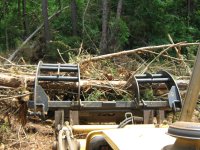
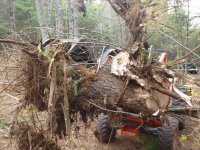
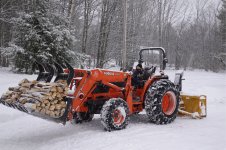
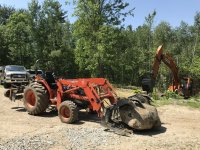
These images show a few examples of how the double lid can do the same, if not more, than a single lid (or narrower) grapple, but that's not to say that the single lid or narrower grapple couldn't accomplish the same work in more time.

Attachments

  • IMG_1957.JPG
    IMG_1957.JPG
    2.5 MB · Views: 368
  • DSC00588.JPG
    DSC00588.JPG
    1.6 MB · Views: 332
  • IMG_1495.JPG
    IMG_1495.JPG
    2.3 MB · Views: 1,000
  • IMG_9383.jpeg
    IMG_9383.jpeg
    4.2 MB · Views: 517
 
   / Sizing attachments (FEL) #14  
I don't know how wide my grapple is. It's not important. What is important is how well it picks up materials. I went with a double lid grapple because I feel that it holds material better by being able to close differently depending on what I'm picking up. But I'm sure that if I had a single lid bucket, I would adjust and figure out how to get the most out of that too.

View attachment 840309
Very well said! I also use mine for small scale land clearing, as it looks like you do, and many times I'll carry multiple stumps of different size where the two lids will clamp at vastly different positions, as your photo shows. If I just had the single lid, I'd simply take more trips but there there is nothing it couldn't do that mine can do.
 
   / Sizing attachments (FEL) #15  
As others have already noted, it really depends on what you want to do with the grapple. My primary use is moving long logs. A secondary use is to clean up brush and slash after logging and firewood harvesting. I need to maneuver in tight quarters in my woods. Driving around with my 66" wide bucket sometimes takes more maneuvering just to get that bucket around trees that I don't want to damage.

I went with a Sundown GR40 forestry grapple (similar to the Frostbite that @fruitcakesa mentioned, though I have to admit, I do like the construction details on the Frostbite a little bit better.) These grapples excel at gripping long logs and holding them securely. To match that gripping in a non-forestry grapple, I'd have had to go with a double lid design. (Some single lid designs will pinch one end of a log, but not grip the other securely, allowing it to swing around.) That's a whole lot more weight and a lot more expense, and I'd lose some of the maneuverability in tight conditions that the forestry grapple allows. The forestry grapple weighs almost the same as the bucket it replaces.
GR40 grapple.jpg


A forestry grapple is more of a specialized implement: It's great for moving long logs and similar long objects. It works well for brush and slash, as long as it it not cut up into really short pieces. It does not do well on small items like firewood cut to 16" lengths or smaller rocks. You can't really "rake" with a forestry grapple. You also lose the ability to carry tools or other supplies which a bucket or some other style grapples allow fairly easily. (I've thought of making a box to carry in my forestry grapple to bring tools and supplies out to the work site, but it's not been enough of a problem to rise to the top of my to-do list. I added a couple of chainsaw carriers to my tractor and a receiver hitch to my logging winch so I can tow a trailer out to the worksite and still have my winch with me.

If I needed to do a lot of other grapple type work, I'd have a different style grapple (or maybe an additional grapple?) However, since very little of my work is out in wide open areas, I would not be at all interested in a grapple that is wider than my tractor (or even one that covers my tracks).
 
   / Sizing attachments (FEL) #16  
As others have already noted, it really depends on what you want to do with the grapple. My primary use is moving long logs. A secondary use is to clean up brush and slash after logging and firewood harvesting. I need to maneuver in tight quarters in my woods. Driving around with my 66" wide bucket sometimes takes more maneuvering just to get that bucket around trees that I don't want to damage.

I went with a Sundown GR40 forestry grapple (similar to the Frostbite that @fruitcakesa mentioned, though I have to admit, I do like the construction details on the Frostbite a little bit better.) These grapples excel at gripping long logs and holding them securely. To match that gripping in a non-forestry grapple, I'd have had to go with a double lid design. (Some single lid designs will pinch one end of a log, but not grip the other securely, allowing it to swing around.) That's a whole lot more weight and a lot more expense, and I'd lose some of the maneuverability in tight conditions that the forestry grapple allows. The forestry grapple weighs almost the same as the bucket it replaces.
View attachment 842193

A forestry grapple is more of a specialized implement: It's great for moving long logs and similar long objects. It works well for brush and slash, as long as it it not cut up into really short pieces. It does not do well on small items like firewood cut to 16" lengths or smaller rocks. You can't really "rake" with a forestry grapple. You also lose the ability to carry tools or other supplies which a bucket or some other style grapples allow fairly easily. (I've thought of making a box to carry in my forestry grapple to bring tools and supplies out to the work site, but it's not been enough of a problem to rise to the top of my to-do list. I added a couple of chainsaw carriers to my tractor and a receiver hitch to my logging winch so I can tow a trailer out to the worksite and still have my winch with me.

If I needed to do a lot of other grapple type work, I'd have a different style grapple (or maybe an additional grapple?) However, since very little of my work is out in wide open areas, I would not be at all interested in a grapple that is wider than my tractor (or even one that covers my tracks).
John_Mc, well said concerning grapples. I want to put a receiver on my Norse450 winch but am not sure of placement. Could you post a pic of your setup? Thanks
 
   / Sizing attachments (FEL) #17  
John_Mc, well said concerning grapples. I want to put a receiver on my Norse450 winch but am not sure of placement. Could you post a pic of your setup? Thanks
I have a Uniforest 35E logging winch (predecessor to their current 35M model). There is a vertical rib running up the center of the butt plate for this winch. I noticed that their larger winches came with a hitch that bolted on to this rib. I bought one of those hitches, drilled a couple of holes in the rib - mimicking what Uniforest did on their larger hitches and pinned it on, so I could remove it without any tools if it was in the way. (They recommend not having it on there when skidding logs, since it can get banged up by the logs.) This was a pin-type hitch. Here is what it looked like:

original winch trailer hitch.JPG


I wanted to be able to tow some of my trailers which take a 2" ball, so I had a local fabrication shop make me a receiver using the same sort of attachment method as the factory hitch. I bought the receiver tube from Northern Tool and the fab shop made the rest. (I actually shortened the tube a bit, since I wanted to keep things close in to the back of the winch. If I were doing it again, I'd leave it a bit longer: I have to cut about 3/4" off any insert I put in it, which is a bit of a pain just to tighten things up by 3/4".) Here it is installed:

Winch receiver hitch.JPG


I had him make the part that goes up against the winch longer and drill some extra holes, so I could adjust the height. I also drilled another hole in the rib, so I could space the pins further apart. I figures that would give a bit more strength/stability. It's shown in the picture above in a higher position. As it turns out, I always run it in its lowest setting. That allows me to raise the winch up higher to clear waterbars and other obstacles without also raising the front of the trailer too high.

I've also seen people add a receiver to a winch that does not have that center rib. They found a place in the butt plate of their winch to cut a hole that would not interfere with the winch mechanism, then welded the tube in to the hole (That's stronger than just butt-welding the receiver tube on to the winch.) I can't recall if they also added extra support gussets or not.
 
   / Sizing attachments (FEL) #18  
I have a Uniforest 35E logging winch (predecessor to their current 35M model). There is a vertical rib running up the center of the butt plate for this winch. I noticed that their larger winches came with a hitch that bolted on to this rib. I bought one of those hitches, drilled a couple of holes in the rib - mimicking what Uniforest did on their larger hitches and pinned it on, so I could remove it without any tools if it was in the way. (They recommend not having it on there when skidding logs, since it can get banged up by the logs.) This was a pin-type hitch. Here is what it looked like:

View attachment 842279

I wanted to be able to tow some of my trailers which take a 2" ball, so I had a local fabrication shop make me a receiver using the same sort of attachment method as the factory hitch. I bought the receiver tube from Northern Tool and the fab shop made the rest. (I actually shortened the tube a bit, since I wanted to keep things close in to the back of the winch. If I were doing it again, I'd leave it a bit longer: I have to cut about 3/4" off any insert I put in it, which is a bit of a pain just to tighten things up by 3/4".) Here it is installed:

View attachment 842280

I had him make the part that goes up against the winch longer and drill some extra holes, so I could adjust the height. I also drilled another hole in the rib, so I could space the pins further apart. I figures that would give a bit more strength/stability. It's shown in the picture above in a higher position. As it turns out, I always run it in its lowest setting. That allows me to raise the winch up higher to clear waterbars and other obstacles without also raising the front of the trailer too high.

I've also seen people add a receiver to a winch that does not have that center rib. They found a place in the butt plate of their winch to cut a hole that would not interfere with the winch mechanism, then welded the tube in to the hole (That's stronger than just butt-welding the receiver tube on to the winch.) I can't recall if they also added extra support gussets or not.
No center rib on my winch and like you, I am concerned about a butt welded receiver getting abused by logs. Cutting a hole and recessing the receiver is probably how I would have to do it.
 
   / Sizing attachments (FEL) #19  
No center rib on my winch and like you, I am concerned about a butt welded receiver getting abused by logs. Cutting a hole and recessing the receiver is probably how I would have to do it.
The one I saw welded in still stuck out just enough to get the pin in from the rear side of the winch. Different heights might avoid the logs better as well? I did not want to go really high and then have to use an insert with a big drop. I figured that long drop was also a long lever and would put more strain on the system.

Logs hitting the empty receiver does not seem to be too bad of a problem when the insert is removed. I've forgotten to take mine off a couple of times, and not had any problems with it getting damaged. However, I don't do a whole lot of skidding. I generally winch the logs out of the woods to the side of the trail, then pick them up with my forwarding trailer or if they are firewood I cut them up right by the side of the trail.
 
   / Sizing attachments (FEL)
  • Thread Starter
#20  
I chose my grapple based upon implement strength. Consequently I have a 60 inch grapple that weighs 820 pounds. I've had a few "lesser" implements and in a short time they seem to crumple - quite easily.

I've never found that I need/want any grapple wider than the 60" one I have. My rear tires are 80 inches - outside to outside. I've never found that the 60 inch grapple - in any way - limits what I can do.

It is a true beast and has served me well for over ten years. Yes - because it weighs 820# I did loose some lifting ability. But - I can still lift 3200# - carefully. My "normal" maximum lift is - 2000 to 2500 pounds. I lift large chunks of pine tree trunk and large rocks. This is my Land Pride 1560 grapple.
View attachment 840106
I REALLY like this grapple. I think I need a root rake one like that. Not many rocks to deal with. and I'll definitely need to be cleaning up the ground. Would this be the best type for ripping out thick briars?


Tractor & Equipment Auctions

2013 ORTEQ ENERGY GN182 GOOSENECK HOSE TRAILER (A58214)
2013 ORTEQ ENERGY...
THREE POINT ATTACHMENT (A58214)
THREE POINT...
JCT 48" HYD TRENCHER (A52706)
JCT 48" HYD...
Deere 50D (A60462)
Deere 50D (A60462)
2020 BOBCAT MT55 STAND-ON SKID STEER (A60429)
2020 BOBCAT MT55...
JOHN DEERE 750 (A58214)
JOHN DEERE 750...
 
Top