Anyone have a scale on their loader?

   / Anyone have a scale on their loader? #1  

Hay Dude

Epic Contributor
Top Poster Of Month
Joined
Aug 28, 2012
Messages
25,666
Location
A Hay Field along the PA/DE border
Tractor
Challenger MT655E, Massey Ferguson 7495, Challenger MT555D, Challenger MT535B Krone 4x4 XC baler, 2-Kubota ZD1211’s, 2020 Ram 5500 Cummins 4x4, IH 7500 4x4 dump truck, Kaufman 35’ tandem 19 ton trailer, Deere CX-15, Pottinger Hay mower, NH wheel rak
I am thinking about a loader scale. Tired of guessing bale weights.
Found this one. $1,000.
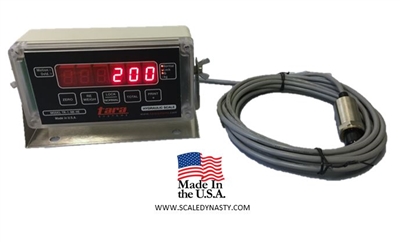

Anyone with knowledge on these or scales in general?
 
   / Anyone have a scale on their loader? #2  
Hay Dude - I do not know why you chose this particular scales. But there are certainly many brands that are MUCH less expensive.

The choice becomes somewhat more limited if you want to go over 2000 pounds.
 
   / Anyone have a scale on their loader? #3  
I have no experience with this type of scale but the question comes to mind of how does the shape or size of load effect accuracy?

Example: lifting a 24” diameter log Vs 4’ x 4’ ft bale. With the mass farther from pivot point does pressure required to lift the same weight also change? I suspect yes but if used for similar sized load like the 4’ x 4’ bales it should provide reasonably accurate weight reference.

Other variable potentially would be lift height at which you measure the weight.

Simple test would be to install a reasonably accurate pressure gauge in the lift circuit of your loader and try lifting a known load several times to similar varying heights. If pressure readings repeat at those heights then once calibrated the scale should react the same.
 
   / Anyone have a scale on their loader? #4  
You seem to have a lot of tractors, so you might me a commercial user, and in that case have at it!
If you're a just a homestead guy, something like this might be useful to get into the ballpark. I might try this myself. @rScotty mentioned something similar in one of my posts a while back and I didn't fully comprehend it until I saw this video.


And the reading changes the further out the load is, here is a test he did with forks

 
Last edited:
   / Anyone have a scale on their loader?
  • Thread Starter
#5  
Hay Dude - I do not know why you chose this particular scales. But there are certainly many brands that are MUCH less expensive.

The choice becomes somewhat more limited if you want to go over 2000 pounds.
I would be at ~2,000lbs/bale. Usually I carry 2 at a time. So about 4,000lbs.

1707102419519.jpeg
 
   / Anyone have a scale on their loader? #7  
Why... Loader will either lift bail or it won't....
Each person would have their own reason. A lot of products are sold by the ton. So, knowing the actual weight may be of benefit,
Also loading a truck or trailer would benefit from knowing the weight going on to the vehicle.

As @oldnslo mentioned, a forklift more or less has a direct vertical weight and may be largely independent of the load configuration.

I think on the tractor, the more leverage out front, the more pressure on the lift cylinders.

However, if the bale size is uniform, and the bale density is uniform, then one could calibrate the system for the center of mass.

So, if the bale is 4' long (from the tractor bucket), then calibrate at the mid point, 2' from the bucket.

Hmmmm

You have a lift cylinder and a curl cylinder.

One should be able to make a computer program that could calculate where the center of mass was based on the two pressures, and then use that to calculate the actual weight.
 
   / Anyone have a scale on their loader?
  • Thread Starter
#9  
Why... Loader will either lift bail or it won't....

Yeah, well I transport and sell hay by the ton.
I’d like to know how much I am loading to see if I am overloading my truck.
 
   / Anyone have a scale on their loader? #10  
I'm far from an expert on loader scales but when I was purchasing equipment, the CAT salesman, whom I trusted (he was a rare breed and I don't usually trust salesmen) suggested I stay away from scales that were not factory supplied and installed as their accuracy and life was questionable. As was stated, where the load is on the forks/bucket/spear, angles of the linkage, angle of the machine etc all play a part in the accuracy.
The factory installed unit apparently took all variables other than the position on the fork into account and even that was a user selectable parameter. So if you had a rectangular bale, you could say the center of mass was 2' ahead and 2' up from the forks.
 
   / Anyone have a scale on their loader? #11  
Yeah, well I transport and sell hay by the ton.
I’d like to know how much I am loading to see if I am overloading my truck.

That is what I expected. I'd like people loading my trailer to tell me what they put on it but nobody seems to have scales on their forklifts.

Many years ago my grandfather had some kind of air gauges on his log truck to estimate the weight. Everyone wants the load right up to the allowable limit without going over. Unfortunately I don't know how they were connected. If a truck had air springs, it would likely be an easy attachment to get the truck or trailer weight.

Anyway, getting the scale on the truck might be another option to look at.
 
   / Anyone have a scale on their loader? #12  
Come on guys. This is the age old question. Which weighs more - a 2000 pound rock or a 2000 pound bag of feathers.

The difference will be - where on the FEL or forks - the 2000 pound weight will be. This WILL NOT change the 2000 pound weight. It WILL change how much force is required to lift that weight.
 
   / Anyone have a scale on their loader? #13  
Ok, feathers or rocks aside, this is a basic pivot beam problem.

So, let's start with a stylized tractor.

BucketForces.gif


Consider masses placed at points A, B, C, D, and E (ignoring weight of the system).

For the mass placed at A, all of the downward force is at pivot A, no additional force on the hydraulic cylinder.
For the mass placed at B, the downward force is split between the cylinder, and the pivot.
For the mass placed at C, all downward force is on the hydraulic cylinder.
Now, move the mass out to position D. One gets a pivot at the hydraulic cylinder, and one gets upward force at the pivot A. The downward force at the hydraulic cylinder increases due to the upward force at A.
Move the mass further out to point E, and one gets more upward force at A, and more downward force on the hydraulic cylinder. The actual density isn't important. Rather the center of mass, and I'm only considering the horizontal center of mass for this exercise.

Now, looking at the axles, the overall sum of the weight on both axles will remain constant. However, the further forward the mass is, the more weight put on the front axle, and the less weight put on the rear axle.

If one always puts the center of mass of the load in the same place, then one can calibrate the system for that placement of the center of mass.
 
   / Anyone have a scale on their loader? #14  
Maybe do a home made torque beam on your loader arm? Like a beam torque wrench? Maybe your loader wouldn't flex enough with only 1800lbs on it?
Or shouldn't the simplest way is to T in a 10,000psi hydraulic pressure gauge on the lift side of a loader arm cylinder? Then just add your own markings for which resting pressures correspond with a few different weights?
 
   / Anyone have a scale on their loader? #15  
Yeah, well I transport and sell hay by the ton.
I’d like to know how much I am loading to see if I am overloading my truck.
Well weigh one bail on something as simple as bathroom scales and divide the weigh
in to 2000 and it will give number of bails (approximate) bales to make a ton.... Quite simple really....

If one bale is 125 pounds, then 2000 ( a ton) divided by 125 is 16... That would be 16 bales.... Probably close enough for a "ton" of hay...

To weigh one bale this is all you need and maybe a cell phone to do the math...

 
Last edited:
   / Anyone have a scale on their loader? #16  
Well weigh one bail on something as simple as bathroom scales and divide the weigh
in to 2000 and it will give number of bails (approximate) bales to make a ton.... Quite simple really....

If one bale is 125 pounds, then 2000 ( a ton) divided by 125 is 16... That would be 16 bales.... Probably close enough for a "ton" of hay...

To weigh one bale this is all you need and maybe a cell phone to do the math...

I think @Hay Dude's bales weigh about a ton each. You'll need quite a few bathroom scales... unless they're now designed for the new American diet.

I don't know the variability from bale to bale, but if one's trailer is good for 30 tons, then one needs to know whether one needs to load 29 bales, 30 bales, or 31 bales. Or, perhaps with heavy or light bales, the question will be 20 bales or 40 bales for that 30 ton limit.
 
   / Anyone have a scale on their loader? #17  
I think @Hay Dude's bales weigh about a ton each. You'll need quite a few bathroom scales... unless they're now designed for the new American diet.

I don't know the variability from bale to bale, but if one's trailer is good for 30 tons, then one needs to know whether one needs to load 29 bales, 30 bales, or 31 bales. Or, perhaps with heavy or light bales, the question will be 20 bales or 40 bales for that 30 ton limit.


Well if its a round bail sure, but my familiarity is with a smaller rectangle bail.... Sorry I even posted.....
 
   / Anyone have a scale on their loader? #18  
Which is heavyer a lb of gold or a pound of lead?

willy
 
   / Anyone have a scale on their loader? #19  
When I drive to the quarry for gravel and I ask for 3,000 pounds, the drive on scale on the way out agrees with what the operator read on his scale. As someone else mentioned, maybe get two bales weighed on a drive on scale and now you have a set of calibration bales for the day. Fresh in the field hay weighs less than 2 months in the barn hay. Of course Hay Dude knows all that. The comment was more for folks that do not buy hay fresh out of the field and 2-8 months of dry barn storage hay.
 
   / Anyone have a scale on their loader? #20  
You have to keep in mind that these things have load cells and
transducers and load cells go bad and get expensive.

You may not agree with this but your trailers tare weight is going
to affect how much you can transport legally.

Your net weight is the weight of the hay load.

Your tare weight is the weight of the trailer.

Your gross weight is the total weight of the trailer, tires, tools,
toolbox, straps and the hay load.

If you are pulled over. Your trailer will be weighed either by
traveling to a police scale house or the trailers axles will be
weighed one at a time and the total weight of the trailer and
total gross load weight will determine whether you receive a ticket.

Your better off investing in a pair of portable tire scales as you
not be saddled with tickets.

www.scales-for-less.com

The AS-928 model with printer will weigh each loaded axle and
provide you with a printout and a wheeled carrying case.

$1,995.00+tax and shipping


Marketplace Items

INTERNATIONAL EAGLE ROAD TRACTOR (A52707)
INTERNATIONAL...
2004 Pierce Tilt Crew Cab Enforcer Fire Truck (A59230)
2004 Pierce Tilt...
2022 CAN-AM BOMBARDIER LIMITED RTV (A59823)
2022 CAN-AM...
UNUSED FUTURE XLA59 - 59" DRUM SPIKE LAWN AERATOR (A52706)
UNUSED FUTURE...
2025 GPS Trailers (A56857)
2025 GPS Trailers...
Informational Lot - Financing (A61307)
Informational Lot...
 
Top
