1963 Case 530CK Backhoe/Loader

   / 1963 Case 530CK Backhoe/Loader #1  

stans1

Silver Member
Joined
Apr 12, 2014
Messages
105
Location
Sparks, Nevada
Tractor
Case 530 CK
Just thought I would see if anyone here would be interested in my 1963 Case 530CK restore project. Been working on it for the last several months and have gotten quite a bit done, but still have a long ways to go! It will include pictures of all the processes that I am doing with before and after pictures. I bought the hoe in 1998 to build my shop and it had been rode hard and put away wet. Was not able to fix and repair all the stuff back then because I had a regular job and there just was not enough time to do it then. After I built my shop in 1998 I fabricated an overhead gantry crane that spans and runs the entire length of my shop with 2 ton electric Coffing hoist. The crane is really great for picking heavy parts off of the hoe and loader.

Since 2012 I have been retired and did not get started until this summer. I had to fabricate and machine a lot of parts, also flush off old welds and re weld and fit up some of the structural frames and such. I though some of you might be interested in a running account of my project.

Thanks, Stan
 
   / 1963 Case 530CK Backhoe/Loader #3  
Looking forward to it.

Sounds like quite a project.

PAGUY
 
   / 1963 Case 530CK Backhoe/Loader #4  
Sure... Have an old Deere 310C that needs some new pins & bushings. I'd like to see how you handled the hoe parts.
 
   / 1963 Case 530CK Backhoe/Loader
  • Thread Starter
#5  
Well, thanks for the interest.............will not send too much at a time, but I do have quite a few pictures that I have taken along the way and intend to take more as I finish more steps.

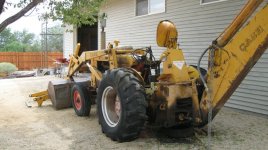
Here are a three to show how it looked as I started:

IMG_1095_rs.jpg
Here shows the stabilizer area after I removed them and before I cleaned it.
IMG_1101_rs.jpg
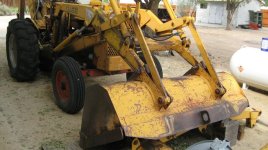
Here is one from the front.

IMG_1103_rs.jpg
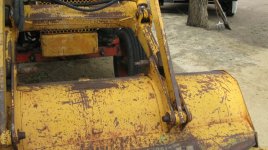
This one shows what the previous owner had put in the bucket links.
 
   / 1963 Case 530CK Backhoe/Loader #6  
I'm sure by now you have a service manual, but in case you don't have them all, here's a pretty handy link that has about everything. Click on items in the menu at left side of page. Case 530CK - Tractor Specs

Found it about 4 years ago, while trying to find info on what I thought was a 530 I bought. Come to find out, it was a 310B.

None the less, maybe someone out there has a 530, and no manuals. If the thread title catches their eye, hopefully this will be of some use to them.
 
   / 1963 Case 530CK Backhoe/Loader
  • Thread Starter
#7  
Thanks for the information that you supplied. Yeah, I have seen this link before, in fact, I discovered this some time ago and saved it to my puter and I continue to reference it for important stuff. And you are correct about the service manual. When I first acquired the 530 I went to the local Case dealer and ordered both the parts and service manual. I also bought the owners manual for the hoe and loader.

I have been busy on my tractor and have not had the time to compose both pictures and explanations to upload to the site, I plan on doing that this weekend. I am not sure where to start with the things I think people on the site will want to see, but I have torn down the frames (hydraulic fluid sections) and structural pieces and all of the pins, cylinders, hoses, clamps, injection pump, fuel tank, lines etc. So if I present stuff that no one is interested in please leave feedback.
 
   / 1963 Case 530CK Backhoe/Loader #8  
I would enjoy watching your project. I actually spent a little time on a 530 years ago.
 
   / 1963 Case 530CK Backhoe/Loader #9  
I'm looking forward to your pictures/info. I really enjoy restoration threads, makes me wish I had time to restore my old tractor.
 
   / 1963 Case 530CK Backhoe/Loader
  • Thread Starter
#10  
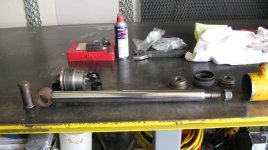
Well this is the first installment with more to come. I decided to start with a cylinder rebuild for the stabilizers since it was one of many parts that I was trying to 電ry up the bleeding of hydraulic fluid. Almost everything on the tractor was leaking and not one of the cylinders would hold its position after shutting down the hoe. Also for those that have not rebuilt a cylinder; this will show you the components and maybe illustrate how simple a cylinder is.

IMG_1006_rs.jpg
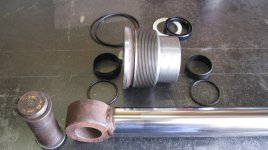
Here is the cylinder completely disassembled. Of course, the rod with the boss on the end where the pin connects to the stabilizer is front and center. On the left is the gland nut with an assortment of seals and wipers.

IMG_1007_rs.jpg
Close up of the gland nut and the seals and wipers

IMG_1009_rs.jpg
This one shows the metal washers that sandwich the packing which is spread out above. That center fibrous looking washer helps the piston (when installed in the cylinder) to ride gently on the cylinder walls and keeps it from binding up.

IMG_1032_rs.jpg
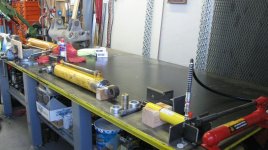
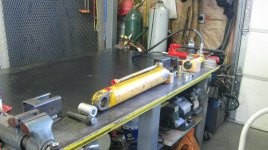
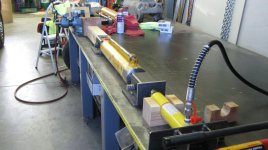
OK, this is the set up that I fabricated to assist in re-installing the piston back into the cylinder. The piston packing can be quite stiff and will resist normal efforts to push it back in, even with lots of lubricant. I used a port-a-power type horizontal jack and pump to facilitate the procedure. You will notice that at each end of the cylinder is an assortment of pins bushings and square tube boxes.

IMG_1033_rs.jpg
A view from the other end.

IMG_1034_rs.jpg
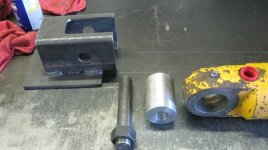
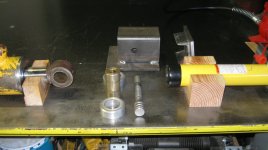
A close up with all the parts needed to hold the port end of the cylinder. You will note that I welded a shoe to the box tube so that the pin bore will always be oriented perpendicular to the axis of the cylinder. When re-installing the cylinder it just makes it so much easier to then install the pins. Once the piston packing is in the cylinder it is pretty hard to rotate it into position.

IMG_1036_rs.jpg
Since there are different sized cylinders on the loader/hoe it follows that there are different sized bosses connected the rods of those cylinders. So, I machined different sized bushing to fit the different sizes. You will note that I stitch welded a shoe or plate onto the sq. tube to keep the orientation with the port end.

IMG_1039_rs.jpg
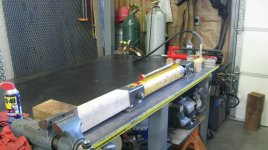
This is a view with the whole set up together to show you how I trapped the cylinder between the jacking device and one of my vises farther down the fab table. If I have a longer cylinder, I just unbolt the vise and move the block to the other vise even further down.

IMG_1040_rs.jpg
It is a simple set up and really saves time!

IMG_1049_rs.jpg
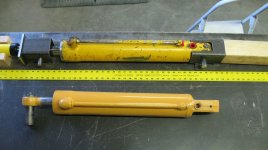
This one show an over view of a cylinder that I just finished and painted and one in the (set up) and a rule to give some perspective to the size. The metal tubes that connect the hydraulic lines were bent up like pretzels, but with a little work with mandrels (matched the I.D. of tubing) and a machinist vise and small hammer I was able to straighten them out again. I have had to chuck up in my lathe most of the gland nuts and re-face the ends then re-bore the シ holes because of the damage caused by others that did not use a spanner to unscrew the gland.
 
   / 1963 Case 530CK Backhoe/Loader #11  
Very good, it is obvious that you know your stuff. Looking forward to following the progress.
 
   / 1963 Case 530CK Backhoe/Loader #12  
Very professional rebuild, you obviously know your stuff.
 
   / 1963 Case 530CK Backhoe/Loader
  • Thread Starter
#13  

Thanks for the vote of confidence all, it is nice when other folks enjoy too!

I think for the next installment I will show you the can of worms I went through when I found out the bearing (cup and cone) on the outboard end of the axle shaft was toast and I had to go into the final drive. I had to fabricate several special tools to repair the axle , and bull gear then press on new bearings, etc.
 
   / 1963 Case 530CK Backhoe/Loader
  • Thread Starter
#14  
Vulcancowboy; were you an operator, or just doing your own stuff?
 
   / 1963 Case 530CK Backhoe/Loader #15  
Very nice! Did you also hone the cylinder or was there no scratching in it?
 
   / 1963 Case 530CK Backhoe/Loader
  • Thread Starter
#16  
Very nice! Did you also hone the cylinder or was there no scratching in it?

Good question ThomasH. You know I only had to hone one. It was the right stabilizer cylinder. I'm speculating, because it did not happen on my watch, but I think a stone or something got caught between the cylinder and the stabilizer leg. With the tremendous leverage that is generated by the cylinder when retracting it put a dent in the cylinder. So I designed and built a device that slides into the cylinder with a pancake jack attached that exerted pressure from the inside but spread out the force in the opposing direction so as not put a crease or dent. When I had finished I honed it and it works perfect with no sticking.
 
   / 1963 Case 530CK Backhoe/Loader #17  
OK, if you can manufacture tools like this, how about posting up all your projects? I for one would like to learn from a master!
 
   / 1963 Case 530CK Backhoe/Loader #18  
Vulcancowboy; were you an operator, or just doing your own stuff?
Actually, just borrowed one. I'm not an operator, although that would be my "dream" job. I did also spend a little time on a 580, 680 and a W24 loader....fun stuff!
 
   / 1963 Case 530CK Backhoe/Loader
  • Thread Starter
#19  
Second Installment:
I had to repair and rebuild the damaged axle bearing and bull gear before I could move the tractor into the shop. When you are working outside, a guy cannot control conditions and that makes the job even harder. Even though I had gravel as a surface to work on, nothing beats a 7 inch slab of concrete!
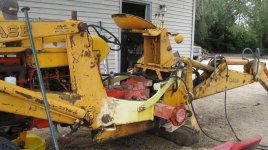
IMG_1166_rs.jpg
Pre-teardown, I got it jacked up and wheel off, now for the real stuff.
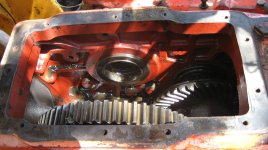
IMG_1187_rs.jpg
Had to open up the final drive to get at the bull gear. You have to remove the cotter pin then spin off the castle nut and press out the axle, you see the seal is pressed into the housing on the outboard end of the axle and will be ruined when you push it out. The cone race was the only thing left, which is pressed onto the axle journal. When both axles are installed in final drive they have only about a half an inch or less between them so a person can get a flat bar between them and start to pry them out. As they move you have to add additional thin blocks and pry some more, I used some aluminum flat stock for my blocks.
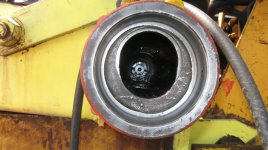
IMG_1185_rs.jpg
Here you can see the damage caused by the bearing coming apart. The axle was no longer being contained by the bearing, gravity took over dropped the tractor on the axle, which tried to eat all the way into and the top of the housing, however, it had not ground on the all important bearing and seal surface cavity, it looked like it had just started to touch that line. If you look into the axle housing you will see the other axle nut.
By the way; that black hose is my air line draped over the axle housing........
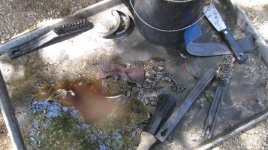
IMG_1184_rs.jpg
In my clean out pan that I put under the housing you can see what was left of the bearing cage and rollers.........not much.
I had to cut the race to get it out of the axle housing.
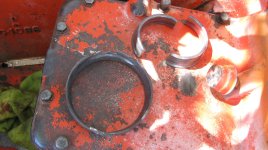
IMG_1188_rs.jpg
As you can see, this is what is left of both inner and outer races after removal. The larger race has been really cut up by the force of the broken parts. Anybody that has worked on bearings knows how hardened they are compared with mild A36 steel.
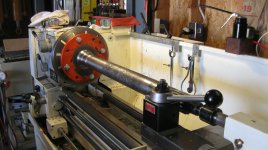
IMG_1190_rs.jpg
Got the axle on the lathe and all dialed in concentric too. Sounds easy, huh? Try getting something this large, secured and centered to the spindle axis.............. it barely fit between the headstock and the tailstock.
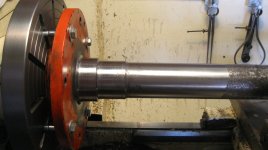
IMG_1192_rs.jpg
I took off less than a .001 total off of the seal journal but just used emery cloth on the bearing journal and axle. I did not want to reduce bearing surface then I would not have had a press fit if I had changed the diameter.
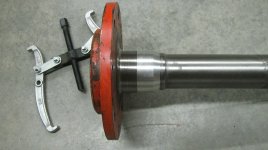
IMG_1201_rs.jpg
Because the seal goes on the axle before pressing on the bearing cone, I had to machine a taper cuff so as not to damage the seal on that sharp lip. I slid back the cuff to show you how it will work.
IMG_1202_rs.jpg
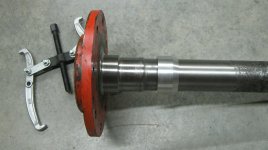
The cuff is now slipped over the bearing journal for final placement of the seal.
IMG_1203_rs.jpg
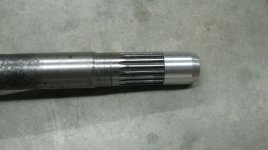
I then had to machine and thread a protective end cap for the end of the axle. When you re-install the axle you have to have this device on or you would ruin the seal that is pressed in the inner housing (there are a total of 2 seals 1 on each end of the axle housing). You will also notice a slight taper about an inch from the spines as the axle goes to a larger diameter. That is inner seal journal. I just cleaned that surface with emery cloth.
IMG_1216_rs.jpg
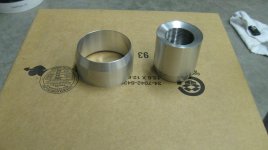
Here are a couple of the tools I had to make to get the axle back in the tractor.
IMG_1225_rs.jpg
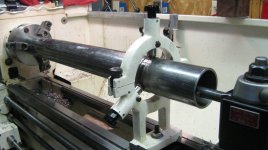
In order to press the bearing cone on the axle I used some DOM (drawn over mandrel) tubing. This is just a long drift tube and slips over the axle to ride on the cone. The interior diameter was just a little under sized to slip over the bearing journal, so once again I had to make anther tool!
IMG_1211_rs.jpg
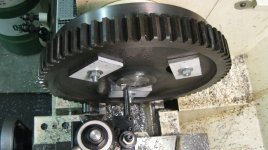
The bull gear was almost too large to mount on my lathe. I turned an inner cone (aluminum) that just tightly fit the lathe plate then turned the opposite end to the matching diameter of the splines of the bull gear. This made it way easier to mate the bull gear to my plate for concentricity.
The reason I went to all that trouble was that the face of the bull gear was ground out badly from the bearing breaking on the other end, when that happened, it allowed the axle shaft to rotate in a conical motion that then chewed up this face. When I removed about .050 to clean up the face, I then had to make a matching shim. You know, I was truly surprised that there was no gear damage from the play at the other end of the axle. I guess there is just enough gear lash that it did not bind up and break corners off the gear, anyway these old hoes are tough!
IMG_1235_rs.jpg
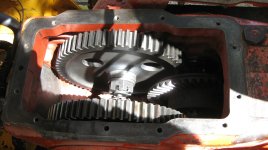
All cleaned up inside gear and axle back in and ready to button up.
IMG_1237_rs.jpg
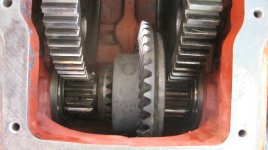
I included this one to illustrate how the ring gear and small spur gears on the stub axles mate up to the bull gears. For those of you that haven not gone into the tractor this far, those stub axles extend through the final drive for the disk and band brakes to attach to. When you do a brake job this is what is on the other end, the spider gears are what allows the other shaft to continue to move while the brake is applied on one side or the other. That makes for a nice turn in tight places.
IMG_1246_rs.jpg
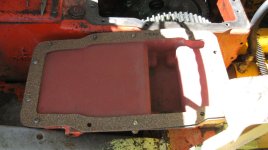
Cap to the final drive, made a new gasket, then re-installed. Time to fill up the housing with gear lube and get the hoe moving toward the shop.
 

Tractor & Equipment Auctions

2002 TOYOTA 7FDKU40 FORKLIFT (A57880)
2002 TOYOTA...
2016 FREIGHTLINER CASCADIA TANDEM AXLE SLEEPER (A59905)
2016 FREIGHTLINER...
2024 CATERPILLAR 305 CR EXCAVATOR (A52709)
2024 CATERPILLAR...
2011 Ford F-550 Bucket Truck - Power Stroke Diesel, Altec AT40G Boom, 45 ft Working Height (A56438)
2011 Ford F-550...
2016 VERMEER PD10 PILE DRIVER (A60429)
2016 VERMEER PD10...
2017 FORD F-350 XL 35' NON-INSULATED BUCKET TRK (A59823)
2017 FORD F-350 XL...
 
Top