A(nother) Home in the (different) Woods

   / A(nother) Home in the (different) Woods
  • Thread Starter
#181  
Aaron - To get enough foam on the underside of the roof deck to hit R50 would have been cost prohibitive. In this way, the foam seals everything up, adds some R value to start and then cellulose fills it in to get the needed R Value, cheaply. There is nothing up there except some wires and plumbing vents, with the one exception of the bathroom fan in the master bath. Without ductwork or HVAC equpipment in the attic space, there is no burning need to insulate at the roof deck.

Eddie - I assume you are talking about the great room ceiling. We just used I-joists for the rafters. They sit on a ridge beam (aka The Big Beam) and the outside wall top plates. We spec'd 14" I joists to span the distance and get the needed insulation depth and the lumberyard detailed out the required blocking and other details. Using them in a shed application, I would guess you would use hangers on the vertical wall, and then sit them on the wall plate on the other end. Given how much more efficient they are than solid lumber, you could probably get away with less depth too, if you wanted (like 9 1/4", perhaps). Your lumber yard should be able to help you out, I'm sure. They work with the manufacturers specs and software to meet code and span requirements. I have a copy of the software and could run you a quick set of numbers to give you a ballpark. PM me with some details (code version, span, dead load, LL) and I will see what I can do for you. Costs are all local, so you really need to call for that yourself. I don't know the cost of that item off hand, and it would take a lot of digging. Another side benefit of these is the thin web means there is minimal thermal bridging for improved efficiency, which you may or may not care about. The crew framed that roof in a day or day and a half, IIRC.
 
   / A(nother) Home in the (different) Woods #182  
Aaron - To get enough foam on the underside of the roof deck to hit R50 would have been cost prohibitive. In this way, the foam seals everything up, adds some R value to start and then cellulose fills it in to get the needed R Value, cheaply. There is nothing up there except some wires and plumbing vents, with the one exception of the bathroom fan in the master bath. Without ductwork or HVAC equpipment in the attic space, there is no burning need to insulate at the roof deck.
Good point. We have rough cut 2x4s in the attic for the floor joists and for the rafters so there wouldnt be much of a depth difference. Currently, the attic has about 3" of well compacted blown in insulation on the floor but it doesnt do much to insulate.

Aaron Z
 
   / A(nother) Home in the (different) Woods #183  
Thanks Dave,

I'll talk to my guy at McCoys when I get closer to starting. I like the idea of being able to go deeper just so I can get more insulation up there. I was also planning on having closed cell foam like you did for a couple of inches and then filling the rest with fiberglass. I like the fact that the foam also acts as an air barrier. My roof will be metal R panels and there won't be any air flow, just solid insulation.

Eddie
 
   / A(nother) Home in the (different) Woods
  • Thread Starter
#184  
Aaron - no reason you can't fill loose cellulose or fiberglass over the rafters. in fact that is even better as you eliminate the thermal bridge form the framing. Sure you might need to add a barrier at the end to keep it from spilling out or drywall a wall or something to do it, but adding ceiling insulation is just about the one and only single improvement that actually pays back in a cold climate. If you have to walk up there for utility access, spend some time and build a catwalk above the future insulation level before you fill it. Then fill it up to r-1 jillion. Blown-in is cheap.

Eddie - Sounds like a plan. Make sure you follow the recommendations for your climate zone, or you can rot our your roof framing from condensation. Here is a good link/explanation. You have it easier where you are, fer sure... I had them put 4" of closed cell, and I actually checked it to make sure. The installer was pretty solid at getting to 4" min. And it had BETTER be closed cell or you are going to have big trouble with condensation. That is critical.
http://www.buildingscience.com/docu...sulation-under-plywood-and-osb-roof-sheathing
 
Last edited:
   / A(nother) Home in the (different) Woods
  • Thread Starter
#185  
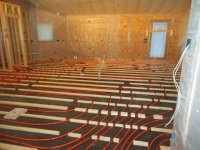
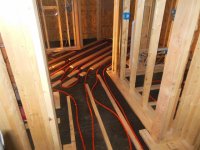
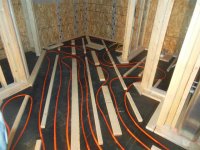
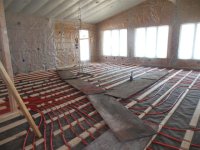
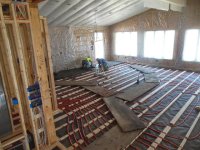
Wrapping up radiant


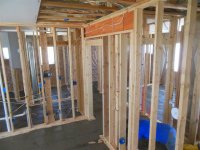
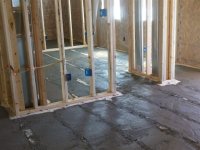
Here are some final shot of the radiant tubing on the main level. Here is the shot with all the sleepers completed. This was a a lot of messing around to get here. The wood sleepers are for screwing down the subfloor, and also to keep the concrete nice and level.

Great room:

Main_floor_tubing%u00252520%u002525281%u00252529%u00252520%u00252528Large%u00252529.JPG

Master bathroom was a bit of a contortionist pattern:

Main_floor_tubing%u00252520%u002525282%u00252529%u00252520%u00252528Large%u00252529.JPG

Main_floor_tubing%u00252520%u002525283%u00252529%u00252520%u00252528Large%u00252529.JPG

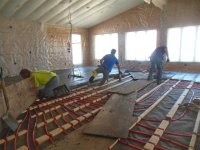
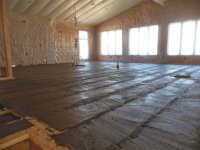
Then I got a crew of guys to do the pour as a side job. Went very well. A nice bunch of guys with a great sense of humor.


Great room progression:


Main_floor_concrete_pour%u00252520%u002525281%u00252529%u00252520%u00252528Large%u00252529.JPG

Main_floor_concrete_pour%u00252520%u002525282%u00252529%u00252520%u00252528Large%u00252529.JPG

Main_floor_concrete_pour%u00252520%u002525283%u00252529%u00252520%u00252528Large%u00252529.JPG

Main_floor_concrete_pour%u00252520%u002525284%u00252529%u00252520%u00252528Large%u00252529.JPG

Master suite and office:

Main_floor_concrete_pour%u00252520%u002525286%u00252529%u00252520%u00252528Large%u00252529.JPG

Main_floor_concrete_pour%u00252520%u0025252811%u00252529%u00252520%u00252528Large%u00252529.JPG

After they left and the concrete set up a bit I took a flooring scraper and scraped off the tops of all the sleepers so they were nice and flat and clear for screwing down subfloor. That was very tiring, but had to be done quickly before the concrete set up too much. No pics of that, just making a mess..

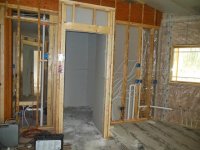
At this point all the rough mechanicals are done and it is basically time for drywall.

One thing you will notice is that I have a lot of pics of this, and not a lot of many other things. It is amazing how much time you have to take pictures when you are not doing the work yourself... Most of the time, by the time I am done it is dark, I am beat, and I could care less about pics...at least at that moment. I know I will want them later, but c'est la vie...
 
   / A(nother) Home in the (different) Woods
  • Thread Starter
#186  
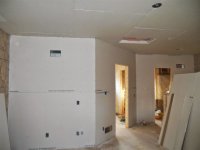
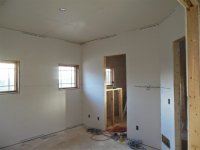
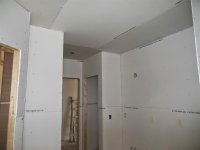
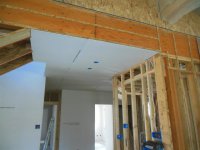
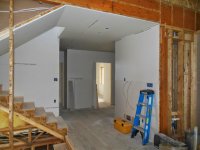
Drywall took all of 5-6 weeks or so, in the end.

As of this writing (5/31/14) all the rock has been hung and the taper is well into taping and mudding. He has about a week left, he thinks. He has been at it for 4 weeks already. We had done some of the ceiling drywall ourselves, as previously noted. Mostly where the insulators needed to foam and blow in ceilings. Other than that, I let Den (the drywall guy) do the rest of it. I am OK with hanging drywall, but I sure wouldn't do the mudding/taping. I hung all the rock in the shop, so this wouldn't scare me off that much except I just don't have the time with all the other things that needed addressing. Plus Den works at a very reasonable rate, so that helps make the call to sub it out easier.

So some sequential progress pics. I haven't taken a lot of the mudding process as it just doesn't look like all that much in photos. I'll get a couple final shots of that.

Day 1, he started with upstairs walls. Ceilings were already done by us, as noted.

Library:

Day%u002525201%u00252520%u002525281%u00252529%u00252520%u00252528Large%u00252529.JPG


Upper level BR:

Day%u002525201%u00252520%u002525282%u00252529%u00252520%u00252528Large%u00252529.JPG

Day 2 he wrapped up most of the upstairs, except the stairwell:

Day%u002525202%u00252520%u002525284%u00252529%u00252520%u00252528Large%u00252529.JPG

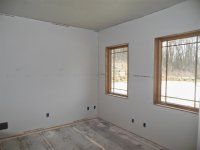
Plus he completed the office on the main floor:

Day%u002525203%u00252520%u002525281%u00252529%u00252520%u00252528Large%u00252529.JPG

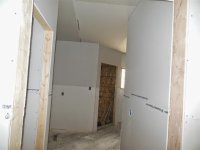
Day 3 he worked on the main level mostly. Hallway in the master suite:

Day%u002525203%u00252520%u002525282%u00252529%u00252520%u00252528Large%u00252529.JPG

Master BR:

Day%u002525203%u00252520%u002525283%u00252529%u00252520%u00252528Large%u00252529.JPG

Day 4 continued in the master suite. Laundry room into closet:

Day%u002525204%u00252520%u002525281%u00252529%u00252520%u00252528Large%u00252529.JPG

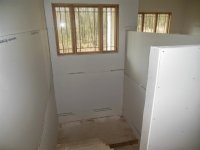
And he did the Upper stairwell. Not sure how he handled those sheets as that is a tough place to work:

Day%u002525204%u00252520%u002525282%u00252529%u00252520%u00252528Large%u00252529.JPG

Day 5 he is wrapping up the master suite. Master bath here. The little room at the back of the photo is the shower which will get tiled, so no drywall in there:

Day%u002525205%u00252520%u002525281%u00252529%u00252520%u00252528Large%u00252529.JPG

Master bath looking out:

Day%u002525205%u00252520%u002525282%u00252529%u00252520%u00252528Large%u00252529.JPG

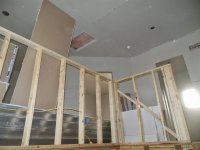
And he started on the Foyer ceiling in the main level:

Day%u002525205%u00252520%u002525283%u00252529%u00252520%u00252528Large%u00252529.JPG

Day 6 - wrapped up the foyer and a lot of the stairwell:

Day%u002525206%u00252520%u002525281%u00252529%u00252520%u00252528Large%u00252529.JPG

And the inside walls of the pantry:

Day%u002525206%u00252520%u002525282%u00252529%u00252520%u00252528Large%u00252529.JPG

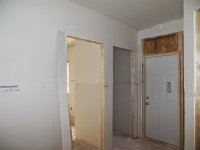
More foyer (Still with the temporary front door):

Day%u002525206%u00252520%u002525283%u00252529%u00252520%u00252528Large%u00252529.JPG

And he started a bit on lower level ceilings:

Day%u002525206%u00252520%u002525284%u00252529%u00252520%u00252528Large%u00252529.JPG

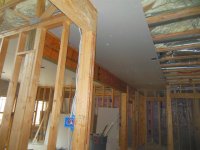
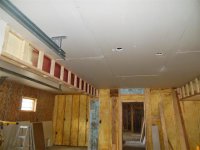
Day 7 - Garage ceilings were basically wrapped up in one day, except for the soffits enclosing the steel beams:

Day%u002525207%u00252520%u002525281%u00252529%u00252520%u00252528Large%u00252529.JPG

Day%u002525207%u00252520%u002525282%u00252529%u00252520%u00252528Large%u00252529.JPG

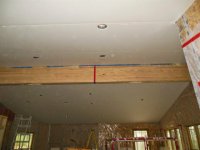
Day 8, he moved back to the main level and did basically all of the great room ceiling:

Day%u002525208%u00252520%u002525281%u00252529%u00252520%u00252528Large%u00252529.JPG

Day%u002525208%u00252520%u002525282%u00252529%u00252520%u00252528Large%u00252529.JPG

I took a few more photos, but nothing real dramatic (drywall does not lend itself to drama...), but he finished off the rest over the next few days, and then started taping a little bit the Friday before Memorial Day (5/23/14). He has been taping all week after Mem day, and will continue for all or most of next week. I'll post another entry with the final pics of that.

After he wraps up taping, we still need to finish off the subfloor. On top of the concrete on the main level, we need to put down another layer of subfloor so there is something to nail the wood floor to (or carpet, or tile...depending on the room). That will take a few days. Then it is time to plastic off all the windows and then blast a coat of primer and some white paint on the ceilings with the sprayer. We might do some finish painting then too, but that will depend on a lot of things (choosing colors, timing, etc).

Once again, note how many more pictures I can take when I'm not doing the work.. Also keep in mind that this was one guy doing it. He had his son helping a few days as he was recently laid off from his job, but basically he did it solo. Kind of amazing for this work.
 
   / A(nother) Home in the (different) Woods #187  
Aaron - no reason you can't fill loose cellulose or fiberglass over the rafters. in fact that is even better as you eliminate the thermal bridge form the framing. Sure you might need to add a barrier at the end or drywall a wall or something to do it, but adding ceiling insulation is just about the one and only single improvement that actually pays back in a cold climate. If you have to walk up there for utility access, spend some time and build a catwalk above the future insulation level before you fill it.
We use it for storage, so we need to keep that space available. There isnt enough space to add any more than the current 4" of height from the top of the ceiling insulation to the attic floor. My current thought is to remove the ancient insulation, wire in lights up there, then spray foam the "floor" of the attic and put the current boards back up there.

Aaron Z
 
   / A(nother) Home in the (different) Woods
  • Thread Starter
#188  
Mother nature hates me


The weather up here had been overall pretty mild the 2-3 years before we started building. The moment I committed to starting this, all **** broke loose. Last year, we had about the wettest spring on record. I was fighting driveway and dirt washout problems constantly as the storms we were getting were dumping tons of rain in short periods, and they kept coming one after another. It finally stopped in July and July/Aug were bone dry (and brutally hot and humid, but at least our foundation excavation did not get washed out...). This slowed everything down and really killed progress. And then came Fall.... Well, we didn't have a fall - it went straight into winter. And then not just any winter, but the worst winter in some 130+ yrs (also as previously noted). And then the spring of 2014...Because 2013 wasn't wet enough - it happened AGAIN. Storm after storm, and this year it was worse. Now with all the extra site work that had been done, I was now having severe washout problems. I was seriously worried that the neighbors were going to take up pitchforks and torches as there was so much silt washing off the property with these almost unprecedented rains. We are starting at about mid May 2014 for this.

I knew I had to get the landscape under control fast.

I had been poking at the excavator for a while but he had kept putting me off. After the last big storm I called him and said "it is now critical - you have to get out there". He has too much going on, but finally he broke out some time and did it. It wasn't perfect, but over the space of 2 weeks he got the landscape about 90% settled. I was also able to use the tractor for a bunch of prep work when he wasn't there to help keep things moving along. I took a few days off work to get this all moving. What I found, not surprisingly, is that if I was not there, not much got done. That was the other main reason I took the time off. The excavator subbed out some of the wall work. He does not like to build walls, and even though I could do it, it was one more thing I really didn't have time for -- especially since I was trying to get this all under control quickly to avoid angering the neighbors and the town with the washout problems. So here are some photos of that process. This gets us pretty much up to date with current progress.

First off, the main drainage culvert. Discussion with the excavator and looking at how water flowed showed a really good place below the turnaround that could be used as a catch basin/collector to get water collected and shot out down a culvert into the woods down below so it wouldn't wash everything out like it had been. So he created a ditch leading down to a catch basin, and dug a trench under the driveway down into the woods to run a big 8" culvert to catch the heaviest rains and shunt them down hill without blowing everything out.

Right in the middle of this photo, you can barely see the round outline of the catch basin, to the right of the road.

Final%u00252520grade%u00252520and%u00252520culvert%u00252520%u002525282%u00252529%u00252520%u002.JPG

Here is the culvert path going down into the woods. If you look closely, you can see the black pipe headed straight down hill, right dead center in the photo, where the dirt ends. The main goal here is to get the water downhill without taking all the dirt down with it. This should do it!

Final%u00252520grade%u00252520and%u00252520culvert%u00252520%u002525281%u00252529%u00252520%u002.JPG

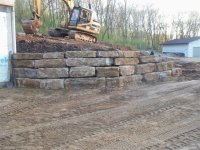
Next up, the walls. We did 3 more walls. 2 of them were pretty small, and one more was a bit larger.

The garage wall. This was mostly to clean things up at the house garage where the turnaround drops off. Not real large, but helped the landscape flow a lot better.
Garage%u00252520retaining%u00252520wall%u00252520%u002525283%u00252529%u00252520%u00252528Large%.JPG

Another little one as an alcove for the service door on the shop. Just trying to keep the hill up on the hill here... [Added note - this was later changed as I needed more wall to keep the water moving away from the driveway. Pics of that later]

Shop%u00252520retaining%u00252520wall%u00252520%u002525282%u00252529%u00252520%u00252528Large%u0.JPG

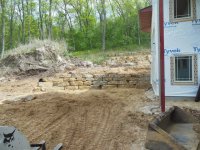
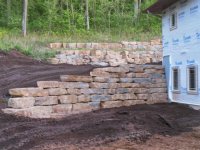
The bigger one - the garden wall. This thing was not supposed to be this big, but the dirt dictated it be pretty substantial. It is 8-9' high at the house, and tapers down from there. We had to do what made the most sense, so the guys kept building it and backfilling to see how it all laid out. They stopped when it made sense. This is the wall in the foreground. The wall in the background was the massive one I did back before we started building.
Garden%u00252520wall%u00252520day%u002525201%u00252520%u00252528Large%u00252529.JPG

Garden%u00252520wall%u00252520day%u002525202%u00252520%u002525282%u00252529%u00252520%u00252528L.JPG

So while all this was going on, I started seeding to get the ground stabilized. This involved a few things: Grass seed, oats (they germinate and sprout a lot faster I am told, and as an annual won't keep coming back much), straw bales, and straw blankets. The blankets are important for erosion control. They are rolls of straw and a plastic netting that you roll out and staple down to help hold everything in place. Plus the straw helps keep the soil moist longer, to help the grass and oats grow.

Here is the first day's work (this is just me doing all this, solo):

East side of driveway, and septic drain field mound:

Seeding%u00252520and%u00252520erosion%u00252520control%u00252520day%u002525201%u00252520%u002525.JPG

Seeding%u00252520and%u00252520erosion%u00252520control%u00252520day%u002525201%u00252520%u002525.JPG

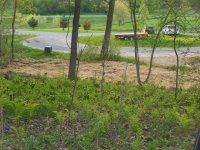
West side of driveway. My goal was to get everything that could be seen from the street settled first so there would be no question I was trying to get it under control. You can see my trailer in the cul de sac with a bunch of straw bales still on it.
Seeding%u00252520and%u00252520erosion%u00252520control%u00252520day%u002525201%u00252520%u002525.JPG

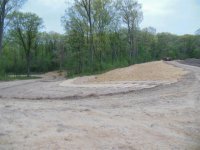
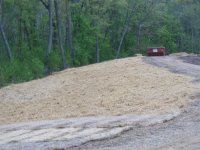
Day 2, the excavator was working on the turnaround up by the front door. He leveled out the pad and placed the crushed limestone for the driving surfaces, and then started placing black dirt on the hillsides. Here he is mostly done with that, and just needed to finish spreading and leveling the black dirt out.

Seeding%u00252520and%u00252520erosion%u00252520control%u00252520day%u002525202%u00252520%u002525.JPG

While he was doing that I worked on more of the driveway down slope areas for seeding. I finished off a large chunk of this that day. Lots of erosion control blankets on the left side, where the water tends to run faster and washout dirt and driveway.
Seeding%u00252520and%u00252520erosion%u00252520control%u00252520day%u002525202%u00252520%u002525.JPG

Seeding%u00252520and%u00252520erosion%u00252520control%u00252520day%u002525202%u00252520%u002525.JPG

Seeding%u00252520and%u00252520erosion%u00252520control%u00252520day%u002525202%u00252520%u002525.JPG

Then I ran out of oats and it was memorial day. I knew the feed store was not open, but the local Fleet Farm store was and they had oats. Since I knew rain was coming, I wanted to get another critical section done. So I grabbed a couple bags and hit it. I got that turnaround slope all settled in, which is another big washout area, so this helps a lot.
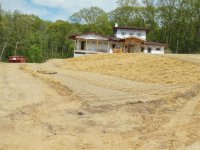
Turnaround%u00252520slope%u00252520seeding%u00252520%u002525281%u00252529%u00252520%u00252528Lar.JPG

Here is a look at the turnaround, not quite complete. The bucket is sitting in the middle of the turnaround, where there will be some sort of garden and trees later. The excavator placed some black dirt there the next day.
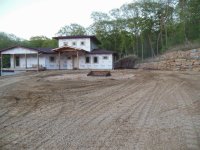

Final%u00252520grade%u00252520turnaround%u00252520day%u002525202%u00252520%u002525281%u00252529%.JPG

And that's about it for now. I have been spending most of my time in the shop trying to get it more ready for work on finishing cabinets and doing doors. Still a lot to go there, but I am making progress...


Update from last night (5/31/14): We had yet another massive washout rain. Something like 3-4" in the early morning hours. And once again the driveway blew out. The only good part is that most of the landscape work I did held up. A couple small washouts, but nothing killer. Next task is to figure out a way to move the water off the driveway before it causes problems. But then they said more thunderstorms tonight. Oh goody...
 
   / A(nother) Home in the (different) Woods
  • Thread Starter
#189  
Aaron, I can understand your point. If you are thinking of replacing all that insulation, you have options. Foam board is easily as good as spray foam, if you use canned foam at the joints. And sheets are a lot cheaper. If you are willing and have the time, you can probably save a lot of money by cutting and fitting foam sheets between the rafters. Then seal all edges with canned foam. Otherwise, let them spray it in full depth and skive it off. They will try to cheap out and spray it enough to almost fill but not quite so they don't have to skive it. With only 2x4 depth, you need all you can get.

Heck, if you want to do sheets, you could fill it up to rafter depth, and then lay a 2" layer on top of that which also gives you a great thermal bridging break. Glue the floor boards to it with foam safe glue. You won't lose much headroom that way, and 6" of foam is R30 at least.

It will be critical to seal all penetrations and joints. If anything pokes through the foam, you either need to foam it in with canned foam or build a box around it with sheet foam (also sealed).

You can suck the insulation out with a wood working dust collector that you can tweak to drop into a dumpster, for example.

Just some thoughts...
 
   / A(nother) Home in the (different) Woods #190  
Aaron, I can understand your point. If you are thinking of replacing all that insulation, you have options. Foam board is easily as good as spray foam, if you use canned foam at the joints. And sheets are a lot cheaper. If you are willing and have the time, you can probably save a lot of money by cutting and fitting foam sheets between the rafters. Then seal all edges with canned foam. Otherwise, let them spray it in full depth and skive it off. They will try to cheap out and spray it enough to almost fill but not quite so they don't have to skive it. With only 2x4 depth, you need all you can get.
Heck, if you want to do sheets, you could fill it up to rafter depth, and then lay a 2" layer on top of that which also gives you a great thermal bridging break. Glue the floor boards to it with foam safe glue. You won't lose much headroom that way, and 6" of foam is R30 at least.
It will be critical to seal all penetrations and joints. If anything pokes through the foam, you either need to foam it in with canned foam or build a box around it with sheet foam (also sealed).
I hadn't thought of sheet foam, will have to keep an eye on Craigslist as there is a guy who has it for cheap from time to time... That and one of those 2 tank sprayfoam systems from ebay would probbaly do it...

You can suck the insulation out with a wood working dust collector that you can tweak to drop into a dumpster, for example.
I know someone who has one of those and if I pulled the gable end window, I could push a hose out there to end on the ground...

Aaron Z
 
   / A(nother) Home in the (different) Woods #191  
Interesting. Any reason you sprayed the "attic floor" rather than the underside of the roof? We are looking at foaming the attic in the future but I had only looked at foaming the underside of the roof deck (vs foaming the "floor" of the attic).

Thanks

Aaron Z

DONT foam roofs that has asphalt shingles on it. It will shorten the life considerably. Around here, its best to put up drywall in the ceiling and spray foam on top then blow in loose cellulose for best protection. I would only foam undersides of roofs if you need the attic space to be livable and you have HVAC mechanicals up there.
 
   / A(nother) Home in the (different) Woods #192  
DONT foam roofs that has asphalt shingles on it. It will shorten the life considerably. Around here, its best to put up drywall in the ceiling and spray foam on top then blow in loose cellulose for best protection. I would only foam undersides of roofs if you need the attic space to be livable and you have HVAC mechanicals up there.

What about a metal roof? Is there any problem spraying directly to the underside of a metal roof?

Eddie
 
   / A(nother) Home in the (different) Woods #193  
What about a metal roof? Is there any problem spraying directly to the underside of a metal roof?

Eddie

Its kinda a tricky question eddie. Are you thinking open cell or close cell foam? Is this for a attic space in house or in a open barn? Are you in the northern climate or south? The northern climate is more susceptible to condensation then the south. Do you need roof support? closed cell is stronger then open cell.
SO -- what now? you know that open cell can soak moisture if exposed to the humid air. closed cell doesnt. However closed cell is expensive so now what? IF you want to install open cell in attic space of house, and it has a metal roof on top of osb sheathing - the only time its possible is to make the attic space air tight, no air gaps etc. you would want to test this with a air blower. This is the only way i know of to make sure the wood doesnt rot with open cell. I dont think its a good idea in a open barn. If you guys already have open cell sprayed on, fear not - just enclose the ceiling in the north climates.
 
   / A(nother) Home in the (different) Woods #194  
Back on post 178, you show that in the great room, they are spraying some closed cell on the underside of the roof deck, and and then filling the rest of the bay with blown in. Doesn't this put the vapor barrier on the wrong side?
 
   / A(nother) Home in the (different) Woods
  • Thread Starter
#195  
The foam setup we did is acceptable practice. It is foaming the underside of the roof deck (yes with asphalt shingles) with closed cell foam. It requires a minimum R value of a vapor impermeable insulation to do this. In my area that is R25. 4" of 2 lb closed cell foam meets that requirement. That then becomes the vapor barrier. The cellulose then just adds R value, and no vapor barrier is installed below the cellulose (or you would make a vapor trap - very bad). The goal is to keep the condensing surface above the dewpoint. You do that by blocking vapor to keep the humidity down, and insulating it to keep the temp on the moist side up. That is what the closed cell foam does, but it needs to be thick enough, and fully sealed up/continuous. In this case the first condensing surface is the underside of the foam, and because of the vapor-impermeable insulation above it, it will always remain above the dewpoint.

Spraying foam under shingles sometimes gets a bad rap as Radioman suggested. There is a feeling that all roof decks need to be vented by a number of people in the building industry, but there is really no negative effect on the shingles from doing this method. This is not to be confused with an unvented roof deck over an ATTIC SPACE. That will kill shingles in a short time as the temps will skyrocket in the enclosed space. The big difference with spraying directly on the deck, is there is no air space to act like a greenhouse. A number of studies have measured shingle temps with vented and unvented spaces like mine. The differences amount only a degree or 2 higher on the unvented one (again - no attic space below), and this is well within the temp ratings of the shingles. Now most manufactures will not warranty shingles installed this way (several used to), but then getting a building materials warranty to be honored is almost impossible in any case. They will always blame "poor installation technique" to try and weasel out of it.

As you can see, I did a ton of research on this before moving forward, and I have zero concern with this method. Open cell is a very bad idea in this application. Closed cell is the correct choice. Check out the link I posted to Eddie a page or two back.
 
   / A(nother) Home in the (different) Woods #196  
Fair enough. I have almost no experience, and this is the first I've heard of that method of insulation. I know you need at least 2 inches of closed cell to make a vapor barrier. And in the traditional attic space, I've seen lots of people do the 2" to seal everything up, then blown in whatever of top to get up to the desired R value. So I would believe that when reversing the order, you would need more, hence the 4" requirements. I've also heard that sometimes, with older homes, they will wrap them with foam board (taped seams) from the outside when residing the house. But this also has the potential to trap moisture in the walls, so I know there is a minimum thickness also, 3" I thought....so I guess it all makes sense...

The foam setup we did is acceptable practice. It is foaming the underside of the roof deck (yes with asphalt shingles) with closed cell foam. It requires a minimum R value of a vapor impermeable insulation to do this. In my area that is R25. 4" of 2 lb closed cell foam meets that requirement. That then becomes the vapor barrier. The cellulose then just adds R value, and no vapor barrier is installed below the cellulose (or you would make a vapor trap - very bad). The goal is to keep the condensing surface above the dewpoint. You do that by blocking vapor to keep the humidity down, and insulating it to keep the temp on the moist side up. That is what the closed cell foam does, but it needs to be thick enough, and fully sealed up/continuous. In this case the first condensing surface is the underside of the foam, and because of the vapor-impermeable insulation above it, it will always remain above the dewpoint.
 
   / A(nother) Home in the (different) Woods
  • Thread Starter
#197  
The amount of foam insulation you need to do this varies with climate zone. The colder the zone, the more you need to keep the deck and insulation surface above the dewpoint. In your zone, it might be 2" - I didn't look it up but southern new england tends to be a lot milder than here. The issue is similar when doing exterior foam as you note. For example, i could have done 4" of sheet foam on top of the roof deck, which would have been the same. I decided not to do it that way as this was a lot easier from a construction standpoint, but that was the initial plan.
 
   / A(nother) Home in the (different) Woods #198  
I agree, if you have the ability to do it from the inside, that's the way to go. Putting foam board on top of the roof deck is good for adding insulation to existing homes. I may be headed that way myself. My house was built in ~1985, and the family room has a vaulted ceiling, and less than desired insulation. I installed a wood insert in the family room fireplace that hadn't ever been used, keeping the room much warmer than in the first 25 years of the home's life, ice damns became a problem. In order to get insulation in there, I am either ripping down the ceiling, or tearing up the roof...
 
   / A(nother) Home in the (different) Woods
  • Thread Starter
#199  
There are advantages to doing it on the exterior. The biggest one is zero thermal bridges. Solid insulation all the way. Hard to beat that in many ways...
 
   / A(nother) Home in the (different) Woods
  • Thread Starter
#200  
Subfloor over radiant on main level

Got a pallet and a half of subfloor sheets delivered to put on over the main level floor over the concrete. It took 2-3 weeks to wrap that up, but it went down pretty good. Had some help on a couple weekends, and did some myself during the week on evenings. It was interesting as the sleepers we put in were so diced up by having to fit around the tubes, that it took time to mark each sheet as to where you could drive a screw before you placed it and secured it. All in all it worked out decently, but like everything, it just took time to get done. Fitting all the angles in the master bath was probably the most time-consuming single part of this. The subfloor is glued and screwed down, and then end result is pretty impressive. With the combination of the initial subfloor, 1.5" of concrete and the second subfloor over it, the main level floor is absolutely rock solid. It doesn't bounce at all or make a bit of noise when you walk on it. The reason for the second subfloor is to have something to attach the finish floor to. Most of the main level is going to be wood floor, and this will work well for that, plus as a base to build up with backer board for tile.

I thought I had more pictures of this in process ( I swear I do..) but I cannot find many them so we will have to go with this for now. You can see the subfloor in place in some of the upcoming interior shots, too. We started in the great room, and here it is over half done. This zipped along pretty decently, until we hit the master bathroom which had a lot of 45 degree angles in it. That took a lot of time, as noted.

Subfloor%u00252520over%u00252520concrete%u00252520%u00252528Medium%u00252529.jpg
 

Marketplace Items

2016 Kubota SVL75-2 (A53317)
2016 Kubota...
2019 Toyota Corolla Sedan (A55853)
2019 Toyota...
1992 Norris Long Basket Trailer (A60460)
1992 Norris Long...
12 X 20 CAR PORT (A58214)
12 X 20 CAR PORT...
SWICT 84" SKID STEER BUCKET (A60430)
SWICT 84" SKID...
2014 FORREST RIVER SALEM TRAVEL TRAILER (A58214)
2014 FORREST RIVER...
 
Top