Ag vs R4 on steep hills with a B7800

   / Ag vs R4 on steep hills with a B7800 #1  

norcal

New member
Joined
Jun 5, 2003
Messages
22
After researching tractors I am leaning towards the B7800 w/FEL. My property has some steep slopes - 25-35 degree pitch - which need fences, clearing of trees, brush... and eventually mowing for pastures. I have spoke with several dealers about which tires are best for hills and received different opinions. Any recommendations, suggestions, practical experiences are appreciated.

BTW - one major reason I am interested in the B7800 is because I have been told that the hydro trans would be safer and easier when needing to shift/go forward and reverse on steep slopes?
 
   / Ag vs R4 on steep hills with a B7800 #2  
Now the steep slope issue is something I have experience with. I have a 3010GST and have been mowing some very steep slopes for 2 years. I do believe if I had it to do over or if I am ever in a position to purchase again I would have to get an HST tractor. I have learned to use the GST safely. As for the ag tire question I have been stuggling with it myself. I have no problem pulling steep hills with my R4's when it is dry. When it is a little wet I have to be careful. When it is really wet I don't even try. I always use FWD. Once I had taken my tractor down the road aways so I took it out of FWD. The next morning I got it out to brush cut some and as I started down one of those steep hills it just took off /forums/images/graemlins/shocked.gif. I held her straight until I reached the bottom of the hill (slid around a 100ft) , change my undies /forums/images/graemlins/blush.gif, and put it back in FWD. Didn't happen again. I don't think it would have slid out with ags but I'm not sure. So I stay in FWD, live with the R4's because I still use my tractor in the yard alot, and stay off the hills when it is wet. Hope this helps a little.
 
   / Ag vs R4 on steep hills with a B7800 #3  
If the hills you need to work on are that steep, there is no question about it. You need R-1 Ag tires. The reason is that the lugs have different spacing and this spacing allows all edges to get a bite. The similar overlap treads in the middle on the R-4's tends to keep the tread level (float) and not allow the different lugs to bite the ground.
 
   / Ag vs R4 on steep hills with a B7800 #4  
Norcal,

Have you actually measured your slopes with a contractor's protractor level or are you just estimating? There is no compact utility tractor that can handle anything more than 20 degrees at the very most. There are specialty tractors with extra low center of gravity and extra wide stance that can go beyond 20 (Ventrac, Steiner, some Power Trac, etc.). If you haven't measured the slopes I highly recommend it. You can get the protractor level at any Home supply store for $5 or less.

JackIL
 
   / Ag vs R4 on steep hills with a B7800 #5  
"BTW - one major reason I am interested in the B7800 is because I have been told that the hydro trans would be safer and easier when needing to shift/go forward and reverse on steep slopes? "

I've got a couple areas that are about as steep. If you go with a gear tranny, you just use MFWD in a low gear. If you need to stop and reverse, use the engine braking by reducing RPM, then brake. You do not want to clutch until you are almost completely stopped, otherwise you could end up with a runaway. If you're backing up, no problem. If you going uphill forward and stop, you really want front weights to keep the front end down as you declutch. I've not done a wheelie yet, but I'm slow and careful on slopes.
No doubt a hydro would be a better way to go (mainly due to the independent PTO), but I still wouldn't pay the extra $1500-$2000 for the hydro.

"There is no compact utility tractor that can handle anything more than 20 degrees at the very most. "

That refers to traveling across the slope and comes from an ANSI specification discussing static stability. I was of the impression the thread was dealing with going up and down steep slopes. Boy, traveling across a 20° slope!! I have trouble going across 12°.
 
   / Ag vs R4 on steep hills with a B7800 #6  
Roy is right about side slopes as far as I am concerned. Manufactures are required to show that new units can handle a static stability rating of 20 degrees side slope but static is the key word. One rut, stump, anthill or log and things change faster than you can react. My pucker factor is working full time if I hit 15 degrees by accident.

If no finish mowing is planned I would vote for R1's set at the widest setting with liquid ballest.

MarkV
 
   / Ag vs R4 on steep hills with a B7800 #7  
"pucker factor is working full time if I hit 15 degrees by accident."

Yeah...that pucker factor keeps your butt in the seat better then the seatbelt. I think it stems from the seal against the seat and the vaccum created by the sudden tightening of the sphincter. I think ANSI has a specification on this too, but the statistics are formidable.

In my previous post, I'd discussed using engine braking and not to clutch until you're almost to a complete halt. I'd like to expand a bit on that...
These non synchro gear transmissions don't shift from one gear to another unless you're stopped. If you push the lever into neutral while going down a hill, you may not get it back into a gear, thus no engine braking. As we all know, tractor brakes aren't too good (dry brakes, anyway...never had wet brakes yet). There was an incident with a man using a Deere 770 CUT (NE Pennsylvania, I think) who lost it going down a slope. We'll never what happened know for sure...the bottom of the slope was a drop off. He and the tractor went over it and the tractor was on top of him when he was found. I'm pretty sure he started down in too high a gear and tried to downshift without stopping completely. As I mentioned, once in neutral, you lose engine braking. Then, you're just along for the ride. Hopefully, you'll live to see another day...
 
   / Ag vs R4 on steep hills with a B7800
  • Thread Starter
#8  
Yes - the original question/thread is about going up and down the hill. Believe me, I have no intentions of attempting to side hill the steeper spots of the property. In fact, the riding mower which gets abused often around here has only seen that part of the property from a distance /forums/images/graemlins/wink.gif

I have been reading other threads relating to tires, weights, driving on hills... which were also very helpful:

- slow and low (low center of gravity)
- remove FEL and use front weights for better center of gravity (removing FEL also improves visiblity and increases manuverability in tight places)
- front / rear wheel weights
- filling tires with liquid
- keep rear mower in down position while on slopes
- backup the slopes
- R1's for beter traction
- adding rear wheel spacers (Kubota sells these)
- Hydro trans has some advantages
- double check that it is in 4wd prior to driving on slopes
- Tilt meter

As this is new to me, I appreciate everyones suggestions.
 
   / Ag vs R4 on steep hills with a B7800 #9  
norcal - there are plenty of debates about different tires but there's little debate about some things. R1's have more traction and are better in mud than R4's - period. Deeper lugs on soft ground mean more traction. R4's usually have more plies, stiffer sidewalls, are better for heavy loader work, and leave less impressions on finish grass so many people go with them as a compromise between ags and turfs. But for your specific question and application R1's will give the best traction and least slippage going up/down a steep grass slope.
 
   / Ag vs R4 on steep hills with a B7800 #10  
</font><font color="blue" class="small">( Boy, traveling across a 20° slope!! I have trouble going across 12° )</font>
Roy -- I routinely mow traversely at just above 20 degrees in my meadow. Forced to do it that way for a short stretch as two patches of saplings preclude me going up and down in that spot. L3010HST with loaded aggies set as wide apart as possible. And I slow way down while watching for stones, groundhog holes, etc. But while my early traverses gave new meaning to the term "pucker factor," the tractor has proven to be extremely stable. (Insert usual disclaimer here.)

However, I must admit that I still -- to this day -- find myself leaning uphill on that section ... as if that would make one hoot of a difference! /forums/images/graemlins/grin.gif

Pete
 
   / Ag vs R4 on steep hills with a B7800 #11  
<font color="blue">There is no compact utility tractor that can handle anything more than 20 degrees at the very most.</font>

Hi,

Boy, that is a pretty strong statement!

While I agree that crossing a 20 degree slope [or greater] is something I want to avoid, I doubt that what you state is true.

Can you site a reference? I don't mean to be antagonistic [sorry, no spelling checker here... /forums/images/graemlins/smile.gif] but from what I have seen looking at the geometry of MY tractor, I truly believe that if I take care and go slowly, I can easily traverse a 20 degree slope safely.

But in the end, your statement sends the right message. The need to be VERY cautious when crossing slopes cannot be argued.

R4 tires on slopes...wet slopes...I was amazed at how I broke into a slide on a wet slope. I say the original poster should go with the R1s if he is going to be on those slopes when it is wet. My opinion anyway...
 
   / Ag vs R4 on steep hills with a B7800 #12  
"Can you site a reference? ...I have seen looking at the geometry of MY tractor, I truly believe that if I take care and go slowly, I can easily traverse a 20 degree slope safely."

I don't have the ANSI specification number, although I've read parts of it here on TBN and links from TBN. It discusses how much side tilt a tractor can handle before rolling sideways. It was done using a basic tractor (no implements) on a tilt table. 20° for a standard machine was the limit with any degree of safety. Remember, not even an operator was seated on the machine when these tests were performed.

Hopefully, one of our TBN bretheren can come up with the number of the ANSI spec.

I've done 15° to 16° for short stretches. That is extremely uncomfortable for me. Once I reach 12°, I look for alternative routes (up and down).

I think is was Bird who had his older tractor (B7100, if I recall) on an 18° side slope, got off the machine and gave it a push from the uphill side to see how stable it was. Well, it didn't roll over!

But just looking at the geometry of your tractor doesn't give any indications of it's capabilities to take a side slope.

You know, I was driving to Pittsburgh on Friday. We went across the PA Turnpike. I did see a PennDOT mower on a slope that had to be well in excess of 20°. I was amazed!! I don't think I could have walked across that slope! Now, the was a tractor built especially for this kind of work. It was very low slung. It did not have dual wheels on the back. It was a Ford, BTW. Reminded me of the old Ford 8N's, but even lower. PennDOT must be using flail mowers exclusively...I saw several tractor mowers on the trip and they were all flail mowers.
 
   / Ag vs R4 on steep hills with a B7800 #13  
</font><font color="blue" class="small">( Bird who had his older tractor (B7100, if I recall) on an 18° side slope )</font>

It was the B2710; didn't have a tiltmeter on the B7100, but don't think it would have been as stable as the B2710. And I suppose the B2710 might have managed 20 degrees, but my nerves wouldn't /forums/images/graemlins/wink.gif
 
   / Ag vs R4 on steep hills with a B7800 #14  
I normally transverse 15 degree. THere is a pucker factor at the angle. I do BH up to 20 degrees of certain areas several times a years also. When I am at 20 or close to it, my pucker factor is real high. I will not transverse more that 20 degrees and this is on known areas.
 
   / Ag vs R4 on steep hills with a B7800 #15  
Norcal--

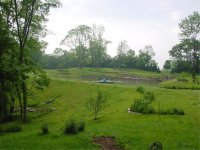
I mow a dam with R4s. I've attached a picture which is pretty blurry due to dumbing down for posting, but you can get a little perspective from the little green stripe at the bottom of the hill which is a kayak that blew over. I go up and down, of course, and with the tail of the tractor always facing up. Sections of the hill are on a 25-deg. slope or maybe a little more here and there (a couple of place feel like I'm backing the tractor up a wall). The guy who built the dam had a 30-HP Kubota and actually drove it over and over the lip of the dam to go downhill with a boxblade and rake /forums/images/graemlins/shocked.gif but he's a pro--makes a skidsteer look like a slot car!! I never get any sidewayser than carefully angling for the next swath, and so far while I've had a little traction loss I've never slid out on the dam, having done that a couple times elsewhere and figured out that I really don't like it. I use low range, of course, 4wd, and the diff lock if necessary, but mainly I make sure I've got good light, I'm not tired or in a hurry, and the grass is completely dry, although our clay doesn't really dry out unless there's been no rain for weeks. The R4s do a credible job and do minimal damage, which of course is an issue with the R1s. Of course, the R4s are designed for loader work, and having had both kinds of tires the R4s seem to me to be a good compromise for slope mowing also as long as you're focused on their limitations.
 

Attachments

  • 276840-Dam hill TBN.jpg
    276840-Dam hill TBN.jpg
    95.8 KB · Views: 353
   / Ag vs R4 on steep hills with a B7800 #16  
Roy,

Your description of the ANSI Roll Test is correct. (ANSI B71.4) The test specifies that in order to pass, no upslope wheel of the tractor must lose contact with the tilt table surface when it it is raised to 20 degrees.

Dynamic effects such as a bounce induced when a wheel drops into a small hole or traverses a small bump can reduce sideslope stablilty rapidly. It would not be prudent to assume that just because a tractor passed the ANSI B71.4 test that the operator could do anything he wanted to safely on a slope "averaging" 20 degrees. The small local effects can have a major effect. As others have pointed out, with any attached implement such as a loader that raises the combined center of gravitiy of the tractor and implement the stability limit is reduced. The mere presence of the operator on the seat always raises the center of gravity and thus has a negative effect.

Please don't try to test the limits. A sideslope incident can occur very rapidly, and "puckering" won't help.

JackIL
 
   / Ag vs R4 on steep hills with a B7800 #17  
I put a tilt meter on my L3130 with R4's and 15 deg doesn't seem like its that much to me personaly. 20 deg seems like its steep enough though and at about 23+ its scary. I've got one slope very smooth and it about pegs the meter. It "feels" like your at 45 deg. Pulling the box blade across it the tractor kind pulled sideways. Meaning you had to point the tractor uphill very slightly to pull straight across. I went across it at about .5 mph this was to cut it down a litte and then get it roughed up to plant grass.
 
   / Ag vs R4 on steep hills with a B7800 #18  
The maximum slope you can safely operate your equipment on is determined by a combination of common sense, caution, operator skill level and knowledge of your equipments operating characteristics. The last two can only be obtained with seat time and observing how the tractor handles on different slopes with different configurations and loads. I have had my BX2200 for 6 months and I am just now feeling comfortable that I know most of its operating limitations on slopes (I’ve been operating tractors for 40 years). I also know that I will be adding to the “operating knowledge” and “skill level” for as long as I own the equipment. So, the maximum safe slope will vary from tractor to tractor and operator to operator.

I live on a hillside so every time I take my tractor out I have to deal with slopes. Most of my property is 15 degrees with a few side hills 20 degrees and a small amount at 10 degree slopes. I also have a bank that is about 30 - 35 degrees (haven’t measured but I will do so tonight). I have always mowed the entire property with my tractors, including the bank. Up to 20 degrees I feel safe going across the slope (slowly when I approach 20 degrees). My property is smooth for the most part, so I do not have to deal with unexpected dips or mounds. Anything above 25 degrees I will only traverse vertically and when the traction is good.

Operating the tractor with a FEL on these slopes is a different story. I don't feel comfortable operating the FEL across slopes greater than 15 degrees (I’m not comfortable even at 15 degrees). If there is any slope I try to operate the tractor up and down the slope. There is no better advice when operating a FEL on a slope than the frequently quoted “low and slow”. Wearing the seatbelt is a no-brainer for me, I always buckle-up.

John
 
   / Ag vs R4 on steep hills with a B7800 #19  
John brings up an interesting point about feeling less comfortable with the FEL on when traversing a slope of around 15 degrees. My tractor the FEL is not removable so I don't have any basis of comparison. Do those of you that operate at steep, 15 degrees and more, side angles have opinions about the difference with or without the FEL mounted.

I do feel like John is correct about each tractor, operator, implement, tire pattern, and other factors having a lot to do with what you are capable of doing. Rick from R&B Manufacturing, the tilt meter people, has been asked for years what are the limits you can go. Rick has always taken the position that there are to many variables to give one answer for every situation. For those who don't know Rick did road bank mowing at one time and those guys do slopes I couldn't bring myself to go on.

MakrV
 

Marketplace Items

2008 JCB 190 ROBOT SKID STEER (A60429)
2008 JCB 190 ROBOT...
2016 FORD F-350 XL SUPER DUTY EXT CAB TRUCK (A59823)
2016 FORD F-350 XL...
2006 Ford Explorer 4x4 SUV (A59231)
2006 Ford Explorer...
TANK MANIFOLD (A55745)
2008 Ford F-250 Lariat 4X4 - 303,424 miles - 6.4L Powerstroke -Automatic (A61306)
2008 Ford F-250...
2022 John Deere Z930M (A57148)
2022 John Deere...
 
Top