Another slope application question

/ Another slope application question #1  

Hill HIgh Guy

Member
Joined
Oct 6, 2017
Messages
30
Location
Purcellville, VA
Tractor
None yet
I finally finished construction my house and can now finance a tractor and I'm ready to buy now. I've gone back and forth on what I need. It's 3 acres of former orchard with field grass now that I want to turn in to a decent lawn. The entire property is a pretty steep slope. I've waffled between a 1 series JD (KB BX) all the way up to an L. Sat on and drove everything in between including JD 2025 and Kubota B's. I asked the JD dealer to give me a quote on the new 20205r as I felt that I could spread the rears for stability and the tires were big enough to add weight by filling them. He doesn't have a 2025r in stock and sent me an email yesterday that he took his boss to my property and they agreed with my slope, a 1 series would be the right move as it would be more stable on the slope I have. Now I'm second guessing myself. Could it be that he would rather sell me a 1 series as he's got a bunch of them or is a smaller tractor truly more stable? I've read a ton on here that those little tractors can be tippy and it's harder to add spacers to the rear wheels. I had a Kubota dealer go out to my property and say a B2650 or even an "L" would be the best fit. This is craziness!!

Obviously I'm a newb and I don't want to buy the wrong tractor for 20K+. Thoughts?
 
/ Another slope application question #2  
I like to quantify.

IMHO, I think the side hill stability of a tractor can be expressed as a fraction: center of gravity height (COG(h)) divided by width (W).
Stability= COG(h)/W.
A smaller value is better.

The hard part is estimating where a model's COG(h) is. And how that COG height is then effected by other additions, such as FEL's, attachments, loaded tires, etc... My gut /guess tells me that most tractor's COG (w/o additions) is a few inches to 1/2 a foot higher than the rear axle.
 
/ Another slope application question #3  
I like to quantify.......

My gut /guess tells me that most tractor's COG (w/o additions) is a few inches to 1/2 a foot higher than the rear axle.

Not too bad a guess according to Tractor Stability - eXtension.

That article refers to a 2WD tractor. That's a potential source of confusion, at least for me. When ag. engineers talk about 4WD tractors, they are referring to the large articulated ag. tractors with front and rear tires of the same size.


Steve
 
Last edited:
/ Another slope application question #4  
I like to quantify.

IMHO, I think the side hill stability of a tractor can be expressed as a fraction: center of gravity height (COG(h)) divided by width (W).
Stability= COG(h)/W.
A smaller value is better.

The hard part is estimating where a model's COG(h) is. And how that COG height is then effected by other additions, such as FEL's, attachments, loaded tires, etc... My gut /guess tells me that most tractor's COG (w/o additions) is a few inches to 1/2 a foot higher than the rear axle.

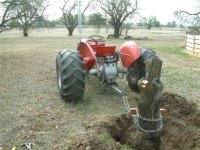
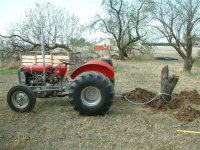
Or when eyeballing tractors for purchase, use the height of the rear axle centerline divided by width measured to the outside of the rear tires to get comparative data. That ratio should be 0.25 or less for stability.

For example, my 1964 MF135 diesel has a 0.24 ratio with those 18.4 x 16 inch rears on 16 inch diameter rims.

MF135 stump1 (1).JPGMF135 stump2.JPG

It helps that the 135 is a straddle tractor with an inherently low COG. When seated your legs straddle the transmission like riding a horse. Most modern tractors are platform designs where you sit higher with the soles of your shoes above the top of the transmission. That raises the COG. Case/IH has its JX series that it calls "straddle" tractors. Unfortunately, these tractors are a lot larger (60-95 hp engine) than CUT size.


Good luck
 
/ Another slope application question #5  
My old late 70's IHH2500b was a low boy, as they say, in that you had to straddle the transmission hump. It felt very stable.

My current Power Trac PT425 is very low as well. You straddle the center links (no transmission, and it's articulated.) I'd guess the soles of my feet aren't a foot off the ground. Very, very stable.
 
/ Another slope application question #6  
I have a whole thread on this subject which you might have seen, Using a Tractor on Mountain Property, as that was a big concern of mine as well. I found the stock JD to be somewhat less suitable for the steep in a couple of ways: higher ground clearance plus quite a bit of cast aluminum down below, where other tractors have cast iron, resulting in less weight down low where you want it = higher COG. Plus I looked at WIDTH and LENGTH, aiming for a tractor that was at least half as wide as it is long, as sideways tipping is the biggest danger, and the stock JD's were a bit longer and narrower than what I chose. Also taller. Now if you add wheel spacers of course that would make a big difference. Not knocking JD at all (know nothing about them except the specs). These are just some points to consider on steep slopes.

Seems to be the consensus here on TBN that, all other things being equal, a heavier tractor is more stable, so maybe your dealer is just trying to make a sale? Not very responsible of him, if true.

MossRoad has a point; maybe you should consider a Power Trac.
 
/ Another slope application question #7  
My current Power Trac PT425 is very low as well. You straddle the center links (no transmission, and it's articulated.) I'd guess the soles of my feet aren't a foot off the ground. Very, very stable.


Maybe you should consider a Power Trac.

Purceville, Virgina to Tazewell, Virgina, home of Power Trac = 309 miles via I-81 South.
 
/ Another slope application question #8  
Not too bad a guess according to Tractor Stability - eXtension.

That article refers to a 2WD tractor. That's a potential source of confusion, at least for me. When ag. engineers talk about 4WD tractors, they are referring to the large articulated ag. tractors with front and rear tires of the same size.


Steve


That's a good article and it links to this: Tractor Overturn, H.J. Sommer III
a bunch of videos of a remotely driven test tractor rolling over in different situations.

The axle, transmission and engine crankshaft are all in a line. The COG will be higher than that due to the engine cylinders and head, radiator, operators station, operator, etc. If the fuel tank is above the engine that will raise the COG too. If it's down low like on many tractors now it'll lower the COG. I had smaller wheels and tires put on my Branson, and 2" spacers between the rear wheels and axle. The R4 tires are wider than R1s as well. This tractor is much more stable on slopes than my old Kubota B7100 with R1s set out as far as they go. It's a bit lower than with the standard wheels and tires so I do need to take more care when operating.
 
/ Another slope application question #9  
I bought R4s on my L5030, thinking the wider width would be better on hills. However, they slide on hillsides, R1s are better.
 
/ Another slope application question #10  
The 6" spacers, r1 tires set to the widest point and loaded tires made a world of difference on my L2501.
 
/ Another slope application question
  • Thread Starter
#11  
The power trac would be nice but I need full tractor capabilities (TLB) for dirt work.
 
/ Another slope application question #12  
I haven't had a problem with the R4s sliding.
 
/ Another slope application question #13  
I haven't had a problem with the R4s sliding.

Then you’re not on a steep slope. I had a Deere 4400 with R4s. No loader during mowing and hung 300lbs off the front. I wouldn’t dare mow my wife’s horse pastures until afternoon and was sure all of the dew was burnt off. Even then it would slide both in the direction of travel and laterally. R1s for me please!
 
/ Another slope application question #14  
Then you’re not on a steep slope. I had a Deere 4400 with R4s. No loader during mowing and hung 300lbs off the front. I wouldn’t dare mow my wife’s horse pastures until afternoon and was sure all of the dew was burnt off. Even then it would slide both in the direction of travel and laterally. R1s for me please!

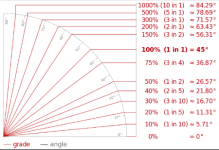
Curious, what is the slope you're talking about?
Grades.png
 
/ Another slope application question #15  
Hill High Guy,

You're going to get considerable differences of opinion on any tractor need with TBN contributors. . . and when you add in slope and sidehill issues, it gets even more "spread" on opinions. Some will say heavier/bigger & wider is the way to go while others will say "lower to the ground and wider" is the key.

But there are some priorities to consider and some concessions to any perfect choice. If you truly have steeper sidehills for mowing, you don't want a front end loader or backhoes attached. . . . Slopes can accept such units when you're careful but honest-to-goodness steeper sidehills don't give much slack for them Imo. But also in this mix is the fact that people refer to slope angles in different ways not to mention how deep (or wide) those sidehill slopes are makes a difference.

Also ground clearance is an issue because that isn't adjustable and while more clearance is good in woods or rough pasture - I believe less ground clearance is better on sidehills. (regardless of tractor frame size)

But the real "get to it" issue to me is what do you need to "do" to make the steep parts what you eventually want? To me the questions get answered when you understand you have possibly 2 needs - and not one :

1. What needs to be done to get those sidehills to the desired look and feel? (leveling the eveness of the surface, brush hogging and stump removal, tilling to smooth the surface for planting/seeding, rock removal, landscaping with trees or garden juts or landscape blocks or rock walls or ????)

2. What do you need to maintain it to have your "decent lawn"? Just the term "decent lawn" could describe farm lawn or city lawn or estate lawn or merely "green growth" - all of which means many different things. As just a simple example - lets say you want a thick lawn that stands up to weeds better and is durable without steady irrigation - that would mean something like Kentucky Blue Grass - which is dense (dense). This makes a beautiful and practical lawn - but not a lawn you want to cut at 7 or 8 inches high once every few weeks. Also - with a Kentucky Bluegrass - on sidehills - you don't want to cut it damp or wet - because what ever your tractor choice - it will slip. Last issue is tire choice. You can use use any kind of tire you want on a decent lawn - but the wrong choices will quickly change a decent lawn into "not a decent" lawn - and its never more true than on sidehills. My neighbor has similar slops as mine but not the sidehill issues the same way. They got a demo unit dropped off by a dealer - but it had ag tire treading (this was a nice large heavy duty 4 wd lawn tractor). 5 minutes on the demo and they already had several lawn repair needs. They ended up with the same model of unit they demo-ed with turf tires and they don't have such needs since.

Maybe these 2 issues can be answered with 1 tractor or maybe it's a tractor and a rental/hire of a track drive skid steer pulling implements. (track drive skidsteers not only have great traction, heavy weight and virtually no ground clearance - but their actual impact to the ground is stunningly small on a per square inch basis).

But if you think you can get consensus agreement of opinions (or you feel you need consensus) . . . I think that is exceedingly difficult.

In my case when I'm cutting lawn in the front with my bigger sidehill angles and considerable slope angles, dog walkers just stare when they see me on my GC1715 with belly mower. :)

If your dealer was really wanting to be accurate. . they'd stand and walk on the land because grass hides land smoothness and land issues as well as what the true slant and inclines are. But walking it really impacts decisions just as actual test drives on the land will.

Jmho
 
Last edited:
/ Another slope application question #16  
I finally finished construction my house and can now finance a tractor and I'm ready to buy now. I've gone back and forth on what I need. It's 3 acres of former orchard with field grass now that I want to turn in to a decent lawn. The entire property is a pretty steep slope. I've waffled between a 1 series JD (KB BX) all the way up to an L. Sat on and drove everything in between including JD 2025 and Kubota B's. I asked the JD dealer to give me a quote on the new 20205r as I felt that I could spread the rears for stability and the tires were big enough to add weight by filling them. He doesn't have a 2025r in stock and sent me an email yesterday that he took his boss to my property and they agreed with my slope, a 1 series would be the right move as it would be more stable on the slope I have. Now I'm second guessing myself. Could it be that he would rather sell me a 1 series as he's got a bunch of them or is a smaller tractor truly more stable? I've read a ton on here that those little tractors can be tippy and it's harder to add spacers to the rear wheels. I had a Kubota dealer go out to my property and say a B2650 or even an "L" would be the best fit. This is craziness!!

Obviously I'm a newb and I don't want to buy the wrong tractor for 20K+. Thoughts?

Have you actually measured your slopes?

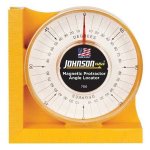
Take an 4' 2x4 and lay it on the hill and put one of these $9.00 angle meters from Walmart (they sell them at a lot of other stores, too) on the board and get your actual angles in many places around your property.

9F942C79-7CF5-4554-868B-E498CFB7846C.jpeg

Also, you can get a topographical map of your place on-line for free that should show 5' changes in elevation. That'll help you locate the most likely steep places, and you can physically check them with your board and angle meter. ;)

Here's a link to free topo maps from the gubermint.

TNM Download
 
/ Another slope application question #17  
Can also take a 2x4 of known length ("run"), a level and a tape measure. Hold board level with one end on ground and measure distance to ground on other end ("rise).
 
/ Another slope application question #18  
Can also take a 2x4 of known length ("run"), a level and a tape measure. Hold board level with one end on ground and measure distance to ground on other end ("rise).

Coby and Moss Road,

I like doing the idea of both of your methods in combination - especially if you have a straight 8 foot length board. However - the user needs to be considering the eveness of the ground where they place the board - in order to get the board making even contact across its length. There are also "ball levels" which look like a 2 or 4 foot level except a ball moves inside instead of a bubble - can measure both slope and side slant at the same time.

I often wonder how soon it will be before someone creates a phone app to do this for us :) :)
 
/ Another slope application question #19  
That's one of the reasons I like to use a 4' board instead of an 8' board. There might be holes and dips the 8' would span. Heck, a 1 foot board might even be better. It's the unseen hole or dip on the side of the hill that'll surprise you. Like a groundhog hole, for example.
 
/ Another slope application question #20  
I often wonder how soon it will be before someone creates a phone app to do this for us :) :)

There are numerous Android apps that will let your device act like a spirit level as well as like a bullseye level.

Aaron Z
 

Marketplace Items

2013 Nissan Versa Sedan (A64557)
2013 Nissan Versa...
2025 SDLANCH Rachet Tie-Down Strap (A64194)
2025 SDLANCH...
JOHN DEERE 1770NT - 12R30" VACUUM PLANTER (A64278)
JOHN DEERE 1770NT...
2018 Ford Fusion Hybrid Sedan (A64557)
2018 Ford Fusion...
2019 ISUZU NPR 16FT 4X2 S/A REFRIGERATED BOX TRUCK (A59914)
2019 ISUZU NPR...
2025 JOHN DEERE 333P SKID STEER (A65053)
2025 JOHN DEERE...
 
Top