Any Subaru owners?

   / Any Subaru owners? #41  
If I remember it right the correct tire pressure is 29 psi front and 28 psi rear. The required pressure is on a label in one of the doors frames.

Yes, check the door placard. I was about to say that 44psi does not sound right, but RIT beat me to it. If the placard says 44psi, my apologies.
 
   / Any Subaru owners?
  • Thread Starter
#42  
OK, what is the code that says you need a o2 sensor?

Head gaskets; the additive MUST have been used; so make sure it has it in. They will only do the head gasket IF it leaks coolant.

P-0325 knock sensor, bank 1 or single sensor. from what one tech told me knock sensor is different than an 02 sensor, but they say it most likely is an 02 sensor under driver side manifold??

There is a worn out sticker on there that says the additive was added but I can't read the rest. Do you keep adding it or are not supposed to flush the coolant? can I buy it from dealer?

Thanks for your pro help.


If I remember it right the correct tire pressure is 29 psi front and 28 psi rear. The required pressure is on a label in one of the doors frames.

Yes, check the door placard. I was about to say that 44psi does not sound right, but RIT beat me to it. If the placard says 44psi, my apologies.

Thanks, I'll check the placard, I read the max pressure off the tires, so I know for sure that they said 44. What if the placard says otherwise, which one should I follow?

JB.
 
   / Any Subaru owners? #43  
Placard pressure at minimum. Between the two to tune to load and handling preferences.
larry
 
   / Any Subaru owners? #44  
Placard pressure at minimum. Between the two to tune to load and handling preferences.
larry

Only if you wish to have your safety and the longevity of the vehicle and the tires take a backseat to your handling preferences.

Do what the placard pressure says about the load.
Monitor tire wear, and modify pressure slightly to account for edge wear vs center wear. Do not be fooled by single edge wear. Your goal is to match center wear to wear of both edges.

The edge wear vs center wear modification removes cases where the manufacturer of the car screws the manufacturer of the tire. The tire manufacturer does not know what season you are running them in, what climate, and what weight. The car manufactuer knows the weight mostly, but does not know the season and temperature, but sometimes fibs to make up for suspension deficiencies. In some cases this leads to death.

Rotate your tires properly, promptly, and per schedule. Verify the pressure while cold frequently.
 
   / Any Subaru owners? #45  
Placard pressure at minimum. Between the two to tune to load and handling preferences.
larry

Only if you wish to have your safety and the longevity of the vehicle and the tires take a backseat to your handling preferences.
Do what the placard pressure says about the load.
Monitor tire wear, and modify pressure slightly to account for edge wear vs center wear. Do not be fooled by single edge wear. Your goal is to match center wear to wear of both edges.
Wrong as a reply to my post. The placard does not often address the load. Even when it does it is unspecific and operator attention, using it as a guideline, will be best.
larry
 
   / Any Subaru owners? #47  
Wrong as a reply to my post. The placard does not often address the load. Even when it does it is unspecific and operator attention, using it as a guideline, will be best.
larry

I think the placard does often address the load. My Subaru does. Yours does not?
 
   / Any Subaru owners? #49  
It gives max load incl occupants of 900# [roughly 30% vehicle weight]. It is a station wagon and has one set of F/R tire pressures, rear being less. No mention of actual load or distribution. Those door pressures could be considered ballpark I suppose. Choice of pressure requires a bit more attention unless youre a persistant average user. Going softer gives some benifit on gravel factored against poorer performance in most other driving conditions. Going a little harder suits everything well and affords safety when loads vary to the higher side.
larry
 
   / Any Subaru owners? #50  
It gives max load incl occupants of 900# [roughly 30% vehicle weight]. It is a station wagon and has one set of F/R tire pressures, rear being less. No mention of actual load or distribution. Those door pressures could be considered ballpark I suppose. Choice of pressure requires a bit more attention unless youre a persistant average user. Going softer gives some benifit on gravel factored against poorer performance in most other driving conditions. Going a little harder suits everything well and affords safety when loads vary to the higher side.
larry

I think we agree, but I'm not sure. The door pressures are the best you are going to know on the matter until you start to adjust your average tire pressure to you average load and your average road surface and your average climate as reflected back to you by your wear pattern.

I just disagree on the handling. Perceptions about handling vary with the person and the conditions. What if the person likes a handling pressure that is different that the one that results from the best tire patch contact.

Yet proper tire patch contact will provide the best traction, the best economy, the best longevity of the tire, the most safety due to proper tire temperature, and the best protection for the Subaru drive train (when combined with correct tire rotation) due to matching wheel diameter. Should individuals alter that due to perceptions of handling? I think not.

I got 80,000 out to the original set on my Baja, and they wore perfectly running right at placard. I LOOKED for tread issues. And the brand I replaced them with is better and safer, and came with an employee discount. It's hard to beat that deal. :thumbsup:

I forgot to mention: My Baja is a 2004. It has two placards. One with all the information you mentioned on the driver side door, and one on the pillar opposite to that placard. The one on the pillar is mentions the spare tire pressure too. It tells you to look at the manual for details. In the manual, it has pictures of under inflated and over inflated tread pattern, and says to fine adjust to achieve the flat pattern. So it agrees with what I mentioned in this post, and the previous one.
 
   / Any Subaru owners?
  • Thread Starter
#51  
Well this is a little confusing, the door post says 29 front and 28 to 36 rear.

I thought for safety they say to always fill to max pressure listed on the tire?
Remember when the tires were blowing out on certain vehicles due to under inflation??

And especially with all wheel drive I would think it's important to keep all tires the same.

Anyway, I need to buy tires, maybe paint the rims, just got it registered today, so I'll get to drive it this weekend.

JB.
 
   / Any Subaru owners? #52  
How do you like it? I have never owned a Subaru small engine. Are you satisfied with it?

At the time I bought it I had a Lincoln and was thinking new one. Then I saw the Subaru in the Bobcat and I was sold. Thing runs like a champ. I bought it the 1st year Miller came out with the larger 250 and it hasn't missed a beat and that was one of their strong selling points. The small Subaru motors have a great rep and I don't think the welder will get near the abuse as a "Suby" with wheels.

I let it sit for 10 months, I had mixed Sea Foam in it. Went to help my neighbor build a bridge, thing fired up like it did the day I bought it.
 
   / Any Subaru owners? #53  
Well this is a little confusing, the door post says 29 front and 28 to 36 rear.

I thought for safety they say to always fill to max pressure listed on the tire?
Remember when the tires were blowing out on certain vehicles due to under inflation??

And especially with all wheel drive I would think it's important to keep all tires the same.

Anyway, I need to buy tires, maybe paint the rims, just got it registered today, so I'll get to drive it this weekend.

JB.

Front axle carries more weight so it has higher pressure. Since most people drive alone I would inflate the rear tires to 28 psi. Then I would increase the pressure only if the rear is loaded and the distance you need to drive is significantly long. Otherwise I wouldn't bother. My feeling is that over-inflating the rear tires while the car is not loaded is not good for the drive-train. If I remember it right the owners manual stipulates maximum difference in diameter between tires 0.25"
 
   / Any Subaru owners? #54  
Well this is a little confusing, the door post says 29 front and 28 to 36 rear.

I thought for safety they say to always fill to max pressure listed on the tire?
Remember when the tires were blowing out on certain vehicles due to under inflation??

And especially with all wheel drive I would think it's important to keep all tires the same.

Anyway, I need to buy tires, maybe paint the rims, just got it registered today, so I'll get to drive it this weekend.

JB.

In that case, they are telling you to adjust to the load you have in the car. If you knew for a fact you are going on a long journey heavily loaded, go up on the pressure. If you are virtually empty, go for the lower. Adjust for the best tire patch on the road.
 
   / Any Subaru owners? #55  
Front axle carries more weight so it has higher pressure. Since most people drive alone I would inflate the rear tires to 28 psi. Then I would increase the pressure only if the rear is loaded and the distance you need to drive is significantly long. Otherwise I wouldn't bother. My feeling is that over-inflating the rear tires while the car is not loaded is not good for the drive-train. If I remember it right the owners manual stipulates maximum difference in diameter between tires 0.25"

If I saw what you wrote, I would not have written, since your's sounds good to me.

I can't vouch for the 0.25, but I would not be surprised.

Also, for the OP, a manual Subaru like mine has a viscous coupling that must deal with what ever comes its way in a "thoughtless" manner, since is it uncontrolled.

An Automatic, unless they changed them, is smart, and it will use the same pulsers that inform the antilock brakes to also inform the CPU. The CPU decides how to actuate the viscous coupling and controls it with a duty cycle relay.

It is possible, though I do not KNOW this to be true, that the automatic tranny type is smarter, and more versatile and more forgiving, since it can "think." My manual, it must distribute the torque without the advantage of being controlled.

I am a stickler because I also have an additional issue: My Baja has a limited slip rear end, since it is the Turbo Model Baja. So, I want my rear tires to match well all the way around.
 
   / Any Subaru owners? #56  
Well this is a little confusing, the door post says 29 front and 28 to 36 rear.

I thought for safety they say to always fill to max pressure listed on the tire?
Remember when the tires were blowing out on certain vehicles due to under inflation??

JB.

Those tires blowing out were Firestones which had a recommended pressure of around 35 PSI when mounted on the mid-90's Ford Explorer. Ford wanted the SUV to ride better so they listed a lower pressure in the trucks' manuals. The lower pressures, combined with the trucks' weight, resulted in catastrophic failures of the tires and accidents.
There a number of articles on this, if you want to research the incidents.

Anyway, I suggest you go a bit higher then Subaru recommends (maybe 5 psi per tire). The higher pressure requirement in the rear tires is probably for load carryng capability (same as when you up the pressure in a pick up when you have a load in the bed).
Bit higher pressure will give you better fuel economy, anyway.
 
Last edited:
   / Any Subaru owners?
  • Thread Starter
#57  
Wow, I never adjusted tire pressure for the load always went by the max pressure, even on the family minivan etc. guess I missed the boat on proper tire pressure :eek:

Right now I got 35 in all 4, seemed to handle good not to bumpy or anything.

I have a question for Sackett2 because of your experience as a Subaru tech.
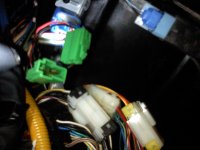
You may be able to tell me what the pair of wires under the dash that are disconnected are for. They are unique in that they have a green connector, none of the other wire connectors are green that I can see.
When I plug them together with car off but key in ignition dash lights start flashing, the electric cooling fan goes on and I hear clicking in the back, maybe fuel pump or something??

I did not try to start the car with them connected, If anyone else has a clue what it is I'd like to hear about it. the only other problem is the overhead clock does not work.

Thanks JB,
 

Attachments

  • 0701111010.jpg
    0701111010.jpg
    120.9 KB · Views: 89
   / Any Subaru owners? #58  
messaged you; leave them unplugged
 
   / Any Subaru owners? #59  
An Automatic, unless they changed them, is smart, and it will use the same pulsers that inform the antilock brakes to also inform the CPU. The CPU decides how to actuate the viscous coupling and controls it with a duty cycle relay.

the Auto has no viscous coupling, the slip needed is all handled with the clutch packs. the manual, being directly linked from the engine to the driveshafts needs a "give point" between the front and rear wheels, and that's what a viscous coupling does. I disassembled a broke one last week, it is a series of thin clutches in a special oil.
 
   / Any Subaru owners?
  • Thread Starter
#60  
Thanks,

For someone who has driven standards all their lives from trucks, tractors, cars and motorcycles. I'm having a little trouble with this little 5 speed, starting in first gear I'm either slipping the clutch to much or bucking like a bronco. Stalled it a couple of times in busy traffic :ashamed:

May have something to do it being AWD ? Can't seem to find the sweet spot.

Been driving the car and I like it, I swear the gas gauge doesn't move. At first I thought it was going up, but the way the gauge is, empty is to the right instead of left.

Even driving the car hard I have not noticed the temp gauge rise from it's mid point, only heard the fans come on a couple times. and just for a brief moment.

Oh yeah, anyone have a recommendation on fuel octane? all it says in the book is 87 or above. I have no problem putting 91-93 octane in it if it will benefit the engine in anyway, since it is such a fuel miser.

JB.
 

Marketplace Items

500 BBL FRAC TANK (A58214)
500 BBL FRAC TANK...
Crown RM6025-45 Stand-On Electric Forklift (A59228)
Crown RM6025-45...
UNUSED FUTURE BOBCAT-E SERIES EXCAVATOR (A60432)
UNUSED FUTURE...
2012 Chevrolet Van (A55973)
2012 Chevrolet Van...
MASSEY FERGUSON 4710 TRACTOR (A59823)
MASSEY FERGUSON...
2461 (A58376)
2461 (A58376)
 
Top