b2910 flasher/hazard fuse shorting out

   / b2910 flasher/hazard fuse shorting out #1  

dlabrie

Gold Member
Joined
Apr 5, 2002
Messages
434
Location
Campton, NH
Tractor
Kubota B2910
I was working on my road with the flashers going when the 20 amp, flasher/hazard fuse blew. I replaced it and it blew when I turned the flashers on again. If I am reading my meter correctly, I have continuity between the + wire going to the flashers and ground . I can't see anything wrong with the wires coming from the back of the tractor to the flashers. Where should I look next? Could it be the flasher switch or module? If so, how do I access it then check it? Also, how do you pull the plug apart that goes to the tail lights?
I can't remember if my directionals were the tail lights or flashers. The tail lights are working but I have no directionals.
Thanks
 
   / b2910 flasher/hazard fuse shorting out #2  
If you have continuity (0 or nearly 0 ohms) that would indicate that the power lead is shorting to ground somewhere.
Chances are there is a pinched wire loom going to one of the flashers, you could find it by replacing the fuse and trying the individual turn signals. One should work and the one with the problem should pop the fuse. Or, you could pull the bulbs and check the wire for the bright filament to ground.
Those tests are for if the wiring looms aren't readily visible for inspection; if you have to disassemble a bunch of stuff to get to the looms it helps to at least narrow it down to a side.
 
   / b2910 flasher/hazard fuse shorting out #3  
you should have continuity from the pos to ground. The continuity is thru the bulbs. Take the bulbs out then test for resistance. Should have no continuity with bulbs out.
 
   / b2910 flasher/hazard fuse shorting out #4  
Turn signals and hazard flashers use the same lights.

Joe
 
   / b2910 flasher/hazard fuse shorting out
  • Thread Starter
#5  
OK. I took both flasher lights off and tested them on a 12 volt battery, they work fine.

with the lights disconnected, I checked for continuity across the + and - wires going to each side, and each side showed continuity between the wires.

Where do I check next, the flasher?

I also just ordered some more fuses.
 
   / b2910 flasher/hazard fuse shorting out #6  
Your Serivce manual can be found here..
http://www.kubotabooks.com/AutoInde...df&AutoIndex=398efa88db0861411c4606a7c4636347

download and in the wiring section you can see the layout. it'll also tell you all the wire coloring layouts. then you can locate the right plugs and wires easier when you dig into those small spaces. Take a bright flashlight out. I will suspect a wire rub or melt to ground someplace if you removed the flasher unit and hazard relay.

We like to note continuity and ohms here a lot. If you can, tell us if you your meter test shows some ohms over just a continuity beeper.
A DC light should have current limiting resistor someplace so when it turns on, the short is more of limiting current flow w/ (say 100ohms) Its very possible some of these things are looping around in parallel on the wiring diagram. Things in parallel will have you reading 0 ohms and reading like a dead short, unless you remove any/all bulbs in parallel or start unplugging things.

so there are a LOT of LINES on the print. Too small for me to trace around and paste together. let us know what you find.
 
   / b2910 flasher/hazard fuse shorting out #7  
OK. I took both flasher lights off and tested them on a 12 volt battery, they work fine.

with the lights disconnected, I checked for continuity across the + and - wires going to each side, and each side showed continuity between the wires.

Where do I check next, the flasher?

I also just ordered some more fuses.

when I read this I'm thinking that you are using a continuity light that lights up when it is connected to 12v and ground to test with. If that is the case then it should light up because it is connected to 12v and ground. I could be misunderstanding your post. Please correct me if I'm wrong. If you are drawing excessive amps I think it would be hard to find why with this type of tester.
 
Last edited:
   / b2910 flasher/hazard fuse shorting out #8  
I was walking back up yesterday and was thinking about this as well. I think the test across the two bulb leads is part 1 of 2... the other test I would do is putting 1 lead on a socket wire and then to ground. Then 1 lead on the other socket wire and then to ground. On each socket in the path. So your checking both of the bulb wires to ground. Since you don't know which wire is part of ground, and which is the hot lead until you dig into the print a bit. And even then I would unplug the socket and then do this same test at the connector ... 1 lead to connector pin , other to ground.. This will be an elimination event IMO. Thoughts...

when I read this I'm thinking that you are using a continuity light that lights up when it is connected to 12v and ground to test with. If that is the case then it should light up because it is connected to 12v and ground. I could be misunderstanding your post. Please correct me if I'm wrong. If you are drawing excessive amps I think it would be hard to find why with this type of tester.
 
Last edited:
   / b2910 flasher/hazard fuse shorting out #9  
Not to hijack.. but I'm in the toughest decision since marriage. (shhhh..... ) Do I buy a M5560 or the M6060.. LOL. Making a choice this week. Will go up Sat. I have the thread posted on Orange buying forum.. but I'm just trying to get on and read posts a lot to idle my brain a bit and help fix something for folks along the way. :) Peace.. cg.

I was walking back up yesterday and was thinking about this as well. I think the test across the two bulb leads is part 1 of 2... the other test I would do is putting 1 lead on a socket wire and then to ground. Then 1 lead on the other socket wire and then to ground. On each socket in the path. So your checking both of the bulb wires to ground. Since you don't know which wire is part of ground, and which is the hot lead until you dig into the print a bit. And even then I would unplug the socket and then do this same test at the connector ... 1 lead to connector pin , other to ground.. This will be an elimination event IMO. Thoughts...
 
   / b2910 flasher/hazard fuse shorting out
  • Thread Starter
#10  
Thank you all for the responses. Let me try to be more clear on what I have tried. I don't know that much about electrical, ohms, etc.

What think I understand is that the positive Gw (Green white) and Rw wires going to the lights should show no continuity to ground when not plugged into the light sockets.

I have the lights removed, they work fine on their own. The fuse is removed. When I use the turn signal, the flasher clicks in both directions.

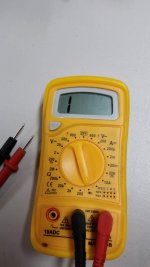
I am using a small electric meter set to the continuity setting, it sort of looks like this (->|). The meter reads '1' when the leads are not together. When they are together, the number changes; I have not taken note of the numbers when testing the wires but will the next time. I put the + lead on the Gw wire, and the - lead to ground, the number on the meter changes which I assume means there is continuity. I also do it with the B (black) wire coming to each side and the number changes because that is ground to ground. I do the same on the other side with the Rw wire and the number changes as well.

So If I am understanding this correctly, both positive wires going to my lights are grounding out somewhere.

If I need to look anything under the dash, how to I get it open?
 
   / b2910 flasher/hazard fuse shorting out #11  
not sure about your meter continuity setting, this could be the ohm setting, your explanation sounds like it is. the ohm emblem looks like an upside down U with legs coming out of each of the bottom lines. Your readings does imply that there could be a short in the positive wire. Ohms is the measure of the amount of resistance. when you test the wires you MUST have all electrical devises disconnected or it will measure the resistance of those devises like the bulbs. DO NOT have any power on the wire you are testing, that could damage your meter. I have never owned or worked on a Kubota so I cannot help with how to get under the dash.
 
   / b2910 flasher/hazard fuse shorting out #12  
We're here to coach ya along here! ask all the Q's ya want! All good. So. to knock this one around a bit more. I like the test you have described above and we need the numbers and if you can, a Pic of the meter and the number if ya can? Else just record the number. (Ohms usually has a multiplier range and can be .automatic on the meter, or part of where you switch too...and ya never know.. so a pic for me say's it all).

OK, you are putting a lead on the Gw to gnd and Rw to gnd. ( PS is Ground in your test the frame or battery gnd btw?). Let's get the numbers.


Once we sort out your Meter and whats what: Here is a thought. See if this makes sense.
A thought (see what the dog thinks here too). The failing fuse line, for current flow on your lights, is a long wire cut in half (for example) w/ a fuse in the middle. If the current exceeds the flow in that long wire... pop!
SO, you have the fuse out now. Try 1 meter lead on one of the fuse holder blades and then 1 to ground. Then you can try 1 meter lead on the other fuse blade holder (other side) and then test to ground.
This can show if the half of the wire on the left is shorted... or if the half on the right is shorted. trying to see if we can help ya eliminate and isolate.

We'll get it yet! I'll try to look at the print in the manual I sent ya the link too tomorrow early over coffee.

From your Q:
So If I am understanding this correctly, both positive wires going to my lights are grounding out somewhere.
My answer (IMO) Possibly. Depends on the number on the ohm meter.
Example of why we need to see it: (google search on what continuity really means for different ohm ranges is below) What this is noting below is that w/o us seeing the number we really cannot tell you if it's shorted to ground or just part of the normal ohms that should be there. Not uncommon to see a meter on + from a LED or light bulb's + wire to ground be a few hundred ohms or more. We 'limit' current to the bulb with a resister at times to limit current shock and longevity of the bulbs. does that help or hinder?


What does continuity mean on an Ohm meter?
Featured snippet from the web
If the range is set to 400.0 Ω, a multimeter typically beeps if the component has a resistance of 40 Ω or less. If the range is set 4.000 kΩ, a multimeter typically beeps if the component has a resistance of 200 Ω or less.


Thank you all for the responses. Let me try to be more clear on what I have tried. I don't know that much about electrical, ohms, etc.

What think I understand is that the positive Gw (Green white) and Rw wires going to the lights should show no continuity to ground when not plugged into the light sockets.

I have the lights removed, they work fine on their own. The fuse is removed. When I use the turn signal, the flasher clicks in both directions.

I am using a small electric meter set to the continuity setting, it sort of looks like this (->|). The meter reads '1' when the leads are not together. When they are together, the number changes; I have not taken note of the numbers when testing the wires but will the next time. I put the + lead on the Gw wire, and the - lead to ground, the number on the meter changes which I assume means there is continuity. I also do it with the B (black) wire coming to each side and the number changes because that is ground to ground. I do the same on the other side with the Rw wire and the number changes as well.

So If I am understanding this correctly, both positive wires going to my lights are grounding out somewhere.

If I need to look anything under the dash, how to I get it open?
 
Last edited:
   / b2910 flasher/hazard fuse shorting out #13  
Maybe this tutorial link below can help ya a bit. I love the sparkfun folks. From your post, the indicator symbol is often the Diode and/or combo Diode & continuity mode. (see URL and pic on the meter in that tutorial).
I think Ohm is the easier of the two. Tell me the brand and model of your meter. I'll find a google image and tell ya where to put the knob. or pop me a PM and we can sort out a few things there.

How to Use a Multimeter - learn.sparkfun.com


For Ohms (resistance) just a few selections up on that same tutorial.
How to Use a Multimeter - learn.sparkfun.com
 
   / b2910 flasher/hazard fuse shorting out
  • Thread Starter
#14  
Maybe this tutorial link below can help ya a bit. I love the sparkfun folks. From your post, the indicator symbol is often the Diode and/or combo Diode & continuity mode. (see URL and pic on the meter in that tutorial).
I think Ohm is the easier of the two. Tell me the brand and model of your meter. I'll find a google image and tell ya where to put the knob. or pop me a PM and we can sort out a few things there.

How to Use a Multimeter - learn.sparkfun.com


For Ohms (resistance) just a few selections up on that same tutorial.
How to Use a Multimeter - learn.sparkfun.com


Thanks for hanging with me on this. I will try to get some pictures tomorrow.
 
   / b2910 flasher/hazard fuse shorting out #15  
Maybe this tutorial link below can help ya a bit. I love the sparkfun folks. From your post, the indicator symbol is often the Diode and/or combo Diode & continuity mode. (see URL and pic on the meter in that tutorial).
I think Ohm is the easier of the two. Tell me the brand and model of your meter. I'll find a google image and tell ya where to put the knob. or pop me a PM and we can sort out a few things there.

How to Use a Multimeter - learn.sparkfun.com


For Ohms (resistance) just a few selections up on that same tutorial.
How to Use a Multimeter - learn.sparkfun.com

Sparkfun headquarters is 15 min from my house! I love the place ;)
 
   / b2910 flasher/hazard fuse shorting out
  • Thread Starter
#16  
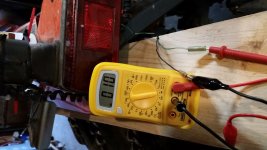
Here is a pict of the meter set to continuity.
no continuity .jpg

Here with the leads crossed
continuity .jpg

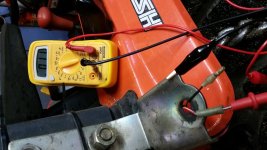
Left side Gw wire to frame ground
Left Gw to frame gnd.jpg

Left Gw to B gnd wire
left Gw to gnd wire.jpg

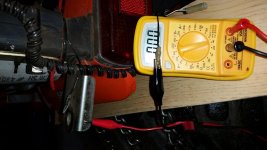
Left Gnd to gnd
left gnd to gnd.jpg

Right side Rw to frame ground

Right Rw to frame gnd.jpg

Right side frame ground to to B gnd wire
right grnd to grnd.jpg


Countryguy, I was confused by the following
Once we sort out your Meter and whats what: Here is a thought. See if this makes sense.
A thought (see what the dog thinks here too). The failing fuse line, for current flow on your lights, is a long wire cut in half (for example) w/ a fuse in the middle. If the current exceeds the flow in that long wire... pop!
SO, you have the fuse out now. Try 1 meter lead on one of the fuse holder blades and then 1 to ground. Then you can try 1 meter lead on the other fuse blade holder (other side) and then test to ground.
This can show if the half of the wire on the left is shorted... or if the half on the right is shorted. trying to see if we can help ya eliminate and isolate
 
   / b2910 flasher/hazard fuse shorting out #17  
Dave, OK, your Meter is definitely on "DIODE" check which passes a small current thru the device and then reports back based on a voltage drop back when I did this stuff. Now, I used to do all this 2 decades ago. So maybe someone else will note if that check is OK or not but...
if you do not mind: I would prefer you turn your Meter knob to the "Ohms 200" setting. 1 click CW (clock wise) Then retry those same tests. No need for the pics. Just report the numbers back w/ the same headings from the pic.

And if you have the time, could you add two small tests? Do the fuse blade (where the fuse plugs in). Red lead on the blade. black lead on the frame. (on the left or top side). And then repeat for the fuse holder right or bottom side) Hope you see where I'm going /w this? back to that long wire analogy and which side of the fuse (from the print I'll know) might be the short to ground. Or, I going to smack my forehead and go duh.. but I think it's in my head that it'll help us. 2min test I think.

All in all - It certainly appears to report that you have 0 ohms gnd to gnd. 10 to 11 ohms from the two Gw and and Rw lines. Let me go check the print and see which is which there and what's what.


Last meeting today is 2:30. I'll pull the print and report back by the late PM for ya.
 
   / b2910 flasher/hazard fuse shorting out #18  
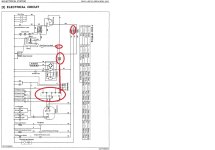
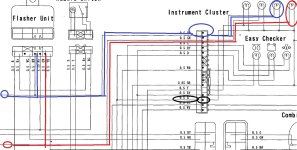
So. In the manual stating on page 337, I pulled some images. As you can see by my Red and blue marks, there is a lot of wiring. As noted in one of the first posts; I've also seen this in equipment as a few scenarios. Rubbed bare to ground, speared to grounding , melted, other conductive (corrosion and other), and then someone's modifications.

From what I can tell, you need to start unplugging things. From the Flasher unit, to the big connector where these all go together and figure out if you can say ... it's shorted on this side... but not that side. Sorry I cannot be more help here but I think your going to be pulling connectors and possibly getting under the hazard dash /console setup.

Some high level notes and pics:

There are two 20am fuses noted in the diagrams. Is yours blowing on the RED wire or the RED/YELLOW wire. The print shows two. the Red is part of the Battery feed and makes sense since if you were stalled and needed hazards they run off the battery.

As you can see from the images, IMO there is essentially 4 areas you get to trace out. And the best way is to start unplugging connectors and then trying the Rw and Gw colors any place you find them on the connectors.

My thoughts....IMO on what I'd be yanking and checking. This includes taking my cutters and cutting and then re-splicing and then heat/shrink + taping back together. The objective here is to find where she's shoring . 20A to me is the 10-11 ohms which will blow it every time.

you get to really dig in now IMO but others may have some better ideas too.


1) The Harness and local wiring the travels the back.
2) the long haul from back ends to the console and fuse assy.
3) The instrument cluster and whats underneath.
4) Flasher unit and wiring. Where is that? part of 1, 2, or 3. Probably under the hood?

B2910OverallElec.jpg

taillight-toEasyChecker1.jpg

taillightMain1.jpg
 
   / b2910 flasher/hazard fuse shorting out
  • Thread Starter
#19  
Dave, OK, your Meter is definitely on "DIODE" check which passes a small current thru the device and then reports back based on a voltage drop back when I did this stuff. Now, I used to do all this 2 decades ago. So maybe someone else will note if that check is OK or not but...
if you do not mind: I would prefer you turn your Meter knob to the "Ohms 200" setting. 1 click CW (clock wise) Then retry those same tests. No need for the pics. Just report the numbers back w/ the same headings from the pic.

And if you have the time, could you add two small tests? Do the fuse blade (where the fuse plugs in). Red lead on the blade. black lead on the frame. (on the left or top side). And then repeat for the fuse holder right or bottom side) Hope you see where I'm going /w this? back to that long wire analogy and which side of the fuse (from the print I'll know) might be the short to ground. Or, I going to smack my forehead and go duh.. but I think it's in my head that it'll help us. 2min test I think.

All in all - It certainly appears to report that you have 0 ohms gnd to gnd. 10 to 11 ohms from the two Gw and and Rw lines. Let me go check the print and see which is which there and what's what.


Last meeting today is 2:30. I'll pull the print and report back by the late PM for ya.

Ohm meter set at 200

Right side
Rw to B wire = 11.1
Rw to frame = 11.4
B to frame = .9

Left side
Gw to B wire = 11.1
Gw to frame = 11.4
B to frame = .9

With negative clipped to frame
Left side of fuse = 80
Right side of fuse = 1
 
   / b2910 flasher/hazard fuse shorting out
  • Thread Starter
#20  
Thanks for highlighting those electric diagrams. I'll have to figure out how to remove the instrument cluster. If this gets much more complicated, I'll just hang a blinking LED from my rops when I need it. :)
 

Marketplace Items

2369 (A60432)
2369 (A60432)
500 BBL FRAC TANK (A58214)
500 BBL FRAC TANK...
2390 (A60432)
2390 (A60432)
(2) 330 GALLON POLY TOTES W/CAGES (A60432)
(2) 330 GALLON...
2013 HAM 289I-30 8 WHEEL PNEUMATIC ROLLER (A60429)
2013 HAM 289I-30 8...
JCB 3CX 14HFCA BACKHOE (A60429)
JCB 3CX 14HFCA...
 
Top