DIY Bridge

   / DIY Bridge
  • Thread Starter
#61  
The creek only runs past my driveway after heavy rains. A lot of times it stops flowing on the surface and goes underground somewhere. My neighbor, who is a half mile upstream has water at his crossing many times when my crossing is dry.I’m in SE Missouri and the ground here is very rocky. Heavy rains/ rushing water is what causes the creek to change. No one really does any maintenance on the creek so we have washouts, gravel deposits, trees growing in the creek beds. All kinds of things.

i don’t expect the 2 36” pipes to handle all the water during the really heavy rain. At that point the bridge will be more of a spillway. I hope is to be able to cross the creek sooner and not have wait more than a day or so. I think you’re right about needing concrete/a footing on the down stream side. I don’t need any washouts or water getting under the crossing.
 
   / DIY Bridge
  • Thread Starter
#62  
The photo you posted looks like a very awkward situation to deal with.

Could you please explain what you think has caused the creek to move? Is there more runoff upstream from development or something? Did the existing creek bed fill up with material? Are there obstructions to flow downstream that didn't use to be there?

Would you happen to have an old photo of the area before this got this way?
The creek has filled will a lot of gravel over the years. The only development was when they moved the highway 3/4 miles closer to us, turned the two lanes into 4 lanes and knocked down some hills to fill in some valleys. Where my county road meets the highway, it’s 35 ft higher in elevation than it was before they moved the highway. Gee, I hope that didn’t sound bitter.
Thanks for commenting.
 
   / DIY Bridge
  • Thread Starter
#63  
(square not cubic, obviously)


Before consulting with authorities, find out if it's a protected watershed or some other designation that might limit your ability to perform construction.
If so, keep that in mind when doing what you need to do.
Been working with the County Commissioners. Not too many restrictions in this part of the country. Sometimes that’s good but sometimes it’s bad too.
 
   / DIY Bridge #64  
Well gary, you can probably tell that we love threads about water crossings here on TBN. Fun projects to achieve on your own property that usually require substantial tractor support.

But c’mon man, get us some real pics of the area and stream in question
 
   / DIY Bridge #65  
You probably know how to do this, but

Type in your property location in Google Maps
Click on Satellite View
Zoom in as appropriate
Click on Shift/Windows Key/S Key to get the Snip Tool (copies what you selected to your clipboard) - a very handy tool
Open Microsoft Paint and click Paste
Use Brushes and other drawing tools to map out your road, dry creek beds, etc.
Click on Shift/Windows Key/S Key to get the Snip Tool and select the image area you want to copy
Reply to this TBN thread, Right click and hit Paste
Select Insert on the lower left thumbnail
Click Post Reply

I takes longer to type this than it does to do the task!
 
Last edited:
   / DIY Bridge #66  
The creek has filled will a lot of gravel over the years. The only development was when they moved the highway 3/4 miles closer to us, turned the two lanes into 4 lanes and knocked down some hills to fill in some valleys. Where my county road meets the highway, it’s 35 ft higher in elevation than it was before they moved the highway. Gee, I hope that didn’t sound bitter.
Thanks for commenting.
It's important for you to know what has caused the stream to widen because it's too expensive to take guesses at what may be needed to get it back in its channel. If the gravel has filled in the channel, then the water has to spread out to compensate. It might also be that the county road work is causing water to run off faster than it did before the valleys were filled and the elevation was changed.

Years ago, there was a footbridge across the creek nearby. They didn't even try to cross the creek in a car when the water was up, but they could walk across the creek on the footbridge.
 
   / DIY Bridge
  • Thread Starter
#67  
T
Well gary, you can probably tell that we love threads about water crossings here on TBN. Fun projects to achieve on your own property that usually require substantial tractor support.

But c’mon man, get us some real pics of the area and stream in question
That was a real photo I posted. Here’s another from today. You can see the water is much lower now.
 

Attachments

  • 81E2597E-8901-431D-8083-161710D432B8.jpeg
    81E2597E-8901-431D-8083-161710D432B8.jpeg
    4 MB · Views: 166
   / DIY Bridge #68  
Are both photos looking down the same direction? Is that the county road at a T at the top of the picture?

1673148445279.png
 
   / DIY Bridge
  • Thread Starter
#69  
Yes, same direction, different times of the year. T at the end of the drive is county road.
It's important for you to know what has caused the stream to widen because it's too expensive to take guesses at what may be needed to get it back in its channel. If the gravel has filled in the channel, then the water has to spread out to compensate. It might also be that the county road work is causing water to run off faster than it did before the valleys were filled and the elevation was changed.

Years ago, there was a footbridge across the creek nearby. They didn't even try to cross the creek in a car when the water was up, but they could walk across the creek on the footbridge.
Last year my wife’s Toyota sat on the far side of the creek because of flooding, for over two months. Nice or something got in it a chew a bunch of wires. After a bad flood we can usually cross it after a day or two in our 4wd F250 or in waders. It flooded Tuesday night and I was able to cross in the F250 on Wednesday morning but the wife was afraid to try in our GMC pickup. We should be able to cross it now in the car. Sometimes we get a mound of gravel in the middle of the driveway that we can’t drive over or around.
 
   / DIY Bridge
  • Thread Starter
#70  
You probably know how to do this, but

Type in your property location in Google Maps
Click on Satellite View
Zoom in as appropriate
Click on Shift/Windows Key/S Key to get the Snip Tool (copies what you selected to your clipboard) - a very handy tool
Open Microsoft Paint and click Paste
Use Brushes and other drawing tools to map out your road, dry creek beds, etc.
Click on Shift/Windows Key/S Key to get the Snip Tool and select the image area you want to copy
Reply to this TBN thread, Right click and hit Paste
Select Insert on the lower left thumbnail
Click Post Reply

I takes longer to type this than it does to do the task!
Don’t have access to the computer right now but I used my phone and took some screenshots.
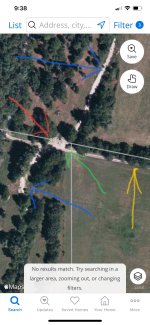
On this photo the yellow arrow shows points to the driveway. The blue arrows show the creek bed. You can see how the creek widens between the green and red arrows. That wide area in my drive is about 100. I think the dogleg is the biggest problem.
 

Attachments

  • B985F432-D1C3-47FA-B9AA-78B383616807.jpeg
    B985F432-D1C3-47FA-B9AA-78B383616807.jpeg
    1.7 MB · Views: 179
   / DIY Bridge #71  
Don’t have access to the computer right now but I used my phone and took some screenshots.
On this photo the yellow arrow shows points to the driveway. The blue arrows show the creek bed. You can see how the creek widens between the green and red arrows. That wide area in my drive is about 100. I think the dogleg is the biggest problem.
I took some liberties.
1673154076690.png
 
   / DIY Bridge #72  
3ft deep and 70ft wide and your trying to put it through two 36in culverts? That dosnt sound right.

Theres a driveway down the road here that has a 6ft culvert it's in a mostly dry ravine and not a steep section.. I believe they put that culvert in 3x before they gave up.
 
   / DIY Bridge #73  
Here is a few pics from the flood we had here when 6" of rain fell overnight. Its became to be known as "the Father Day flood of 2018". Something like 350 culverts and bridges got washed out. Lots and lots of culverts and bridges were made larger after that.
pilgrim-river-washout-houghton-flood-1024feature.jpg
flood-road-3.jpg
 
   / DIY Bridge #75  
Water likes to take the path of least resistance. It's hitting that dogleg and doesn't like having to make the bend. So it is fanning out and the gravel is being deposited into the creek bed I'm guessing because the water velocity is slowing down at the dogleg.

Could you post a picture of the creekbed facing upstream and a picture facing downstream? Is the creekbed pretty much the same depth and about as full of gravel?
 
   / DIY Bridge #76  
Lots of good info here. As mentioned, you need to know you drainage area and your storm volume and then you can decide on a culvert. Here is the chart I have used in the past. However, with the increased frequency of +100 year storms (or should I say 500 year storms back to back?!), you will be well served going to the next size up.

For this chart, the number of acres is your drainage area. Then pick the type of ground that is most common upstream. Find you square footage and convert that into a pipe diameter. [Keep in mind, this chart is for a 2.5" per hour rainfall event. If you think you might see more rain per hour, then you will need a different chart.]

Note my scribbles below. For a 113 acre drainage basin, I calculated the need for a 16 sq ft cross-sectional pipe. So I selected 60". Or you can do two pipes, as long as they equal 16 sq ft.

1673191511956.png
 
   / DIY Bridge #77  
Keg99 charts above are probably a simplification of what is a more complicated calculation. 2.5“ inches per hour of rainfall seems pretty low for where I live in Illinois but might not be a bad number to use. I think the OP is in Texas? We also often used a C factor lower than 0.4 around here but once again for Texas 0.4 might be a good number. The C number is a runoff coefficient. For example a concrete parking lot 95% of the water will runoff. For a partly sandy soiled farm field maybe only 15% of the rainfall runs off. For designing something like a driveway culvert its probably a great place to start with the above chart.
 
   / DIY Bridge #78  
Aerial view sort of shows you didn't pay attention to creek channel over the years and allowed it to dogleg down the road instead of yearly maintenance to keep it where you want it... Water is like electricity it takes path of least resistance.... A little creative tractor work and some layers of coarse gravel and a shallow area where you want the water to flow is simple one day project...

Bridge or culverts or ford is long term solution ....
 
   / DIY Bridge #79  
Aerial view sort of shows you didn't pay attention to creek channel over the years and allowed it to dogleg down the road instead of yearly maintenance to keep it where you want it... Water is like electricity it takes path of least resistance.... A little creative tractor work and some layers of coarse gravel and a shallow area where you want the water to flow is simple one day project...

Bridge or culverts or ford is long term solution ....
you such of a great help ... I don't know if you notice but the road goes across the creek and always did as long as it's been a road there is no way around it...
 
   / DIY Bridge #80  
That dogleg sure does look familiar!

A dogleg just like that caused a problem locally. Ultimately that dogleg was caused some 40 years before when a farmer decided to use his bulldozer to move the creek on his land. The creek was tiny, seasonal, and nobody cared.

The original farmer had moved on, lots had been created, the land became part of a town subdivision with new owners who bought and built. None of the new owners knew that the stream had been moved 30 or 40 years before.

Then along came some years with more than normal precipitation causing annual flooding problems on the new roads and driveways.

This was all a sort of local mystery until someone thought to dig out some old maps - then the cause of the problem became obvious.

The solution was to move the downstream section of the creek back to where it was originally, deepen the channel, and rock line the banks. Then the various upstream low water crossings and small bridges became effective.

rScotty
 

Tractor & Equipment Auctions

1608 (A57192)
1608 (A57192)
2019 KENWORTH T680 TANDEM AXLE SLEEPER (A59905)
2019 KENWORTH T680...
1990 INTERNATIONAL 3800 DAY CAB DUMP TRUCK (A58214)
1990 INTERNATIONAL...
2014 International WorkStar 7300 4x4 Altec A55F 55ft. Material Handling Bucket Truck (A60460)
2014 International...
2006 Mac Truck CXN613 (A56438)
2006 Mac Truck...
2005 John Deere 7320 (A60462)
2005 John Deere...
 
Top