Ecoboost question for DP

/ Ecoboost question for DP #1  

handirifle

Veteran Member
Joined
Jul 2, 2010
Messages
1,727
Location
Central Coast of CA
Tractor
Massey Ferguson 1010
Or anyone else that seems to know Fords like the back of their hand.

Not looking to switch over or anything drastic like that, but wanting to understand them. I know the 3.5 EB has 2 turbos, or at least I think they do, so how do they work? Are they compound, or parallel? How does Ford get that excellent torque down low and keep it almost to 5K?

Like I said, I am not switching from diesel, now that I'm there, but the EB is impressive for a gasser.
 
/ Ecoboost question for DP #2  
I'm not really sure. Jonesboro is the technical guy.

All I know is mine with 3.73 gears pulls like a freight train.

Chris
 
/ Ecoboost question for DP #3  
In parallel. And they are tiny.

The small size allows near instant spool up and boost. To give you a rule of thumb, doubling atmospheric pressure with boost, effectively doubles the displacement of the motor. So a 3.5 L feels like a 7 L with just 15 psi of boost.
 
/ Ecoboost question for DP #4  
I asked the same question a few months ago, and yes they are parallel. Two little turbos spool up pretty quick. I know on the 6.4 Powerstroke, they were sequential.
 
/ Ecoboost question for DP #5  
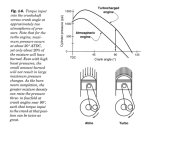
A visual on what's happening inside a turbo'd engine. You'll notice that peak pressure is delayed by a few degrees because of the different ignition timing curve and that the total area under the curve is much larger.


Cylinder Pressure.jpg
 
/ Ecoboost question for DP #6  
Another reason not to go sequential is the boost pressure. 15 psi of boost is very high for a gas engine but 30 psi for a diesel engine is very common.
 
/ Ecoboost question for DP
  • Thread Starter
#7  
Yea my truck hits 25 pretty easy. Seems I read somewhere, that there is a cam timing design that opens the exhaust valves open longer, or earlier (not sure which) to cause faster spool up. Any truth to that?

I had wondered about a lot of the turbo gassers in the past, and they all seemed designed for high RPM ops and seemed like turbo lag was bad because of it, ie. The 80's Buick 3.8 v6.

It makes a little more sense on a pass car, but a truck is for work, IMHO.
 
/ Ecoboost question for DP #8  
/ Ecoboost question for DP #9  
If you are talking about diesels, lots of things affect spool up, the inducer size, housing size, shape of the inducer, cam timing, injection timing, the number of injection events and probably stuff I don't know about.
 
/ Ecoboost question for DP #10  
It makes a little more sense on a pass car, but a truck is for work, IMHO.

That's where the direct injection comes into play. You would never be able to load a turbo gas motor at low rpm without it. It would detonate itself to death.
 
/ Ecoboost question for DP
  • Thread Starter
#11  
Don't most big rig trucks have turbocharged engines?

Yea I was referring to the slow spool up of typical or should I say, old school, turbo gas engines. Higher RPM boost, makes more sense to me for a pass car than a truck. A truck needs boost early on, as diesel trucks do.

Yes I understand there are about a dozen factors affecting boost or spool up time. Mine have VGT, or variable geometry turbocharging, which varies the direction the exhaust gasses actually hit the turbo vane, allowing for faster spool up, AND higher boost pressures as the RPM's climb.

Didn't realize the DI reduced detonation. I guess it makes sense, the fuel cannot PRE DETONATE if it's not in there until time for spark.
 
/ Ecoboost question for DP
  • Thread Starter
#12  
I think it's Mazda, that has been working with Cummins to develop a compression fired gas engine, no spark plugs. Sort of a combined technology engine, or a hybrid I suppose. Last I read it really helped fuel comsumption, reduction (or better MPG).

Spark plugs have come a long way since I was a kid, but eliminating the spark system completely would be a huge plus for gas engines.
 
/ Ecoboost question for DP #13  
So I have 2 questions while everyone's talking all technical...

1) why a turbo instead of supercharger, I think the answer is that turbos are more efficient, but maybe someone can elaborate.

2) something I have always wondered about the high fuel pressure (paticularly di) with diesels is if there is enough pressure in the fuel rail to overcome cylinder pressure, which is enough to cause combustion... what would keep the fuel lines from combusting if there was even a tiny bit of air in them?
 
/ Ecoboost question for DP #14  
So I have 2 questions while everyone's talking all technical...

1) why a turbo instead of supercharger, I think the answer is that turbos are more efficient, but maybe someone can elaborate.

2) something I have always wondered about the high fuel pressure (paticularly di) with diesels is if there is enough pressure in the fuel rail to overcome cylinder pressure, which is enough to cause combustion... what would keep the fuel lines from combusting if there was even a tiny bit of air in them?

1) Definitely more efficient, although some of the supercharger advances have probably closed this gap. When you don't need the boost, the turbo has almost no losses in the system while the supercharger always saps some energy.

2) The combustion is partially dependent on the atomization of the fuel as it expands to a lower pressure. I'm not really sure if it would be possible to ignite the fuel without a large surface area but it certainly would be less likely to ignite in liquid form than when it sprays.
 
/ Ecoboost question for DP #15  
Or anyone else that seems to know Fords like the back of their hand.

Not looking to switch over or anything drastic like that, but wanting to understand them. I know the 3.5 EB has 2 turbos, or at least I think they do, so how do they work? Are they compound, or parallel? How does Ford get that excellent torque down low and keep it almost to 5K?

Like I said, I am not switching from diesel, now that I'm there, but the EB is impressive for a gasser.

They get the torque from a combination of fuel delivery through direct injection which can be programmed to precise timing and multiple injections per power stroke, variable valve timing on the intake and exhaust valves, combustion chamber design, and obviously twin parallel turbos that pack a lot of oxygen in. Having complete control of combustion like this involved some computer programming skills along with old school combustion design. The combustion duration being prolonged is probably a big reason for the big numbers. This engine could not function without an ecu monitoring and controlling every explosion. Too many variables that must be controlled and a lot of calculations are being made on every stoke. This engine and many others today are being designed by a bunch of nerds vs the gear heads of yesterday.
 
/ Ecoboost question for DP #16  
So I have 2 questions while everyone's talking all technical...

1) why a turbo instead of supercharger, I think the answer is that turbos are more efficient, but maybe someone can elaborate.

Packaging is another issue. It is difficult to introduce an intercooler under a roots type blower that has enough capacity without making the whole package too high to fit under the hood. It also takes considerable horsepower to drive a supercharger although the screw type are pretty efficient.
 
/ Ecoboost question for DP #17  
Look at the new Hellcat engine, it all fit under the hood. Pickups have a lot of room under the hood also so I don't think its a packaging issue. They probably choose turbos because of fuel mileage and the noise factor. In a car like the Hellcat, the owners think the supercharger whine sounds cool but on a everyday drive, not so much.
 
/ Ecoboost question for DP #18  
Look at the new Hellcat engine, it all fit under the hood. Pickups have a lot of room under the hood also so I don't think its a packaging issue. They probably choose turbos because of fuel mileage and the noise factor. In a car like the Hellcat, the owners think the supercharger whine sounds cool but on a everyday drive, not so much.

Yes, but you are not going full throttle for more than a few seconds at a time. If you wanted to tow with it, work it, the intercooler would have to be an order of magnitude larger.
 
/ Ecoboost question for DP #19  
Another reason not to go sequential is the boost pressure. 15 psi of boost is very high for a gas engine but 30 psi for a diesel engine is very common.

heck the big Cummins boost to 60 psig
 
/ Ecoboost question for DP #20  
Yea I was referring to the slow spool up of typical or should I say, old school, turbo gas engines. Higher RPM boost, makes more sense to me for a pass car than a truck. A truck needs boost early on, as diesel trucks do.

Yes I understand there are about a dozen factors affecting boost or spool up time. Mine have VGT, or variable geometry turbocharging, which varies the direction the exhaust gasses actually hit the turbo vane, allowing for faster spool up, AND higher boost pressures as the RPM's climb.

Didn't realize the DI reduced detonation. I guess it makes sense, the fuel cannot PRE DETONATE if it's not in there until time for spark.


All this takes is more & more $$$$$$$$$$ to create these science fair engines. What about reliability, durability, and the ability of the average guy (since there is little middle class left) to afford these things? We'll all be driving econoboxes by the time they're through.
:soapbox:
 

Marketplace Items

2015 Ford Focus Hatchback (A59231)
2015 Ford Focus...
2017 Freightliner Cascadia 125 T/A Sleeper Cab Truck Tractor (A59230)
2017 Freightliner...
2019 Chevrolet Silverado 6500HD 4x4 ETI ETC37IH 37FT Insulated Bucket Truck (A59230)
2019 Chevrolet...
Brock 48'x16' Flat Bottom Grain Storage Tank (A57148)
Brock 48'x16' Flat...
207275 (A52708)
207275 (A52708)
2018 Chevrolet Impala Sedan (A59231)
2018 Chevrolet...
 
Top