Electrical question

   / Electrical question #1  

joeu235

Platinum Member
Joined
Mar 27, 2014
Messages
724
Location
Little River, TX
Tractor
John Deere 4020 / 6403 / 317 Ford 5600
Anyone know why a 12 AWG is allowed for a 20A 120v single phase circuit but 10 AWG is required for a 30A 2 phase 240v circuit? The 30A 240v is actually carrying less amps per wire than the 20A 120v.
 
   / Electrical question #2  
Anyone know why a 12 AWG is allowed for a 20A 120v single phase circuit but 10 AWG is required for a 30A 2 phase 240v circuit? The 30A 240v is actually carrying less amps per wire than the 20A 120v.


You are only considering a single circuit, motors will reach 300% current when starting, and can frequently trip breakers once they load up. You don't want the wire glowing in the wall before the breaker takes it out...
 
   / Electrical question #3  
Anyone know why a 12 AWG is allowed for a 20A 120v single phase circuit but 10 AWG is required for a 30A 2 phase 240v circuit? The 30A 240v is actually carrying less amps per wire than the 20A 120v.
Size of wire is determined by the rating of the overcurrent device (fuse or circuit breaker). A 30 amp 240 volt circuit can carry up to 30 amps per conductor. A 20 amp a 120 volt circuit can carry up to 20 amps per conductor. One is good for 7200 watts (240X30) the other is good for 2400 watts (120X20). 10 gauge would also be required for a 30 amp 120 volt circuit. This is before any de-rating that must occur for continuous or motor loads. Most circuit breakers will hold roughly 3 times their rating briefly in order to start motor or compressor loads, that's some of the reason you multiply motor loads by 1.25 (125%) to determine proper wiring ampacity.
 
   / Electrical question #4  
Anyone know why a 12 AWG is allowed for a 20A 120v single phase circuit but 10 AWG is required for a 30A 2 phase 240v circuit? The 30A 240v is actually carrying less amps per wire than the 20A 120v.


Not sure what you are asking.
 
   / Electrical question #5  
You are only considering a single circuit, motors will reach 300% current when starting, and can frequently trip breakers once they load up. You don't want the wire glowing in the wall before the breaker takes it out...

A 10HP 240V motor with 40.0 FLA uses #8 copper R75 rated for 50 amps on a 100amp breaker .
 
   / Electrical question #6  
Just to be clear. 240 is still single phase. They (the two 110 legs) are just different windings of the transformer, with the neutral in the center.
 
   / Electrical question #8  
Just got me to thinking. You can draw 15 amp off each side of a split receptacle fed with 14/3, like plugging in a kettle and a toaster oven, for a total of 30 amps (well, in a way) but couldn't draw 30 amps between the two legs as you would exceed the capacity of the 14 AWG. That, can become confusing.
 
   / Electrical question #9  
A 10HP 240V motor with 40.0 FLA uses #8 copper R75 rated for 50 amps on a 100amp breaker .

Sizing branch-circuit conductors. Branch-circuit conductors that serve a single motor must have an ampacity of not less than 125% of the motor's FLC as listed in Tables 430.147 through 430.150 [430.6(A)]. You must select the conductor size from Table 310.16 according to the terminal temperature rating (60°C or 75°C) of the equipment [110.14(C)].
Not sure what your getting at, you might have a smart (adjustable) breaker, or engineered overloads or some kind of electronic circuit protection... If your everyday motor is FLA rated at 40 amps, and you run it on 12awg, and put a 60 amp breaker on it... you MIGHT have a problem.... I was only illustrating that a motor might only run at 8A, but is a dynamic load. No load amps, Full load amps, locked rotor amps, inrush current.... Single phasing not withstanding.

Your wire should never be the weak link.
 
   / Electrical question #10  
I think the OP believes that a 30 amp load on a 240v circuit draws draws 15 amp through each conductor.

This is not true.

I think this is the answer. The OP doesnt understand how a 240v split-phase circuit works.

Quite simply a 240v DOUBLE pole 30 amp breaker....it wont trip until 30 amps are exceeded on ONE or BOTH legs. NOT 15 each totalling 30+


Just got me to thinking. You can draw 15 amp off each side of a split receptacle fed with 14/3, like plugging in a kettle and a toaster oven, for a total of 30 amps (well, in a way) but couldn't draw 30 amps between the two legs as you would exceed the capacity of the 14 AWG. That, can become confusing.

This is where people get into trouble with a MWBC. IF you wire the red and black in the panel to opposite legs....the amperage on the neutral will cancel.

But if someone does this, or in the future by re-arranging the panel, and end up with both feed wires of the MWBC on the SAME leg.....then if you tried to pull 15a on each....you are putting 30a back on that 14ga neutral.
 
   / Electrical question #11  
Just got me to thinking. You can draw 15 amp off each side of a split receptacle fed with 14/3, like plugging in a kettle and a toaster oven, for a total of 30 amps (well, in a way) but couldn't draw 30 amps between the two legs as you would exceed the capacity of the 14 AWG. That, can become confusing.

Also (sometimes) confusing: If each side of the split receptacle is drawing 15 amps, (for a total of 30 amps passing through the breaker and receptacle), the return current in the neutral is (15 amps + 15 amps =) 0 amps. :eek:

(Some may insist it's really 15 + (-15)=0)
 
   / Electrical question #12  
I wish for starters that there was some universal description of the two (110V) transformer windings. I call them legs, but that not a good description. Hence all the improper talk about "phases". Curious, that there isn't a better description.

It's hard to explain to a DIYer if they don't know how a transformer works.

I always wondered if in Europe they use the same system, which would mean almost 500 volts entering the home.
 
   / Electrical question #13  
IMHO:
I think "legs" are a good description for the conductors or bus. When talking about "the system", I usually just say "120/240V single phase" and anybody who has understand the conversation up to that point knows what you're talking about. And if they don't, then maybe they shouldn't be playing with electricity and we shouldn't be having the conversation.:rolleyes:

Plus, "single phase 120/240" seems more descriptive and easier to say than a "120/240V split phase" system" or a "single phase, 3 wire system', or a "center tapped, single phase, 3 wire system" . Also "leg" is a more universal, familiar term, as it often used with 3 phase systems.
 
   / Electrical question #14  
Stupid question, but where does 208 and 347 (in Canada) come from? We have 600 3 phase.
 
   / Electrical question #15  
Also (sometimes) confusing: If each side of the split receptacle is drawing 15 amps, (for a total of 30 amps passing through the breaker and receptacle), the return current in the neutral is (15 amps + 15 amps =) 0 amps. :eek:

(Some may insist it's really 15 + (-15)=0)

There ain’t no 30 amps anywhere . It is two circuits of 15 amp that are 180 degrees out of phase . Neutral would flow zero current .
 
   / Electrical question #16  
Stupid question, but where does 208 and 347 (in Canada) come from? We have 600 3 phase.


From a wye configured transformer secondary . Three set of windings that are physically and mechanically 120 degrees apart. Divide 600 by the square root of 3 and that makes 347V to neutral.
 
   / Electrical question #17  
I wish for starters that there was some universal description of the two (110V) transformer windings. I call them legs, but that not a good description. Hence all the improper talk about "phases". Curious, that there isn't a better description.

It's hard to explain to a DIYer if they don't know how a transformer works.

I always wondered if in Europe they use the same system, which would mean almost 500 volts entering the home.

Europe sends one live line of a three phase service and the common neutral into homes and businesses with a single phase service . 240V to neutral. A three phase service would still be 240 from any line to neutral. 416V from any line to any other line .
 
   / Electrical question #18  
Sizing branch-circuit conductors. Branch-circuit conductors that serve a single motor must have an ampacity of not less than 125% of the motor's FLC as listed in Tables 430.147 through 430.150 [430.6(A)]. You must select the conductor size from Table 310.16 according to the terminal temperature rating (60ーC or 75ーC) of the equipment [110.14(C)].
Not sure what your getting at, you might have a smart (adjustable) breaker, or engineered overloads or some kind of electronic circuit protection... If your everyday motor is FLA rated at 40 amps, and you run it on 12awg, and put a 60 amp breaker on it... you MIGHT have a problem.... I was only illustrating that a motor might only run at 8A, but is a dynamic load. No load amps, Full load amps, locked rotor amps, inrush current.... Single phasing not withstanding.

Your wire should never be the weak link.


50amp wire will never melt or fail. It is thermally protected .
 
   / Electrical question #19  
Stupid question, but where does 208 and 347 (in Canada) come from? We have 600 3 phase.

208v in the USA is low-voltage 3-phase.

It is used for 120v stuff like office lighting in a factor. And in many cases alot of appliances or motors that are designed for 240v single phase, will also operate on 208v.

So 208 3-phase is a wye configuration that has a center neutral.

Any one of the phases to neutral is 120v. (single pole breaker in that panel) So thats all the lighting.
A double pole breaker can be installed and have 208v between two of the phases. (this can sometimes be used on 240v appliances)
A 3-phase breaker can be installed and power 3-phase motors if the motors can be wired to that voltage (low voltage)
 
   / Electrical question
  • Thread Starter
#20  
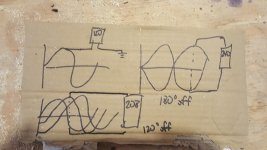
I've got lots of training in navy 3 phase ungrounded and industrial 3 phase, but have forgotten most of it. But I'm fairly certain 240v is x2 120v phases that are 180 degrees off.

20171120_102141.jpg
 

Tractor & Equipment Auctions

2020 Takeuchi TL8R2 Track Loader with 72in Tooth Bucket (A56438)
2020 Takeuchi...
207273 (A52708)
207273 (A52708)
John Deere 6110M (A53317)
John Deere 6110M...
PARTS ONLY - Has Title - 2023 Ram 1500 Classic Pickup Truck - Hemi 5.7L - Automatic Transmission (A56438)
PARTS ONLY - Has...
2018 Kia Forte Sedan (A59231)
2018 Kia Forte...
2020 BOBCAT T590 SKID STEER (A60429)
2020 BOBCAT T590...
 
Top