Electrical through concrete foundation

/ Electrical through concrete foundation #1  

Cliff_Johns

Elite Member
Joined
Jan 15, 2004
Messages
2,771
Location
Northern Illinois
Tractor
JD 4110
The excavation is done for my garage. It will have a 12"X12" concrete "beam" or footing around the outside and four inches of slab above that, plus a 4"X4" step for the walls to sit on.

I want to run somewhere between 50 and 100 AMP service out to this garage, and I want 220 available.

The garage is 40 feet from the house and the electrical needs to be buried 18". It is sloped down from the house about 3 feet if any of that matters.

I guess the usual way to handle underground service is to come through the concrete with a pipe (special conduit?). I'm thinking that I should put a piece of this into the concrete while it's being poured. How big should the pipe be for that service requirement, and should it be an"L" with an elbow so it comes out the side of the footer (I can't imagine how else it would wortk)? I guess it would be best to cap both ends so no concrete gets inside.

Any advice on this procedure would be much appreciated.

Cliff
 
/ Electrical through concrete foundation #2  
I think they call the elbow a 'sweep' which is a long curved elbow. I would put it in such that it is in the place where you want to go down through the concrete floor and under the footing. Plugging the ends with rags or something to keep out concrete would be a good idea as well. Everything you can think of before pouring concrete is a plus later on. Keep it about 18" below the expected outside grade of the garage, and 2" inside diameter should give you plenty of working room. The box stores should have what you need.
 
/ Electrical through concrete foundation #3  
PVC/Plastic conduit will last for ever and you can pour around it. Just leave it long above the slab and the pour shouldn't affect it. An ell is correct with straight sections vertical and horizontal. Cut the vertical to length when ready. Pick the size you need for the gauge that the run will require and then double it. Easy to have alot of conduit poured in than to need more runs later and not have enough room left. Make sure you fish it and leave the fish in unless you're unlike me and enjoy fishing.

You only need a grade beam in IL ??

Enjoy the new building.
Kevin
 
/ Electrical through concrete foundation #4  
I used PVC thru my foundation and floor in the garage for my 100 amp service. I also used PVC for the run from the house to the garage. It is about 40 feet away. Make sure you have the pipe in place for the wall and floor. Make sure you glue all the joints. Don't do like my stupid contractor did. He put the one in the wall only. Then he poured the garage floor without the vertical pipe in place. His guy spent hours cutting thru the floor to put in the vertical pipe. He wouldn't listen to me. I was stupid and didn't know anything. He on the other hand knew everything. He also got fired and I took on the 2nd floor house project myself. Enjoy your project and don't skimp on wall plugs. Use 20 amp breakers for the walls. Use a 50 amp for a welder and 30 amp for an air compressor.
 
/ Electrical through concrete foundation #5  
You might also want to add separate PVC for future telephone, intercom, and even cable tv lines. How about a water line for a slop sink or hose bib? Any thought on adding a waste line for future bathroom? Not knowing if you would install the above mentioned items down the road it certainly is a lot easier to put the PVC in place now then later. Also, not knowing if your building needs to be inspected or not you might want to get a 'final' inspection on the building prior to digging any trenches for electric, water, etc. Any thought on a floor drain in the center of the concrete? A few items to think about. Good luck!!! /forums/images/graemlins/cool.gif
 
/ Electrical through concrete foundation #6  
</font><font color="blue" class="small">( I think they call the elbow a 'sweep' which is a long curved elbow. I would put it in such that it is in the place where you want to go down through the concrete floor and under the footing. Plugging the ends with rags or something to keep out concrete would be a good idea as well. Everything you can think of before pouring concrete is a plus later on. Keep it about 18" below the expected outside grade of the garage, and 2" inside diameter should give you plenty of working room. The box stores should have what you need. )</font>

Ditto . That's exactly what I did with my garage. Put the sweep"s" in and then poured the concrete. Makes life a whole lot easier in the end. G
 
/ Electrical through concrete foundation #7  
A 3" PVC conduit will handle a 200 amp service. Purchase a length of 3" PVC electrical conduit and put the sweep in the ground below the footing and use another 18" piece of 3" PVC for a riser that will be above the floor about 1" out from the wall, at the wall section. This will allow you plenty of material to be above the floor when it is finally poured. You can cap it with a 3" PVC cap that is tapped onto the pipe. Also put a small section of pipe on the other end of the sweep where it is pointed toward the direction of the house. Cap this also. No need to put any fish tape in yet, because is is a relatively short distance and you will have no difficulty with fishing it when you complete the job. I would also put in at least 2 other sweeps of 2" size.... one for telephone/communications and the other will be used for future water connections. You can alway pull a 3/4" NSF black plastic water line from the house to the new building at a later date. PVC is very inexpensive and available at all of the building supply stores. I believe in putting all conduits down about 24" for safety reasons. Also consider the depth of frost in your area if you install a water line. Afterward if you decide that you want to have it closer to the surface, it is flexible enough to allow you the choice when you make your final connections. Just remember that it is better to have conduit in the locations that you will not need it, than it is to try to get it there at a later date when the floor is poured. I also believe in putting a 1" or 2" conduit under the floor from one side of the building to the other. Think of it like a "cross" on the floor. Through this conduit, you can pull electrical wires from one side of the shop to the other with ease. Sure beats running the wires up the wall, across the ceiling, and down the other wall. If you think this out clearly before you start and decide where you might want power, it is inexpensive to place the conduit for future use under the floor. Also consider the width and hight of the garage door opening and plan that location carefully. A 10' wide door doesn't cost much different from a 8' wide door in the overall cost of the building. That extra 2' will make things a lot more comfortable when entering and exiting with an implement on the tractor.
One final though, if you are going to be putting a separate electrical service on this building, then the PVC sweep will need to be located on the outside of the building so the electrical meter can be mounted on the outside wall. Electrical meters are no longer allowed to be installed on the inside of the building. If your power is coming from the home, then the sub panel would be mounted on the inside as I have described...... Good luck with your new project and keep us posted with questions and progress......
 
/ Electrical through concrete foundation #8  
Cliff, a couple things:

Northern Illinois should require a frost footing. Especially with the recent winters, that will pop right out of the ground when the freeze comes---unless the 12'' x 12'' beam you mention is a 'grade beam'. However a grade beam is heavily re-inforced and is supported every so often by a pier that goes down below the frost line.

As far as the service size (50 or 100A), go with the larger. The incremental cost for the wire and panel from 50 to 100A will be minimal compared to the future capability you will have. But, without knowing what you are doing in the garage its hard to help out here. I assume the 220V is for a welding rig, but do you plan on any heavy loads (amperage)? Heat, A/C, woodworking equipment, compressor, plasma cutter, etc.? How big is the garage?

As far as the conduit through the foundation PVC sweeps, or radius elbows (same thing different names) are what you need (when someone refers to an ell it is often meant for a 90 degree turn through a wall above grade, you often see these on the sides of buildings because someone didn't get a sleeve into pour). Always install a pull line and duct tape the openings as they are installed. Even if concrete doesn't get in there, someone will stick something in there to make your life miserable.

Also, think about communications. Doesn't hurt to put a couple extra 1'' conduit in to cover any future phone needs, or what ever else might come down the pike.

ell -- http://www.cantexinc.com/conduit%20bodies.htm

sweeps -- http://www.cantexinc.com/schedule_40_standard_radius_elbows_-_plain_end.htm
 
/ Electrical through concrete foundation #9  
Hey Junkman,

Welcome back. Glad you decided to return. /forums/images/graemlins/smile.gif
 
/ Electrical through concrete foundation #10  
JUNKMAN!!!!!! /forums/images/graemlins/smile.gif /forums/images/graemlins/smile.gif /forums/images/graemlins/smile.gif /forums/images/graemlins/smile.gif /forums/images/graemlins/smile.gif /forums/images/graemlins/smile.gif /forums/images/graemlins/smile.gif /forums/images/graemlins/smile.gif /forums/images/graemlins/smile.gif /forums/images/graemlins/smile.gif /forums/images/graemlins/smile.gif /forums/images/graemlins/smile.gif /forums/images/graemlins/smile.gif /forums/images/graemlins/smile.gif /forums/images/graemlins/smile.gif /forums/images/graemlins/smile.gif /forums/images/graemlins/smile.gif /forums/images/graemlins/smile.gif /forums/images/graemlins/smile.gif /forums/images/graemlins/smile.gif /forums/images/graemlins/smile.gif /forums/images/graemlins/smile.gif /forums/images/graemlins/smile.gif /forums/images/graemlins/smile.gif /forums/images/graemlins/smile.gif /forums/images/graemlins/smile.gif /forums/images/graemlins/smile.gif /forums/images/graemlins/smile.gif /forums/images/graemlins/smile.gif /forums/images/graemlins/smile.gif /forums/images/graemlins/smile.gif /forums/images/graemlins/smile.gif /forums/images/graemlins/smile.gif /forums/images/graemlins/smile.gif /forums/images/graemlins/smile.gif /forums/images/graemlins/smile.gif /forums/images/graemlins/smile.gif /forums/images/graemlins/smile.gif /forums/images/graemlins/smile.gif /forums/images/graemlins/wink.gif
 
/ Electrical through concrete foundation
  • Thread Starter
#11  
Thanks to everyone, this has all been very helpful. This building is only 14' by 20', so no below-frost-line footings are required. It's a floating slab with a thickened edge.

I need to call the building department tomorrow morning and see if PVC is acceptable, then I will get some pieces to make the "sweep" at Home Depot, I guess. Sounds like 2" will work fine for 100AMP. (welcome back Junkman -- I don't think I have a need for 200AMP, and I'm feeding off my house meter and it's only 200 AMP total anyway.)

They do not allow drains here unless the water is pumped out. so I won't be putting in drain pipe. If I add water hookup, it's taxed differently, so I'll just use the hose for now.

Cliff
 
/ Electrical through concrete foundation
  • Thread Starter
#12  
Oh, I forgot to say, I will add a couple smaller pipes too, as Junkman sugested, for the various and sundries that I might decide to add later. Phone especially sounds like a good idea.

I had considered just adding the conduit on the outside coming up the side of the concrete and entering the building and about a foot or so. It would be behind a bush anyway. Are there special problems with that? Or do we go through the concrete mostly so it looks tidy.
Cliff
 
/ Electrical through concrete foundation #13  
Glad to be of help..... I know you couldn't see it in the picture of my garage, but I thought it out well before doing mine. Now if I could only find the floor.... LOL.... One trick that I didn't mention was to put a few holes on the foundation wall above the floor. If you don't use them, you just cement them in later on. This is accomplished by hanging pieces of PVC pipe on nails on the foundation forms walls. The contractor can help you with this. I would put a few on each wall in the event that you want to run something outside without drilling through the wood. An example of this would be air lines. I filled mine with expanding foam and just dug out the foam when I wanted to use one.... You can never have enough places to get through the concrete. For those times that I don't have a hole where I need it, I have a Milwaukee hammer drill...... a big one at that!!!!!
As for coming up the outside of the building, you can do that also, but my preference is always to keep everything inside where possible. There is nothing wrong with coming up the outside and then drilling a hole in the side wall. When you do the outside PVC, there is a sliding PVC joint that accomodates any movement so the PVC will not be under stress and crack. It is called an "expansion joint" and I believe that it is required by code. If the slab is going to be floating, and the question will be how much movement there will be. In that event, it might be the better method going on the outside, because if the slab moves a lot, and the PVC can't, it will crack. This is a variable that you will have to get guidance from the local building officials. As for the water, you can pull line through at a later date, after the final inspection and certificate of occupancy is issued. This provision for water, I would definitely put under the slab for frost protection. If it is deep enough to be safe from frost and inside the building, you will be relatively safe from movement problems. Besides, if there is a crack in the PVC that the water line runs through, it will not harm anything. The local topography and water table needs to be considered at all times to make the decision as to what is best. If the garage is on the top of a knoll or hill, there wouldn't be much standing water in the ground.... if it is low lands, then all bets are off. For the small amount of money involved, I would put it in the floor anyway and then if you change your mind, all that you have wasted is less than $50 worth of materials. If you put the outside PVC pipes in sand, then it will lessen the problems of frost. Most conduit problems are a result of poor installation techniques, not materials.
 
/ Electrical through concrete foundation #14  
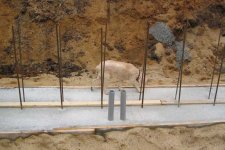
Good comments by all. Here's a picture of the "sweeps" coming up through my footing. I put in a 2nd on for telephone/communications lines. The sweeps go down below the bottom of the footing and out the bottom. We put some extension pvc pipes on top of the sweeps to get them high enough to avoid being clogged by the pour.
 

Attachments

  • 446020-IMG_4013_rebar_conduit_4x6_L40.jpg
    446020-IMG_4013_rebar_conduit_4x6_L40.jpg
    74.7 KB · Views: 750
/ Electrical through concrete foundation #15  
Here in north Texas, in every house I've seen, electric service comes out of the ground outside the building, up through conduit to a breaker box. This breaker box is then connected through the wall to the service panel inside the building (or garage) where the individual circuit breakers are installed.

I don't know if this is a requirement or if thats just the way builders like to do it.
 
/ Electrical through concrete foundation #16  
bebster...... I believe that it is time to change your avatar picture from the JD to the Cocker Spaniel..... that sure is a sweet looking dog..... /forums/images/graemlins/grin.gif

Alan...... the difference between what is being done in this post and a home are different situations. In a home situation, you have a meter that the underground PVC is connected to first and then it goes to the electrical panel in the house. If the meter is located on the pole in a remote location, then there is a disconnect switch just under the meter before the conduit and wire enter the ground and at the opposite side, where it comes out of the ground it goes up the side of the home and in through the wall. I this instance, the power is coming from inside the homes electrical panel and going to a sub panel in the garage. The NEC (National Electrical Code) deals with each type of installation differently depending on the type of building and other factors that are too many to get into in a general discussion such as this....
 
/ Electrical through concrete foundation #17  
I would also wrap a little insulation or slide a piece of pipe wrap on the pipe, it allows room for pipe to expand, which will help cracking in slab that usually will start at a point like that. It also allows you to move the pipe some to corect alignment

1 1/2" conduit would work for the wire size for that distance and amps- it also fits better on a 2x4 wall- 2" pipe thru a 2x4 plate don't leave much wood
 
/ Electrical through concrete foundation #18  
Good thought, however I did try the insulation once and it wasn't all that successful. What I did learn is that a 2 1/2" PVC pipe will slip over 2" PVC pipe nicely. If you want a tighter fit, you can use some tape on the inside pipe. You could do this if you wanted some "fudge factor". I wasn't thinking of the pipe coming up inside the wall, but more likely the sub panel would be surface mounted to a piece of plywood. Since this is a garage, there is no need to conceal the wiring and a surface mounted panel is easier to wire and make changes to later on. This is a personal choice, nothing more.
 
/ Electrical through concrete foundation #19  
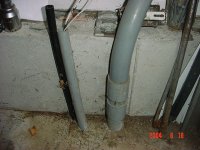
Here is what I used for mine. The black pipe is for a future water line if I ever decide to put water out there. The smaller grey pvc pipe has the cable and phone line in it. The larger pvc pipe is the power line and goes all the way up to the breaker panel.
 

Attachments

  • 446105-DSC01683.JPG
    446105-DSC01683.JPG
    62.3 KB · Views: 608
/ Electrical through concrete foundation #20  
Thanks for clearing that up Junkman. After posting it, I thought about it and realized the difference. I am planning a well house and I will certainly bring the power into the building underground. Makes no sense to do otherwise especially if its allowed.
 

Marketplace Items

2023 WRANGLER 5500T ARTICULATED WHEEL LOADER (A58214)
2023 WRANGLER...
500 GALLON STEEL FUEL TANK (A60430)
500 GALLON STEEL...
UNUSED SDLANCH 20'X20' HIGH END CARPORT (A60432)
UNUSED SDLANCH...
WATER TRAILER (A58214)
2013 Nissan Rouge SUV (A59231)
2013 Nissan Rouge...
2011 VOLVO A40F OFF ROAD DUMP TRUCK (A60429)
2011 VOLVO A40F...
 
Top