generator to home panel connection

   / generator to home panel connection #21  
larryccf, panel boxes are designed to be customer accessible both for maintenance and for the installation of new circuits. I didn't say it wouldn't work as designed, I said it was a bad design because it allows the interlock to be removed totally just with the simply act of removing the panel cover. The other point I don't like about that system is how do you know the main breaker is actually open when you flip the lever?? The breaker is totally sealed and there is no way to check it without removing the panels covers which disables the interlock. Transfer switches are designed so that they have a visible opening that can be verified by opening the enclosure, which does not bypass the interlock function at all plus they are constructed much more robust. The chances of one failing to open the circuit to the utility when operated are slim to next to impossible. A good interlock system won't allow you to circumvent it easily, if at all.

"i've also been told that it's a common practice today, in light of the proliferation of residential generators, for lineman to disconnect & isolate a circuit before working on it "

When so many customers can be fed off one transformer, it is impractical to isolate every circuit and sometimes impossible to ABSOLUTELY KNOW FOR CERTAIN that you have them all. Circumstances enter into it. Lots of times there is just one District Officer working by himself. Most connections up the poles are crimped and if you think outages take a long time to fix now, add on the time require to isolate every service and then reconnect them all. It is NOT the responsibility of the utility to guarantee there is no backfed condition, it is the responsibility of the customer to guarantee he cannot backfeed into the utilities system.

"i'm not sure how an interlock kit, properly installed and used creates a safety hazard"
An interlock system that is so easily circumvented is by definition a safety hazard.

"both times they asked me about the interlock kit and i told them i'd made it and showed them the letter from my county bldg inspector's office approving it - both times, after inspecting it and how it functioned and was connected, neither tech from utility company said word one about the interlock kit regarding any danger to their lineman - i feel safe in assuming if they felt there was a scenario that was potentially dangerous, they'd have said something"
I have heard of and seen inspectors and techs that were less than adequate,to put it politely. If they think this is a good design, I lump them in with the "less than adequate" group for the reasons I have already listed.

"they still haven't replaced the underground cable leading up to my house meter - apparently, their words, a mole or something has broken the insulation on one leg or wire and moist soil grounds it out when it rains but it hasn't been permanent outage or occurred often enough so they've left without replacing it"

This cavalier attitude from the utility to a customer is almost unbelievable! They KNOW there is definitely a problem with their service and they won't fix it until it fails totally??? Before that happens (and it WILL happen), you will experience worse and worse problems with voltage drop on that leg to the point that appliances/equipment may burn out. If the neutral goes, a lot of stuff can be burned out on both hotlegs. Google "open neutral" to see what happens. The utility knows this can happen. They can't NOT know, it is so basic. This is the sort of thing that makes me right teed off! You can bet money that if this was the service drop to the utility personel or their friends, they would have it repaired tout de suite!

larryccf, please don't take any of this personally, it is not meant to be and I really do think you did an excellent job of copying the commercial unit. Using epoxied-in-place acorn nuts on the back prove you are thinking and trying to make it as safe as you can. I understand the desire to use something much cheaper than a regular transfer switch which I know is very expensive.

It's still not a good design!
 
   / generator to home panel connection
  • Thread Starter
#22  
on the basis you've stated it, i can see (and respect) where you're coming from - yes, if someone, a stuck on stupid, pulled that panel cover, then all safety locks are out the window

basically i'm the only person that operates the gen in an outage, and if i'm on the road, my brother in law will but he knows the system and that was main reason for the red label - for his benefit. But neither of us would work an electrical circuit - i'm adverse to 120/240V circuits - i'll fool with 12V all day long but don't care to learn what i don't know the hard way on house wiring.

the part about the equipment burning out on that one leg just gave me more motivation to raising a little more **** - agee, i felt it was cavalier on their part, but i saw it at the time as trying to save on costs as all the utilities (from reports) have been trying to do the same for a number of years - i know where they used to come thru and cut the trees every 2-3 years (under the power line running across the back of the property), they now come thru every 5-6 yrs

tks for the heads up on the "dropped leg" bit - wish my electrician would have said something along those lines
 
   / generator to home panel connection
  • Thread Starter
#23  
on the basis you've stated it, i can see (and respect) where you're coming from - yes, if someone, a stuck on stupid, pulled that panel cover, then all safety lockouts are out the window. On the main breaker opening all the way, there's about 1/8" gap between the handle and that plate when it's thrown off that you can hear the audible clik of it throwing all the way

basically i'm the only person that operates the gen in an outage, and if i'm on the road, my brother in law will but he knows the system and that was main reason for the red label - for his benefit. But neither of us would work an electrical circuit - i'm adverse to 120/240V circuits - i'll fool with 12V all day long but don't care to learn what i don't know the hard way on house wiring. If i move, that interlock kit will have to leave with me.

the part about the equipment burning out on that one leg just gave me more motivation to raising a little more grief with utility company - i agee, i felt it was cavalier on their part, but i saw it at the time as trying to save on costs as all the utilities (from reports) have been trying to do the same for a number of years - i know where they used to come thru and cut the trees every 2-3 years (under the power line running across the back of the property), they now come thru every 5-6 yrs

tks for the heads up on the "dropped leg" bit - wish my electrician would have said something along those lines
 
   / generator to home panel connection #24  
Sorry Larry... I did assume.. good luck to you like i said nice looking job,, Oooo and I also assumed that in the begining when you said you were useing an old dryer outlet it was 30a... In our part of the country it is 30a.. "per NEC" codes..
 
   / generator to home panel connection #26  

Attachments

  • 100315_lg.gif
    100315_lg.gif
    6.9 KB · Views: 267
   / generator to home panel connection
  • Thread Starter
#27  
Sorry Larry... I did assume.. good luck to you like i said nice looking job,, Oooo and I also assumed that in the begining when you said you were useing an old dryer outlet it was 30a... In our part of the country it is 30a.. "per NEC" codes..

no problem
 
   / generator to home panel connection #28  
The only idiot proof and truly safe way to hook a generator to a home is if your off grid, anything electrical/mechanical can and will break!
I like the design, wish I could use it but I am off grid!
Send the ninjas now, before a dog gets hurt!!!!!
I believe in safety but where does it end? If we cut all trees down, less downed power lines, much safer for the linemen,right?
 
   / generator to home panel connection #29  
   / generator to home panel connection #30  
maybe they give a break on shipping? lol
 
   / generator to home panel connection
  • Thread Starter
#31  
The only idiot proof and truly safe way to hook a generator to a home is if your off grid, anything electrical/mechanical can and will break!
I like the design, wish I could use it but I am off grid!
Send the ninjas now, before a dog gets hurt!!!!!
I believe in safety but where does it end? If we cut all trees down, less downed power lines, much safer for the linemen,right?


got it on the calendar for first thing tomorrow morning -
as far as off grid, that's where i'm headed, off grid

but want to do it in steps - noticed honda came out with a "cogenerator" - ( Honda Power Equipment - Honda Home Energy: Micro Combined Heat and Power )
pretty neat idea, basically a cabinet the height & width of a washing machine but half as deep front to rear. Inside, a 160cc liquid cooled honda single cyl engine connected to a 1.2KW generator, set up to run on natural gas (or propane)

idea is, the cogen is connected to your furnace's controls, including the thermostat - and the radiator to the engine is in a cabinet connected to your duct work (they also have unit for hot water furnaces). Every time your furnace is getting ready to come on, the cogen fires first, and is putting the heat from the radiator into the ductwork, so you capture the heat coming off it. 2nd, they've got a catalytic convertor on the exhaust, and basically using it to help capture any residual heat and i believe from unburnt gases as well. but as it fired up just before the furnace, it's turning a 1.2KW gen

the bad part - someone at honda was smoking some pretty serious homegrown - they won't sell that unit - they partnered with ECR Internationall in the northeast, who won't sell it unless you buy a complete pkg including their forced air furnace (they said this after confirming to me that it will work with any forced air system).

Price on a furnace/cogen pkg - $20K. I just had a high end HVAC firm price me for a new 95% nat gas furn to replace my 20 yr old unit - full retail, installed $4600. So at best, they're pricing that cogen unit at $15,600


i ran thru the basic math if i were to try to build a homemade version - i've got a spare honda 2 cyl liquid cooled eng i'm rebuilding, and was rebuilding to combine with a 5-8KW gen head.

per honda's specs, that 13 hp eng burns .84 gal hour at full load, i converted the energy value of gal gas into "therms" or 100 CCF nat gas, and it worked out my per kwh cost for electricity, before allowing for heat recapture, would be 17 cents (local rate is currently 9.6cents). But if i were to recapture all the heat energy from the nat gas that engine is burning, then my cost per kwh drops down to 2.6 cents an hour (assuming the furnance would have burned that same amt of nat gas to generate heat). that 2.6 cents/kwh doesn't allow for any depreciation, maintenance, amortization costs.

now the issue is, that engine doesn't run at a very high efficiency rate, ie energy from gas input, so i'd need to learn catalytic converters to see what can be done to increase the energy capture from that gas flowing thru unburnt.

If that can be done (and right now that's a questionable "IF"), my thinking was to have a battery bank of maybe 6 batteries, with an inverter, and let the gen recharge those - let it run in the evening for 2-3 hours. And run off batteries for as much as possible.

I'm waiting for solar panels to get more affordable and believe that will be happening in 2-3 years with some of the advances i've read about.

negative - this system is only good in the winter, unless i set up a way to transfer the captured heat into the hot water heater (the honda cogen will also do that, per ECR).

the catalytic converter part, way back thru college in the late 60s, i worked mechanicing at a car dealership - still know a few of the folks i worked with, one of them is currently a Tech for nissan - hoping i can get some useful info from him - i just have zero knowledge of catalytic converters other than they run hotter than ****
 
   / generator to home panel connection #32  
I had an electrician hook up my generator and he used one of the simple plates on the main panel. I think he said the part cost about $30.
I bought a propane generator at Home Depot for $1200 and spent almost double that by the time it was wired and piped in. Best money I've ever spent.
FC
 
   / generator to home panel connection #33  
If you have a nice home stay out of your breaker box with a generator. Don't back feed the house. Power things directly from the generator or to a power management system installed by someone qualified. If not done properly at least it will melt all the wiring in your house. At worst it will burn your house down.
 
   / generator to home panel connection #34  
Although I agree that the interlock would not be 100% safe given an idiot can remove the cover and disable the interlock I still think this is a really elegant solution and I think the theory is sound (good job too). I do however think that without a CSA/UL sticker I would be worried what my insurance company might think if there was ever an electrical fire (related to the generator or not). They are always looking for excuses to refuse to pay!

I also wanted to throw my hat into the ring and comment on the generator backing feeding the electrical grid. I will assume straight off that this is not a great idea but I don't think the generator would do it for long before "removing" itself.

Lets say you have accidentally connected your generator to the dead utility company lines by removing the panel and disabling the interlock and having both generator and main breaker on. This would mean your generator will be driving the secondary of a very large transformer, attempting to power your house and the neighbors (on the same transformer or down the road). This will represent a very serious load to the generator indeed! I would argue that this would cause the generator to draw a lot of current and trip one of the breakers in the system (either the generators or the one in the panel).

There might be dangerous voltages on the line but not for long! I seriously wonder how many times someone would keep resetting the breaker before deciding something was up!? ;-)

I am also curious as to how you could melt all the wires in the house? The breakers should be preventing that. Any personal experiences someone might share?

Cheers,
S.


------------------------------------------------
Don't expect the world to make sense. It doesn't!
 
   / generator to home panel connection #35  
There are times in a mans life that he needs to step aside and let the pro do what they do best.

With electricity it is never s good idea to try and save a buck and jeopardize safety. You've got codes to deal with and on and on.

My suggestion is bring in a pro and just get it done right no matter what you
do.
 
   / generator to home panel connection #36  
I someone is not comfortable ,then hire someone. you might get a pro and you might not, unless you have a good reference. But these devices are approved so...
 
   / generator to home panel connection #37  
So we are using a female plug on the system side of the setup. And a male plug on the genset side. ........Not on my watch.
 
   / generator to home panel connection #38  
Yes on the wall is a female outlet twist lock on. same as on the generator. Thus you need a cord with a male on each end. completly safe unless you grab the male prungs that stick out. Thats the point You have to be careful . But what is the alternative? a male rescessed outlet plug?
http://www.federalindustrialsales.com/images/electrical/hbl2751.jpg

this cord end would only be live when the generator is started. So the cord is plugged into the wall outlet first then the generator started.simple procedure. And being of the twist variety I guess no one will use it in a regular outlet and find the female end live.
I dont believe there is any other alternative. thus the lack of replys other than is unsafe.
only other way i see is to have a disconnect box with a line out that would have to have a female twist to plug into the generator and then youd be relying on the disconnect to be OFF when you are not using it. padlock perhaps but far more likely to remain energized.
 
   / generator to home panel connection #39  
Yes on the wall is a female outlet twist lock on. same as on the generator. Thus you need a cord with a male on each end. completly safe unless you grab the male prungs that stick out. Thats the point You have to be careful . But what is the alternative? a male rescessed outlet plug?

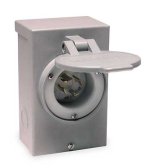
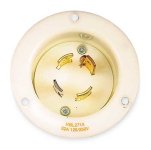
I support that the manual back-feed lock out strap works safely as advertised (if it is installed correctly), but DO NOT! DO NOT! DO NOT! mount a female outlet on the house side that you plan to power. YES there are male outlets for that side (see images). Someone with even less knowledge of this than you could kill themselves if they were to have a double ended male plug plugged into the gen set and the other side laying loose
 

Attachments

  • L14-30.JPG
    L14-30.JPG
    7.6 KB · Views: 332
  • L14-30 (2).JPG
    L14-30 (2).JPG
    12.4 KB · Views: 466
  • XL-3D090.JPG
    XL-3D090.JPG
    10.4 KB · Views: 137
   / generator to home panel connection #40  
Lets say you have accidentally connected your generator to the dead utility company lines by removing the panel and disabling the interlock and having both generator and main breaker on. This would mean your generator will be driving the secondary of a very large transformer, attempting to power your house and the neighbors (on the same transformer or down the road). This will represent a very serious load to the generator indeed! I would argue that this would cause the generator to draw a lot of current and trip one of the breakers in the system (either the generators or the one in the panel).

As a Journeyman Lineman I can say without a doubt that it is absolutely possible to backfeed through a transformer and energize neighbours services. Depending on the time of day and time of year, there may be so little combined load that the generator handles it very well! And who's to say the dangerous voltage always has to be the higher voltage? 120V is more than adequate to cause ventricular fibrillation. Also, read up on shunt wound generators. They will drop off output voltage as resistance load goes up. Enough resistance load and they will run but not produce any voltage. A Lineman can check for voltage, find none, and then disconnect enough load that the generator is able to produce voltage again. This is NOT a hypothetical situation, it has happened.

There might be dangerous voltages on the line but not for long!

Are you saying you consider it acceptable to backfeed into a transformer and produce dangerous voltages if you only do it for a short time? How long do you think you could handle 14,400 volts going through your body before you were harmed?


Once again: It is NOT the responsibility of the utility to guarantee there is no backfed condition, it is the responsibility of the customer to guarantee he cannot backfeed into the utilities system.
 

Tractor & Equipment Auctions

2021 Kubota SVL75-2 Track Loader (A56438)
2021 Kubota...
DEUTZ MARATHON 60KW GENERATOR (A58214)
DEUTZ MARATHON...
Electric Diesel Fuel Pump with Hose Reel (A55851)
Electric Diesel...
2015 TEXAS PRIDE TRAILER  30 FLATBED GOOSENECK TRAILER (A58214)
2015 TEXAS PRIDE...
2014 MAGNUM PRODUCTS LIGHT TOWER COMBO (A55745)
2014 MAGNUM...
2017 CATERPILLAR 120M2 MOTORGRADER (A59823)
2017 CATERPILLAR...
 
Top