geothermal pond loop?

/ geothermal pond loop? #41  
Thanks Chilly,
I just spoke to a man who sells the heat pumps. He was nice enough to give me some good time and answered many questions. He's been using a well-dump system for the last 30 years and my well will work with that system. Not sure that I want to do a dump even though I have 20+ gallons per minute flow, I like the idea of running it back to the aquifer. The easiest set up is the dump though and it's very efficient at 175 feet down it's just about right for my 2 ton needs. The dump means I'll be putting about 180 gallons an hour into the dry well, probably a lot less though as the pump will probably only run 15 minutes per hour on most days. Let's see, that comes out to 180/4 or 45 gph. I'll have to think about it.
Rob

Be careful of your water quality, if it's hard at all it'll dramatically shorten the life of your heat exchanger. With a closed loop system you have much better control over the water in it.

Sean
 
/ geothermal pond loop? #42  
Be careful of your water quality, if it's hard at all it'll dramatically shorten the life of your heat exchanger. With a closed loop system you have much better control over the water in it.

Sean

Thanks, I'll check the water. I think Hydron has limits on their site.
Rob
 
/ geothermal pond loop? #43  
The first 450 feet of our 500' loop is only in about 4-5 feet of water, then it drops down to 10-15' for the final 50' before it loops back towards the house. Two ton unit.
Our water is VERY soft but acidic so a closed loop was a no brainer.
Our installer/supplier had been involved with some "direct exchange" units many years ago but none of the copper has lasted longer than 10-15 years due to the acid soil conditions.
I also looked into a stainless steel plate heat exchanger but didn't have enough depth of water.
 
/ geothermal pond loop? #44  
Fluffed coils are known as slinkies. Most horizontal installs use slinkies, as it takes less ground area for a relatively small increase in the amount of pipe. Almost all pond installs also use closed loops, because of water issues. Most people who do pump and dump do it because they sit on a very good aquifer.
 
/ geothermal pond loop? #45  
There are also vertical closed systems. My brother sells the equipment in Europe. They are popular because most houses sit on small parcels. They are tricky to design correctly due to the fact that wells are expensive. There is a fine line between overkill (costly) and proper function. He told me that they design them such a way that the well will be about halfway frozen at the end of the heating season.
 
/ geothermal pond loop? #46  
Fluffed coils are known as slinkies. Most horizontal installs use slinkies, as it takes less ground area for a relatively small increase in the amount of pipe. Almost all pond installs also use closed loops, because of water issues. Most people who do pump and dump do it because they sit on a very good aquifer.

I do, 20+ gpm. The driller told me I could easily have 50 gpm but because no one uses that much they just call it 20+. I can dump it into my stream which is about 25 feet away from it. The trouble is that i have a lot of iron and if I remember my PH is high.
The beauty of well dumps is that you get warmer water, usually around 55F as opposed to 42F for ground loops.

Rob
 
/ geothermal pond loop?
  • Thread Starter
#47  
I didn't notice the thread was still active{my bad} thanks for all the advice. From everything I'm learning{gathering} it seems that inground{closed loop} will be my best bet. I also read that geothermo works best in clay type soils below frost grade{7'+ down for this area}. I curse this clay soil of ours but maybe it isn't such a bad thing after all :). My next biggest issue will be rocks{boulders}, we grow them in this area.

Are there any sites that explain the pumps/electronics of the systems?
 
/ geothermal pond loop? #48  
I didn't notice the thread was still active{my bad} thanks for all the advice. From everything I'm learning{gathering} it seems that inground{closed loop} will be my best bet. I also read that geothermo works best in clay type soils below frost grade{7'+ down for this area}. I curse this clay soil of ours but maybe it isn't such a bad thing after all :). My next biggest issue will be rocks{boulders}, we grow them in this area.
Are there any sites that explain the pumps/electronics of the systems?

20 20,
I have the same soil (two rocks for every dirt) and my top soil ends at about 24" with clay below that. I was thinking about digging a hole and burying a temperature sensor and putting one in my pond too. I have a geothermal installer comingout tomorrow, I'll post his professional opinion after we talk.
Rob
 
Last edited:
/ geothermal pond loop? #50  
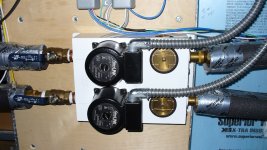
Here's a shot of the pump that was installed with my system. This is for 8 tons of cooling. I have a similar pump center for a 3 ton, and the only difference is it has only one pump on it.

The brass circles on the right are valves that come out on sides (well, top and bottom in this pix) that allow the water to be pumped in, air pumped out, and allow the methanol to be added to the system (as an antifreeze).

These are 240V pumps. They are labeled as drawing 1.8 amps each, listed as 377 Watts (yeah, the math doesn't quite work out....). You can also see the valves so you can work either the heat pump or the field independently.

IIRC, the system is pressurized at about 50 PSI. The two lines go outside, and the manifold pit is buried. It's clear from various posts that how and where the manifold is done varies greatly, and it's not too hard to figure out the pros and cons of each approach.

The wires above are not related, they go to the outbuilding. You can see the bottom of the gas tubes (just like telephone company uses) at the top of the picture. It was a big win running 5 3" pipes for 80 feet so they were way outside the perimeter of the house. It let this field be installed after construction, and let me get things to the outbuilding. I also ran a 3" electrical conduit. I mention this because nature abhors a vacuum, so while the ground is open thing about if there is anything else you want to put in there.

Pete
 

Attachments

  • hp_flowcenter_small.jpg
    hp_flowcenter_small.jpg
    461.5 KB · Views: 325
/ geothermal pond loop? #51  
Here's a shot of the pump that was installed with my system. This is for 8 tons of cooling. I have a similar pump center for a 3 ton, and the only difference is it has only one pump on it.

The brass circles on the right are valves that come out on sides (well, top and bottom in this pix) that allow the water to be pumped in, air pumped out, and allow the methanol to be added to the system (as an antifreeze).

These are 240V pumps. They are labeled as drawing 1.8 amps each, listed as 377 Watts (yeah, the math doesn't quite work out....). You can also see the valves so you can work either the heat pump or the field independently.

IIRC, the system is pressurized at about 50 PSI. The two lines go outside, and the manifold pit is buried. It's clear from various posts that how and where the manifold is done varies greatly, and it's not too hard to figure out the pros and cons of each approach.

The wires above are not related, they go to the outbuilding. You can see the bottom of the gas tubes (just like telephone company uses) at the top of the picture. It was a big win running 5 3" pipes for 80 feet so they were way outside the perimeter of the house. It let this field be installed after construction, and let me get things to the outbuilding. I also ran a 3" electrical conduit. I mention this because nature abhors a vacuum, so while the ground is open thing about if there is anything else you want to put in there.

Pete

Hi Pete,
What I'm weighing is the difference in cost on a daily basis for a field or my well. That is, does the well that has higher temps(~55F) and the need to pump water up 175 feet every time the system calls for it cost more or less to run than pipes run out in my field or pond that are 6 to 7 feet down but only run ~42F? Also the fact that if there's a failure your pulling your well pump up.
Rob
 
/ geothermal pond loop? #52  
Hi Pete,
What I'm weighing is the difference in cost on a daily basis for a field or my well. That is, does the well that has higher temps(~55F) and the need to pump water up 175 feet every time the system calls for it cost more or less to run than pipes run out in my field or pond that are 6 to 7 feet down but only run ~42F? Also the fact that if there's a failure your pulling your well pump up.
Rob

it is kinda comparing apple to oranges to a certain point.

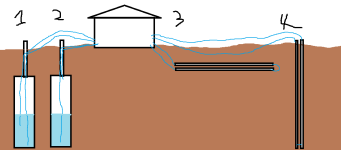
#1 in diagram (pump is either in well or in house) there will be no difference between #1 in diagram and #3 in diagram and #4 in diagram exception friction loss of pipe, and possible thermal mass for heating and cooling.

#2 in diagram, has a pump located in bottom of well. and pumping water up to house. and then the return water is just falling back down into the well. this to me would be the worst when speaking $$$ both long and short term.

#3 in diagram is horizontal loops same as 1 and 4

#4 in diagram is vertical loops same as 1 and 3

in above i am looking at friction loss, or static head in feet loss, which can add up rather quickly. the more friction loss you have. more pump power you will need.

when both ends of pipe (sending and returning lines) both end below the water line in a well. there is no static head. but as soon as one or the other end of pipe ends up above the water line. then you end up with #2 in diagram.
 

Attachments

  • types geothermal.png
    types geothermal.png
    19.4 KB · Views: 222
/ geothermal pond loop? #53  
There are also vertical closed systems. My brother sells the equipment in Europe. They are popular because most houses sit on small parcels. They are tricky to design correctly due to the fact that wells are expensive. There is a fine line between overkill (costly) and proper function. He told me that they design them such a way that the well will be about halfway frozen at the end of the heating season.

Closed loop vertical and closed loop horizontal are designed the same. The length of the loops depend upon the thermal conductivity of the soil or rock you put the loop in. Rock has an average thermal conductivity of 1.4 and clay is .64 (Btu/hr ft F). With a vertical system you have to grout the hole after the pipe is installed, with a thermal conductive grout so it seals up the hole. Bentonite is normally used. With a horizontal loop you need good soil washed in around the loop pipes. You don't want rocks and even sand around the pipe, as it leaves air pockets. If you have a lot of large rocks, your installer will probably suggest vertical loops. A pump and dump, or open loop system, will require a much larger pump than the small circulation pump used in the closed loop system, so they are not as efficient, but as someone pointed out, the water temp will be constant, and a little better for heat transfer. The problem is the minerals in the water will wear out a heat exchanger much faster than a closed loop system, so the life of the equipment can be a lot shorter.
 
/ geothermal pond loop? #54  
Closed loop vertical and closed loop horizontal are designed the same. The length of the loops depend upon the thermal conductivity of the soil or rock you put the loop in. Rock has an average thermal conductivity of 1.4 and clay is .64 (Btu/hr ft F). With a vertical system you have to grout the hole after the pipe is installed, with a thermal conductive grout so it seals up the hole. Bentonite is normally used. With a horizontal loop you need good soil washed in around the loop pipes. You don't want rocks and even sand around the pipe, as it leaves air pockets. If you have a lot of large rocks, your installer will probably suggest vertical loops. A pump and dump, or open loop system, will require a much larger pump than the small circulation pump used in the closed loop system, so they are not as efficient, but as someone pointed out, the water temp will be constant, and a little better for heat transfer. The problem is the minerals in the water will wear out a heat exchanger much faster than a closed loop system, so the life of the equipment can be a lot shorter.

My thoughts exactly.

Sean
 
/ geothermal pond loop?
  • Thread Starter
#55  
A pump and dump, or open loop system, will require a much larger pump than the small circulation pump used in the closed loop system, so they are not as efficient, but as someone pointed out, the water temp will be constant, and a little better for heat transfer. The problem is the minerals in the water will wear out a heat exchanger much faster than a closed loop system, so the life of the equipment can be a lot shorter.

That is why I figured I'd go with a closed loop system, the water in this area is very hard. I don't know of one person within a couple miles that has nice clear water.
 
/ geothermal pond loop? #56  
I had an open loop at the other house, got 12 years out of it. Shut it down because the well capacity was dropping. Put it in because it was easy (ran of of the existing well) and the switch to trying out a geothermal was a last minute decision. Vertical or horizontal, not much pipe cost difference on a closed loop and the pump is only combating friction, not always doing heavy lifting like a open loop from a well.

As for temperatures, there is a ton of YMMV due to latitude and soil differences. Here, ponds might be 40 degrees, horz. loops 51, and wells can run 55 or so.

On my horz. loop I put a light covering of fine clay over the bottom pipe in the trench. This was both to help the thermal conductivity as it was to protect the pipe from any rocks during the fill in. Most geo installers don't do this.
After fill in, I had a pump set up at the pond and flooded each trench many times with a few thousand gallons of water to help get all the air out as the silt from the clay filled any gaps. And of course there's no good way to verify how effective any of that was. It did take about 18 months for the trenches to finally settle out.

As for power cost differences, a 3 ton geo loop would need 1.8 amps on the loop pumps. A well pump (3/4 HP, 8 GPM for 150' well) would need about 6.8 amps. So it's an extra 1.2 KW for the well pump but you might be 5 degrees warmer than a horz loop. Close call since other factors like your cost of electricity, lower run time on the geo unit (due to more heat from the vertical well), possible additional cost of heat exchanger repair if it goes at 10 years on a system with a 20 year life, etc.

I think you could make the number go either way for you, but at the end of the day there are so many factors that are either estimates or SWAGs that it's hard to say. I think an advantage of the closed loop system is less uncertainty. You know how big the circulation pumps are. You don't have to worry about water quality and heat exchanger life. And the few things left that are uncertain are things you can't change like the temperature of the water you get from your loop. I've already weight in on my "I don't like ponds 'cause they're cold" viewpoint.

I suspect that if you knew the difference in water temperature that someone well versed in HVAC design could tell you the difference in run times for some scenario (like taking a 68 degree room of some volume to 72 degrees). You could then compute the electricity costs. But maintaining that temp would then require some knowledge of the cycle time/duty cycle and then you get too many variables such as house insulation, outside temperatures, house air leakage, wind speed and direction, etc.

At some point in every HVAC design, you're punting. It's just some folks are better kickers.

Answers are never easy, are they :laughing:?

Pete
 
/ geothermal pond loop? #58  
Pete,

I think you hit the nail on the head with the uncertainty factor. How well the system holds up, basically avoiding premature trouble, is important to me. No one wants to be sitting in the middle of the winter with a compressor down!

Rob
 
/ geothermal pond loop? #59  
Pete,

I think you hit the nail on the head with the uncertainty factor. How well the system holds up, basically avoiding premature trouble, is important to me. No one wants to be sitting in the middle of the winter with a compressor down!

Rob

My geo has direct electric heat backup built in the hot/chilled liquid accumulator.
 
/ geothermal pond loop? #60  
My geo has direct electric heat backup built in the hot/chilled liquid accumulator.

Mine does too, we used a 40 gallon electric hot water tank for an accumulator or "buffer tank". The elements are still in it and hooked up, just switched off unless they're needed.

Sean
 

Marketplace Items

Leroi 185 PT Air Compressor (A62177)
Leroi 185 PT Air...
2014 MAGNUM PRODUCTS LIGHT TOWER COMBO (A58216)
2014 MAGNUM...
Winchester Gun Safe (A61166)
Winchester Gun...
2025 Wolverine BC-13-72W 72in Brush Cutter Skid Steer Attachment (A60352)
2025 Wolverine...
Misc Chains, Straps, Go Light, Clamps (A62177)
Misc Chains...
New/Unused Landhonor Gas Powered Water Pump (A61166)
New/Unused...
 
Top