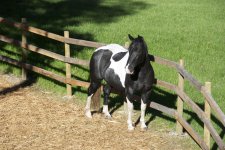
Horse Paddock Drainage - Clay

/ Horse Paddock Drainage - Clay #1  

Dave5264

Gold Member
Joined
May 25, 2009
Messages
376
Location
Near North Ontario Canada
Tractor
08 Montana C5264, 2011 McCormick CX100 XS
Hi Guys, looking for ideas on keeping our paddocks less muddy.

3 horses - 2 sacrifical paddocks 2 - 3 acres each

Our Farm is largely blue clay (at least 8-12feet of clay) under the 4 - 6" of top soil. In spring and fall the sacrificial paddock(s) are completely destroyed (per their name) due to horse traffic in a clay area - zero vegitation remeains and they are re-seeded annually. All that, we can deal with.

The issue now is, My wife is absolutely beside herself with the Mud the hoses have to stand in this spring, feels like a "terrible horse owner". We cannot move them to the summer pasture Grass fields yet (1 no grass growing, 2 they'll desrtoy them, 3 they have to be introduced to grass gradually in the spring to avoid founder).

So right now there is little I can do (so bad i cant even get a 4wd tractor through it), but for next year, any ideas on what I can do to keep them dry (er) ? doesnt have to keep the entire field Dry, just give them a choice so if they want to stand dry, they can.

here's what has NOT worked so far:

Natural slope - all paddocks are on hill sides, to reduce standing water - i can only imagine what it would be like if thery were flat

Filled one area in the "Run -in" shed with straw to temporarily create a dry spot - short term limited fix, done many times

Excavated one area (so they'd have a dry area to stand) and sand filled it - just filled with water and the sand got worked in to the clay .

Dug Drainage trenches in the field - got filled in with traffic over time (few months)

Dug Drainage trenches and filled & with gravel -Gravel got worked into the clay and back to square one.

I have one area on a hill that I still need to eradicate from Choke Cherries, and thay has a pure Gravel base (no clay) but that may take a longer term

Ideas welcome - wife unhappy = me unhappy

thanks
 
/ Horse Paddock Drainage - Clay #2  
Is the water that is making 2 sacrificial paddocks wet from rain or ground water?

Are the summer paddocks draining water on to the 2 sacrificial paddocks?

If its rain water running on to the sacrificial paddocks I'd get some of that clay you have and make a terrace at the top of each sacrificial paddocks to direct the water away from the sacrificial paddocks? You may have to make more than one terrace per sacrificial paddock.

If it's ground water you're out of my league.
 
/ Horse Paddock Drainage - Clay #3  
this is an idea hopefully to fuel the idea fire here on tbn

but what about a 12-18in ditch with a perforated piped then clean rock all with in a trench with geo fabric then a mix of sand and suitable footing./ grass growing material in a thin layer

then drain the pipes to daylight maybe include clean outs?
so basically make the ditches into drains
 
/ Horse Paddock Drainage - Clay #4  
this is an idea hopefully to fuel the idea fire here on tbn

but what about a 12-18in ditch with a perforated piped then clean rock all with in a trench with geo fabric then a mix of sand and suitable footing./ grass growing material in a thin layer

then drain the pipes to daylight maybe include clean outs?
so basically make the ditches into drains
 
/ Horse Paddock Drainage - Clay #5  
I am really hoping you get some ideas.

I am on that same clay-except it is black and it is about 2-3K miles south of you.

This year we tried a thick bed of cypress mulch as a test. For what little rain we got, it worked okay, but is also breaking down quickly from the horses.
 
/ Horse Paddock Drainage - Clay #6  
It's been pretty wet here too. I put pea gravel "pads" in my sacrifice pasture. We also have a run in shed that has a rubber horse mats over a crushed gravel floor where they can dry there toes out. We don't like to see them standing in mud all the time either.
 
/ Horse Paddock Drainage - Clay #7  
I put a total of 8" of limestone screenings (#9's to dust) in my paddock around the barn, over a two year period. There is a gentle slope away from the barn. I wet them down good, and rolled them with the Bobcat after I had it graded out. Right now, it is still good an solid, even with al the rain we've had. :thumbsup:

Just be sure to use saltwater limestone, not fresh water limestone. Fresh water type will turn to mud, within a couple years...
 
/ Horse Paddock Drainage - Clay #8  
Try a small patch of pea gravel. No prep. Just dump it on the ground.
 
/ Horse Paddock Drainage - Clay
  • Thread Starter
#9  
Thanks for the ideas guys.

The paddocks are at the highest spot on the property and are one each side of a hill. no water drains on to them, all the water is from rain, we have had alot this spring. without horses, it sheds the water fine, but the hoof traffic creates 1000's of pockets in the softening spring clay to catch the water on the entire surface of the paddock -- even when a gravel filled ditch was channeling some water the other surface of the paddocks was still like soup. part of the issue here is, as the frost comes out of the ground it leaves the clay very soft even with no rain, so these hoof sized pockets occur no matter what.

I like the pea gravel idea and the saltwater limestone. maybe try that when it dries out so i can get in. I did put down sand and gravel last year, 10-12 tonnes of it in a 10'x20' area, worked for 1 year, now you cant even tell it was there !

I just this morning put 400lbs of cedar saw dust and shavings on an 8'x8' patch outside the run-in shed (stomped it in the soak up the water) and more straw in the shed. The shavings/saw dust made a small improvement. decent improvement for the $6 whole dollars the bags of saw dust cost me. Will be going back for more once my back recovers from lifting the bags.
 
/ Horse Paddock Drainage - Clay #10  
Hi Guys, looking for ideas on keeping our paddocks less muddy.

3 horses - 2 sacrifical paddocks 2 - 3 acres each

Our Farm is largely blue clay (at least 8-12feet of clay) under the 4 - 6" of top soil. In spring and fall the sacrificial paddock(s) are completely destroyed (per their name) due to horse traffic in a clay area - zero vegitation remeains and they are re-seeded annually. All that, we can deal with.

The issue now is, My wife is absolutely beside herself with the Mud the hoses have to stand in this spring, feels like a "terrible horse owner". We cannot move them to the summer pasture Grass fields yet (1 no grass growing, 2 they'll desrtoy them, 3 they have to be introduced to grass gradually in the spring to avoid founder).

So right now there is little I can do (so bad i cant even get a 4wd tractor through it), but for next year, any ideas on what I can do to keep them dry (er) ? doesnt have to keep the entire field Dry, just give them a choice so if they want to stand dry, they can.

here's what has NOT worked so far:

Natural slope - all paddocks are on hill sides, to reduce standing water - i can only imagine what it would be like if thery were flat

Filled one area in the "Run -in" shed with straw to temporarily create a dry spot - short term limited fix, done many times

Excavated one area (so they'd have a dry area to stand) and sand filled it - just filled with water and the sand got worked in to the clay .

Dug Drainage trenches in the field - got filled in with traffic over time (few months)

Dug Drainage trenches and filled & with gravel -Gravel got worked into the clay and back to square one.

I have one area on a hill that I still need to eradicate from Choke Cherries, and thay has a pure Gravel base (no clay) but that may take a longer term

Ideas welcome - wife unhappy = me unhappy

thanks

I used to live near Seattle and a lot of horse owners had similar problems. The King County(WA) Soil Conservation District people had a program that helped horse owners with these kind of problems. The had some design information for sacrifice areas( trenches drain rock, fabric, etc).

I'd advise you to do a google search on "horse sacrifice paddocks" , etc and see if you can find some helpful info about solving your problem. If not, try contacting the King County(WA) Soil Conservation District directly and see if they can point you in the right direction.
 
/ Horse Paddock Drainage - Clay #11  
Trying to divert the water away won’t help. Every time a horse takes a step it creates a divot. That divot holds a small amount of water, which makes the ground soft. Then the next divot is deeper because the ground is softer. And so on, and so on …. It just keeps getting worse until it dries up in the summer. I deal with it with cattle as well. Here’s the best solution I’ve seen. The fabric is key.

Viewing a thread - Gravel lane picture
 
/ Horse Paddock Drainage - Clay #12  
How many horses are we talking about?

I have two and know how much ground distrubance they do in the spring. Our land is also on a side slope and we are in heavy snow country as well. Also soil over clay base.

Our pasture is cross fenced and we keep them on the highest level as it dries up faster. How ever our pastures are also somewhat rolling which creates natural changes in elevation, The horses are pretty smart they know where to go to dry out the hooves.

Maybe instead of true ditching you could creat some shallow swales to a good run off spot. the horses can walk through or jump and the water always chooses the path of least resistance. I am thinking something say 10 to 15 feet across at the top to a center depth of 2 to 2-1/2 feet
 
/ Horse Paddock Drainage - Clay #13  
We didn't put our pea gravel down to create dry areas. We put it down for a riding surface. It doesn't sink into the mud like sand or anything else we have tried. It won't pack. The only thing is that is a real pain to remove snow from pea gravel. It is as fluffy as snow and it's hard to tell the difference.
 
/ Horse Paddock Drainage - Clay #14  
Our solution for this is a material called spaghetti hog but trying to hog an area of 2 - 3 acres would be expensive. Spaghetti hog is a forest by product, wood chippings in long strands that weave together to form a mat. We winter our two horses in a smaller area, about half an acre, where we have spaghetti hog throughout to a depth of about 3". Cost initially was around $2400 and we need an additional load per year for maintenance which costs around $600 delivered.

The stuff provides a soft surface for the horses to run around in, stops the area from turning to mud and mush.

We've also put the hog throughout our riding ring and on the surface of the access road up to it. I've attached a shot that shows the material.
 

Attachments

  • Spaghetti hog.jpg
    Spaghetti hog.jpg
    458.5 KB · Views: 1,191
/ Horse Paddock Drainage - Clay #15  
Sounds like you need 'drain tile'. A friend was describing an old farming field he has. And the professional ball fields have pretty fancy drains under them. Out with a potato digger, some geo fabric, gravel, etc to me.

I have used a chipper over the years for on the spot shavings. Ok, a use for the old stuff I have been stacking for the past summer. In any case, it is good stuff for the inevitable low spots. And it's good for the ground in any case. Yes, short term, but you can't get it all at one time.

http://en.wikipedia.org/wiki/Tile_drainage
 
/ Horse Paddock Drainage - Clay #16  
Sounds like you need 'drain tile'. A friend was describing an old farming field he has. And the professional ball fields have pretty fancy drains under them. Out with a potato digger, some geo fabric, gravel, etc to me.


+1 in the field drainage tile.

And not just one line either. Get with a reputable tiling crew and install as many lines as they suggest. That will take care of your spring time ground saturation and make it easier to absorb and shed heavy rains.
 
/ Horse Paddock Drainage - Clay #17  
i used 2 layers (10-12") of 1-1/4 and 5/8 minus gravel base for my paddock areas and fenced them in. they are about 15'x60' and have a 12x14 covered shelter on one end.. this solved my mud problem after fighting it for a couple winters and trying other types of footing (hog fuel, sand, straw, etc). no need to get elaborate mesh, geotext, etc. keep it simple. i keep a seperate sacrifice area which i haven't done anything with. it gets muddy but the horses can at least get out during the day and burn off some energy running, kicking, snorting, whatever. we always wash their feet off when we bring them off of it because the mud will dry around their feet/ankles and cause mud rot which is not pretty.
 
/ Horse Paddock Drainage - Clay #18  
In central Maine we have the blue clay and the wet spring and wet fall conditions. The spring is the worst as the ice melts out of the ground. The 2 horses kill whatever they walk on. If manure gets worked in - within 2 years there's 6" of muck to go through. Adding shavings, sawdust, old hay helps for a day or two but then makes it all really worse - churned muck.

I ditched all around the riding area with open ditches sloped to carry the water away. I sloped the riding area with a high and low point to carry the water away. Then I added gravel with 1" stones 5" to 8 " deep. (all done with delivered gravel, a mini backhoe (Northern tool) and front end loader.)
It has taken a couple of years- but the ground is good as soon as the snow melts for the horses. I work to clear the manure off it (important). I build small roadways for the horses to move to the back field by ditching both sides of the road and dumping the dirt to raise the level of the road then smooth and slope it for runoff. I slope the ditch sides so the horses and step down and up easily. I've covered the road with 5-6 inches of gravel and I have dry roads now with constant running water in the ditches on both sides. Great for their feet and I can drive on it with the tractor - even though the fields have standing water in places.
Figure out where the water goes naturally, then help it get there with the ditches. I do use a culvert when I have to. For a riding ring I would slope lengthwise. Then I would add a ridge running lengthwise down the middle and slope the gravel sideways left and right. Sideways from the middle- the water has less distance to travel to be off it. The long lengthwise slope just encourages all of the water to move out of the area altogether. I think the water both runs off and what amount does go down through the packed gravel, runs off on the dirt below. I think you could add a layer of finer gravel to make a smoother riding surface.
Add manure/clay/organic etc. and the muck will come back. My wife dumped some scoopable cat litter in a wet spot near an edge and covered it with gravel- now that's a slick slimy clay spot. Clay is only good if it is dry - inside a stall where water and moisture cannot travel upwards from the ground.
Good luck.
 
/ Horse Paddock Drainage - Clay #19  
In central Maine we have the blue clay and the wet spring and wet fall conditions. The spring is the worst as the ice melts out of the ground. The 2 horses kill whatever they walk on. If manure gets worked in - within 2 years there's 6" of muck to go through. Adding shavings, sawdust, old hay helps for a day or two but then makes it all really worse - churned muck.

I ditched all around the riding area with open ditches sloped to carry the water away. I sloped the riding are with a high and low point to carry the water away. Then I added gravel with 1" stones 5" to 8 " deep. (all done with delivered gravel, a mini backhoe (Northern tool) and front end loader.)
It has taken a couple of years- but the ground is good as soon as the snow melts for the horses. I work to clear the manure off it (important). I build small roadways for the horses to move to the back field but ditching both sides of the road and dumping the dirt to raise the level of the road then smooth and slope it for runoff. I slope the ditch sides so the horses and step down and up easily. I've covered the road with 5-6 inches of gravel and I have dry roads now with constant running water on both sides. Great for their feet.
Figure out where the water goes naturally, then help it get there with the ditches. I do use a culvert when I have to. For a riding ring I would slope lengthwise. Then I would add a ridge running lengthwise down the middle and slope it sideways left and right. Sideways from the middle- the water has less distance to travel to be off it. The long lengthwise slope just encourages all of the water to move out of the area altogether.
Add manure/clay/organic etc. and the muck will come back. My wife dumped some scoopable cat litter in a wet spot- that's a slick slimy clay spot now.
Good luck.
 
/ Horse Paddock Drainage - Clay #20  
Skim off a few inches of surface and store it in a pile. Grade the remanent surface to the natural slope. Lay down a thin layer of sand followed by geotextile. On top of this put down 2-3 inches [total] of sand and gravel, then another layer of geofabric. Top with at least 4 inches of gravel clay mix. Youll have to touch up the top from time to time as the horses compact it with their hi heels, but itll end your muck by preserving the permeable drain sandwich below.
larry
 
 
Top