hp requirements for disking

/ hp requirements for disking #1  

MarshValley

New member
Joined
May 24, 2010
Messages
3
The implement brochures give widely varying info on how much hp is needed to pull a disk, generally from 5 to 10 hp per foot, which is quite a variation. I'm shopping for my first tractor, for a five acre old walnut grove and building site. Soil is black adobe tending toward dg. I will mostly be rough-cut mowing and moving material around with a FEL, but think I will also want to disk. Terrain is nearly level. Do I really need 40 hp to pull a 4-foot disk? Is that total hp or PTO hp? I'm leaning toward Kubota, JD or NH because of proximity of dealers. Any thoughts? Thanks, NE
 
/ hp requirements for disking #2  
For a disc/chisel/plow, you're looking at engine HP. Also weight and traction. A 40HP tractor can handle anything from a heavy 5' 3pt disc to a lightweight 10' drag disc harrow depending upon conditions.

In general.............a 40hp 2wd tractor mated to a 6-7' mounted tandem disc is pretty safe. You probably won't know for sure until you get your tractor and a disc out there on the place and try to do what you want to do with them to know for sure.
 
/ hp requirements for disking #3  
You need draw bar horsepower and to get that you need WEIGHT to the ground.

The weight of the disk, the soil conditions and the angle of the disks determine how deep it will cut - which, together will the speed you pull at, determine HP needed.
If anything you should be surprised that the range of HP requirement is ONLY 2:1
(-:
 
/ hp requirements for disking #4  
MarshValley,
From your description of work I would consider a 30 hp tractor with fel, rear brush mower, tiller and boxblade. I would recomend a simple drag to smooth out the tilled ground.

Using a tiller will reduce the number of implements you need to get a good seedbed. It will also allow you to select a smaller more compact tractor as well since the need for higher traction is eliminated.
 
/ hp requirements for disking #5  
In these small tractors its ALL about how much weight you have.....as they will spin out before lugging the engine down in most cases. Then too.....a heavy disc will cut deeper which requires more weight and power on the tractor....and so on. It's extremely hard to give a hp requirement because of so many variables.

A tiller can be a better implement for working the land with these little tractors. (here the 5 hp per foot requirement seems to be right). I have both tiller and 5 1/2' disc.....and prefer using my tiller if I don't have allot of rocks and stumps to contend with.
 
/ hp requirements for disking #7  
a ford N can easilly pull a 6.5' 3pt disc.. or a 8' pull disc. N were about 27 pto hp ( later ones ).

now. that said.. the weight of the disc, and how agressive you have it set, along with actual soil conditions will dictate how well it pulls, how deep it goes per pass, and how agressing you can get.

soundguy
 
/ hp requirements for disking
  • Thread Starter
#8  
Thanks for the comments.

Another consideration, also partially hp related, is using a blade. Some tractors can take a front blade; all can take a rear blade on the 3-point. My terrain is nearly level but also somewhat hummocky, and will be more so after I pull some trees. How do rear blades, box scrapers, and front blades compare for light-duty grading? Seems like a rear blade would be harder to use. Is a box scraper of equal (or greater?) utility for grading? Thanks, NE
 
/ hp requirements for disking #9  
box blades are good for moving dirt and general flattening of land. grader blades are more for road maint, or finish grading.

if you hook a stump on a grader blade.. I expect it to bend easilly. can bend a box blade by hooking a stump sometimes too.. especially the lighter ones. remember.. adding a blade to a farm tractor does not make it a bulldozer.

soundguy
 
/ hp requirements for disking #10  
Thanks for the comments.

Another consideration, also partially hp related, is using a blade. Some tractors can take a front blade; all can take a rear blade on the 3-point. My terrain is nearly level but also somewhat hummocky, and will be more so after I pull some trees. How do rear blades, box scrapers, and front blades compare for light-duty grading? Seems like a rear blade would be harder to use. Is a box scraper of equal (or greater?) utility for grading? Thanks, NE

Tractors ain't dozers, so front blades tend to be hazardous to some FELs if used as dozers.
Box scraper is easier to use and I think easier to learn.
GENERALLY a Cat 1 tractor cannot cut hardpack soil without first loosening it.
I use the box scraper with scarifiers down for the first loosening pass over the high spots that I want to take down.
If it is TOUGH and very hard packed I might only use the middle 4 or 6 scarifiers a) to be able to rip through at all b) to reduce the turning moment if an outer scarifier catches something really tough.
So yes, there is greater utility in a box scraper.
 
/ hp requirements for disking #11  
Marsh,

I pull a 6' disk with a JD 2210 in heavy soil. The disk is older, adjustable and fairly light. It needs to be weighted down to do much digging. The tractor is somewhere around 18hp drawbar, and has filled tires and plenty of suitcase weights up front.

In high gear, the tractor will NOT pull the weighted disk at it's most aggresive/angled setting. Moving the disk down to a middle/angled setting the tractor will pull the disk in high gear, uphill slopes are still a problem though.

In low gear the tractor will pull the disk fine in any setting, any slope, but low range does not have the ground speed for the disk to fling and turn the soil over properly.

Typically new disking takes several passes with small bites. For the smaller areas I'm working now a tiller works much better.

In my case, I'm pretty sure 5 more hp disking would be a big difference. More HP would be even better. 20 more HP and I'd probably start wanting a bigger disk.

Hope that helps.

Joe
 
/ hp requirements for disking #12  
The implement brochures give widely varying info on how much hp is needed to pull a disk, generally from 5 to 10 hp per foot, which is quite a variation. I'm shopping for my first tractor, for a five acre old walnut grove and building site. Soil is black adobe tending toward dg. I will mostly be rough-cut mowing and moving material around with a FEL, but think I will also want to disk. Terrain is nearly level. Do I really need 40 hp to pull a 4-foot disk? Is that total hp or PTO hp? I'm leaning toward Kubota, JD or NH because of proximity of dealers. Any thoughts? Thanks, NE

If you want to do this estimate scienterrifically, here's some info

http://www.tifton.uga.edu/eng/Publications/farm tractor.pdf

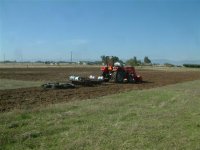
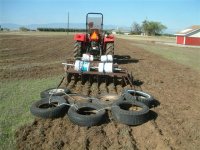
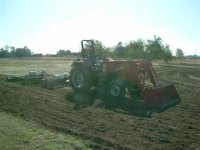
Discs need two things to work effectively: weight and speed. Heavier is better so you need to add weight to small, light weight discs, especially if the soil is hard and gravely. For example, I plow my 6 acre hayfield (very gravely) with an old 6.5 ft Towner offset disc with about 500 lb of added weight (4 concrete weights strapped to the frame of the disc).

DSCF0111 (Small).JPG DSCF0112 (Small).JPG DSCF0114 (Small).JPG

The disc alone probably weighs 700 lb, so my 2008 Mahindra 5525 (54 hp engine, 45 hp pto, 2WD, gear tranny) is dragging about 1200 lb plus a tire drag to bust up the clods.
Speed: I pull that disc 5-6 mph and make several passes at right angles to get the hayfield prepared for planting.
I probably could pull this disc/drag rig with a 40hp (engine) tractor but more hp is usually a good thing to have in your back pocket.
 
/ hp requirements for disking #13  
As the guys said before it comes down to traction. I pull a 11' disc at the local go cart track with my 28HP Jinma but there is no grass, it pure dirt and my tractor is 4 wheel drive with R1 tires and weighs 5,200# with me on it. They have trouble moving it with a 35HP John Deere with R4 tires and not much weight, maybe 3,500#.

My personal disc is a old Ford 6.5' 3 point unit and is a much better fit for all soil conditions.

You need weight, good tires like R1's, and a properly set up disc.

Chris
 
/ hp requirements for disking #15  
The previous comment on Ford n's is right on the mark. The big difference is fuel consumption. I used a 8 ft pull-type on my 1951 8n last year and had the ground ready for planting after discing (3) times. Also, each time discing was less because the cut was wider. With a 6.5 ft, 3-point that I used the previous 18 seasons, it always took 5-6 times before the ground was ready to plant. This year again, my ground is ready for planting after (3) passes with the pull-disc. The bottom line here is that the gallons of gas used with the pull-type disc is well under half what it always took with the 3-point. I now have a strong dislike for 3-point discs for this reason, and I dont think they are a good tool for any purpose. If your jobs are too small for a pull-type or transport disc, you would be much further ahead with a tiller than a 3-point disc. I apologize in advance to all the 3-point disc folks that I usually rile up with comments like these. I just think that these days, fuel is too precious of a commodity to waste with a 3-point disc. Remember folks, it is possible to get the job done, doing less work. Working the ground extra deep in some spots and not even touching it in others allows the 3-point to do more work yet take longer to prepare the ground for planting. Physices does explain it, you just got to go a little past the first chapter of the book.
 
/ hp requirements for disking #16  
The previous comment on Ford n's is right on the mark. The big difference is fuel consumption. I used a 8 ft pull-type on my 1951 8n last year and had the ground ready for planting after discing (3) times. Also, each time discing was less because the cut was wider. With a 6.5 ft, 3-point that I used the previous 18 seasons, it always took 5-6 times before the ground was ready to plant. This year again, my ground is ready for planting after (3) passes with the pull-disc. The bottom line here is that the gallons of gas used with the pull-type disc is well under half what it always took with the 3-point. I now have a strong dislike for 3-point discs for this reason, and I dont think they are a good tool for any purpose. If your jobs are too small for a pull-type or transport disc, you would be much further ahead with a tiller than a 3-point disc. I apologize in advance to all the 3-point disc folks that I usually rile up with comments like these. I just think that these days, fuel is too precious of a commodity to waste with a 3-point disc. Remember folks, it is possible to get the job done, doing less work. Working the ground extra deep in some spots and not even touching it in others allows the 3-point to do more work yet take longer to prepare the ground for planting. Physices does explain it, you just got to go a little past the first chapter of the book.

sso/dd (same snake oil/different day) Doesn't your balloon ever land? Maybe you should have a pull-type hitch installed to that three-point disc you have....so that you can save some fuel?? :laughing::laughing::laughing:
 
/ hp requirements for disking #17  
What gets me in all of these disking threads is most everybody leaves out weight, size of disk blades and type of disk that they are talking about.

ALL of these things make a HUGE difference in what a tractor can and cannot do.
 
/ hp requirements for disking #18  
What gets me in all of these disking threads is most everybody leaves out weight, size of disk blades and type of disk that they are talking about.

ALL of these things make a HUGE difference in what a tractor can and cannot do.


Very good point, a 28" conical blade in the 300 to 400lb/blade on an offset disk is a load in itself.

Also most seem to think a tiller is alot slower than a disk without considering that most of the people here have very small tractors with less tractive force than a good pickup.
 
/ hp requirements for disking #20  
Very good point, a 28" conical blade in the 300 to 400lb/blade on an offset disk is a load in itself.

Also most seem to think a tiller is alot slower than a disk without considering that most of the people here have very small tractors with less tractive force than a good pickup.

Steve,

I'm confused. I've always tried to run disks around 7 mph. Admittedly I've never run anything in the 40 foot wide class (never ran any bigger than 12'.) I've never seen the tractor/tiller combination that could run that fast. What tiller/tractor is as fast as a disc?

Joe
 

Marketplace Items

2016 Ford Explorer AWD SUV (A64557)
2016 Ford Explorer...
Trek (A65640)
Trek (A65640)
2004 Caterpillar 315CL Excavator (A64194)
2004 Caterpillar...
2017 Ford Transit 250 Cargo Van (A64556)
2017 Ford Transit...
2022 EZ-GO ELITE ELECTRIC GOLF CART (A63276)
2022 EZ-GO ELITE...
2012 Peterbilt 337 S/A 17ft. Cab and Chassis Truck (A64194)
2012 Peterbilt 337...
 
Top