Looking at old grain trucks... Need help.

   / Looking at old grain trucks... Need help. #41  
You'll hear it in that ole truck. No insulation in the cab, motor right in front of you, you'll learn the sound of when to shift quickly. Still say buy both. When will you ever have this opportunity again?
 
   / Looking at old grain trucks... Need help. #42  
I agree as about buying both. You said 800-1000ea. He'd probably be happy to see them both go to you for 1600. Think of it as a parts truck or a savings account. The two together will be worth two grand or more pretty much no matter what.
 
   / Looking at old grain trucks... Need help. #43  
Yes, if you can afford and especially have a place to keep under cover I would buy both.

About the 2-speed rear, if it works it can be handy but you don't absolutely need it the way you will be using; and when it malfunctions on an old truck like that it's a problem. Anything vacuum operated on old stuff is potential problems, whether it be wipers, axles or brakes. That's why the comments about brakes; are the trucks vacuum hydraulic or air? Most likely hydraulic and the cylinders and booster can give problems if truck has been parked, so check them out.

It's not true that gearing and top speed has to be the same on both trucks. With a 2-speed rear they could be speced where low range was lower than a single speed straight axle and high range could be higher/faster road gear.

What are the trannies in these trucks, 4-speed or 5-speed? Most likely 4 speed but maybe the 1950 has a 5-speed which could compensate for the single speed axle getting off the line.

Assuming they're both 4-speeds, if the axle is working you can start that one off in 2nd on the road as long as the axle is in low. If the axle's not working or you don't want to take a chance with it you can probably always start out in 1st gear and be OK. If it were me I wouldn't get into split-shifting old stuff like that, why take a chance on busting something or getting hung up between gears like others have mentioned. If the 2-speed works OK, just start off in low range, run thru the tranny gears, and once in top gear on the highway shift the axle into high using the clutch, like using an overdrive; why look for trouble on a nice old truck. If you want to practice downshifting the axle, first try going from high to low without shifting the tranny at the same time; downshifting the axle takes more skill than upshifting and can be harder on the axle if done wrong or something is not working right.

I wonder why the old truck was being used more in recent years than the newer one, I guess you'll find out when you look them over. Maybe more miles on one or it needed something fixed. Check both trucks for rust on the frames, especially where the spring shackles mount to the frame in the back (front too). Look for rusty hydraulic brakes lines which might need replaced.

Good luck and I hope you get both trucks, a lot of parts might be interchangeable. Your old friend seems like a a very nice guy.
 
   / Looking at old grain trucks... Need help. #44  
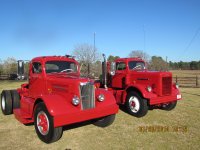
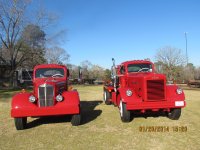
My '56 White WC22 has an Eaton electric shift two speed rear axle. I've never driven it under load but driving it empty takes some getting used to because the Clark 5 speed OD trans is not synchronized. The two speed axle works great. This truck has a flathead 6 cylinder 145 hp White Mustang engine. My '59 White 4400TD originally had a ten speed Fuller Road Ranger trans but I changed it out for an Eaton 13 speed trans. The '59 has a 220 Cummins in it.
You have to remember these veteran trucks were built when the truck speed limit usually was 45-50 mph. They are geared for slower speeds and don't have the power for high speed rear ends unless you're running empty.
 

Attachments

  • white 1.JPG
    white 1.JPG
    100.1 KB · Views: 1,499
  • IMG_2335.JPG
    IMG_2335.JPG
    774.1 KB · Views: 404
  • IMG_1218.JPG
    IMG_1218.JPG
    634.6 KB · Views: 604
  • IMG_1221.JPG
    IMG_1221.JPG
    745.8 KB · Views: 546
   / Looking at old grain trucks... Need help. #45  
My '56 White WC22 has an Eaton electric shift two speed rear axle. I've never driven it under load but driving it empty takes some getting used to because the Clark 5 speed OD trans is not synchronized. The two speed axle works great. This truck has a flathead 6 cylinder 145 hp White Mustang engine. My '59 White 4400TD originally had a ten speed Fuller Road Ranger trans but I changed it out for an Eaton 13 speed trans. The '59 has a 220 Cummins in it.
You have to remember these veteran trucks were built when the truck speed limit usually was 45-50 mph. They are geared for slower speeds and don't have the power for high speed rear ends unless you're running empty.
My neighbor had a White that looked like your '56, may have been a '55. It had 10.00-20 rubber, flathead engine, 5 speed x 2-speed electric axle and he would load 10 ton on an 18 foot body. Is your WC22 a little heavier than that? I had a '56 GMC 18K GVW at the same time, 270 OHV, 4-speed/2 speed electric Eaton. It would run 55+ mph with no problem on the flat highway. The Eaton worked good but 2 times it got water in the motor unit and had to be repaired/replaced. I know it took a toll on the clutch when we were waiting for parts and had to leave the axle in high for a while. You'd be slipping the clutch when backing up with a load or the driver would try to start out in 2nd instead of 1st. These trucks were probably around $4K or less bought new, more for the White of course.
 
   / Looking at old grain trucks... Need help. #46  
JESSE1 said:
My '56 White WC22 has an Eaton electric shift two speed rear axle. I've never driven it under load but driving it empty takes some getting used to because the Clark 5 speed OD trans is not synchronized. The two speed axle works great. This truck has a flathead 6 cylinder 145 hp White Mustang engine. My '59 White 4400TD originally had a ten speed Fuller Road Ranger trans but I changed it out for an Eaton 13 speed trans. The '59 has a 220 Cummins in it.
You have to remember these veteran trucks were built when the truck speed limit usually was 45-50 mph. They are geared for slower speeds and don't have the power for high speed rear ends unless you're running empty.

Both great looking trucks! I like the 59 more though. Awesome set!
 
   / Looking at old grain trucks... Need help.
  • Thread Starter
#47  
Yes, if you can afford and especially have a place to keep under cover I would buy both.

About the 2-speed rear, if it works it can be handy but you don't absolutely need it the way you will be using; and when it malfunctions on an old truck like that it's a problem. Anything vacuum operated on old stuff is potential problems, whether it be wipers, axles or brakes. That's why the comments about brakes; are the trucks vacuum hydraulic or air? Most likely hydraulic and the cylinders and booster can give problems if truck has been parked, so check them out.

It's not true that gearing and top speed has to be the same on both trucks. With a 2-speed rear they could be speced where low range was lower than a single speed straight axle and high range could be higher/faster road gear.
I've been doing some more research and found an online owner's manual that showed that they are basically the same. The split just gives lower gearing. The recommended pattern was 1L, 1H, 2L, 2H, 3L, 3H, 4L, 4H.
What are the trannies in these trucks, 4-speed or 5-speed? Most likely 4 speed but maybe the 1950 has a 5-speed which could compensate for the single speed axle getting off the line.
They're both 4 speed.
Assuming they're both 4-speeds, if the axle is working you can start that one off in 2nd on the road as long as the axle is in low. If the axle's not working or you don't want to take a chance with it you can probably always start out in 1st gear and be OK. If it were me I wouldn't get into split-shifting old stuff like that, why take a chance on busting something or getting hung up between gears like others have mentioned. If the 2-speed works OK, just start off in low range, run thru the tranny gears, and once in top gear on the highway shift the axle into high using the clutch, like using an overdrive; why look for trouble on a nice old truck. If you want to practice downshifting the axle, first try going from high to low without shifting the tranny at the same time; downshifting the axle takes more skill than upshifting and can be harder on the axle if done wrong or something is not working right.
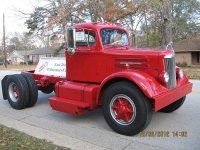
The manual says the axle is a vacuum shift, so no clutching is needed. According to GM, just flip the switch, let up on the gas, wait a couple seconds and ease the gas back on.
I wonder why the old truck was being used more in recent years than the newer one, I guess you'll find out when you look them over. Maybe more miles on one or it needed something fixed. Check both trucks for rust on the frames, especially where the spring shackles mount to the frame in the back (front too). Look for rusty hydraulic brakes lines which might need replaced.
I think part of the reason the '50 was licensed later was because it had a hitch on it and it was needed to tow stuff. The shorter box makes hitching up a little less awkward. The '52 was still used, but just hauling grain from the fields to the bins, so it wasn't being licensed anymore, as it never left the farm.
Good luck and I hope you get both trucks, a lot of parts might be interchangeable. Your old friend seems like a a very nice guy.
I don't think getting both would fly with the wife. ...And yes, my friend is one of the nicest guys I've ever met. Our families have shared many memorable experiences together for close to 30 years, and we will miss them dearly. I'll be very satisfied to have just one.
 
   / Looking at old grain trucks... Need help. #48  
When shifting a 5 & 2 the pattern changed when you got to 4th. You went from 4 low to 5 low then back to 4 high to 5 high.
Not sure how many were like that but I'm sure it confused a lot of drivers, me included until I looked at a shift chart on a sun visor.
You could tell the Wife what a rare opportunity this is to get both. ???
 
   / Looking at old grain trucks... Need help. #49  
IIRC, the maximum GVW on the old 6400's was around 19,500 to 20,000 lbs, although that might be later 50s models to get that high. Chevy had two models of two ton trucks back then, the 6100 and the 6400, the difference was that the 6400 had a longer wheelbase. The 6100 was designed for a 9' body, the 6400 for a 12' body.

There were three different types of 5 speed transmissions available back then, a gathered ratio with a gear ratio around 1.45:1 in 4th gear, a short fourth version with a 1.20:1 or 1.18:1 ratio in 4th (that one had the odd shift pattern), and an overdrive version with a 1:1 ratio in 4th, with an overdrive between 0.85:1 to 0.75:1. The overdrive might be a regular "H" pattern or the odd pattern, depending on manufacturer.

But on the Chevys, a 4 speed was much more common, even with a 2 speed axle. I don't think Chevy offered an electric shift for the axle until later on.
 
   / Looking at old grain trucks... Need help.
  • Thread Starter
#50  
IIRC, the maximum GVW on the old 6400's was around 19,500 to 20,000 lbs, although that might be later 50s models to get that high. Chevy had two models of two ton trucks back then, the 6100 and the 6400, the difference was that the 6400 had a longer wheelbase. The 6100 was designed for a 9' body, the 6400 for a 12' body.
The tag on the pillar says GVW is 16,000 lbs. No published weight on a complete grain truck that I can find, but there have been numbers between 6500 and 8000 lbs floating around, depending on equipment and accessories. I'll have to use a truck scale so I can find my true load capacity once I make my decision and purchase.
There were three different types of 5 speed transmissions available back then, a gathered ratio with a gear ratio around 1.45:1 in 4th gear, a short fourth version with a 1.20:1 or 1.18:1 ratio in 4th (that one had the odd shift pattern), and an overdrive version with a 1:1 ratio in 4th, with an overdrive between 0.85:1 to 0.75:1. The overdrive might be a regular "H" pattern or the odd pattern, depending on manufacturer.

But on the Chevys, a 4 speed was much more common, even with a 2 speed axle. I don't think Chevy offered an electric shift for the axle until later on.
I've been finding more data on these two models and I'm pretty sure both of these trucks have the 4 speed. As it turns out, the gear ratios between the single speed rear and two speed are close, but not identical.

Single speed axle: 6.17 to 1
Two speed axle H: 6.13 to 1
Two speed axle L: 8.10 to 1

Joe
 
   / Looking at old grain trucks... Need help. #51  
Thought i would bring this thread back to life. Did you purchase a truck?
 
   / Looking at old grain trucks... Need help.
  • Thread Starter
#52  
Thought i would bring this thread back to life. Did you purchase a truck?
We're waiting for the snow to melt enough to test drive them, as the shop has rather large drifts all around it. Nobody has been using the shop all winter, so there has been no immediate need to remove the drifts. We also figured warmer weather would be much more conducive to tinkering with equipment that hasn't been run in a couple years.

Soon! :thumbsup:

Joe
 
   / Looking at old grain trucks... Need help. #53  
Bump!
 
   / Looking at old grain trucks... Need help.
  • Thread Starter
#54  
UPDATE!

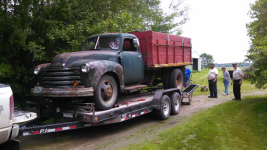
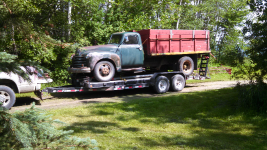
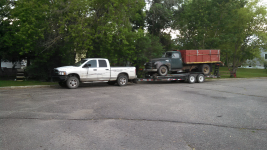
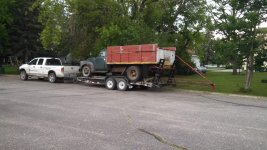
Today, my friend called and said it's time. I hooked up my trailer, called my dad and drove 50 miles to the old farmstead. We puttered around and quickly found that only one truck was going to start. We knew the battery was bad, so we hooked up the jumper cables to the 1950 Chevy 6400, pulled the choke, turned the key and stepped on the floor starter. Much to my surprise, it fired right up! Once we gave it a little gas to get going, it settled right down and purred like a kitten. We actually drove it from the shop to the yard. This short trip taught us that the brakes were not working, (no fluid) and the timing is off. If we step on the gas too much, it wants to die. If we hold on to the distributor while stepping on the gas, it does just fine. A little time with a timing light should remedy this little issue.

We then engaged the PTO and pulled the hoist lever. The box raised all the way to nearly 45 degrees and revealed two telescoping (two stage) hydraulic cylinders. Apparently, these were installed in the 50's by Polaris Industries. We lowered the box and loaded some other stuff I bought into it before loading it onto the trailer.

We drove it onto the trailer and I said, "This is the one. How much?"
"Oh, I dunno... how does $1000 sound?"
"Sold!"

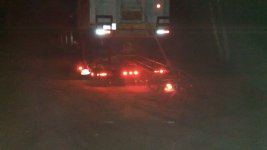
We loaded a hay bale elevator between the wheels, which stuck out 12ft. I put a red flag on it but knew we'd be driving in the dark. A quick call to the MN highway patrol told me I needed a marker light on the back for night driving. We drove to the local hardware store, bought a trailer plug, some wire and a trailer light and made a portable marker light that we mounted on the end of the elevator.

To recap: I bought the 1950 Chevy 6400.
We unload tomorrow.

Joe
 

Attachments

  • ForumRunner_20140629_000906.png
    ForumRunner_20140629_000906.png
    655.3 KB · Views: 271
  • ForumRunner_20140629_000830.png
    ForumRunner_20140629_000830.png
    841.1 KB · Views: 240
  • ForumRunner_20140629_001002.png
    ForumRunner_20140629_001002.png
    673.4 KB · Views: 219
  • IMG_20140628_223659_446.jpg
    IMG_20140628_223659_446.jpg
    275.9 KB · Views: 208
  • IMG_20140628_173617_846.jpg
    IMG_20140628_173617_846.jpg
    618.4 KB · Views: 231
   / Looking at old grain trucks... Need help. #55  
Sweet rig!
 
   / Looking at old grain trucks... Need help. #57  
Nice find.

Chris
 
   / Looking at old grain trucks... Need help. #58  
Nice truck and easily worth a grand! First thing I'd do is go thru the mechanical stuff and get it safe and reliable to drive. Then decide on the cosmetics. I'd fix any rust or corrosion issues and then maybe just leave the original "patina" on the exterior. Regardless of what you decide, it is great that you are saving this truck from the scrap heap!
 
   / Looking at old grain trucks... Need help.
  • Thread Starter
#59  
Today, we looked under the truck while it was still on the trailer and it's easy to see. We found that the main brake line from the master cylinder to about midway back has a hole rusted through. The lines from the "T" to the rear brakes have been replaced and look great. We pulled off the rusty line so it can be measured and replaced. Meanwhile, I'll buy a new battery and we'll start going through the wiring and lighting. I don't care if it looks a little rough, but I want it roadworthy, legal, and safe.

It has since been unloaded and parked near the garage, where we have easy access to tools and electricity to work on it.

Joe
 

Tractor & Equipment Auctions

2008 Toyota Camry Sedan (A59231)
2008 Toyota Camry...
UNUSED FUTURE 12" HYD AUGER (A52706)
UNUSED FUTURE 12"...
2017 CAT TL1055 (A60462)
2017 CAT TL1055...
2017 Ford Expedition SUV (A59231)
2017 Ford...
2007 JCB 3CX BACKHOE (A60429)
2007 JCB 3CX...
207282 (A52708)
207282 (A52708)
 
Top