Low water pressure questions ( well system )

   / Low water pressure questions ( well system ) #21  
I have low water pressure in my house to the point that if I flush a toilet I get practically no water anywhere else .

Stats : 2 story house. 2 full baths. clothes washer, dish washer, water heater, 3 outdoor spigots. Shallow well ( maybe 125 ft ) . Jet pump . Water tank rated at max. 75 psi ( I think non-bladder type ). Iron filter installed . 30/50 switch . Very old air volume control. Pressure gauge on tank ( shows normal 30/50 psi ). No nipple to pump air into tank.

What I 've done : I drained tank several times in the hope that tank was water logged ( No help ) . I changed from a 20/40 switch to the 30/50 switch ( slight, but unacceptable pressure gain ).

Only thing I can think of to change is the 30/50 switch to a 40/60 switch and replace old air volume control. Any reason I shouldn 't do this ?

Sure could use ya 'll 's advice and suggestions .

As far as I know, the term "water-logged" only refers to conditions found in bladder tanks. It means that the bladder has allowed water to rise to the upper portion of the tank that is normally "air only". When that happens, there is water on top of the bladder pushing it downward in addition to the air pressure. What happens is that the pump will "short cycle" because it doesn't actually fill the tank correctly and you don't get as much water in there as possible. The pressure in the lines will stay fairly constant except right before it cycles - the pressure drops quickly and then comes back when the pump is on.

You mentioned that you get good pressure when the pump is on and it has had chance to "catch up". I believe that your issue is likely in the fittings from the tank into the house lines being obstructed or restricted in some manner - most likely, right at the "T" where it all comes together. Something in there is acting as a restrictor to the water entering the line from the tank, and until / unless the full pressure of the pump can route to the house lines, there just isn't enough "push" there to up the house pressure (and the pump's flow primarly diverts to the tank).

Another thing that you have to look at is the size of the plumbing. You should likely have a 1" copper line coming from the tank to form the start of the household lines. From there, the lines should shrink to 3/4" for much of the run and then down to 1/2" for the taps. If you don't have a way to restrict the flow slightly at the exit points, turning any one tap on will often drop the household pressure pretty significantly.
 
   / Low water pressure questions ( well system ) #22  
This is not correct. That is the flow rate of the pump. The flow rate of the well is how much water the well is capable of providing per minute over a period of time. What's typically looked for is the recovery rate of the well.

Give me a break, if his well had such awful recovery that flushing a toilet overwhelmed it, his pump would have been dead within weeks. You're complicating a basic testing procedure with unnecessary nit-picking and I'm not going to get into a debate with you over terminology just so you can feel you are contributing, as none of your post brings the OP closer to fixing his pressure issue.
 
   / Low water pressure questions ( well system )
  • Thread Starter
#23  
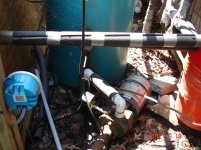
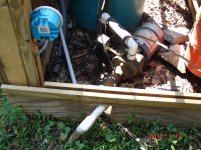
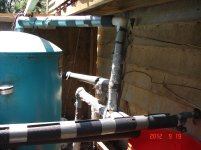
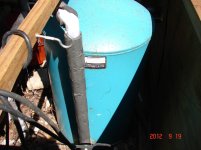
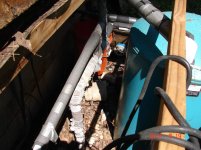
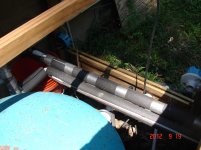
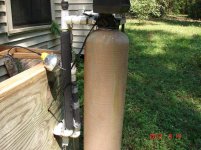
I 'm gonna get some pipe measurements ( dia ) for ya 'll and some pictures of my set up that may give ya 'll some more clues as to what might be wrong . Not sure how long that will take me to get done and posted . Pictures are sometimes better that words .
 
   / Low water pressure questions ( well system ) #24  
Give me a break, if his well had such awful recovery that flushing a toilet overwhelmed it, his pump would have been dead within weeks. You're complicating a basic testing procedure with unnecessary nit-picking and I'm not going to get into a debate with you over terminology just so you can feel you are contributing, as none of your post brings the OP closer to fixing his pressure issue.

Flushing a toilet requires that the water be refilled from his tank. Until and unless the tank drops below its minimum threshhold, the pump doesn't even become part of the equation.

My response to *your* post was to clarify terminology and help the OP (and others) better understand how the components of their well work together and where there could be pieces to examine. Heck, I even included some ideas about how to test pieces of the well.

In a separate response, I shared some thoughts on where *I* would be looking for issues if it were my well. I have learned a LOT throughout my life, and the things that proved most useful and valuable were often taught to me by people that "nit picked" over details. I prefer done right over done twice.
 
   / Low water pressure questions ( well system ) #25  
Flushing a toilet requires that the water be refilled from his tank. Until and unless the tank drops below its minimum threshhold, the pump doesn't even become part of the equation.

Which makes your desire to add a red herring like recovery rate testing even more irrational and pointless.

I have learned a LOT throughout my life, and the things that proved most useful and valuable were often taught to me by people that "nit picked" over details. I prefer done right over done twice.

Then you should have been taught by said nit-pickers the well pump rate is matched to the recovery rate when it was installed, so your little side trip is moot and simply adds unnecessary complexity. Funny you worry about details in terminology, yet ignore the detail of derailing the discussion. You wouldn't happen to work in politics, would you? :duh:
 
   / Low water pressure questions ( well system ) #26  
Which makes your desire add a red herring like recovery rate testing even more irrational and pointless.


Then you should have been taught by said nit-pickers the well pump rate is matched to the recovery rate when it was installed, so your little side trip is moot and simply adds unnecessary complexity. Funny you worry about details in terminology, yet ignore the detail of derailing the discussion. You wouldn't happen to work in politics, would you? :duh:

Pump rates are NOT always matched to recovery rates. Recovery rates change over the course of a year and from year-to-year.

The OP has a problem with pressure. Pressure is directly related to volume. How is understanding the flow rate capability of the well derailing the conversation? If your MPG in your car was bad and you tried increasing pressure in the fuel rails to no avail, would it not be desirable to understand that your fuel pump couldn't supply the fuel you needed at any pressure?

Proving inaccurate commentary "just to feel like you contributed" is not helping the OP. I can't help it that you don't like the fact that you were called out for being inaccurate / incorrect in your statements.
 
   / Low water pressure questions ( well system )
  • Thread Starter
#27  
tryin ' a test pic. DSC00009.jpg
 
   / Low water pressure questions ( well system ) #28  
If a standard pressure switch is a 40/60 this would mean that the system pressure should be about 60 psi on the high side and 40 psi on the low side. Let's say we were to open a valve just long enough for the pressure to drop below 40 psi the pump would come on. It should recover to the 60 psi pressure in a minute or two.

When flushing a toilet all you need to re-fill is 1.6 gallons. How long does it take to refill the toilet? Get a pressure gage and attached to to one of the hose bibs and track the pressure changes.
 
   / Low water pressure questions ( well system )
  • Thread Starter
#29  
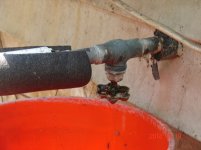
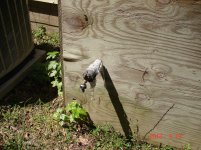
Here comes the rest . Plastic pipe is 1" . short copper with the valve is 3/4" . Note slow leak at cut off valve around shaft knob . Been there for years .DSC00010.jpgDSC00011.jpgDSC00012.jpgDSC00013.jpgDSC00014.jpgDSC00015.jpgDSC00016.jpgDSC00017.jpgDSC00018.jpg
 
   / Low water pressure questions ( well system ) #30  
I think EarPlug has a good suggestion in getting a pressure gauge. If you can locate a couple of different points in the line where you could attach it, you might be able to see a pressure difference occurring between two points and being at least part of the issue.

For example - the leak in that shut-off valve could indicate that there's something built up inside of there keeping it from seating properly and not leaking. And, if the pressure inside the house doesn't match the outside, it might be a good place to look.
 
   / Low water pressure questions ( well system )
  • Thread Starter
#31  
I think EarPlug has a good suggestion in getting a pressure gauge. If you can locate a couple of different points in the line where you could attach it, you might be able to see a pressure difference occurring between two points and being at least part of the issue.

Only place I can think of I might find inside is at my clothes washer ( at end of water line run ) . I have hot and cold water spigots there that the washer hose hook to like a garden hose . Next would be what kind of pressure gauge can be adapted to screw on like a garden hose . I can not think of one other place in the house I could do that . All of the rest of the places are the small 1/4 " ( ? ) supply lines to faucets and toilets . Showers are 1/2 " pipe with cut off valve and no apparent way to attach anything . Pretty sure of this as I was the one that installed most of the plumping years ago .

My biggest fear is that the 3/4 " major lines inside of house have become clogged . Almost insurmountable fix task .
 
   / Low water pressure questions ( well system ) #32  
Only place I can think of I might find inside is at my clothes washer ( at end of water line run ) . I have hot and cold water spigots there that the washer hose hook to like a garden hose . Next would be what kind of pressure gauge can be adapted to screw on like a garden hose . I can not think of one other place in the house I could do that . All of the rest of the places are the small 1/4 " ( ? ) supply lines to faucets and toilets . Showers are 1/2 " pipe with cut off valve and no apparent way to attach anything . Pretty sure of this as I was the one that installed most of the plumping years ago .

My biggest fear is that the 3/4 " major lines inside of house have become clogged . Almost insurmountable fix task .

I would *guess* that it's more likely that any issues with clogging would be more likely at elbows and around joints (like shut-off valves). Buildup inside the straight runs of plumbing should be less likely. If you are able to locate pressure differences from one point in a line to another, that would go a long way in determining "where to cut".

If you *do* have to take out a piece of the plumbing and replace it, it isn't usually too bad as long as you have access to the pipe. If you have to tear your walls apart to get to them, that's a whole different story. Finding the issue is task one. Once you get that accomplished, you'll have a better idea of what options might be available to correct it.

Do you have a pressure gauge on the line where it comes out of the tank? And, have you verified that it's accurate?
 
   / Low water pressure questions ( well system ) #33  
What does the pressure gauge do when water is running in the house? Does the pressure gradually drop or does it suddenly drop?

The recovery rate of the well and the pump flow rate are different. Our well recovers at 15 GPM. Best I can tell our pump is 5 GPM. 15 GPM for a well in our area is danged good. The recovery rate and other well data is on a plate on the side of the well pipe. You might be able to see if your well has a plate, but from the photos, it looks like it might be hard to find, if it exists at all.

Since flow is your problem, what happens if you let the water flow at the well? Does the water flow gradually drop as the pressure drops in the tank? We had our bladder pressure tank fail a year or so ago and I wonder if the tank is the problem. The symptoms are different though.

Can you open a faucet nearest the water supply line to the house? If the flow is reduced at that point, compared to the flow at the well, that would be a clue. Compare that flow to flow at other parts of the house as well.

Also you might want to check the aerators and filters on your faucets. We have high mineral content which can build up on the aerators and filters. I don't think that is your problem but our previous kitchen faucet filter would clog up with minerals every 2-4 weeks affecting water flow. It was a Moen faucet and we had other problems with it. Moen gave us a replacement faucet for a few dollars, and so far, it has not clogged up. The filter looks like the mesh is a bit larger.

Later,
Dan
 
   / Low water pressure questions ( well system )
  • Thread Starter
#34  
Here is a good starting point for learning how a non-bladder tank works: Cycle Stop Valves, Inc.

There are more moving parts with a non-badder tank

A good read ! If I 'm understanding it correctly there are mechanical parts in a bladderless tank that could over the years break down or even corrode to nothing .
 
   / Low water pressure questions ( well system )
  • Thread Starter
#35  
Do you have a pressure gauge on the line where it comes out of the tank? And, have you verified that it's accurate?

The pressure gauge is located in the side of the tank . It 's readings match the 30/50 switch I have .
 
   / Low water pressure questions ( well system ) #36  
The pressure gauge is located in the side of the tank . It 's readings match the 30/50 switch I have .

The different switches are often simply set to different values. You don't always need to replace a 30/50 switch to go to 40/60, for example... You simply adjust the cut-in and cut-out switches based on pressure reading from a known-good gauge. The fact that the gauge matches the switch is only "slightly" useful at this point. It isn't necessarily bad info, but it isn't verified either. Seems like it would be at least close and that's good.

One of the things that's important too is that you have to have the tank pre-charged with the proper amount of air. If not, you won't get the right sort of pressure capacity. If there's far too little air in the tank, you have a very small volume of air that can be compressed by adding water to the tank. That translates directly to a very low amount of what is called "draw-down" (the amount of water you can use from your tank before the pump will come on again). With low draw-down comes short cycling of the pump (on for less than two minutes to fill the tank then off, then back on again after drawing only a gallon or two from the tank - maybe a little more).

You set the charge amount for your tank by shutting the pump breaker off, opening a tap, and allowing all of the water to drain from the tank - you may have to do this *at* the tank if your air level is significantly low. Once the tank is empty, you add air until there's about 2 lbs of pressure LESS than your cut-in setting. At that point, you turn the breaker back on.

Have you reset the pressure pre-charge in your tank?
 
   / Low water pressure questions ( well system )
  • Thread Starter
#37  
What does the pressure gauge do when water is running in the house? Does the pressure gradually drop or does it suddenly drop?

The recovery rate of the well and the pump flow rate are different. Our well recovers at 15 GPM. Best I can tell our pump is 5 GPM. 15 GPM for a well in our area is danged good. The recovery rate and other well data is on a plate on the side of the well pipe. You might be able to see if your well has a plate, but from the photos, it looks like it might be hard to find, if it exists at all.

Since flow is your problem, what happens if you let the water flow at the well? Does the water flow gradually drop as the pressure drops in the tank? We had our bladder pressure tank fail a year or so ago and I wonder if the tank is the problem. The symptoms are different though.

Can you open a faucet nearest the water supply line to the house? If the flow is reduced at that point, compared to the flow at the well, that would be a clue. Compare that flow to flow at other parts of the house as well.

Also you might want to check the aerators and filters on your faucets. We have high mineral content which can build up on the aerators and filters. I don't think that is your problem but our previous kitchen faucet filter would clog up with minerals every 2-4 weeks affecting water flow. It was a Moen faucet and we had other problems with it. Moen gave us a replacement faucet for a few dollars, and so far, it has not clogged up. The filter looks like the mesh is a bit larger.

Later,
Dan

Not knowing slow from fast, this is the best I can tell you right . When opening a spigot at well house 41 sec passes before pump kicks on . With spigot still on pump cuts off after 1 min. ( less time if spigot is closed ) . Can 't say about inside faucet yet as I need my helper home to assist with faucet as I monitor pump .

Trouble fo me and bladder tanks is I have egg water and as I understand it bladders don 't help to remove egg smell like bladderless do by mixing air with water .
 
   / Low water pressure questions ( well system ) #38  
There are many potential issues or causes that could be the problem...I believe hiring a good plumber would be worth the money and maybe save you from replacing items that don't need to be replaced. Ask around for someone that is reasonable and maybe you can trade services? Also, get your water tested...based on your picture I would say your well is less then 28 ft in depth and prone to contamination.
 
   / Low water pressure questions ( well system )
  • Thread Starter
#39  
You set the charge amount for your tank by shutting the pump breaker off, opening a tap, and allowing all of the water to drain from the tank - you may have to do this *at* the tank if your air level is significantly low. Once the tank is empty, you add air until there's about 2 lbs of pressure LESS than your cut-in setting. At that point, you turn the breaker back on.

Have you reset the pressure pre-charge in your tank?

Does this also apply to tanks with no bladder ? I have no Schraeder ( spl ? ) valve anywhere on tank to add air . 2 lbs less means if my cut in pressure is 30 psi I should have 28 psi in empty tank ?
 
   / Low water pressure questions ( well system )
  • Thread Starter
#40  
Also, get your water tested...based on your picture I would say your well is less then 28 ft in depth and prone to contamination.

Very well could be lol as the well was dug many years ago and paid for by dear old mom who just wanted to buy her son something . I was young then and didn 't pay much attention to important stuff . Mis-spent youth I was :D
 

Marketplace Items

2014 NISSAN NV CARGO VAN (A59905)
2014 NISSAN NV...
2004 MACK CV713 MIXER TRUCK (A55745)
2004 MACK CV713...
1998 Mazda B2500 (A57149)
1998 Mazda B2500...
30 INCH TOOTHLESS BUCKET FOR MINI EXCAVATOR (A58214)
30 INCH TOOTHLESS...
2019 Dodge Grand Caravan Van (A59231)
2019 Dodge Grand...
2384 (A60432)
2384 (A60432)
 
Top