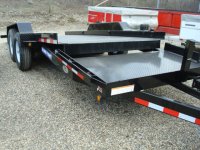
Matching a trailer to my load/truck, current setup isn't cutting it????

   / Matching a trailer to my load/truck, current setup isn't cutting it???? #21  
DEPENDING ON IF YOUR REAR HITCH IS RATED FOR THE WEIGHT....A PINDLE HITCH-BUMPER PULL TRAILER WILL HANDLE A LOT OF WEIGHT! YOU CAN PICK THOSE UP CHEAP AT AUCTIONS FROM UTILITY COMPANIES OR GOVERNMENT AUCTIONS. THEY ARE USED TO HAULING BACK HOES, SMALL DOZER'S ECT. BEHIND DUMPTRUCKS. WE ALWAYS USED THEM AT A UTILITY COMPANY SO WE COULD PULL WITH BUCKET TRUCKS-THEY HAULED DITCHERS AND BACKHOES. BUT A GOOSENECK IS PROBABLY THE BEST BET-IT WILL DISTRIBUTE THE WEIGHT, EASIER TO TURN IN TIGHT PLACES AND A GOOD USED ONE WILL BE JUST AS MUCH AS A NEW BUMPER PULL. CHECKING ON CRAIGSLIST-A 36' 4 YEAR OLD TRAILER-2-10K OIL BATH AXLES WITH DUAL TIRES FOR $3700. THATS A LOT OF TRAILER TO PULL IN TRAFFIC AND THRU NEIGHBOR HOODS!
 
   / Matching a trailer to my load/truck, current setup isn't cutting it???? #22  
Go with a 30' gooseneck and you will never look back or want a bumper pull again. I have a short bed f350 and there are no issues pulling a goosneck. Don't get 7k axles you need 8k or larger if you go single wheel gets load range g or 17.5 well worth the extra money.
I have pulled my set up with older f350 and current 12 f350 and my 97 f450 all do fine up to about 22000 on the trailer as I run out of trailer tire.
 

Attachments

  • ForumRunner_20130714_083103.png
    ForumRunner_20130714_083103.png
    623.6 KB · Views: 298
   / Matching a trailer to my load/truck, current setup isn't cutting it???? #23  
Is a Class 5 hitch and WD hitch, easily retrofitted to my truck? How much would something like that cost?

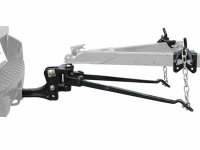
Weight distributing hitches will work on about any hitch receiver. You also need room on the trailer front rails for the connectors for the spring bars. This setup is normal and common for anyone with a bp travel trailer.
 
   / Matching a trailer to my load/truck, current setup isn't cutting it???? #24  
You can get a Reese Titan hitch for about any 3/4 ton truck up. They will easily handle the tongue weight you want.

Chris
 
   / Matching a trailer to my load/truck, current setup isn't cutting it???? #25  
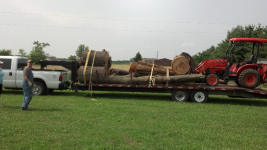
Rusty, have you used both? The reason I ask is because my current trailer is a dovetail with fold up ramps and I hate it. I know it isn't good to hang the rotary cutter off the end but I would love to be able to let it overhang a few feet, whereas now I can't, because the ramps are always in the way. I haven't used a flat deck trailer but I can't see why it would be a big deal. I would really only use it for equipment, and not a car or anything that needs a shallow angle of approach. I feel like I would get more usable space with a flat deck.

The other use I have for the trailer, is to lay my Woodmizer sawmill on it for when I want to do a mobile job. The mill is not a trailerable model (LT 15) but is easily setup on a trailer. I've done this on my current setup but it overhangs as well.
View attachment 327354


I also do not like how little clearance I have on the back of the tractor, more than one occasion I have scraped/dragged the bottom of the trailer on a customer's driveway, I have to be really careful of that.


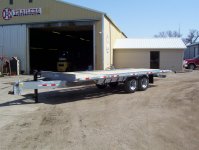
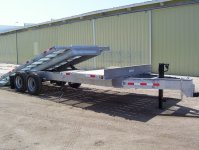
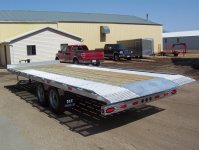
I'm browsing online and found this PJ trailer...
PJ Trailers - 8" I-Beam Deckover (F8)
I would probably like the 26' model, it comes with two 7,000lb axles and has a 14k lb weight rating. The trailer weighs 4k lbs (actually 4300 but let's say 4k for easy math:D) I'm assuming this means I can safely and legally carry 10k lbs?
If I were to upgrade to the two 8k lb axles, could I then legally carry 12k lbs on the trailer?


What would be better, two 8k lb axles, or three 7 lb axles? It seems like 3 axles would weigh more, and I couldn't take advantage of the extra weight rating, but it may ride or carry the load nicer with 3 axles? What are the advantages and disadvantages of 2 or 3 axles?
Just keep in mind you're considering changing 2 things from you current setup that will effect loading. Deckover=higher, steeper load. No dovetail = steeper again. Personally I prefer a dove on a deckover.. If you want to spend the money there are options like pop-up doves, fold-over wedge ramps, pop-up center sections that try to give you the best of both. If you go with no dove you will need the longest ramps, which can get heavy for sliding in. Commercial for-hire haulers like straight decks because they want to have every inch available for a paying load.

Tri-axle 7K's versus two 8K's you will get a lot of opinions. Tri-axle = 2 more tires to maintain but they are a lot cheaper than the 17.5" tires on an 8K. Tri-axle can put more stress on axles/tires/wheels with sharp turns. Tri-axle should definitely give you higher capacity/GVW. If two 8K's can cut it for your loads, then go with that, otherwise consider the tri-axle. Extra weight of 3 axles, eh, maybe a little. Remember everything on the 8K's is heavier, axles, hubs, tires, wheels, so could almost be a wash.

I don't know if you're concerned about your total gross combination wt. Some guys like to stay under 26K because of CDL requirements. In that case a 16K trailer and 10K rated truck works out OK. If that's not a problem we can spend your money and tell you to buy a tandem-dual. Pay attention how trailers are rated. Some manufacturers include the tongue weight in the MGVW (ie. two 7K axles and MGVW is greater than 15K. Others do not do this, that is 2 7K axles and they rate the trailer at 14K. I suppose legally and technically you should not exceed the max specified on the trailer's frame tag. Does it matter?, depends on enforcement in your locality.

If you decide to have a bumper pull built tell them you might be using a WD hitch and want to have that part of the front A-frame clear for the brackets or plates. Things like breakaway batteries, tool boxes, chain trays, cross braces, etc can get in the way.of the WD stuff.

If you decide to go BP, keep an eye on your receiver for rust and cracks, etc. Maybe best to replace it with a nice heavy rated Reese or Curt like Chris suggested and have piece of mind. Good luck whatever you decide.
 
   / Matching a trailer to my load/truck, current setup isn't cutting it???? #26  
Does anyone have experience with a weight distributing hitch off road on farm land?

My use was on a RV pulling a horse trailer.

Where we used to live, the hay field had terraces big enough that the trailer would drag the ground.
 
   / Matching a trailer to my load/truck, current setup isn't cutting it???? #27  
Just keep in mind you're considering changing 2 things from you current setup that will effect loading. Deckover=higher, steeper load. No dovetail = steeper again. Personally I prefer a dove on a deckover.. If you want to spend the money there are options like pop-up doves, fold-over wedge ramps, pop-up center sections that try to give you the best of both. If you go with no dove you will need the longest ramps, which can get heavy for sliding in. Commercial for-hire haulers like straight decks because they want to have every inch available for a paying load

Tri-axle 7K's versus two 8K's you will get a lot of opinions. Tri-axle = 2 more tires to maintain but they are a lot cheaper than the 17.5" tires on an 8K. Tri-axle can put more stress on axles/tires/wheels with sharp turns. Tri-axle should definitely give you higher capacity/GVW. If two 8K's can cut it for your loads, then go with that, otherwise consider the tri-axle. Extra weight of 3 axles, eh, maybe a little. Remember everything on the 8K's is heavier, axles, hubs, tires, wheels, so could almost be a wash.

I don't know if you're concerned about your total gross combination wt. Some guys like to stay under 26K because of CDL requirements. In that case a 16K trailer and 10K rated truck works out OK. If that's not a problem we can spend your money and tell you to buy a tandem-dual. Pay attention how trailers are rated. Some manufacturers include the tongue weight in the MGVW (ie. two 7K axles and MGVW is greater than 15K. Others do not do this, that is 2 7K axles and they rate the trailer at 14K. I suppose legally and technically you should not exceed the max specified on the trailer's frame tag. Does it matter?, depends on enforcement in your locality.

If you decide to have a bumper pull built tell them you might be using a WD hitch and want to have that part of the front A-frame clear for the brackets or plates. Things like breakaway batteries, tool boxes, chain trays, cross braces, etc can get in the way.of the WD stuff.

If you decide to go BP, keep an eye on your receiver for rust and cracks, etc. Maybe best to replace it with a nice heavy rated Reese or Curt like Chris suggested and have piece of mind. Good luck whatever you decide.


I agree a longer tri axel is the way to go. With the long loads hes hauling it makes keeping the axel weights much more manageable.

Your comment about the CDL may be a little off the mark, anytime the trailer by itself is 10,001 or greater the 26,000 gvw is no longer valid.
 
   / Matching a trailer to my load/truck, current setup isn't cutting it???? #28  
I agree a longer tri axel is the way to go. With the long loads hes hauling it makes keeping the axel weights much more manageable.

Your comment about the CDL may be a little off the mark, anytime the trailer by itself is 10,001 or greater the 26,000 gvw is no longer valid.

I thought the trailer weight is state by state. I'd go dual tandem over a triple axle anyday. If all your doing is straight than it'll work but start getting into tight areas and its just dragging that rear axle all over the place. Also it is more to replace tires on but Ill take 8 over 6 for heavy loads.

Brett
 
   / Matching a trailer to my load/truck, current setup isn't cutting it???? #29  
So just to make sure I understand this correctly, the tongue weight load does not apply to the total weight on the trailer? So if I have a 16k lb trailer, and it weighs 4k lbs, I can load MORE than 12k lbs on it legally?

in short yes.

The axles are designed to hold 16K. if you scale the trailer only, youll find that you have less than 16K on the trailer axles. If you have less than 16K on the trailer axles your are legal. The next question is is your GCWR is under your tow rig maxium, and or have you exceeded the GAWR for the rear axle. If both of those are also true, you are legal with with more than 12K of cargo on a 16K trailer that has a curb weight of 4K. (by the amount of weight you transferred to the tow vehicle via TW)
 
   / Matching a trailer to my load/truck, current setup isn't cutting it????
  • Thread Starter
#30  
Thanks for all the really great advice so far regarding my towing needs. The more I think about it, the more I think I'll want to stick with a bumper pull. There is a really good chance I will purchase a new truck in the next few years and I plan to add a cap to the bed, which I could not do with a GN.

Based on my pictures/explanations, would you guys agree that 26' would be sufficient for my needs? Would it be a good idea to go with a 28' if the price was not too much more? Typically the longer trailers tow nicer and with the extra couple feet I may be able to balance the load better. However, I don't want it to get too long either.

If I don't need the rotary cutter when I do a job, I'm all set with even a 24' trailer, however the times I need the rotary cutter I can really use that extra space.
 
   / Matching a trailer to my load/truck, current setup isn't cutting it???? #31  
a long trailer will always haul a long or short load, a short trailer....only works for a short load.
 
   / Matching a trailer to my load/truck, current setup isn't cutting it???? #32  
I'm hoping that in the next few years I'll be buying a new truck, it will either be a 3/4 ton or another 1ton diesel. It seems like a lot of the new trucks come with class V hitches, whereas mine is only a Class IV I believe (it's rated at 10k lbs)

I don't know exactly what truck and hitch you have (year, make, model, configuration, etc...) but I would bet if you look in the fine print, you will find that the 10k rating of your current hitch assumes that you are using a WD system, and there is a lower number that comes into play if you are not using a WD system. I'm not sure how manufacturers can get away with not putting this critical information front and center, but I've seen this happen more than once. The owner's manual says that the vehicle comes with a 10k tow rating, and then somewhere else in small print, it mentions that, oh, by the way, if you're not using a WD system, it's only 5k.
 
   / Matching a trailer to my load/truck, current setup isn't cutting it???? #33  
   / Matching a trailer to my load/truck, current setup isn't cutting it????
  • Thread Starter
#34  
I don't know exactly what truck and hitch you have (year, make, model, configuration, etc...) but I would bet if you look in the fine print, you will find that the 10k rating of your current hitch assumes that you are using a WD system, and there is a lower number that comes into play if you are not using a WD system. I'm not sure how manufacturers can get away with not putting this critical information front and center, but I've seen this happen more than once. The owner's manual says that the vehicle comes with a 10k tow rating, and then somewhere else in small print, it mentions that, oh, by the way, if you're not using a WD system, it's only 5k.

I do believe you are correct on that, as far as needing a WD hitch, but I can't say for sure.

Is the WD hitch more for a better ride, and safer towing, or is it more so the weight of the trailer doesn't physically damage the hitch itself? As mentioned earlier, I've never been driving the truck and towing and felt any sort of ill effects such as too much tongue weight, too little, or anything like that. The rear end has never sagged any more than level. I have even stiffer springs in the rear than it came with stock, and had an airbag setup but removed it because I never once needed it. I've loaded the back up with just over 3k lbs of concrete and it didn't even sag....


If the WD hitch is for the hitch integrity, then i may be slightly worried about it, but if it's for a better ride, I can't say I've ever felt that I don't have a good ride already. Although, I have certainly noticed differences, and heavy loads of course, but I have never felt unsafe towing, like I have in lesser trucks/setups.

If I go with a larger bumper pull, I do plan on upgrading my hitch and going with a WD hitch, but only because I've read that I "should" on this website, I don't actually understand how they work and why I "need" one?
 
   / Matching a trailer to my load/truck, current setup isn't cutting it????
  • Thread Starter
#35  
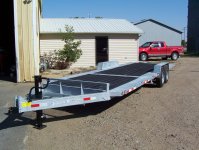
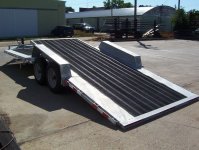
I do like the tilt trailers, but like GN's, it seems like it adds more weight to the trailer, taking away weight that I could use as cargo.
 
   / Matching a trailer to my load/truck, current setup isn't cutting it???? #36  
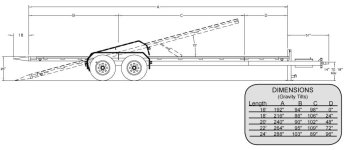
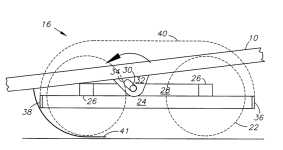
I do like the tilt trailers, but like GN's, it seems like it adds more weight to the trailer, taking away weight that I could use as cargo.

I haven't done any research, but for the non powered gravity tilt, I can't see much weight difference. Add two hinge pins, some steel for the hinges and extra framework, a dampening cylinder, then subtract the weight of the ramps no longer needed. Couldn't be much difference. :2cents:

TD10.jpg US08118315-20120221-D00000 (Large).png

Some don't have a dampening cylinder.
1370369745DSC08486.JPGDelta.jpg
 
   / Matching a trailer to my load/truck, current setup isn't cutting it???? #37  
   / Matching a trailer to my load/truck, current setup isn't cutting it???? #38  
I do believe you are correct on that, as far as needing a WD hitch, but I can't say for sure.

Is the WD hitch more for a better ride, and safer towing, or is it more so the weight of the trailer doesn't physically damage the hitch itself? As mentioned earlier, I've never been driving the truck and towing and felt any sort of ill effects such as too much tongue weight, too little, or anything like that. The rear end has never sagged any more than level. I have even stiffer springs in the rear than it came with stock, and had an airbag setup but removed it because I never once needed it. I've loaded the back up with just over 3k lbs of concrete and it didn't even sag....

If the WD hitch is for the hitch integrity, then i may be slightly worried about it, but if it's for a better ride, I can't say I've ever felt that I don't have a good ride already. Although, I have certainly noticed differences, and heavy loads of course, but I have never felt unsafe towing, like I have in lesser trucks/setups.

If I go with a larger bumper pull, I do plan on upgrading my hitch and going with a WD hitch, but only because I've read that I "should" on this website, I don't actually understand how they work and why I "need" one?

You need to look at the capacity of your hitch. For example, my f150 with max tow package is rated for 500/5000 without WD and 1150/11500 lbs with a WD. This is the case even with some 3/4 and 1 ton trucks of recent history.

Yes it is safer and improves ride quality. Second, it could be because of structural issues but have no proof. The torque from the WD bars apply load to the front mounting bolts on the hitch spreading the tongue weight across the entire hitch. Without a WD hitch, the entire tongue load is supported only by the rear most bolts on the hitch through the truck frame. All that stress is also just applied to the frame at those two locations.
 
   / Matching a trailer to my load/truck, current setup isn't cutting it???? #39  
I thought the trailer weight is state by state. I'd go dual tandem over a triple axle anyday. If all your doing is straight than it'll work but start getting into tight areas and its just dragging that rear axle all over the place. Also it is more to replace tires on but Ill take 8 over 6 for heavy loads.

Brett

I had dual tandems. They were 12K axles and I hated them. Brakes, brarings, and a flat along the side of the road is no fun on a inner. I have hadbmy 18K tri axle for 9 years and will never go back.

Chris
 
   / Matching a trailer to my load/truck, current setup isn't cutting it????
  • Thread Starter
#40  

Thanks for the link :thumbsup:

I read through the pages and at least now I understand how they transfer weight to the front of the truck, it seems like it's all about the leverage created by the "bars", forcing a lever arm where the receiver hitch plugs in, to apply a force which transfers the weight forward. I guess that makes sense.

Based on my towing experience, I have to say that I've never felt like I really need one, even now knowing a little more about them. I suppose I should have one however, and would probably notice a big difference. It's probably one of those things that you never knew you needed until you used it, sort of like a grapple. :D (just not to THAT extent)
 

Marketplace Items

2004 Volvo VNM S/A Day Cab Truck Tractor (A59230)
2004 Volvo VNM S/A...
2025 Stump/ Trench Bucket Mini Skid Steer Attachment (A56857)
2025 Stump/ Trench...
2021 BMW 1200RT (A55853)
2021 BMW 1200RT...
(9) 55 GALLON METAL DRUMS (A60432)
(9) 55 GALLON...
2445 (A60432)
2445 (A60432)
2008 Featherlite Portable Office Command Center T/A Trailer with Wacker Neuson G50 Towable Genera... (A59230)
2008 Featherlite...
 
Top