Mig Welders

/ Mig Welders #1  

pmsmechanic

Elite Member
Joined
Dec 6, 2013
Messages
4,407
Location
Southern Alberta, Canada
Tractor
4410 and F-935 John Deere, MF 245
I'm posting this because I just may be missing out on something. I really don't get what the hype is about mig welders. Most times I've used one I end up being able to do a better job with a stick welder. This could be because of my inexperience with migs but I'm to the point of don't even show me one I'll stay with my trusty stick any day. The other day I tried to remove a broken off bolt out of aluminum with a mig. After four tries I said enough of this and I took the transmission home and got the bolt out after two tries with my stick welder. I just couldn't get enough penetration with the mig. My technique is to weld a washer onto the bolt and then a nut. I like to get the bolt hot enough to melt wax and let the wax run into the threads. I rarely get a bolt out the first time but I've never run into a broken bolt that I couldn't get out using this method.

Two advantages that I can see to a mig. I've welded stove pipe with one and that's difficult with a stick. Also the weld is cleaner and needs less cleaning up to paint.

So clue me in. What am I missing.
 
/ Mig Welders #2  
All processes have there place. It's up to us to pick the correct process for the task at hand. In heavy civil, and marine construction, if you can't run a wire feeder, you don't stay long.
 
/ Mig Welders #3  
I bet there is a lot of other welding that you don't do, because a stick can't do it (well), and it wouldn't occur to you that a MIG can. Pretty much all tools are that way, as you put more time into it you think of other uses For it. Aiming the wire for a precise tack is something much more difficult with stick. H

Agreed on the rusted stuck bolt - getting penetration right at the start (then quit ! ) is an application where you need a lot of heat quick, pretty much opposite of What a MIG does. However I've done what you described with a MIG and a washer. Also welding a nut on -thru the center, (while wishing I had a stick I could jam down in there).

Getting stuck bolts out by welding is for the experienced welder. Also burning a broken stud out with O/A ( but not in Alu! :D ).
 
/ Mig Welders #4  
While I have not yet moved from a hammer and nails to a air framing nailer, I have moved on from a stick to a Wirefeed welder. :) Still the ultimate welding these days seems to be a cross between MIG and Stick, where a stick is used with shielding gas (TIG)
 
/ Mig Welders #5  
So clue me in. What am I missing
I can only relate my own experience but a "cheater lens" solved most of my issues along with getting the wire feed speed/voltage correct for the job...
 
/ Mig Welders #6  
While I have not yet moved from a hammer and nails to a air framing nailer,...

A "palm nailer" is a cheap (about the same price as a quality framing hammer) step in the right direction...no special nails required...and they can double as an air hammer for some things...!
 
/ Mig Welders #7  
MIG has a number of advantages:

1. The deposition rate is far higher than stick.
2. Shielded MIG gives much cleaner welds (as you've noted).
3. Spatter can be controlled better with a MIG.
4. You can weld thin sheet metal.
5. MIG welding can be faster than stick.

One of the problems people run into with MIG and complain about is lack of penetration on thick materials. That is generally caused by running small diameter wire at lower amperage values.

I often use .045 wire, and in some cases have used 1/16-inch wire with amperages at 250+ Amps. Big wire and high amperage gives all the penetration you need. At 280 Amps with 1/16 wire you can weld 1/2-inch steel in one pass.

You have to match the wire + amperage to the thickness of the material. Most home MIG machines are 220 Amps and less which is not conducive to welding thicker materials. You can weld thicker material but it takes good joint preparation and often requires multiple passes.

If you like stick and can make good welds with that process - then that's what you should use. They build Navy and commercial ships using MIG welders - I would hardly call that "hype."
 
/ Mig Welders #8  
Still the ultimate welding these days seems to be a cross between MIG and Stick, where a stick is used with shielding gas (TIG)

TIG requires a lot of technique, lots of practice, expert assistance.
MIG is popular because it's easy and is well suited to common thickness of materials.
 
/ Mig Welders #9  
I have gotten out more broken bolts than I can count with my mig welder by welding a nut on.

My guess is you had too small of a MIG machine, Or just ran it too cold.

I dont imagine the first time you ever stick welded anything was a good weld. It is a difference process with its own pros and cons, and requires learning and practice like everything else.
 
/ Mig Welders #10  
As have been pointed out by others, Every welding process has its place:

Stick is not the easiest to learn from a skill set perspective but sounds like you already have that problem solved. Even a $100 230 volt used buzzbox welder can rule on metal 1/8" thick and thicker steel. Rusty metal no problem. Welding outdoors in the wind no problem. No consumables to buy either. You can even weld 16 gauge (1/16") with stick if you are real good. Metal thinner than 1/16" thick though and the stick process is just not well suited regardless of how expensive your stick machine is.

Inexpensive migs ($300 to $1000) rule on metal less than 1/16" thick down to about 24 to 26 gauge thick. Sure they can weld thicker as you spend more money for the welder the thicker steel you can weld. Sure mig is faster, but liners, tips, bottles, and shielding gas do add up as far as costs go in making that weld. Mig not so great outdoors and horrible on rusty metal. Mig is much easier to learn skillset, but it is also easy for a newb to make a beatifual looking weld that really is nothing more than a caulking bead strengthwise with mig IMOP.

Wanna weld razor blade thickness metal together then that is the territory of tig.

There are no free lunches in welding (although I thick stick is as close as it gets to one). It is all in how much you wanna spend to weld. Faster processes make fiscal sense for businesses where time is money and wage savings can offset the more expensive welding processes in cost savings. Backyard hobbyist: Well the more expensive welding processes take much longer to pay back dollars wise.

For a minimal cash investment: Nothing covers more bases than an $75-100 used AC 230 volt stick welder and a decent quality $350 115 volt mig welder. Use the mig on thin sheetmetal less than 1/8" thick and use the stick on all 1/8" and thicker stuff. If funds allow then go AC/DC on the 230 volt stick welder and 230 volt on the mig but the costs go up doing this, but you have more overlap in each machines capability too.
 
/ Mig Welders #11  
Wanna weld razor blade thickness metal together then that is the territory of tig.

Agreed.

But the versatility of a MIG is compelling.

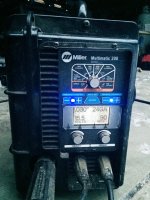
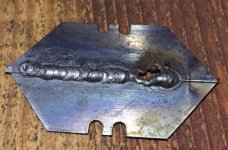
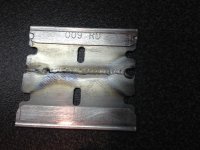
I'll probably never weld razor blades together again but was able to do a satisfactory weld, on the 1st try (with a MIG). If all I had was a stick I would find it extremely limiting.

attachment.php
 

Attachments

  • razor_Multimatic.jpg
    razor_Multimatic.jpg
    238.7 KB · Views: 168
  • razor_topweld.jpg
    razor_topweld.jpg
    199.3 KB · Views: 521
/ Mig Welders #12  
Nice pictures Sodo, but those are carpenter's utility knife blades and easily within the thickness capability of mig. Heck those things are thicker than sheet metal on most cars.

Razor blades are a fraction of that thickness.
 
/ Mig Welders #13  
OK you caught me, the old double edge razor blades were something like .005
This utility blade is probably .023-.025

O.P> asked what's the fuss about MIGs, why people like them. This is just an example of the versatility of a MIG. Lots of folks reading thru these threads get the message that they need to get a stick or go home.

It's my opinion that those folks who are looking for a useful tool will be stymied by the long learning curve for stick welding. They ought to start with a MIG, and if they need a stick, then get one they're easy enough to come by.
 
/ Mig Welders #14  
OK you caught me, the old double edge razor blades were something like .005 This utility blade is probably .023-.025 Intent is to show an example of the versatility of a MIG, the topic of this thread.
plus it's a lap joint! Fail!

Sent from my iPhone 5s 64Gb using TractorByNet
 
/ Mig Welders #15  
It's my opinion that those folks who are looking for a useful tool will be stymied by the long learning curve for stick welding. They ought to start with a MIG, and if they need a stick, then get one they're easy enough to come by.

I think the opposite... learn to stick weld decently and learn what makes a good weld. Later (if you desire) get a mig for the speed. It is also cheaper for production welding.
 
/ Mig Welders
  • Thread Starter
#16  
This thread has taken a life of it's own and I like it. I originally started it because I was very frustrated after trying to use a mig and then I got on one of these forums and one more person had extolled the virtues of a mig. I've cooled off by now but at the time it was more than I was willing to take.

Maybe a bit of history. Dad had a tombstone Lincoln welder. He never encouraged us to weld but he didn't say we couldn't either. One of the first projects I remember (16 17 years old) doing was welding all the holes shut that had rusted trough the sideways barrel that we used as a water trough for the cows. Dad of course figured I had wasted my time but I learned how to weld thin rusty junk with a stick.

After I moved to Alberta (age 22) I took a two week welding course that the government of Alberta put on for farmers. I played with tig and mig and dc welders there and learned a lot. I even set up my brothers mig to weld al. During those years I worked for a farmer that had a Miller 225. Good welder. One of my major projects for him was to build a 110 foot tower for his two way radio antenna. It was put up in the early 80's and is still standing.

About 1995 I got my heavy duty ticket and started my own business as a repair person. I get to work on motorcycles, boats, quads, trailers, cars, trucks and farm machinery. I still weld but don't enjoy it as much as I used to. I'm not as steady as I used to be and I can't see as well either. My present welder is a 295 amp John Deere that I bought new for $230 in the mid 80's.

I'm fortunate in having had a wide variety of experiences repairing and building things.
 
/ Mig Welders #17  
This thread has taken a life of it's own and I like it. I originally started it because I was very frustrated after trying to use a mig and then I got on one of these forums and one more person had extolled the virtues of a mig. I've cooled off by now but at the time it was more than I was willing to take. Maybe a bit of history. Dad had a tombstone Lincoln welder. He never encouraged us to weld but he didn't say we couldn't either. One of the first projects I remember (16 17 years old) doing was welding all the holes shut that had rusted trough the sideways barrel that we used as a water trough for the cows. Dad of course figured I had wasted my time but I learned how to weld thin rusty junk with a stick. After I moved to Alberta (age 22) I took a two week welding course that the government of Alberta put on for farmers. I played with tig and mig and dc welders there and learned a lot. I even set up my brothers mig to weld al. During those years I worked for a farmer that had a Miller 225. Good welder. One of my major projects for him was to build a 110 foot tower for his two way radio antenna. It was put up in the early 80's and is still standing. About 1995 I got my heavy duty ticket and started my own business as a repair person. I get to work on motorcycles, boats, quads, trailers, cars, trucks and farm machinery. I still weld but don't enjoy it as much as I used to. I'm not as steady as I used to be and I can't see as well either. My present welder is a 295 amp John Deere that I bought new for $230 in the mid 80's. I'm fortunate in having had a wide variety of experiences repairing and building things.

I enjoyed your story. Any chance of a pic of your JD welder?

Terry
 
/ Mig Welders #18  
I think the opposite... learn to stick weld decently and learn what makes a good weld. Later (if you desire) get a mig for the speed. It is also cheaper for production welding.
I've heard all my life the best way to learn how to weld is to start with oxygen & acetylene. This is the fastest way to learn puddle control. Once you learn puddle control, then you have to learn how to read the puddle, and anticipate what the puddle is going to do, so you can make corrections, before the puddle falls on your feet.:eek:
 
/ Mig Welders #20  
<snip>
For a minimal cash investment: Nothing covers more bases than an $75-100 used AC 230 volt stick welder and a decent quality $350 115 volt mig welder<snip>
I agree with the concept but reality bites.

Where does this store selling quality
$75-100 used AC 230 volt stick welder
exist?
I searched Craigslist, auctions, rebuilt etc. for a year and RARELY in my area did a < $100 stick welder show up that looked like it would even work.
And then it would be gone right after posting. And mailorder had horrendous shipping costs.

It's like telling people they can get a nearly new 5' tiller for $500, or a 5' bush hog for $250. I score a lot of deals on Craigslist and auctions but when I was seriously looking for a welder the only areas they were popping up were the west coast (SA hand me downs?) and depressed areas of Ohio.

I finally gave up on the used stick welder search and bought a new PA 300 (for $287.05).

Even that pinnacle of cheapness, Harbor Freight, charges about $150 to $200 (?list? $300) for their "225 amp" 240V stick welder.

So please all you pros stop enticing us with references to a used $75 240V buzz box and be more realistic.

And I agree an inexpensive 240V stick and a decent 120V MIG may be a good mix.
 

Marketplace Items

500BBL WHEELED FRAC TANK (A58214)
500BBL WHEELED...
2023 HarbinGer V3 Plus 8KW S/A Towable Light Tower (A60352)
2023 HarbinGer V3...
Hot Pressure Washer S/A Trailer (A59228)
Hot Pressure...
1761 (A58375)
1761 (A58375)
2006 TerraGator 8104 (A61307)
2006 TerraGator...
1981 LINK BELT HSP 8028 (A58216)
1981 LINK BELT HSP...
 
Top