New Home Begins

/ New Home Begins
  • Thread Starter
#381  
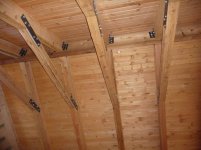
When they finished the plates, they completed the T&G and started on the Raycore roof panels. [/ATTACH]

tkappeler, will the installers use any type of spray foam (such as Great Stuff) between the Raycore panels to fill in any gaps, if needed?

Yes, spray foam to fill gaps and then metal foil tape the same as they did with the walls.
 
/ New Home Begins #382  
Great thread! We're building right now too, and it's familiar to read about someone else battling all the rain/snow/wind this winter. For a while, I bet we were out of action at least 2-3 days per week, which really slows progress. Seems like just as soon as the ground dries up and I think about getting in there with a tractor, it rains again...
 
/ New Home Begins
  • Thread Starter
#383  
Great thread! We're building right now too, and it's familiar to read about someone else battling all the rain/snow/wind this winter. For a while, I bet we were out of action at least 2-3 days per week, which really slows progress. Seems like just as soon as the ground dries up and I think about getting in there with a tractor, it rains again...

Yes, and the weather adds to the costs:

Extend portable toilet 1 month
Extend rental of telehandler by two weeks
Rent 2" diaphragm pump 3 times
Rent 2" hoses for connection to permanent sump 3 times
Buy tarps

and so on
 
/ New Home Begins
  • Thread Starter
#384  
The framers got all of the raycore panels up today. The temporary support in the middle of the great room has been removed and the remaining collar tie installed. All plates are up and finished, Funny how when you encounter something new, its always the last one to do that you finally have it down to a science and it goes quickly.

The front gable has it's panels installed too.

Next up:

Sheath the front gable.
Finish panels in back gable and sheath
build and install gable overhangs.
purlins and sheathing
crickets

Then sheathing inspection only a few days away :)

Unfortunately, it's snowing now. Not expecting more than an inch or two. Supposed to end by 2AM. but we will see if they can work tomorrow.

The excavator also called today to say that he has 15 truckloads of fill he can bring by for $50 per triaxle. It saves him and me since he will be removing it from one location and rather than dump it back at his place, he can just bring it here and save a loading charge. I will also have him bring over his smaller dozer to make the ramp to the garage and build up around it so I can get my tractor into the garage to finish there. His equipment is too big to be of much use there.

P1020788.jpg
 
/ New Home Begins #385  
I love your roof, Tom. That T&G over beams is the 'cat's meow' as far as I'm concerned. I like mine as well today as 11 years ago when it was installed. I think everyone will "Ooh!" and "Ahh!" when they see your room.:thumbsup:
 
/ New Home Begins #386  
No, there won't be another layer of foam. Yes, i understand the thermal bridging, but it is still far better than a typical attic with stapled up R30 or insufficient or matted down blown in insulation.

Well insufficient insulation is insufficient, no matter what. A proper blown-in insulation job in trusses (for example - not your situation, I know...) covers the trusses with a very thick layer of cellulose or fiberglass and covers the framing members totally, eliminating the thermal bridging problem. In your case, you can over-deck the panels with a layer of foam and do the same thing here. 1" of polyiso foam would help a lot, again sealing the seams as they did with the Raycore panels. Right now you have direct thermal bridges to the outside that bypass the insulation. You can prevent this issue now (yes, it will cost money - probably a couple grand depending on roof area), but it will be very hard to fix later. You may find you will have serious ice dam problems, depending on how your climate is. If the snow never sticks around for long, then probably not so big a deal, but if it does, the risk of big problems goes up.

I'm guessing those are 2x6's in the panels. Polyiso is ~R7.2 per inch. A 2x6 is listed at R6.9 (lumber is roughly R1.33/inch). 5.5" of foam is R39.6, so you have ~R40 insulation with R7 "bars" regularly spaced. You will undoubtedly see the lines a day after a snowfall.

I realize you can't do everything, but I'm hoping you find this input helpful.

-Dave
 
/ New Home Begins
  • Thread Starter
#387  
Well insufficient insulation is insufficient, no matter what. A proper blown-in insulation job in trusses (for example - not your situation, I know...) covers the trusses with a very thick layer of cellulose or fiberglass and covers the framing members totally, eliminating the thermal bridging problem. In your case, you can over-deck the panels with a layer of foam and do the same thing here. 1" of polyiso foam would help a lot, again sealing the seams as they did with the Raycore panels. Right now you have direct thermal bridges to the outside that bypass the insulation. You can prevent this issue now (yes, it will cost money - probably a couple grand depending on roof area), but it will be very hard to fix later. You may find you will have serious ice dam problems, depending on how your climate is. If the snow never sticks around for long, then probably not so big a deal, but if it does, the risk of big problems goes up.

I'm guessing those are 2x6's in the panels. Polyiso is ~R7.2 per inch. A 2x6 is listed at R6.9 (lumber is roughly R1.33/inch). 5.5" of foam is R39.6, so you have ~R40 insulation with R7 "bars" regularly spaced. You will undoubtedly see the lines a day after a snowfall.

I realize you can't do everything, but I'm hoping you find this input helpful.

-Dave
Dave,
Thanks for the input Dave.

Yes, I do find the advice helpful as I enjoy the opinions and knowledge of the people here very much. The only thing I know for certain is that more information is helpful. I do plan on doing some layer of blow in insulation over the batts in the truss areas. When I responded before, I was talking about how homes, at least around here, are typically done around here ... shoddy in many instances.

I will consider adding to the panel before they put the purlins and decking on.

Tom
 
/ New Home Begins #388  
I think even though there is some thermal bridging in the SIP panels they do meet the insulation code for your region and additional insulation to eliminate the bridging would have a long payback. I think that your money would be better spent making sure all the cracks and holes in the building are sealed tight so that there is not air infiltration into your house. just my :2cents::2cents: Rick
 
/ New Home Begins #389  
I understand your point Rick on overall roof R-value averaged, but I disagree. In this case, the thermal bridging is excessive, IMHO. This is the roof, and insulation standards are higher on the roof for good reasons.. Hot air rises, so the roof tends to lose more heat than walls do, so that is one reason it is important to have good roof insulation.. The other one is ice dams. If the roof gets too warm, the snow melts, runs down and then refreezes when it hits the eaves, and this causes backups of ice and thus ice dams. This leads to roof leaks. Thermal bridges like this one lead to ice dams as the bridges melt snow in that area, and then the water runs down, even though the rest of the roof is cold. This is not like a typical SIPs roof panel as there are full 2x's in the panels, every 24" (or so it appears from the pics). Most SIPs roofs have I-joist splines which limit the thermal bridge to almost nothing (the thickness of the plywood web).

Given that he was already putting down T&G sheathing, I bet this could have been done with only foam board insulation and then sheathing over that, for something to nail the shingles to. I'm not sure the panels really add much structural here, though the bent spacing below may be a bit large for just 3/4" T&G to work. Still, it could be worked out without thermal bridges, I'm sure. 6" of polyiso is R43.2, which is just above the R38 code for TKappler's area (Based on a quick Google search), which is probably better than he is getting with the roof now. Lets say 5.5" of polyiso = 39.6 and the 1.5" wide 2x6's are R6.9 (per above). A weighted average says that means the whole roof should be rated at about R37.5 (linear average) which means it technically does not pass. Now you add a little extra for the T&G and it is probably over R38 total, but not by a lot.

If it was me here, I would add 2" of foam over the top of this. Ideally, 2x 1" layers offset seams, and seams sealed. Or just do the 6" foam and skip the panels, depending on load limits.

Like I said, you can't do everything, but the roof is pretty important, IMHO.
 
/ New Home Begins
  • Thread Starter
#390  
I understand your point Rick on overall roof R-value averaged, but I disagree. In this case, the thermal bridging is excessive, IMHO. This is the roof, and insulation standards are higher on the roof for good reasons.. Hot air rises, so the roof tends to lose more heat than walls do, so that is one reason it is important to have good roof insulation.. The other one is ice dams. If the roof gets too warm, the snow melts, runs down and then refreezes when it hits the eaves, and this causes backups of ice and thus ice dams. This leads to roof leaks. Thermal bridges like this one lead to ice dams as the bridges melt snow in that area, and then the water runs down, even though the rest of the roof is cold. This is not like a typical SIPs roof panel as there are full 2x's in the panels, every 24" (or so it appears from the pics). Most SIPs roofs have I-joist splines which limit the thermal bridge to almost nothing (the thickness of the plywood web).

Given that he was already putting down T&G sheathing, I bet this could have been done with only foam board insulation and then sheathing over that, for something to nail the shingles to. I'm not sure the panels really add much structural here, though the bent spacing below may be a bit large for just 3/4" T&G to work. Still, it could be worked out without thermal bridges, I'm sure. 6" of polyiso is R43.2, which is just above the R38 code for TKappler's area (Based on a quick Google search), which is probably better than he is getting with the roof now. Lets say 5.5" of polyiso = 39.6 and the 1.5" wide 2x6's are R6.9 (per above). A weighted average says that means the whole roof should be rated at about R37.5 (linear average) which means it technically does not pass. Now you add a little extra for the T&G and it is probably over R38 total, but not by a lot.

If it was me here, I would add 2" of foam over the top of this. Ideally, 2x 1" layers offset seams, and seams sealed. Or just do the 6" foam and skip the panels, depending on load limits.

Like I said, you can't do everything, but the roof is pretty important, IMHO.

Dave,

I appreciate the insight and I am going to consider it. And I do not want to start a war like the earlier concrete fiasco several pages back. :D

Maybe I am missing something and I apologize if it seems silly but ... haven't homes been built for the better part of the last century with thermally bridged walls and imperfect installed and undersized insulation? Haven't these same homes had less than adequate attic insulation too? Aren't all walls other than a double wall and SIPs thermally bridged?They all have not succumbed to ice damming.

edit: I did look into SIPs for the roof, however; to get anywhere near an R40, I had to have almost 12" thick panels and this was not going to work, either aesthetically or from an expense standpoint.

The figures stated by raycore, along with installation techniques are all reviewed and approved by the architect, structural engineer and township inspectors.

I am doing what I feel I can afford to do to make a tight home. I am NOT trying to make a superinsulated or I would have double walls and owned a bank. The whole green drive can't be a all or nothing camp. Incremental advancements have a place and it is far better than 90% of the homes, at a fraction of the cost, of those in the area, including some McMansions.

Two years ago, the attic insulation standard in NJ was R30. Does this mean that a mere R39 is paltry? If I compare to the neighbor who built two years ago, I am still better than he is.

Sorry, let me put the soapbox away.:eek:
 
/ New Home Begins #391  
I think Dave makes a good point about the need to differentiate between roofs and walls.

Ice dams are probably not a big issue in your climate I am guessing? Around here, they are very common in a normal winter, and do lead to leaks in ceilings when enough melt water backs up behind the ice dam to flood the shingles. Maybe the "cold roof" air gap between the purlins in your case will prevent that.
 
/ New Home Begins #392  
Tom, no problem - and I fully understand. Let me explain a bit.

First things... ice dams are a roof problem only. Air sealing and insulation in the ROOF are the root of ice dam problems. And yes, there are a lot of problems in older houses in this area. You can get away with a lot more in walls, and all it affects is your heating/cooling bill.

The second issue is the type of construction.

Had you built a "typical" truss or rafter roof with blown-in or batt insulation, then you would be in a different realm. What you have is an "insulation contact roof deck" - that is different. With a typical truss roof, you blow in insulation over the ceiling and the roof deck is vented to the outside making it cool. That solves a lot of roof deck issues as there are no thermal bridges to the deck (If it is done right..). With a SIPs type roof (like you have), the issues are different. There is no vent space keeping the roof deck the same temp as outdoors. Therefore you need to keep it cool to avoid melting snow. The only way is by building a deck that is air tight and insulated enough to keep the heat in and the snow happy outside. With thermal bridges like you are showing with the panels, you will have snow melt issues, which may result in ice dam & leak problems (a lot depends on your local climate...)

You can get away with a lot more sloppy construction if you have a vented attic above your ceiling, but you do not. Even the sloppy guys there are learning it is not great to do that too... But the issue here is there is nothing between your heated living space and the outside except the insulation in the roof deck. If there are thermal bridges, they will cause problems by melting snow and making the water run down the roof.

Not sure if I am making my point, but if you held a consistent R30 or R39 then you would be fine in either case. The differential between the R39 foam and the R7 studs, is the problem. Make sense? feel free to ask more if I am not explaining it well enough...

And this is the key point - if you have ice dam problems after building, you will have to strip the shingles and lay down 1-2" of foam. How much fun will that be vs doing it now?


I am glad to see the Superior Walls worked out well. I suspected it was our local outfit that was the problem here, but I wanted to caution you to make sure you were aware.

I am impressed with your progress and really love the look of the T&G ceiling. Please don't take my comments as trying to drag you down, though I know that is easy to do. I'm trying to help by applying accepted Building Science practices here.... The envelope is the critical piece...
 
/ New Home Begins #393  
Tom,

thank you for sharing the link to your build. Great build and progress. I'm looking forward to following your steps as you progress.

Jeremy
 
/ New Home Begins #394  
I too, looked at the roof and thought, this was a weak link in this system. A cold roof system would help with the ice dams, but I would be more concerned with the cold ceiling, at the 2x4s, if moisture might condense and leave water damaged stripes in your ceiling? A friend, bought a home that had T&G ceiling in the dormer, it had vertical stripes 2" wide, but had fiberglass,not foam.
It is a great looking home and building sight.
 
/ New Home Begins
  • Thread Starter
#395  
Dave(s),

Although I am not in the trades professionally, I have been around them most of my life so I do understand the concepts and differences you point out. I also pour over trade journals such as JLC, Builder, Remodeler and FHB to keep up on new products, techniques, trends and best practices.

At least in our area, the temps are not as bad. There are a lot of homes in the area with cathedral ceilings which fall into the same category as what I have. And I know that a cold roof like mine are NOT the norm on these other homes. I have not heard of problems caused by the bridging. Could be I have not asked the specific questions. Could be that at least in our area, the temps are more moderate compared to your areas.

Anyway, you have sufficiently scared the crap out of me to at least ask specific questions of Raycore, Architect, framers, etc before the purlins and decking go on. :D
 
/ New Home Begins #396  
Insulation is a good thing and it's best to maximize it if the cost is reasonable. However, when we are talking in the R40 range, the heat loss from the house is going to dominated by air infiltration and window losses. If it was my house, I would focus on good seals and long term stability. I have a concern that some of the high tech super insulation approaches may work fine when installed but lose a lot of effectiveness 30 or 40 years from now.

Also keep in mind that, because we are building our houses so tight now, many codes require outside air intake. I think any new house in a cold climate now should seriously consider an outside air heat recovery system. How much value is going from R40 to R45 if the code requires a 6 inch hole in your basement wall?
 
/ New Home Begins #397  
Oh well, if you are sufficiently scared, then mission accomplished :laughing:

Joking aside, I have no idea what the optimal balance between building cost and R-value is in your area. I do think insulation is often under-valued. In the long run, insulation allows becoming financially uncoupled from energy markets. Green or otherwise, energy is expensive.

Home building is a funny thing. Practices with known downsides are used for decades. In part to avoid risk, and also just because "that's the way we do things." When forced by economics, changes are experimented with, some of those turn out to be duds, and some succeed and become the new standards that go on to outlive their value.

Generations of Mainers have shoveled their roofs to prevent collapse and ice dam problems. They probably did the same math; knowing that if they spent enough during construction, 95% of that shoveling could be avoided. The same applies to going through 15 cords of wood every winter.

Economically, it boils down to what value is placed on the permanence of homes from two perspectives: how long we typically expect to live in a home, and how long the home and it's neighborhood are expected to maintain value. There are reasons we don't spend enough to build "forever" houses, and we have to live with those reasons--in every sense.
 
/ New Home Begins #398  
Insulation is a good thing and it's best to maximize it if the cost is reasonable. However, when we are talking in the R40 range, the heat loss from the house is going to dominated by air infiltration and window losses. If it was my house, I would focus on good seals and long term stability. I have a concern that some of the high tech super insulation approaches may work fine when installed but lose a lot of effectiveness 30 or 40 years from now.

Also keep in mind that, because we are building our houses so tight now, many codes require outside air intake. I think any new house in a cold climate now should seriously consider an outside air heat recovery system. How much value is going from R40 to R45 if the code requires a 6 inch hole in your basement wall?

I have an outside air heat recovery system. It essentially is a joke and if I ran it 24/7 like I supposed to would get zero benefits from my insulation. Could as easily leave a window open. It does strip some heat/cool energy but I would guess in the range of 10%.
 
/ New Home Begins #399  
Insulation is a good thing and it's best to maximize it if the cost is reasonable. However, when we are talking in the R40 range, the heat loss from the house is going to dominated by air infiltration and window losses. If it was my house, I would focus on good seals and long term stability. I have a concern that some of the high tech super insulation approaches may work fine when installed but lose a lot of effectiveness 30 or 40 years from now.

Also keep in mind that, because we are building our houses so tight now, many codes require outside air intake. I think any new house in a cold climate now should seriously consider an outside air heat recovery system. How much value is going from R40 to R45 if the code requires a 6 inch hole in your basement wall?

The air tightness of new housing and the low efficiency of heat exchangers are good reasons to take care in what materials are built and brought into a house. Carpet, wood finishes, paints, vinyl anything and radon abatement are all areas where good choices need to be made. Reducing the pollution load in inside air reduces the need for air exchange while still maintaining healthy indoor air quality.

Boosting the cfm's well beyond what is typically installed, and having exhaust vents that actually go outside, for bathroom vents and range hoods can really help. In a tight house, you need to allow in make-up air for those exhaust fans. Cracking a window open works even if it is low-tech.
 

Marketplace Items

BUNDLE OF 1 1/2"X1 1/2"X79" TUBING (A60430)
BUNDLE OF 1 1/2"X1...
2023 CATERPILLAR 279D3 SKID STEER (A60429)
2023 CATERPILLAR...
60" HYD BRUSH CUTTER (A52706)
60" HYD BRUSH...
UNUSED FUTURE FT50-(50) 12' PIECES OF GALVALUME (A60432)
UNUSED FUTURE...
1981 LINK BELT HSP 8028 (A58216)
1981 LINK BELT HSP...
2022 Kubota LX2610SUHSD Compact Utility Tractor (A55315)
2022 Kubota...
 
Top