You are using an out of date browser. It may not display this or other websites correctly.
You should upgrade or use an alternative browser.
You should upgrade or use an alternative browser.
Polebarn lean-to posts
- Thread starter fishpick
- Start date
- Views: 44335
More options
Who Replied?
/ Polebarn lean-to posts
#21

Gittyup
Elite Member
- Joined
- Oct 4, 2007
- Messages
- 3,145
- Location
- Mid Atlantic
- Tractor
- Kioti CK25 Shuttle Shift, loaded tires, JD X739
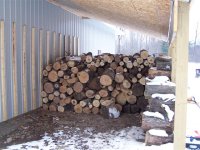
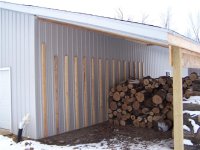
Thanks for the pix, Rex. Thats very close to what I want, except my connection to the barn is to an end wall.
I talked to a builder today. He said for metal roofing with no sheathing on a 3/12 pitch, a 2x8 span of 16' was acceptable at 16" spacing. But, just barely.
An on line calculator yielded 16'8" at 12" spacing, 35 psi snow load.
I'm going to investigate trusses before I decide.
I talked to a builder today. He said for metal roofing with no sheathing on a 3/12 pitch, a 2x8 span of 16' was acceptable at 16" spacing. But, just barely.
An on line calculator yielded 16'8" at 12" spacing, 35 psi snow load.
I'm going to investigate trusses before I decide.
accordionman
Gold Member
HELLO TO ALL,
i have a 30x50 building by WICK. i ask about why they did
not put concrete around the post. they said, NEVER put
concrete around post, they will not last as long, because
the concrete holds moisture. that was 23 years ago, and
everything is still standing.
good luck to all.
accordionman
i have a 30x50 building by WICK. i ask about why they did
not put concrete around the post. they said, NEVER put
concrete around post, they will not last as long, because
the concrete holds moisture. that was 23 years ago, and
everything is still standing.
good luck to all.
accordionman

EddieWalker
Epic Contributor
I agree with this in most situations, but there are exceptions. When building in sand, there just isn't enough strength in the hole to hold the post there. I like to make the holes larger and use the extra cement to hold them in place. Except for sand, I never use concrete on poles.
Eddie
Eddie

gerard
Veteran Member
If I had a backhoe I wouldn't hesitate to use it for the posts. There's been a lot of comments about wind, soild compaction etc. I had an addition put on my barn and they used a 24 inch auger which makes the hole a lot bigger than needed and runs into the same problems of "uncompacted soil", maybe just not quite as big a problem as with a backhoe. However, if you run a few lag bolts in the bottom of the post and let them stick out, fill in some of the hole with dirt after you place the posts and dump in some concrete, there's no way that post is going to rip out of the ground before the whole roof comes off. This is only a consideration for a short time anyway as the soil will naturally recompact over time as a couple of rains filters through the dirt and the dirt resettles. Re the fost heaving issue - it IS a must to go below the frost line. Post lifting occurs primarily if moisture gets under the post, freezes, and expands. Not from frost freezing and pushing against the post horizontally, that will put lateral pressure on the post and I suppose cause some compression but that won't translate into an upward force. I'm in a cold climate and have never seen post's heave if they are deep enough.
gerard
Veteran Member
I have mixed feelings about the conrete issue - have heard about a 50 50 split among contractors re: emebdding in concrete. Have heard the concrete accelerates the decomposition of the post. If I was building my "forever" barn, I would look at "postsaver" polyethylene sleeves that slide of the post for the 4 feet that goes in the ground. This keeps the post totally out of contact with the soil and or concrete. (The bottom is also belled to resist upward forces.) There's also a product that maes the whole bottom of the post pre cast concrete with some heavy duty angle iron attached at the top. The post bolts into the angle iron and the entire portion that goes in the gound is high psi pre cast concrete. tis is also a great idea and keeps all ofthe wood out of the ground. Perma-Column: Pre-cast concrete columns for post frame building industry - Stop rotten posts - Replace rotten posts - Post Frame Construction - Pole Barn - Pole Building - Post Replacementaccordionman said:HELLO TO ALL,
i have a 30x50 building by WICK. i ask about why they did
not put concrete around the post. they said, NEVER put
concrete around post, they will not last as long, because
the concrete holds moisture. that was 23 years ago, and
everything is still standing.
good luck to all.
accordionman
Last edited:

PCABE5
Platinum Member
Last summer I removed the concrete used on my mothers lean-to. It was just a post in a hole with concrete around them. The holes were below the frostline (48") but the frost of the first 36" pushed the posts out of the ground on average of 6-7". So I can tell you that it can and does happen.
I pulled all the posts (used the 2320 FEL) redrilled the holes to 12"x48" and poured a 12"x4" footing and placed some vertical rebar then placed a 8" sonotube on top of the footing and finished the pour. This creates a footing below the frostline that is flaired out from the main pier and the tube keeps the water/ice from acting on the main vertical and the rebar ties the two together. The posts are attached with Simpson ties to the piers. Soil was placed around the piers in layers and with water and compacting to remove air pocket and help settle the soil.
I like this type of system, as post can be replaced pretty easily and the flair footing really anchors the posts from up draft loads. I also have a free standing three sided lean-to that I built just like this (20'Lx10'Wx8'H) 9 years ago and it has yet to move. It sits in a pasture fully exposed to winds from all directions that sometimes have exceeded 60mph.
I pulled all the posts (used the 2320 FEL) redrilled the holes to 12"x48" and poured a 12"x4" footing and placed some vertical rebar then placed a 8" sonotube on top of the footing and finished the pour. This creates a footing below the frostline that is flaired out from the main pier and the tube keeps the water/ice from acting on the main vertical and the rebar ties the two together. The posts are attached with Simpson ties to the piers. Soil was placed around the piers in layers and with water and compacting to remove air pocket and help settle the soil.
I like this type of system, as post can be replaced pretty easily and the flair footing really anchors the posts from up draft loads. I also have a free standing three sided lean-to that I built just like this (20'Lx10'Wx8'H) 9 years ago and it has yet to move. It sits in a pasture fully exposed to winds from all directions that sometimes have exceeded 60mph.

sugarmaple
Bronze Member
FOOTING TUBE FOOTING TUBE
Please go to foottube DOT cee oh em for a simple, effective post base that will not heave with frost. There is a video that shows how it works. These are Canadian in origin where they KNOW frost, and their building standards are significantly higher when it comes to efficiency. Those who live in soft, relatively stone free soil locations cannot appreciate the problems stoney, boulder strewn soil conditions create. Backhoes and excavators are a necessity. PHDs don't amount to a hill of beans. I have no vested interest in footing tube, they are simply the best solution I have seen in 35 years of building plus I am tiring of reading about concrete embedment and why backhoes don't work. Pressure treated material will rot in some conditions, not always, but not infrequently either. (Cut off a 6x6 and see how far the preservative has penetrated.) Reinforcing steel in the footing tube connected to a steel post anchor and the code built roof will withstand any wind load up to the engineered design limit. Check with an engineer if you have concerns or extremely wind conditions. In my little microclimate we see gusts up to 70, more in the occasional thunderstorm microburst and I am planning on using this system to carry a small barn that I put on wooden piers 25 years ago that has succumbed to soft springtime soil conditions and a persistant south wind. I would never have had this problem had footing tubes existed way back when...
FOOTING TUBE FOOTINGTUBE
Please go to foottube DOT cee oh em for a simple, effective post base that will not heave with frost. There is a video that shows how it works. These are Canadian in origin where they KNOW frost, and their building standards are significantly higher when it comes to efficiency. Those who live in soft, relatively stone free soil locations cannot appreciate the problems stoney, boulder strewn soil conditions create. Backhoes and excavators are a necessity. PHDs don't amount to a hill of beans. I have no vested interest in footing tube, they are simply the best solution I have seen in 35 years of building plus I am tiring of reading about concrete embedment and why backhoes don't work. Pressure treated material will rot in some conditions, not always, but not infrequently either. (Cut off a 6x6 and see how far the preservative has penetrated.) Reinforcing steel in the footing tube connected to a steel post anchor and the code built roof will withstand any wind load up to the engineered design limit. Check with an engineer if you have concerns or extremely wind conditions. In my little microclimate we see gusts up to 70, more in the occasional thunderstorm microburst and I am planning on using this system to carry a small barn that I put on wooden piers 25 years ago that has succumbed to soft springtime soil conditions and a persistant south wind. I would never have had this problem had footing tubes existed way back when...
FOOTING TUBE FOOTINGTUBE
philbuilt
Gold Member
I'm with Sugarmaple on this one. The footing tube will allow the use of the backhoe with minimum compaction. Just dampen the soil it will pack.
The base and vert taper will do the work.
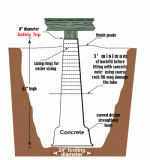
Being in the sign industry we find many post rotted off in concrete. Eddie one posted that he adds a crown to the top of the crete to shed the water away from the post. That work well, but on a building I would not want this. I like the clean look. Short term wood direct buried (no crete )we found last the longest.
Phil
The base and vert taper will do the work.
Being in the sign industry we find many post rotted off in concrete. Eddie one posted that he adds a crown to the top of the crete to shed the water away from the post. That work well, but on a building I would not want this. I like the clean look. Short term wood direct buried (no crete )we found last the longest.
Phil
EddieWalker
Epic Contributor
Interesting design. I wonder how much more money it will cost to do something like that compared to drilling a hole with a post hold digger and sticking a post in the hole, then backfilling with dirt? Then I wonder if there is a significat strength increase going that method? Not factoring in time, which is probably significant, the only expense to putting the wooden post in the ground is the rental or purchase of the post hole digger.
Of course, if you realy want to dig your holes with a backhoe, that method sure looks like a winner!!!!!!
Eddie
Of course, if you realy want to dig your holes with a backhoe, that method sure looks like a winner!!!!!!
Eddie
shinnlinger
Silver Member
PCABE5
Platinum Member
EddieWalker said:Then I wonder if there is a significat strength increase going that method?
Eddie
The obvious strenght increase is preventing downward movement because of the larger footing size verses just the size of a 6x6 and the flared design creates added resistance on the upward movement due to frost and wind in this case. You can buy the plastic tubes or make your own flared footing like I had described earlier which is cheaper because your not buying a plastic tube you wouldn't need. I would still use a PHD for any hole 24" or less as it is so much quicker and the surrounding soil is undisturbed.
catvet
Gold Member
Not suggesting this for a barn but have you seen the redifooting system? Apparently you can do it all with plastic. Don't need no blankty-blank concrete or Pressure treated in ground. 
OP

fishpick
Platinum Member
You know - I'm really tempted after seeing the strong opinions here - to ask the following question:
"After the lean to is built and I want to add a light under it - should I use wire-nuts or solder the wires"
Good points all around - I kinda like that footer design and the taper - was thinking I might do a modified version of that with a homemade form - then back-fill the holes.
FWIW to those that are concerned with compaction - my soil is of a composition such that making it wet when I back-fill - then watering it well - letting it sit - and re-watering it - it will become almost hard as rock (Bluebird Meadow Farms: Preparing for the pour - part 2)
It really self compacts very well - add in a tamper - and I'm comfortable with my plans.
"After the lean to is built and I want to add a light under it - should I use wire-nuts or solder the wires"
Good points all around - I kinda like that footer design and the taper - was thinking I might do a modified version of that with a homemade form - then back-fill the holes.
FWIW to those that are concerned with compaction - my soil is of a composition such that making it wet when I back-fill - then watering it well - letting it sit - and re-watering it - it will become almost hard as rock (Bluebird Meadow Farms: Preparing for the pour - part 2)
It really self compacts very well - add in a tamper - and I'm comfortable with my plans.
chatcher
Silver Member
There are a few competing theories on how to set a post. The common method around here, and the one I used, was to dig the post holes below frost line, pour in a slug of concrete, let it set, and set the poles on TOP of the concrete, filling around the poles with dirt. The idea as I understand it is to give the posts a solid bottom so they don't settle, but let the framing of the building locate, level, and brace the posts. As for wind lifting the building, my guess is the pitch of the roof tends to transfer horizontal wind pressure into DOWNWARD pressure on the posts, but I am not an engineer...
Blagadan
Gold Member
Footings for lean-to structures have to be stronger than if you were building a walled structure for the very reason EddieWalker suggested. I have seen lean-to's pull huge lumps of concrete out of the ground. Like a spinnaker on a yacht, A lean-to will yield huge upward energy given the right circumstances.
Heres another way I've seen it done...

Heres another way I've seen it done...
OP
fishpick
Platinum Member
Blagadan - like the artwork!
philbuilt
Gold Member
On the footing tube I wonder if you could reuse the plastic tube? If and when the snow will go away I have a spot to try it and can report back. They are smooth inside. Set, pour,wait overnight, and tap on the outside and try to lift off. It just may work.
Phil
Phil

Here are some similar links:


- Replies
- 22
- Views
- 5K

