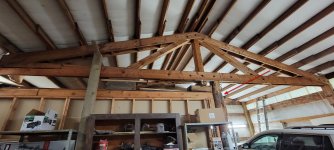
Roof Beam replacement.

/ Roof Beam replacement. #1  

RobertEH

Gold Member
Joined
May 16, 2022
Messages
332
Location
Idaho Panhandle
Tractor
LS MT235HE
I have a neighbor who had a bean on one of the truss’s in his shop break (allegedly due to snow load, but it happened prior to him purchasing the property).


I offered to help him replace it. The plan is:

1 Using the forks on the tractor, provide just enough upward pressure on the rafter to allow removal of the broken beam. We will brace the loader once we have the rafter lifted for safety.

2 remove the bolts in the fractured truss and replace with new wood

3 lower the forks so the roof settles in on the new wood.


Any faults with this plan?


In the photo, the red circle shows the broken beam, and the blue arrow shows the rafter we will put upward pressure on.
1699894748335.png
 
/ Roof Beam replacement. #2  
I have a neighbor who had a bean on one of the truss’s in his shop break (allegedly due to snow load, but it happened prior to him purchasing the property).


I offered to help him replace it. The plan is:

1 Using the forks on the tractor, provide just enough upward pressure on the rafter to allow removal of the broken beam. We will brace the loader once we have the rafter lifted for safety.

2 remove the bolts in the fractured truss and replace with new wood

3 lower the forks so the roof settles in on the new wood.


Any faults with this plan?


In the photo, the red circle shows the broken beam, and the blue arrow shows the rafter we will put upward pressure on.
View attachment 831893
Upward lift alone on the rafter does not appear to constrain the horizontal force of the rafter. The broken beam in tension constrains the horizontal force (inherent strength of a triangle) The upward force is provided by the vertical post.
 
/ Roof Beam replacement. #3  
My suggestion is to use a mechanical screw jack or mechanical jack post for any lifting because it will give you the most control over the lift. It is easy to go too far with a FEL and cause more damage. A mechanical screw jack can't leak down, either, like a hydraulic jack while you are working on this.
 
/ Roof Beam replacement. #4  
If the beam on the other side is not broken then I wouldn't replace the broken one. What I would do is see is you can jack and pull everything into place. If you can then fill the joint with glue and clamp it till it's dry. Run a few GRK screws into the break while it's drying. After your sure it won't move then I would fill in with another piece glued and screwed beside the broken beam.
 
/ Roof Beam replacement. #5  
I don't know but suspect that there should be considerable force along the length of the beam. Applying upward pressure will probably tend to relieve some of this force but I have no idea how much. So I would try to remove any load along the length of the beam before I did anything else. Maybe use a come along with chains. Apply force with the come along until you can see the broken beam getting slightly shorter at the break. Then use some sort of mechanical means, like the screw jack previously mentioned, to apply vertical force. A hydraulic jack and wedges could also be used. I would not rely on a hydraulic alone, but would use it only for raising. I would avoid using the tractor. In this situation it would seem to be best to do everything slowly.
Eric
 
/ Roof Beam replacement. #6  
+1 to the come-along - is there any sign of either wall not being vertical at that point or bulging outwards? Is the hip of the roof a straight line? Just wondering what ill effects have occurred due to the lack of that beam. If there's nothing to be seen then I'd try to just brace things (vertical jack + horizontal come-along tension) lightly without much movement
Looks like there's a web to the right, so that truss beam is definitely supposed to provide some vertical load and not just tension (thus, the blocks supporting it under the web).

What was the truss beam originally sitting on?
Is its mate next to it (behind it, in the pic) also broken or is that one handling most of the weight & tension for that region now?
Can we see a pic of one of the unbroken truss beams and where they're sitting?
Did someone put that vertical board that's next to the jack there to hold it up?

I suspect that if you're going to jack it up, you should probably do it at a point closer to the peak than where your blue arrow is since the load is coming from the peak.
1699906853234.png
 
/ Roof Beam replacement. #7  
Could be very bad plan.
Not a beam, but part of truss that is broken. Removing the broken tension member could cause the building to expand outward and collapse roof.
How long has member been cracked.
I would try to add reinforcements to existing beam rather than replace the broken member.
Can you take more picture of entire truss and broken section
 
/ Roof Beam replacement.
  • Thread Starter
#8  
Appreciate the thoughts. Has me rethinking some things.


20231014_162015.jpg

Here is a photo of the full truss. the 6x6 to the left of center is just sitting there as a temporary brace. The "tree" just right of center was put there by the prior owner as a safety...

  • I will have to go over and look to see if the beam on the other side is also broken or not. I want to say it is? but not 100% sure.
  • I am not sure if the wall is bulging - not so obviously so that it jumped out at me, but worth checking.
  • Beam/truss cracked under the prior owners care - not sure how long but it has been at least 2 years. I believe the temporary measures have kept it intact for quite some time.
I am unclear regarding what folks mean about using a come along? what would I be connecting each end of the come along to? Would I be pulling the base of the truss upwards towards the roof from somewhere near the center of the truss in an attempt to release pressure on the edges and potentially seal and sister some new wood alongside the broken boards?
 
/ Roof Beam replacement. #9  
1699910064363.png

Probably loosen a wall panel or two on each side, put some tension between the two uprights - because the bottom beam of a truss is supposed to be in tension (the roof load pushes out, the bottom beam keeps the triangle from collapsing). That's why the question about the wall bulging outward.

Check the level/vertical of the posts at both ends of the broken beam.
As previously mentioned, if everything seems perfect (no bulging, everything properly vertical) then you should just get a little bit of tension on the top chords of the truss (the roof sloping parts) so that when you put in the new beam, and then relax that tension, it settles to how it is now. Obviously, if there's a bit of bulging, you want to slightly overcorrect that so that once again, when the new beam is placed and the tension is relaxed, it settles to how you want it to be, long term.
 
/ Roof Beam replacement. #11  
Gotcha. very helpful.

So the come along would essentially be a temporary stabilizer to keep the walls from bulging while working on the truss.
Yes ... As others have posted, That cracked piece isn't a really a load bearing member, it's in tension. Notice the vertical crack, If it were a loaded beam, the crack would be on the bottom. I surmise only the broken piece is fastened to the vertical post. The unbroken section is free to move. Even with the supports pictured, if you cut it, the roof may collapse, not merely bulging the walls outwards
.
 
/ Roof Beam replacement. #12  
The easiest and probably best repair is add a couple of pieces of steel angle iron to the bottom of the cracked member. use structural screws to attach angle to beam. The connection points of the truss are designed and would need to rebuilt in similar strength
 
/ Roof Beam replacement. #13  
Why not just lash another beam along side ? Be done with it. If the wall has pushed out. Pull it in. The building seems shy of enough vertical roof support. Maybe even another truss on each side, appropriately spaced.
 
/ Roof Beam replacement. #14  
Why not just lash another beam along side ? Be done with it. If the wall has pushed out. Pull it in. The building seems shy of enough vertical roof support. Maybe even another truss on each side, appropriately spaced.
Good idea, although based on the picture in post no. 8, the entire building appears to be lacking in verticle support at the walls as well as spacing between the end and center truss. Unlikely this building meets the building code.
 
/ Roof Beam replacement. #15  
The easiest and probably best repair is add a couple of pieces of steel angle iron to the bottom of the cracked member. use structural screws to attach angle to beam. The connection points of the truss are designed and would need to rebuilt in similar strength
This is a "depends" solution. If the bottom of the cracked member is not fastened to the roof member or inadequately connected, then the wall will push out collapsing the roof.

To my eye, the "beam" has failed in tension. The upper portion has sheared horizontally with the "vertical crack" a tension failure

I think the temporary shoring is taking enough load off the truss to prevent roof collapse. But the shoring doesn't fix the broken truss connection.
 
/ Roof Beam replacement. #16  
If the wall has pushed out. Pull it in. The building seems shy of enough vertical roof support. Maybe even another truss on each side, appropriately spaced.
I believe this observation to be correct, not enough vertical posts and not enough trusses to keep this building living in a snow zone.
I would recommend having a good carpenter take a look for structural loading for the snow load and wind loading for your area. They will tell you right away if the spans of the perlins are to long or if there are not enough trusses.
The only thing I would do at this point is to take a come-along and place tension from one post to the opposite post until you get a qualified carpenter out looking at it. just snug it up not moving anything.
 
/ Roof Beam replacement. #17  
That truss is built incorrectly. The design puts excessive down pressure on that bottom member that's supposed to be under tension. Google pictures of trusses and notice that the angled braces on either side of the vertical center support always go from center of the bottom member to a point midway on the upper cord, which is the opposite of how that one is built. How many trusses are there in this building and what is the span? Looks like about 30 ft. wide?
 
/ Roof Beam replacement. #18  
Why not just lash another beam along side ? Be done with it. If the wall has pushed out. Pull it in. The building seems shy of enough vertical roof support. Maybe even another truss on each side, appropriately spaced.
To assist just the one beam, with no consideration for any other part of the structure, I think your solution is the best. Assuming, and this is a big assumption, that every thing was built to code and this particular beam just happened to fail, perhaps just because it was persnickety and wanted to cause trouble, then adding another beam without removing the persnickety beam seems like it would be the fastest and least expensive fix. Just make sure the new beam will be able to properly take the load of the broken beam. It also may be advantageous to threaten the broken beam with a burn barrel so that it doesn't cause any further problems.
Eric
 
/ Roof Beam replacement. #19  
I am grateful to the other members who have pointed out many aspects of this that I did not realize.

What is the distance between trusses in this building? It looks like the end wall truss is pretty far from the one that is broken.

truss.jpg
 
/ Roof Beam replacement. #20  
I am grateful to the other members who have pointed out many aspects of this that I did not realize.

What is the distance between trusses in this building? It looks like the end wall truss is pretty far from the one that is broken.
More than likely they're 10 ft. apart. That's the standard in the area where the OP and myself live. Waiting to hear from the OP on the width of the building, but if it's what I think it is (30'), he's going to have some potentially significant structural changes to make. There's not much use simply replacing the cord of the truss that broke since it broke due to a design flaw, not a flaw in the wood. It'll just happen again. The diagonal braces on those trusses are basically backwards and most of the problem. At minimum he should cut those out and get rid of them before replacing the bottom beam. It's possible he could get away with just doing that, but I'd be more comfortable with some more significant changes, if the setup of the building allows. Since it's already got a wall beneath it, that truss could be supported by a post up to the peak, essentially turning it into rafters. That'd work with the other trusses in the building too, but not (of course) if there needs to be full width clear span.
 

Marketplace Items

(2) UNUSED FUTURE 10' SLIP-ON FORK EXTENSIONS (A60432)
(2) UNUSED FUTURE...
UNUSED RAYTREE RMBD50-50" HYD DRUM MULCHER (A60432)
UNUSED RAYTREE...
2005 EZ-GO Utility Cart (A55851)
2005 EZ-GO Utility...
UNUSED FUTURE P45-56" HYD MINI BREAKER HAMMER (A60432)
UNUSED FUTURE...
2014 Forest River Rockwood Premier 2317G S/A Pop Up Trailer (A59231)
2014 Forest River...
UNUSED FUTURE REMOTE CONTROLLED TOY (A60430)
UNUSED FUTURE...
 
Top