Running Water Lines

   / Running Water Lines #1  

Alan L.

Elite Member
Joined
Apr 6, 2000
Messages
3,212
Location
Grayson County, TX
Tractor
Kubota B2710
I need to run about 350 feet of water line. I plan to use 1.25 inch all the way - PVC that comes in 20 foot sections. I want to put in a couple of those frost-free faucets, but also I want to be able to pump water into my one-acre tank (pond), such that the pump will run 100% of the time during these periods.

I picture just having the open pipe sticking up and a 90 directing the stream to the tank, with a gate valve. Only problem is that it would be subject to freezing, but I don't know of a long neck frost-free setup for such a big faucet.
Any ideas?

Also, I plan to rent a trencher. Would a walk behind be OK, or should I go for the bigger one? In heavy clay, only occasional rocks, none bigger than 3 or 4 inches, going about 24" deep, how long will it take to trench the 350 feet?
 
   / Running Water Lines #2  
If you want to pump to the pond so the pump will run full time during that period, think about a pump relay. It could be set up so when that line runs, it turns the pump on, and keeps it on till that line shuts off. That would minimize cycling on the well pump. That could be tied to the rest of your irrigation too. Most good timers have a Master Valve/Pump relay connection(actual pump relay is a seperate unit).

While you have the trench open, think about electrical, low voltage lighting, and irrigation. It would be the time to get that in while the trench is there...

I have dropped wire in to trenches for irrigation valves, even though it was a way off project. It is easier and cheaper to do it all, then to run the trencher again, risk hiiting the 1-1/2 line you just put in ect.

350' is a long run... Have you done water needs calculations(GPM) to make sure you don't have excessive pressure loss?

I haev trenched that much in clay in 2-3 hours. It is, though, very dependant on your particular conditions... It would be a great opportunity rent a hoe /forums/images/graemlins/grin.gif
 
   / Running Water Lines
  • Thread Starter
#3  
My experience has been that when I turn on an inch and a half pipe full blast the pump will run all the time. In the past, going a different direction toward the creek, I found that I could fine tune the valve so that the pressure stays the same - doesn't decrease and run the tank out of air, but also doesn't increase thereby shutting off the pump. The cycling you refer to is the reason for this, along with the need to get some water in my pond that is getting low in this dry weather.

I wouldn't know the first thing about needs calculations. I guess I need whatever I can get. The source is inch and a quarter coming out of my pressure tank, so it wouldn't seem to make sense going bigger than that, or would it?

This phase is not really for an irrigation system, just a faucet so I can hook up a water hose and water the garden which is near the pond. Right now we are dragging about 150 feet of water house out there. The reason for the extra footage is the need to put some other faucets in, plus having to go around my building to avoid the driveway. There will be several corners in the water line.

Putting wiring in the hold makes sense, but the bury cable for those distances might get pretty expensive. Since my wife wants a gazebo in that area, I had better consider that though.
 
   / Running Water Lines #4  
I rented one of these before to dig my 650 foot ditch for high speed cable lines.
http://www.toro.com/professional/sws/loaderattach/trencher/22465.html
It took me only 3-4 hours to do mine. I'd guess less than 3 hours for you.

Have you considered high pressure hose for the water line? 20 foot sections is a lot of places for a leak to develop. Hose would eliminate leaks if it's all 1 roll.
 
   / Running Water Lines #5  
Not sure how it is in Texas, but around here with all the roots and migrating rocks all those joints would be asking for trouble. Better to buy a roll and minimize your chances of leakage.

As for the frost faucets, I've seen them as big as four inch diameter with a six foot riser. You'd probably have better luck searching in the snow belt. Pete
 
   / Running Water Lines #6  
I'm planning to run about 350' feet of line from my pump to the back yard and think Boondox has a point about the joints. I have that black texas clay and have concerns about the expansion and contraction of the soil pulling PVC joints apart over time. I'm kind of leaning towards poly tubing for the long run. I might switch to PVC for the actual lawn sprinkler setup in the yard. But at least I'd have one continuous run from the pond.
 
   / Running Water Lines #7  
I've done something similar, but a little more complicated than what you're proposing. I wanted to keep my pond at a constant level and provide water to a number of faucets throughout my property, such that a 150' hose would reach any spot on 5 acres from one or another of the faucets.

Of course, I don't have to worry about freezing.

I ran a 1-1/2" line from my well to the back side of my pond. It would have been closer to run in to the pond on the "front" side (closer to the well), but eventually the water inlet for the pond will be hidden in natural pond landscaping. That was a total of about 600'. I then tee-d off that line with a 1" line that I ran up the central "spine" of the property for about 300'. I popped up out of the ground with 1" verticals to a 3/4" hose bib every so often.

At the end of the 1-1/2" line to the pond, I placed a Hudson float valve. When the pond water is low, the float is lowered and the water can flow through a 1" outlet. When the water level reaches the float it pushes up and turns off the flow.

I dub the trenches with a rented, walk-beside trencher in sandy= with no rocks. I still have a lot more trrenching to do; more water lines to the other end of my property, electric and propane line trenches. Next time I will rent a ride-on trencher. I made that decision even before I discovered I had heart problems. The walk-beside is OK for short runs. I paid about $80/day for the walk-beside; the ride-on will run about $150/day, but will be faster.

I ran all the trenches and returned the trencher, installed the pipes, then backfilled with the FEL on my little tractor.

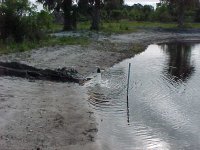
Here's a picture of the float valve. It was about $35. It took about 3 days of constant running to get the pond from this level up to near the top of the sandy area on the shore.
 

Attachments

  • 693536-MVC-019S.JPG
    693536-MVC-019S.JPG
    43.8 KB · Views: 294
   / Running Water Lines #8  
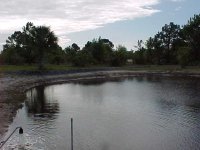
Here's a picture of about half the pond so you can compare the volume. Overall, the pond is probably 12' deep. Once the pond is full, it only takes a couple of hours per day to keep it full in the dry season. During the rainy season, like now, the well water is not needed -- the problem is keeping it from overflowing. I can't imagine that yours would seep out any faster than ours in our sandy soil; I can't imagine having to run it all the time after it gets full.
 

Attachments

  • 693544-MVC-021S.JPG
    693544-MVC-021S.JPG
    32 KB · Views: 300
   / Running Water Lines #9  
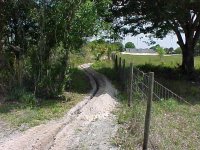
Here is some of the trench I dug; this is near the well; the pond is w-a-a-a-y out and over to the left.
 

Attachments

  • 693546-MVC-013S.JPG
    693546-MVC-013S.JPG
    60.9 KB · Views: 292
   / Running Water Lines #10  
At my place, there is a literal gridwork of underground utilities between the buildings and even to the dock on my lake and the island in the lake. An old college roommate owns an "underground plumbing" service. So, I've sort of had a professional do all of my work. Well, he ran the expensive equipment anyway. I got to do all the dirty work. /forums/images/graemlins/tongue.gif

First off, since I have so much underground, I can tell you that you need to bury a conductive tape along with your pipe so you can later locate it. Otherwise, being a plastic pipe, you will not be able to locate it. I don't know about you, but I'm beginning to be off just a bit on where I think things are that I buried 15 years ago. Just put me on a Ditch Witch and I'll always find a water line. /forums/images/graemlins/blush.gif

Also, I ran a 2 1/2" water line back to my place. From there, the smallest line anywhere to any place is 1". I have frost free faucets sticking up in several places that are 1". Based on that, I'd certainly just advise you to put in a large frost free faucet at your pond. I don't know how deep you have to go in your area, but I started out at 36" deep with the main line, and each successive line afterwards went under that line when crossing.

One quick thought, you may want to see what it will cost for you to have a company come out with a boring machine and just punch the line in for you. I had my college buddy use his boring machine for the last few underground additions. That is really nice! No mess, no rut, and it's simple to just set the run at whatever depth I know to be under all other utilities. Besides, I don't know how I would have added electricity to my island otherwise.

As someone else pointed out, a single solid run is much less likely to break with no joints. The stuff I had run for a water line out to my barn is extremely tough. On a really muddy day I had a concrete truck get hung up right over my water line. He sank down well over 36". As a precaution, I shut off the water to the barn to prevent an even bigger mess when he ruptured the line. As it turns out, he got two of his rear wheels around the line and sawed on it for a while. Even so, it never broke! /forums/images/graemlins/shocked.gif

After that episode, I have used a single roll of line even when not using a boring machine. A small boring machine would do what you need. It may not be too expensive if there is any competition in your area. My buddy does underground bores up to 60" now. Apparently that drill bit is rather expensive. He told me that when they get that bit stuck they dig it up; no matter where it is - under a highway or even under a building.
 
   / Running Water Lines #11  
As mentioned by Don use a ride on trencher. They can usually go deeper that the walk behind. Just make sure it's all below the frost line.

Egon
 
   / Running Water Lines #12  
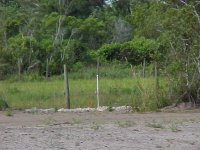
This is one of the faucets I installed. Like I said, it's not some fancy frost-free hydrant, just a hose bib screwed on PVC. Another advantage of Florida living...I also don't worry about the joints in the PVC. I thought about running the black poly tubing, but I would have had to cut it and install the adaptors every time I tee-d off for a hose bib, and I would have had a bear of a time handling that much 1-1/2" poly, so I went with the PVC.

Oh, yeah, almost forgot -- I went with the 1-1/2" because that's what the outlet of my pump is. If the outlet was 1-1/4", I don't think I would have gone up to the 1-1/2", but that's a question for a hydro engineer. I just brute-force that kind of engineering...
 

Attachments

  • 693557-MVC-025S.JPG
    693557-MVC-025S.JPG
    42.3 KB · Views: 194
   / Running Water Lines #13  
Hi Alan,

The walk behind trencher is gonna be allot cheaper then the rider. For only 350 ft, it's fine. I've got two 700 foot runs to dig in the next month or so and will use a walk behind for that.

On the PVC, be sure you get Schedule 40 with the bells on the end. The bells are much, much longer then buying unions to join your pipes. The water department in my area requires me to use purple primer and clear glue. They said that their results with any other glue has failed. Clear glue with purple primer will hold up to clay soils.

I like Don's solution to pumping water to his pond. I'm going a more simple route myself. I'm putting a timer on my pump and will run it so many hours every night. If it's not enough water, I will increase the run time.

For your spicket sticking up, I'd reckomend wraping it in foam insulation, then sleeving it with a 3 or 4 inch PVC pipe. At the top of the sleeve, cut a hole in the side, fit your spicket through it and glue it all together. Then put a cap on the sleeve for a nice clean look and to keep out moisture and debris.

Allot of RV Parks do it this way, which is how I plan to do it too.

I'm not a big fan of combining electrical and water in the same trench. It's illegal in most places with code. It also makes for a difficult repair if one or the other needs digging up again.

I'm required to have virgin soil seperating my lines.

If you don't need the electrical line just yet, I wouldn't do it. When you decide to build the gazebo, and size your electrical requirements, then worry about putting it in.

Eddie
 
   / Running Water Lines #14  
Your right Eddie. The ride on around here will not only be far more costly to rent, but add in a trailer and a bare bones 3/4 ton truck to pull it. You could have it delivered , but that of course will cost you. Unless you need more width, more depth or on the side of a hill where you need to run perpendicular to the slope, a walk behind is very easy for just 350', thats not much. You can have it done rather quickly. For depth, width and hillsides, a ride on is the best choice.
 
   / Running Water Lines #15  
Low voltage would be ok, like for 12v yard lights. 110vac line voltage would be an issue in the same tranch though.... You're right.

SHC-40 pipe in 20' sections should work fine. As mentioned, the type with the belled ends would be best. I use that around our clay and heavy rock.
 
   / Running Water Lines #16  
</font><font color="blue" class="small">( I need to run about 350 feet of water line. I plan to use 1.25 inch all the way - PVC that comes in 20 foot sections. I want to put in a couple of those frost-free faucets, but also I want to be able to pump water into my one-acre tank (pond), such that the pump will run 100% of the time during these periods.

I picture just having the open pipe sticking up and a 90 directing the stream to the tank, with a gate valve. Only problem is that it would be subject to freezing, but I don't know of a long neck frost-free setup for such a big faucet.
Any ideas? )</font>

Whatever your water source, it will have to be capable of all the water a 1.25" line can deliver with open discharge... that's a bunch of water and most wells may have a problem with the volume. I'd want an automatic control to shut off the pump if the source was inadequate. BTW, IIRC a 100' long 1" PE line can deliver 30+ gpm at 50 psi open discharge; as long as the pump/water source can deliver it.... which is an important consideration, especially if you're pumping form a well and it is being drawn down. That makes the pump have to work harder, so the right sized pump is a critical component to this project.

I suggest a 400' roll of 160 psi PE (polyethylene) tubing zig zagged in the trench to allow for contraction/expansion. It's inexpensive and saves a lot to time and future problems when compared to say sch 40 PVC and a coupling every 20'. You protect it from sharp edges the same as PVC. It is more forgiving if frozen too and you'll get much better flow out of PE than any other product. You would simply tee off for each 3/4" or 1" hydrant wherever you wanted one.

I'd also advise against a gate valve. A PVC ball valve is a much better choice, less expense and will work long after a gate valve will break or stick open/closed due to infrequent use.

I have no ideas for the end at the pond but I would probably just leave it open with a screen cover so birds etc. don't get in it.

Gary Slusser
 
   / Running Water Lines #17  
Alan, you might check into just hiring it out. When I did my 600 ft. electric run last year, I hired a sprinkler co. to come out and do the job. Took him all of an hour and a half, with a big diesel unit (but admittedly this is in soft sand). Wasn't even a rider. Cost me $250, and renting a smaller unit would have cost me almost as much for a half day. I've rented trenchers for sprinkler projects, drainage systems, and the like in the past, and had enough maintenance problems going through mud, chains breaking etc., to learn that it's just easier not to deal with the hassle.

Steve
 
   / Running Water Lines #19  
One caution on the black roll pipe - don't make the end connections until after the trench has been backfilled for an hour or so.

If the pipe is laying in the sun, it gets warm and "grows" a bit. I was talking to an excavator we had hired to do some work, and he told me he did a job where they dug the trench, dropped the pipe in, and made the connections. Then, after they backfilled, the pipe cooled (and shortened). It pulled the connections apart.............chim
 
   / Running Water Lines #20  
"The source is inch and a quarter coming out of my pressure tank, so it wouldn't seem to make sense going bigger than that, or would it?"

It absolutely makes sense to upsize the long run. It is not about diameter but head loss. There is a lot of friction in a long run of pipe and since losses due to friction increase with velecity a loarger pipe with slower moving water flows better. At the end of the run you will have more flow with a larger pipe. I would advise no less than 2" for even a run of several hundred feet. I also advise using the PE roll though the PVC, if installed correctly, is a very suitable pipe.

The PE pipe is commonly available in rolls up to 2" diameter. Then it is also available through water companies, called HDPE, as big as you want. You can imagine the roll becomes impossible as the diameter gets bigger and then the pipe is sold in lengths to be welded together with a machine. We use the larger HDPE for water mains, sewer force mains, and even storm lines since it is very tough and well suited to directional drilling.
 

Tractor & Equipment Auctions

2019 PJ TRAILER 32FT GOOSENECK (A55745)
2019 PJ TRAILER...
2016 Nissan Altima 2.5 Sedan (A59231)
2016 Nissan Altima...
MARATHON 76KW GENERATOR (A58214)
MARATHON 76KW...
2022 Ford Explorer AWD SUV (A59231)
2022 Ford Explorer...
5004 (A55851)
5004 (A55851)
2014 VOLVO L45G WHEEL LOADER (A60429)
2014 VOLVO L45G...
 
Top