septic field frozen

   / septic field frozen #1  

v8only

Silver Member
Joined
May 27, 2012
Messages
225
Location
Mb
Tractor
1988 John Deere 755
Hey all,

I need some additional advice, I live in Canada where it gets to -30 Celsius during the winter months, I grew up in the country with septic fields and have always covered them with hay bales to trap snow and keep the field from freezing. I now have my own house and have followed the same principle cover your field with bales. Last year it was a very cold winter and we saw frost go down 6' I spotted the bales on hoping to catch snow and my field ended up freezing. THIS year i bought an additional 60 bales which including my old bales gives me a total of 90 bales and this year is not as cold as last year and it froze again.

I have talked with my field builder and he feels there is nothing that can be done other than to keep it more covered, i have talked to my local RM and they feel that the contractor who built my field is the best around these parts so there is no worry about a failing system as this contractor does top notch work.

So what other options can I do to stop this from happening?

I have thought of:

-shrubs to surround the field to act as a natural wind break
-heat trace in the lines to cycle on a timer to turn on a few hours once and a while
-excavate and install rigid insulation above the lines to help insulate


Thanks.
 
   / septic field frozen #2  
OK - lets start with some info.

How do you know that the drain field has frozen.

A properly constructed drain field WILL NOT freeze. One or many things are happening -

the DF lines are buried to shallow - the lines, because of shallow burial, do not have adequate ground cover

the effluent from the lines is not draining away sufficiently - the wet soil freezes easily

there may be some form of obstruction in the DF lines causing effluent to pond up and freeze

the DF lines do not have the correct slope and do not drain the effluent properly

The fact is - - you have freezing problems in the DF because the effluent either remains in the lines or soil long enough to freeze
 
   / septic field frozen #3  
I doubt your field is freezing with all that insulation over it. Are you sure that is the problem? I've had -40C at our place and the field did not freeze.

Only problem I've had with my system is the contractor installed a section of pipe that was not properly bedded and after 2 years it settled enough to cause a dip in the line that was more than the pipe diameter and the pipe ended up plugging. It was only an issue in the winter when it was cold. I ended up digging up the pipe and reinstalling it with proper grade and bedding.

Is it a pumped system or gravity?

Maybe the effluent isn't getting to the field. It could be freezing in the pipe between the field and the septic tank or pump station or it's plugged.

Maybe the distribution box is plugged or freezing. Can you open the DB to see if there is evidence of any freezing?
 
   / septic field frozen #4  
A 6 ft. deep frost level is way down there for sure . I live in northern Me. and see temps. down to 30 or 40 below on rare occasions and have never had a freeze up and I have never had to cover my leach field. Could the problem be in the tank itself , or what is going in the tank that maybe shouldn't be . To many household chemicals etc. etc. can really do a number on killing the bacteria needed to keep it active . A plumber friend of mine gave me a hint they used at the border crossing when they were having problems with their septic . He used a gal. or two of very spoiled milk . It helps to reactivate the bacteria needed .
 
   / septic field frozen #5  
Odd, not quite as cold here but well below freezing and the snow is clearly less deep over my tank suggesting plenty of "heat" coming from the tank. Of course, with two daughters, the washing machine is on the Endless Cycle......
 
   / septic field frozen #6  
I put my washing machine discharge out my floor drain, to go out the side of a hill. Made a french drain for my water softener last summer. Also, try and keep from flushing the toilet for every little urination (doesn't always go over well with the city slickers!) Basically try and keep the nastier stuff in the septic perculating and making heat and keep the huge volumes of water down.
 
   / septic field frozen #7  
What kind of pipe is in the field ? If it is sock pipe , you may have an issue . That was the rave 20 years ago . It plugs with grease and will not drain . Terrible product . You need the open bottom chambers .
 
   / septic field frozen #8  
What kind of pipe is in the field ? If it is sock pipe , you may have an issue . That was the rave 20 years ago . It plugs with grease and will not drain . Terrible product . You need the open bottom chambers .

I remember many many years ago I would help my dad on construction projects and they would use 2x10 hemlock planks with cut outs , put in a triangle pattern ,and put the creosote right to them planks before assembly . I wonder if those old fields are still in operation .
 
   / septic field frozen
  • Thread Starter
#9  
OK - lets start with some info.

How do you know that the drain field has frozen.

A properly constructed drain field WILL NOT freeze. One or many things are happening -

the DF lines are buried to shallow - the lines, because of shallow burial, do not have adequate ground cover

the effluent from the lines is not draining away sufficiently - the wet soil freezes easily

there may be some form of obstruction in the DF lines causing effluent to pond up and freeze

the DF lines do not have the correct slope and do not drain the effluent properly

The fact is - - you have freezing problems in the DF because the effluent either remains in the lines or soil long enough to freeze

I will try to give more information:

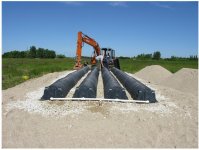
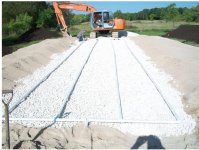
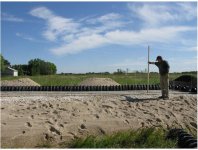
-my system in a new type sand mound it is positioned 4' ABOVE the surrounding ground, apparently this is the new way of doing things around here. The construction of my system is as follows: small amount of excavation on the ground level, crushed stone, 1-1/4" rigid line with 1/8" holes perforated, mound chambers, and backfilled with sand and a layer of top soil to grow grass. My DF lines are basically sitting level with my existing landscaping (maybe 6-8" above max) at the end of my DF there are access caps (threaded caps on the pipes) these access caps are to allow the DF holes to be cleaned out or frost removed. Therefore the new systems do no have the same amount of ground coverage that the older systems do.

After my high level alarm in my septic tank went off sunday I checked the operation of the pump to ensure it was not jammed or the float was not working, after i verified all was working I went to the field removed bales to access the access caps, i unscrewed the caps and they are solid full of ice.

I feel that my DF is freezing because of exactly what you said: you have freezing problems in the DF because the effluent either remains in the lines or soil long enough to freeze.

I know the lines have a good slope because in the summer I have the lines "flushed and cleaned" with all access caps removed you can clearly see the effluent flow to the end of the field out of the access caps, with the access caps on it "pressurizes the pipe and allows it to bleed from the 1/8" lines"

I feel the ground around the field might be saturated and i dont have enough of the surrounding area covered to prevent the run off from freezing and eventually working its way up and it finally has no where to go....

I doubt your field is freezing with all that insulation over it. Are you sure that is the problem? I've had -40C at our place and the field did not freeze.

Only problem I've had with my system is the contractor installed a section of pipe that was not properly bedded and after 2 years it settled enough to cause a dip in the line that was more than the pipe diameter and the pipe ended up plugging. It was only an issue in the winter when it was cold. I ended up digging up the pipe and reinstalling it with proper grade and bedding.

Is it a pumped system or gravity?

Maybe the effluent isn't getting to the field. It could be freezing in the pipe between the field and the septic tank or pump station or it's plugged.

Maybe the distribution box is plugged or freezing. Can you open the DB to see if there is evidence of any freezing?

The system is pumped, I have a 2 chamber holding tank (solid side and liquid side) the liquid chamber tank holds the pump and pushes out to the field, there is NO evidence of ice build up inside the tank.

What kind of pipe is in the field ? If it is sock pipe , you may have an issue . That was the rave 20 years ago . It plugs with grease and will not drain . Terrible product . You need the open bottom chambers .

the pipe is 1-1/4" solid pipe with 1/8" drainholes and covered with mound chambers.

I have some photos of how this system looks during construction:

field3.JPGfield1.JPGfield2.JPG
 
   / septic field frozen #10  
I don't profess to know anything about septic systems, but that seems like a really stange approach to building one. Everything is above grade!
 
   / septic field frozen #11  
That 1-18 pipe is too small . N eed 4" That is called a mound system where the ground will not perc . They set it up above grade then backfill the sys tem .
 
   / septic field frozen #12  
Assuming that the drain field effluent discharge point is higher than the pump. Can you get effluent in the line that remains there between the pump cycles and gradually freezes.

Or question: how does the effluent drain line drain when the pump is off?

Sorta like the old cylinder water pumps that had a hole in the tubing below the frost line to prevent freezing.
 
   / septic field frozen #14  
Just get the pump truck in to hold you over for another couple of weeks. There's no way you're going to thaw it out any quicker.

I've seen these new above ground systems being installed around here, but only in places that were low lying or on bedrock.
 
   / septic field frozen #15  
Mine is very similar

A Wisconsin mound system what my PE called the design many years ago. Pump chamber, sewage pump, float switches, control box, high level alarm. I have 2 inch lines with custom drilled 3/8" holes (holes facing down) and under pump pressure pushes the effluent into the stone beds. I also have drain back to the tank when the pump shuts off.

I used a couple of concrete well risers and a cover so I would have easy above grade access to my pump chamber at all times. Have you/ can you observe that the pump is working correctly? Obviously if it wasn't eventually the high level alarm would sound too.

From my control panel I can manually activate the pump and thru my riser observe down inside the tank.

I had problem once the outfeed line broke between the point leaving the tank and before entering the manifold for the drain lines. And actually it was just before the T where the vent riser came up. I only knew it because 50 ft down from drainfield there was a continuous soggy spot where the grass was growing like crazy. With a little observation you could actually see the additional green growth line right towards the break and even in the winter the snow would also melt over that area.
 
   / septic field frozen
  • Thread Starter
#16  
yea i will be waiting for spring to come around a thaw it out, i just want some other ideas on how to prevent this from happening in the future.

I have observed the pump working as i activated the pump and can see it discharge out of the line once disconnected.
 
   / septic field frozen #17  
It sounds like the only good way to do it would be to try and insulate the mound better and insulate the access covers. Those covers are letting heat out. Also, if your frost can penetrate 6' into the ground, it sounds like you need to make sure your field is insulated by at least 6' of cover. I would think some 2" insulation and a couple feet of dirt would work well? I never really thought about a sand mound freezing before, but at those temps, anything is possible!
 
   / septic field frozen #18  
Think what you have is the 'EquoFlo' concept field.
Well built it should be OK but for that to happen the soil need to be able to absorb. Normally a peculation test is needed to confirm otherwise the contractor trucks in an absorbent sand for the base.
Septic effluent does not freeze but pure water will.
A leaking toilet valve will put a septic system out of action in short notice as will many bath tub loads of water.
A household of 3-4 teen girls can kill your field faster than a leaking toilet float valve.

I had 3 houses in cold Quebec north all with conventional drainage fields that never created any problems.
The fields are about 16- 24" deep with only snow cover.
My daughter's froze up as I had cautioned my son in law to fix his leaking toilet tank valve. He neglected and they lost 1/2 winter's usage.

One tenant thought to leave a tap open to prevent freeze up. Fresh water froze nicely. (used a hose connected to the hot water tank and promptly thawed the 3" tank line)

LOL, joys of country living!

Bacteria created in a septic system will keep that effluent cozy warm and freeze free.

Another thing you learn about over time is NOT to use bleach in the washing machine. Bleach (Javex) kills microbes. Microbes create heat as they attack the contents of your tank.
Bleach as well as all those nice toilet self cleaning blocks (also bleach) will do you in.
Also all the advertized 'enzimes' are really advertising hype. Forget it. Human waste and food scraps will do better than any advertized cure all product.
 
   / septic field frozen #19  
Have not had a chance to read the whole thread, first year we where in our house our drain field froze or i thought it did. Same system you have. Jumped through same hoops, until i called a plumber friend of mine. Where it comes out of your pump going up to the field. There needs to be a small hole in the plastic pipe so the water can drain back. They didn't have it. Drilled a hole ain't froze since.If you take the top off where your pump is with the pump running you should see water pissing out the side. Good luck Steve
 
   / septic field frozen #20  
In normal soil, frost has to overcome the typical ground temperature as it works downward. You don't have that reservoir of ground temperature in the mound really, at least not the same as native settled soil. So I bet the mount has a significantly less frost resistance than the ground. If you have a 6' frost line in regular soil, I don't see how a 4' mound of sand/stone has a chance, even with bales of hay on top. Maybe there is a better way to insulate the mound from air temperature above so that it can trap/hold some ground temperature, but I have my doubts.
 

Marketplace Items

54in Loader Fork Attachment (A59228)
54in Loader Fork...
UNUSED FUTURE FT15 EXCAVATOR (A60430)
UNUSED FUTURE FT15...
UNUSED FUTURE EQUIPMENT SEAT (A60432)
UNUSED FUTURE...
2005 CATERPILLAR 345CL EXCAVATOR (A60429)
2005 CATERPILLAR...
NEW HOLLAND T4.75 TRACTOR (A52707)
NEW HOLLAND T4.75...
MANIFOLD TRAILER (A58214)
MANIFOLD TRAILER...
 
Top