Slope...What is safe V2.0.

   / Slope...What is safe V2.0. #1  

Evets Tsorf

Bronze Member
Joined
May 16, 2019
Messages
51
Location
northern California
Tractor
John Deere 750
There was a thread started a couple weeks ago posing the question,what is safe, anyone roll over? This thread went off the rails for sixteen pages, discussing the type of vegetation we mow and why, discussions of the meaning geometric equations and some reference to the Road Runner and Coyote.

In this thread I posed a question that I am still looking for an answer for.

I purchased an older John Deere 750 for a piece of property I purchased last year. It has some slopes that I would not use this tractor on. Some I do with a tight sphincter. I have a five foot brush hog that is big for this tractor, I made an assumption that as this implement being quite heavy and very low to the ground should increase the stability of the tractor. There are many stories about people rolling their tractor brush hogging, rolling tractor and wirling blades likely to tighten my life insurance underwriters sphincters too.

What am I missing on the CG of the tractor, the brush hog is lower and heavier than many ballast boxes we put on our tractors for stability.
 
   / Slope...What is safe V2.0. #2  
Your tractor is a bit on the small or light side for that brush hog but not unworkable. Some tractors allow the rear wheels to be moved farther apart - that would add stability. Putting ballast (liquid) into the rear wheels would also help lower center of gravity. If the tractor happens to start over be prepared to exit in a hurry. The mower may slow you down but the tractor probably weighs three times what that mower does. If you have a front loader, keep it low. The TBN store does carry a tilt meter. That may be a worthwhile investment for you.
 
   / Slope...What is safe V2.0. #3  
Does your manual has any data on side way stability? Any picture showing the slopes?
 
   / Slope...What is safe V2.0. #4  
Side mowing slopes is pretty much always a bad idea unless the machine is designed for it. Aside from whatever the tractor may do, that extra weight behind can start to slide down hill and pull the rear of the tractor with it. It's not just static ballast, it's whirling ballast on wheels and will react accordingly.

Mowing straight downhill with extra weight behind can push the tractor and maybe overcome limitations of the transmission and the ability of the tires to adhere to the ground.

Mowing straight uphill with that weight behind can cause the front tractor wheels to become light on the ground and lose steering.

I do my steepest hills straight up and down with a belly mower.
 
   / Slope...What is safe V2.0. #5  
In your original post you asked what is a safe slope, uphill, downhill, and sideways. The reason you never got a satisfactory answer is that nobody knows. It depends on a lot of factors, including lots of details about your equipment, which you didn't provide.

I used an JD 870, which is one model later than your machine and one size larger, to mow my field with a 5-foot Bush Hog brand rotary cutter for over 20 years. I have the rear tires set to maximum width and all four tires loaded. My steepest slopes are 20 degrees, or 36%. I have mowed across that once, but quickly decided to mow that section up and down. The problem is, it's that steep at the top and bottom as well, where I have to turn around. I do that carefully.

I've seen suggestions from time to time about getting an incline meter. Why? That only tells you what the slope is and not how steep is safe. You can measure the slope for free with your iPhone.

You ask whether the mower makes the tractor more stable, since it's lower than a ballast box. A ballast box is used to compensate for a load on the FEL, not for hillside stability. I doubt the mower makes the machine any more stable, but it will certainly drag it sideways on a side hill. Even on my less steep sections I need to run the front tires close to a foot higher up the hill to keep the mower cutting where it should.
 
   / Slope...What is safe V2.0. #6  
I think the specific question is:

Is a tractor with a brush hog attached more stable on a side slope than the tractor would be without the brush hog?

At first thought it seems like it might be, but all bets are off if the mower causes the rear wheels to break free and start sliding down slope.

My gut is telling me that a relatively large mower on a smaller tractor would make the tractor less stable on a side slope, rather than more stable...especially when the tractor is moving.

Edit: After posting I see Terry has the same conclusion in his last paragraph
 
Last edited:
   / Slope...What is safe V2.0. #7  
You can increase the track width with spacers to improve stability on those slopes. And use the widest rear tires you can find.

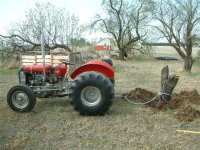
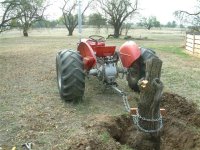
Here's my 1964 MF135 diesel that has rears with 16" rims and 18" tread width. This tractor was lowered to work in the orchard. The front spindles were shortened to keep the tractor level.


MF135 stump2.JPG
MF135 stump1 (1).JPG

Good luck
 
   / Slope...What is safe V2.0. #8  
The only way I see an inclinometer being of any use would be to mount it, then pick up one rear tire with a forklift until the tractor is ready to tip over. Mark that angle on the inclinometer as the bail out point.
 
   / Slope...What is safe V2.0. #9  
My :2cents:
- Adding weight below the CG lowers the CG.
- When the attachment is lowered to where its weight is on the ground, it doesn't lower the CG.
- On flat ground, one can see that a raised mower will put more of the tractor and mowers total weight on the rear tires. One would say that on a sidehill, this will alter the traction and increase sliding possibility (i.e. more weight on a decreased effective tire area) depending on soil conditions, tire types, etc...

However, remember that on a sidehill, when tailwheel is slightly raised, some of the mower's weight gets applied to the top link (above the CG.). It seems to me that some of this force would be in a twisting "downhill" torque direction, promoting overturn. (Other may want to check my thoughts here.) This would be in addition to lightening front axle traction.

- I say that if the mower is lowered to were tailwheel eliminates torque on the toplink, and remaining mower weight is on lift arms below tractor's CG, CG is being lowered. While also not shifting as much weight from front axle to rear axle

This is a very dynamic situation. Another reason it doesn't make sense to depend on maximum tilt angles determined when "at rest" that are totally different than when traveling and dipping into a hole, or climbing a stump, or while turning, etc..
 
   / Slope...What is safe V2.0. #10  
Also remember that no matter how stable you feel on a slope or how many times you've worked it safely and 'even' it looks, one molehill, gopher hole or soft spot from moisture can change your angle quite suddenly and toss the machine to one side unexpectedly. I've hit hidden low spots when not on a slope that have kicked me to one side quickly.
 
   / Slope...What is safe V2.0. #11  
Your tractor is a bit on the small or light side for that brush hog but not unworkable. Some tractors allow the rear wheels to be moved farther apart - that would add stability. Putting ballast (liquid) into the rear wheels would also help lower center of gravity. If the tractor happens to start over be prepared to exit in a hurry. The mower may slow you down but the tractor probably weighs three times what that mower does. If you have a front loader, keep it low. The TBN store does carry a tilt meter. That may be a worthwhile investment for you.

I'm gonna disagree with this advice because the Deere 750 has a ROPS and a seatbelt. You're more likely to survive a rollover in a tractor with a ROPS if you stay securely belted into the seat with both hands gripping the steering wheel and just ride it out. You'll stay within the safe zone. That's what ROPS and seatbelts are for.
 
   / Slope...What is safe V2.0. #12  
Truly depends on many, many factors. Starving the engine of oil, soil condition, type of soil, rocks, loose clippings, tire type, tractor type....

I mow up and down a 30- 35 ° yard with my husqvarna with locking differential I bought specifically to do the job.

I drive, not mow, my tractor straight up upwards to 45° slopes but only when the soil is in good condition, not too dry and not too wet. Our current drought has kept me off the steeper parts. I keep a grader box on the back to drop when needed.

I imagine if I was mowing with a 3 pt mower or bushhog, I would only back up slopes and keep my loader bucket ready to lower if needed....but if your mower's weight will push your tractor around..idk

Like the previous responses state, there are too many factors and it comes down to what you are comfortable with. Good luck
 
   / Slope...What is safe V2.0.
  • Thread Starter
#13  
Thank you for your responses. Would agree if tail wheel of brush hog is on ground some weight stability would be lost but a good portion of the weight will still be transferred to lower lift arms. In a potential roll over the weight would again be transferred to the tractor at a very low point as soon as the tail wheel lifts off the ground.

A couple takeaways from the posts. 1. I will expedite the installation of my ROP's. and seat belt. 2. I am still going to avoid cross hilling and use great caution any time I am on a slope. 3. it sounds like many of the roll over issues with brush hog attached may be due to the inertia of the brush hog causing the rear of the tractor to slide sideways on a hill and creating a side hill situation. I will save my mad mouse driving antics for the little lawn tractor where my fat *** can shift ballast or bail more easily.
 
   / Slope...What is safe V2.0. #14  
Would agree if tail wheel of brush hog is on ground some weight stability would be lost but a good portion of the weight will still be transferred to lower lift arms.
About half of it.
In a potential roll over the weight would again be transferred to the tractor at a very low point as soon as the tail wheel lifts off the ground.
By the time the tail wheel is off the ground you have tipped far enough that it doesn't matter -- you're going over.
 
   / Slope...What is safe V2.0.
  • Thread Starter
#17  
Have seen this numerous times, the slope is fairly representative of hills on my property, I go up and down these slopes with FEL low. It looks like the point of tipping is nearly twice the slope of hill with one front wheel going into a hole and the other climbing a pile of dirt remove from hole. My sphincter is tight on the slope before the hole.
 
   / Slope...What is safe V2.0. #18  
I have some dips in my steeper slope that I plan on filling this Winter. Trick is to get them filled, packed, seeded and growing sufficiently to hold before the rains wash the new dirt away.

Will the weather cooperate or not is the big question. Some years I get long enough stretches of 60 degree days in December and January to do it, other years, not even close.
 
   / Slope...What is safe V2.0. #19  
Diggin It - post# 10 has, pretty much, hit the nail on the head. Generally speaking you can tell by that feeling in the seat of your pants. When things get dicey - the 'ol bod tends to tighten up.

I would bet that very few tractors tip just because the OP drove onto too steep a slope. You will drive onto a slope that has always been safe and then you encounter a hole, swale, gopher mound, your load will shift - - over you go.

Out here I'm particularly careful - being all by myself. If I roll and get pinned - I will, sooner or later, become coyote food. Not a pleasant thought.

I make it a point to go up/down slopes - not horizontal. That's exciting enough whether empty or carrying heavy loads.
 
   / Slope...What is safe V2.0. #20  
Generally speaking you can tell by that feeling in the seat of your pants.

Respectfully, I disagree.

:2cents: :
Your body, and seat of the pants, is tilted the same whether you're on 5' wide tractor where the CG is 3' above ground, or on a 7' wide tractor where the CG is 2.5 above ground. Whether tires are loaded or not. Whether FEL is has a bucket full of rocks or empty.
If you're used to the feeling of one tractor and you get on the other, you're either going to chicken out too soon or too late.

When I'm mowing a ditch, where if I roll, its only a 30 degree tip before I come to rest on the other side of the ditch, and say ditch is tucked in a nice tree lined ravine, I might feel fine.
However, if I'm mowing on top of a bare, tree-less hill that's 200-300 feet above the valley below (top-o world feeling), I'll chicken out much much earlier, despite the actual slope not even being close to the slope of the ditch at the bottom.

The fear is a psychological, seat of the pants, feeling based on one's perception at the time, but the actual physics doesn't care about one's feelings or how tight they're clenching their butt.
:2cents:
 

Tractor & Equipment Auctions

2014 Chevrolet Tahoe SUV (A59231)
2014 Chevrolet...
2013 FORD F250 (A60460)
2013 FORD F250...
25 DUAL AXLE GOOSENECK TRAILER (A55745)
25 DUAL AXLE...
Commercial truck Frame with Axle (A59230)
Commercial truck...
2011 Toro Workman HD Utility Cart (A59228)
2011 Toro Workman...
2017 Ford Explorer AWD SUV (A55853)
2017 Ford Explorer...
 
Top