Tractor classification — HP vs torque

   / Tractor classification — HP vs torque #1  

S854

Platinum Member
Joined
Dec 5, 2017
Messages
886
Location
Helena, MT
Tractor
‘67 MF 135 Deluxe / ‘22 Kioti CK2610 HST/Bad Boy ZT Elite 54”
Why do manufacturers rate their tractors according to HP rather than torque?

I can see why automakers use HP ratings to sell their cars… to the uninitiate, HP is king — more HP = faster car… (although this isn’t always the case).

Tractors, on the other hand, make better use of torque… maybe I misstated that, torque is better applied using large, lugged tractor tires.

In my compact tractor world, the under 25 HP class, engine displacement varies greatly… and generally speaking, more cubic inches can result in more torque at a lower RPM… everything else being equal… (I.e. bore, stroke, naturally aspirated etc.)

Comparing apples to oranges, JD 25 HP (1.1 liter) to Kioti 25 HP (1.6 liter), it would seem the larger engine would produce a more useable torque curve starting at a lower, more fuel efficient RPM. i realize HP and torque are related, you can’t have one without the other.

I’ve searched forthis information on manufacturers websites… all they list is HP… why wouldn’t a tractor company want to exploit the torque differences between competing brands?
 
   / Tractor classification — HP vs torque #2  
Lugability was a real thing in geared field tractors for ground engagement as its a measure of how torque builds as rpm drops so the tractor wouldn't stall out, and since you can't downshift nicely under load, a tractor would just gut it out at lower rpm until it climbed the hill or got through that heavy patch.
With little HST tractors usually running at a constant rpm and not doing much ground engagement where you max out the hp and rpm starts to fall, lugability isn't really too important most of the time?
I guess for mowing perhaps or snowblowing, if you are using cruise control, higher lugability would be nice. I like the HST without cruise and just back off the pedal a bit if the injector pump is going near WO. In low range, I find at 2100rpm+ it doesn't lug too often when pulling the box blade.
 
   / Tractor classification — HP vs torque #3  
I agree.

I don’t have the answer. You’re right that you can’t compare 25 HP tractor ratings without digging deeper as you rightly mentioned, displacement and torque very greatly from manufacture to manufacture and engine to engine.

I have no clue why tractor manufacturers use HP for the ratings but, HP is definitely a more familiar term and, I guess you could say HP sells.

Mike
 
   / Tractor classification — HP vs torque #4  
Some do give torque specs. Look on tractor data. I don’t really bother much with engine HP.
What you really want to look at for a measure of power is drawbar HP or drawbar performance.

1678204651550.jpeg
 
   / Tractor classification — HP vs torque #5  
Why do manufacturers rate their tractors according to HP rather than torque?

I can see why automakers use HP ratings to sell their cars… to the uninitiate, HP is king — more HP = faster car… (although this isn’t always the case).

Tractors, on the other hand, make better use of torque… maybe I misstated that, torque is better applied using large, lugged tractor tires.

In my compact tractor world, the under 25 HP class, engine displacement varies greatly… and generally speaking, more cubic inches can result in more torque at a lower RPM… everything else being equal… (I.e. bore, stroke, naturally aspirated etc.)

Comparing apples to oranges, JD 25 HP (1.1 liter) to Kioti 25 HP (1.6 liter), it would seem the larger engine would produce a more useable torque curve starting at a lower, more fuel efficient RPM. i realize HP and torque are related, you can’t have one without the other.

I’ve searched forthis information on manufacturers websites… all they list is HP… why wouldn’t a tractor company want to exploit the torque differences between competing brands?

Torque to the wheels is what matters, not the torque provided by the engine. Torque provided by the engine can be, and is, multipled or divided by the transmission and rear end gear ratios. The HP provide by the engine cannot be increased.

Torque determines what you can do. HP determines how fast you can do it.
 
   / Tractor classification — HP vs torque
  • Thread Starter
#6  
Torque determines what you can do. HP determines how fast you can do it.
I've seen several BIG tractors working fields around our small "estate"... pulling two or three implements behind them...

Without exception, they were motoring along at a snails pace (compared to the speed they run on the local roads, between fields)...

Which reinforces my question of torque vs HP... those big tractors were relying on the engines torque to get things done... which is why I purchased a tractor in the first place... to get things done...
 
   / Tractor classification — HP vs torque
  • Thread Starter
#7  
JD 1023SE.jpg
JD 2025R.jpg
CK2610.jpg
LX2610.jpg
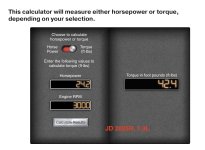
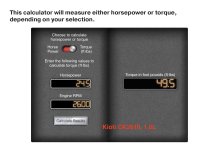
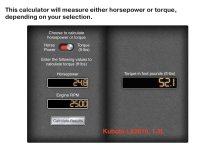
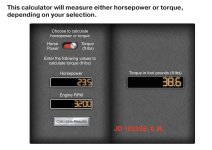
These four tractors are from the "25 HP" class... obviously of different physical size... Model and engine size I listed in RED... all the specs (rated HP, rated RPM) came from TractorData

Again, I don't get why Kubota doesn't tout their torque figures...
 
   / Tractor classification — HP vs torque #8  
I've seen several BIG tractors working fields around our small "estate"... pulling two or three implements behind them...

Without exception, they were motoring along at a snails pace (compared to the speed they run on the local roads, between fields)...

Which reinforces my question of torque vs HP... those big tractors were relying on the engines torque to get things done... which is why I purchased a tractor in the first place... to get things done...
Most tillage and seeding implements are designed to work in the 5 to 6 MPH range which is they are going slow in the field vs down the road. If in rocky soil may be going even slower to reduce impact force on the implement.
 
   / Tractor classification — HP vs torque #9  
I'd say horsepower is more important for farming. Torque is the rate of change of horsepower. So, in a car, higher torque gets you a better 0-60 time. Horsepower establishes your top speed. For the same horsepower at the max speed, the higher torque gets you there faster. (Not the best analogy, but keeps it simple. Power is work rate, so how much can you do per second, minute, hour, ...

For farming or tractor apps, power is how wide a mower deck can you handle or how much plow can you pull. Torque would be how quickly can you recover from a plugged up deck or how long will it take to spin up the chipper when you choke it.

Since the best fuel 'economy' usually occurs at the peak torque rpm, (Best breathing and exhausting flow), choosing motor specs to suit you application could save you some $ in the long run.
 
   / Tractor classification — HP vs torque #10  
Why do manufacturers rate their tractors according to HP rather than torque?

I can see why automakers use HP ratings to sell their cars… to the uninitiate, HP is king — more HP = faster car… (although this isn’t always the case).

Tractors, on the other hand, make better use of torque… maybe I misstated that, torque is better applied using large, lugged tractor tires.

In my compact tractor world, the under 25 HP class, engine displacement varies greatly… and generally speaking, more cubic inches can result in more torque at a lower RPM… everything else being equal… (I.e. bore, stroke, naturally aspirated etc.)

Comparing apples to oranges, JD 25 HP (1.1 liter) to Kioti 25 HP (1.6 liter), it would seem the larger engine would produce a more useable torque curve starting at a lower, more fuel efficient RPM. i realize HP and torque are related, you can’t have one without the other.

I’ve searched forthis information on manufacturers websites… all they list is HP… why wouldn’t a tractor company want to exploit the torque differences between competing brands?
Look up Daedong engines in your browser. It has all the different engine models, power, peak torque, and emission levels for the Kioti engines.

Looks like includes engines for other applications, too, with, for example, higher rated eng speeds.

The interesting thing to me is the major torque upgrade going from what I think is the CK2610 engine (IDI) to the direct injected 3510/4010 engine. Torque almost doubles.

Also, the 35 hp 3510 engine seems to have the same torque output as the 40hp 4010. Makes sense, since, being a naturally aspirated engine, torque is probably smoke limited.
 
   / Tractor classification — HP vs torque #11  
High torque and low weight... How does that work out on a tractor?
 
   / Tractor classification — HP vs torque #12  
View attachment 787302
View attachment 787304
View attachment 787303
View attachment 787305
These four tractors are from the "25 HP" class... obviously of different physical size... Model and engine size I listed in RED... all the specs (rated HP, rated RPM) came from TractorData

Again, I don't get why Kubota doesn't tout their torque figures...


my 2 cents

When testing/dynoing engines Torque is measured. It can be "calculated" as above, but starts out as a measurement.
The amount of force applied at a distance- the twisting force.

1lb foot is 1lb of force applied 1 foot away from the axis of the shaft.

Some tractor owners (All else being equal) will chose an engine with the lowest RPM for the HP desired /rated.
That way the torque will be higher because the HP is just a mathematical derivative of both torque and RPM .
This choice does result in limiting the engines idle to top RPM "width"
But also seems to give a torque rise as RPMs are reduced.
These engines are generally of larger displacement and may be physically larger with more mass as well.
Not a bad thing since the engine is also a stressed part in many tractors.

Some brands like to advertise gross HP... which is pretty worthless.

The PTO HP is much more telling. Always impressed when the advertised HP is closer to the actual PTO power.
There does seem to be an overall trend to increase the RPM and reduce the Cubic displacement in newer CUT's YMMV
 
Last edited:
   / Tractor classification — HP vs torque #13  
Back in the mid seventies, one of my first jobs out of college was developing master pump settings for various engine applications on the dyno. What I recall is that a relatively high power turbocharged tractor would have a torque rise of 15% at the time. NA engines had less torque rise, as they would quickly run out of air and be smoke limited as to the shape of the torque curve.Torque rise is the difference between torque at rated engine speed and torque peak. Fifteen percent allows the all speed governors to maintain constant engine speed when the plow or implement encounters difficult going in the field.

combines had no need for much torque rise between rated and peak torque , just based on the nature of operation, ie running on what is called the overrun curve between high idle and rated.
Some fuel systems didn’t have much sontrol of delivery at different engine speed, so you were essentially hardware limited as to the shape of the curve. The drivetrain and cooling system guys were also pretty much in control of what the final shape of the power curve looked like. Putting out a tractor that wouldn’t cool, or blew up geartrain wasn’t a financially viable option from a warranty or customer satisfaction perspective.
 
   / Tractor classification — HP vs torque #14  
I understand the OP's question, however this is a forum for SCUT/CUT and our uses for these tractors go beyond 'simply' tractoring/pulling field implements... we're looking for a multitool for our smaller 'operations'.

To that, HP is the best benchmark for advertising the capabilities of a tractor to what you're attempting to perform.

My 4105 (41hp) was sold to me (quite rightly) as 'just over the minimum' to handle round bales. And this has proven to be true, in my experience... especially 'in the field'. Thankfully my Dealership/Salesman (a 'farmer' himself) asked me what my tractor needs were and sold me the tractor that I needed.
 
   / Tractor classification — HP vs torque #15  
Because engine torque doesn't really matter.

As you say, it's all multiplied through the gearboxes, final drives and tyre size before it gets to the ground. If you have an engine spinning at 3200rpm and it's gear reduced to be going 5mph pulling an implement there is no meaningful difference to an engine spinning at 2400rpm and geared appropriately to travel at 5mph pulling the same implement.

James
 
   / Tractor classification — HP vs torque #16  
At the end of the day vendors sell what the customers are looking for.

Commercial customers buy a machine to do a job and ask questions like "how much dirt can this move per hour and gallons of fuel are used per hour" and "how many acres per hour can I till and how many gallons of fuel are used per acre".

Residential buyers ask questions like "What is the HP" and "where is the cup holder".
 
   / Tractor classification — HP vs torque #17  
Because engine torque doesn't really matter.

As you say, it's all multiplied through the gearboxes, final drives and tyre size before it gets to the ground. If you have an engine spinning at 3200rpm and it's gear reduced to be going 5mph pulling an implement there is no meaningful difference to an engine spinning at 2400rpm and geared appropriately to travel at 5mph pulling the same implement.

James
Yep. And that’s why I look at drawbar power first, since after all, this determines what the tractor will actually pull or drag.
If you are planning on tilling, dragging logs, freeing unstuck vehicles, pulling out stumps, etc. that is your go-to measurement on power.
If PTO implements is your need (mower, snow blower, etc.) then look at PTO HP.

I need both, so I try to select tractors that dyno (PTO dyno) well AND have high drawbar power.

What the engine makes on a engine dyno stand outside of the tractor is pretty irrelevant.
 
Last edited:
   / Tractor classification — HP vs torque #18  
Because engine torque doesn't really matter.

As you say, it's all multiplied through the gearboxes, final drives and tyre size before it gets to the ground. If you have an engine spinning at 3200rpm and it's gear reduced to be going 5mph pulling an implement there is no meaningful difference to an engine spinning at 2400rpm and geared appropriately to travel at 5mph pulling the same implement.

James
That’s not true, due to the reason I explained before. An engine set up with zero torque rise, pulling any sort of implement at full power, will die and have to be restarted in a lower gear if it hits heavier soil or encounters any condition that requires more torque to keep moving.

An engine with higher torque rise may slow down, but will continue to pull through the difficult situation without stopping to downshift.
 
   / Tractor classification — HP vs torque #19  
Both the engine rated at 3200 rpm and the one rated at 2100 rpm can have torque rise.
 
   / Tractor classification — HP vs torque #20  
View attachment 787302
View attachment 787304
View attachment 787303
View attachment 787305
These four tractors are from the "25 HP" class... obviously of different physical size... Model and engine size I listed in RED... all the specs (rated HP, rated RPM) came from TractorData

Again, I don't get why Kubota doesn't tout their torque figures...
.
Well, that's a good example of the difference between "Internet lookup" versus "education".

Where did you get those calculators? The first thing that an engineer thinks when looking at the calculators is to wonder how they are defining a value for the torque? That's not an easy or intuitive programming problem. Torque is not flat, nor is it a smooth curve with RPM. It varies all over the place. And there isn't a standard for displaying it. At the minimum, there would have to be a catalogue of specific torque curves and some sort of look- up table for each and every motor at every RPM.

As to your original question, I think the value of HP is in salesmanship and simplicity. If your interest is in engine breathing, compression, gearing, and TORQUE.... you probably already know these things and are taking HP with a grain of salt & going for a look at the torque curve with rpm instead.

But there is no way that salemen or manufacturers are going to change.

rScotty
 

Marketplace Items

2021 CROWN C5-1000-50 STRAIGHT MAST FORKLIFT (A60429)
2021 CROWN...
2019 CATERPILLAR D6T LGP HI TRACK CRAWLER DOZER (A60429)
2019 CATERPILLAR...
2366 (A60432)
2366 (A60432)
2020 Bobcat MT85 (A53317)
2020 Bobcat MT85...
KUBOTA SVL75-2 SKID STEER (A60429)
KUBOTA SVL75-2...
2023 JOHN DEERE XUV 590M S4 UTV (A59823)
2023 JOHN DEERE...
 
Top