"Trail" driveway: How do I improve it?

   / "Trail" driveway: How do I improve it? #41  
Cheaper is not better, or even as good as what you are supposed to use. If there is round rock in the mix, then it will never lock together and if the rock does not lock togheter, it will not shed water. If it doesn't shed water, it will absorb water. If there is water in your road, it will develop potholes, sink holes and soft spots. In other words, a total waste of time and money.

Road base rock needs to be at least four inches thick to accomplish anything. For it to lock together when compacted, it needs that thickness under ideal conditions. If you have soil that moves, freeze/thaw cycles and extreme conditions, then you need it to be thicker. How thick really depends on your location and usage.

Road base has many names, but it always looks the same. Busted up rock with sharp edges of all sorts of sizes from several inches down to very fine particles. This is critical for it to compact and become a solid mass. Once compaced, it will only come apart in large sections. Water will shed from it and heavy traffic can drive over it during heavy rains.

The type of rock that is used makes a difference. Some rock is soft and some is too hard. Mostly you are stuck with what's available, and we're really splitting hairs in even bringing it up. Mixing your rock gives you an unknown and there is no way to predict what you will end up with or how long it will last.

Cement Wash is also a cheap way to go, but you end up with round rock and sand. Neither work for a solid road, and in my opinion, it's a total waste of money for a road material.

Adding cement to the dirt is expensive and useless. It doesn not have any load carrying ablitiy, and will crack almost instantly.

A load of rock that is in the 22 to 24 yard range will give you a 4 inch road that is ten feed wide and a hundred feet long. Ten feel wide is plenty for a driveway. Is there a reason to go more then 12 feet wide? Local Code? I've had semi's come down my ten foot wide road many times without any problems. I've had my dozer picked up and hauled down my road without leaving any sign of it. My dozer weighs 40,000 pounds, so that's a pretty good sized load.

Keep it simple. Build up the road with good fill dirt to create a crown. Compact it. Address the drainage and give the water a place to go. Cover the dirt road with at least four inches of road base rock, or whatever it's called there, and compact it.

NEVER EVER drag a box blade or any other blade over the road once it's compacted. All you are doing is thinning the rock and speeding up the decaying of it. If you find that you have a low spot, add more rock to that spot. You will have to loosen up the existing rock to get it to mix and compact. Then compact it all together.

Eddie
 
   / "Trail" driveway: How do I improve it?
  • Thread Starter
#42  
You don't want to big of stone if you are only going 2 inch. I'd say the 3/4 process. (around here that means 3/4 and under down to dust for compacting) another thing I don't know if someone mentioned it, yet but the millings, when they grind the asphalt road surfaces, that stuff packs good and is usually cheaper.

I'll get a picture of the scrap rock. Maybe I was misleading; There's nothing huge in it. The biggest stones are probably 1.5", & there's few of them that big. My friend just used it in his driveway. It packs tight as can be, & he didn't even use a compactor; Just spread it & started driving on it.

more and more people want it now so the price is going up, at one time they would give it away.

Well, judging by how tightly my friend's driveway's scrap rock has compacted & stabilized, the yard probably realizes by now that this "scrap rock" is the bees knees.

You are paying a premium where you are, I pay less than 200. for a full triax load, these are the big quarry trucks, around ~20 ton. plus this is processed Basalt trap rock, the highest quality material you can get. I guess it's all about location and distance traveled.

I can see from an aerial photo that the distributor where my friend got his scrap rock has railroad tracks running into it, so they obviously train in some (all?) of their material. (haven't been there myself; only talked to them on the phone). I'm not sure we have any type of stone quarries around here, just limerock & sand.
 
   / "Trail" driveway: How do I improve it? #43  
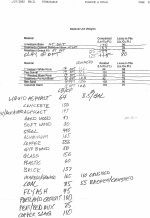
Here is some usefull information on material weights to convert tons to yards. Just do the math based on length width and depth. One cy=27cf
 

Attachments

  • MATERIAL WEIGHT.jpg
    MATERIAL WEIGHT.jpg
    169.4 KB · Views: 97
   / "Trail" driveway: How do I improve it? #44  
Adding cement to the dirt is expensive and useless. It doesn not have any load carrying ablitiy, and will crack almost instantly.

Eddie

To clay yes, but to sand it is ideal. For soils with clay and sand we use a mixture of lime and flyash. It's far from useless and what we built roads and parking lots on.

Bank run gravel, which is all round, holds together extremely well on our heavy clay soils. Because its bank run and not screened it has different aggregate sizes and some clay which binds together well.

For a driveway with only occassional heavy traffic 2-3" works well as log as the road has some sort of crown for drainage. For the few rotten spots a road may have we use the cement or lime method and the problem is permenently solved.
 
   / "Trail" driveway: How do I improve it?
  • Thread Starter
#45  
So, if I use some parts of your math with mine, & say I spread the material at only 2" thick (since some of the trail seems OK as-is), & assuming the truck really holds 21 tons (42,000 lbs - Can that be???), by your math I'd get only 60 linear feet at 12.5' wide ... Meaning with my 600' driveway length & a paltry 2" thickness, it's gonna take ten $437 truck loads = $4,370 total ... for a pretty darn thin layer.

OK my math was wrong. I made up an Excel spreadsheet to be able to fiddle with the figures:

When I enter 1.5 tons (aka 1 cubic yard), a driveway width of 12.5' & a driveway thickness of 12", I get the 2' of driveway length Dan stated (2.16' to be more precise). So, a 21-ton truckload should provide about a 30' long stretch using these figures (30.24' to be more precise), & to do my entire 600' driveway would require 19.8 21-ton truckloads, so 20 :), & would cost $8,740.00 ... :(

When I change the thickness to just 2", I calculate that I should get about 180' of driveway length (181.44' to be more precise), which would require only 3.3 21-ton truckloads, so 4 :), & would cost $1,748.00 ... :eek:

That's a little more palatable :)

And since it's likely most of the driveway doesn't actually need any material (not much anyway), I now think I'll get good benefit from just one or two 21-ton truckloads placed in the sometimes-muddy areas, as a start.

At this point I'm really trying to not waste too much $ now on driveway material that might become useless or pointless later.
 
   / "Trail" driveway: How do I improve it?
  • Thread Starter
#46  
Here is some usefull information on material weights to convert tons to yards. Just do the math based on length width and depth. One cy=27cf

That's also helpful - Thanks!

Using the materials from your 1" Hanson White Rock thru Concrete Sand, it looks like 111 pounds per cubic foot is reasonable for these guesstimates, which would be 3,000 lbs per cubic yard ... same as Dan stated.
 
   / "Trail" driveway: How do I improve it? #49  
the soil cement link was dead? I have all the sand/ fine gravel/slate chips I want for free right at my doorstep but it doesnt compact to well. The tractor gets around fine on them but not the best for walking. I would like to hear more about mixing cement into it and would it harden up or make a firmer type gravel?? We have no clay so don't know if your lime fix would work Eddie. Thanks

Rick
 
   / "Trail" driveway: How do I improve it? #50  
the soil cement link was dead? I have all the sand/ fine gravel/slate chips I want for free right at my doorstep but it doesnt compact to well. The tractor gets around fine on them but not the best for walking. I would like to hear more about mixing cement into it and would it harden up or make a firmer type gravel?? We have no clay so don't know if your lime fix would work Eddie. Thanks

Rick

Cement would work great. Lets say you have 100' of 12' wide road you want to stabilize at 4". The weight of the soil would be 43,500 lbs. Multiply that by 6% and you get 2500 lbs of cement. That is what we use for city streets. You could use 4% for a driveway and it would work great. To save money you could use flyash, but I think it is only available in bulk.
 
   / "Trail" driveway: How do I improve it? #51  
http://www.secement.org/PDFs/IS008.PDF


Another stab at a different site for soil cement.:eek::eek:


Eddie: Done properly soil cement is quite expensive.

The materials used should be evaluated and then the proper amount of portland and water added. mixing and then proper compaction are also required.

Probably easiest to google " Soil Cement" as there are many articles on it.:thumbsup:

My personnel knowledge is well out of date but some that was laid down as a base for city streets 40 years ago is still in place.:)
 
   / "Trail" driveway: How do I improve it? #52  
Egon,

Soil Cement and Oil Sand are two cheaper methods for cities and counties to finish off a road that they don't want to spend the money on to pave or concrete. It's a temporary method that saves them initial expense, but doesn't give them a long term road. Depending on usage, they are the worse roads out there.

Using it for a driveway instead of gravel doesn't make any sense to me at all. The machine to mix up the cement with the soil is a massive rotor tiller. It's big, it's expensive and it takes a crew to operate it. To get it out to a driveway job a pay a crew their wages makes it more expensive then spreading gravel, and thats not even counting what 2,500 pounds of cement will cost for every 100 feet of driveway. If you buy the 92 pounds sacks of Portland Cement from Lowes, it's going to be about $250 for every 100 feet.

Without aggrigate, that's more like making mortar then concrete. That's not adding rebar or anything to make it stronger, or building up a pad under it.

To me, it seems like a lot of work and expense to get a driveway that isn't much better then doing nothing.

Eddie
 
   / "Trail" driveway: How do I improve it? #53  
Eddie, if soil cement is done properly it will last. It works well as a base but does need asphalt or concrete for cover.

Most of what I have seen laid down was crushed rock aggregate properly graded and mixed in a batch plant. :D
 
   / "Trail" driveway: How do I improve it? #54  
Egon,

Soil Cement and Oil Sand are two cheaper methods for cities and counties to finish off a road that they don't want to spend the money on to pave or concrete. It's a temporary method that saves them initial expense, but doesn't give them a long term road. Depending on usage, they are the worse roads out there.

Using it for a driveway instead of gravel doesn't make any sense to me at all. The machine to mix up the cement with the soil is a massive rotor tiller. It's big, it's expensive and it takes a crew to operate it. To get it out to a driveway job a pay a crew their wages makes it more expensive then spreading gravel, and thats not even counting what 2,500 pounds of cement will cost for every 100 feet of driveway. If you buy the 92 pounds sacks of Portland Cement from Lowes, it's going to be about $250 for every 100 feet.

Without aggrigate, that's more like making mortar then concrete. That's not adding rebar or anything to make it stronger, or building up a pad under it.

To me, it seems like a lot of work and expense to get a driveway that isn't much better then doing nothing.

Eddie

Why not mix it in with a garden tiller behind the CUT? Yes reclaimer/mixers are expensive, but that is because of the depth, width and production they handle. A simple 4 or 5' tiller behind a tractor will work. I just recomend scarifing the soil first to make it easier on the tiller, which is what we do with the big iron anyway. I would still put a light course of gravel over it or rap, but it will never pothile under light traffic.
 
   / "Trail" driveway: How do I improve it? #55  
As a licensed Engineering Contractor, you should not use fabric, fabric is normally used for stopping rock from pushing into the ground. If rock does push into the ground ..good it will make a better base. First make sure the water drains off the roadway. So grade it so it will drain. Most roads are done at 2% slope that would be 2' in 100. If the rock locks in , then add your material. Where your low spots are just make it a little thicker since the rock will spread out the weight of any vehicle. You may have to add a little as time goes on , but this won't break the bank.
 
   / "Trail" driveway: How do I improve it? #56  
I have to say that road is absolutely beautiful. I wouldn't want to do anything to it if it's been working for years. It's hard to get something that pretty by working at it.

+1 :thumbsup:
 

Marketplace Items

CATERPILLAR 72" HANG-ON WHEEL LOADER FORKS (A60429)
CATERPILLAR 72"...
2009 Skeeter SL190 19ft Boat with 21ft Boat Trailer (A59231)
2009 Skeeter SL190...
500 BBL FRAC TANK (A58214)
500 BBL FRAC TANK...
CATERPILLAR CS54B SMOOTH DRUM ROLLER (A60429)
CATERPILLAR CS54B...
HYDRAULIC THUMB FOR MINI EXCAVATOR (A58214)
HYDRAULIC THUMB...
UNUSED RAYTREE RMLL60-60" HYD LAND LEVELER (A60432)
UNUSED RAYTREE...
 
Top