Planters Tree Planter

   / Tree Planter #1  

L_Nicholson

Silver Member
Joined
Jan 16, 2006
Messages
108
Location
Madison, Indiana
Tractor
1998 JD 4400
I was thinking about planting about 25 ac. of my property in trees and started looking around for a tree planter. Anyone have any suggestions... I have (will have on Wednesday) a 35 hp tractor to pull the planter.

Some folks rent them but I'm having a hard time tracking one down.

Thanks
Lee
 
   / Tree Planter #3  
Call you local agriculture extention office and ask them about available programs for planting. In some cases, you can have your seedlings planted for you for just the cost of the seedlings.
The AG office should be able to help you out. They may also know where you can borrow or rent at low price a tree planter.
John
 
   / Tree Planter
  • Thread Starter
#5  
Thanks Guys for the quick responses. I'm talking with the local DNR Forestry division and there is a cost share program. They reimburse you 50% of the planting cost. My out of pocket would be 125.00/ac according to the forester. I'm thinking of phasing my property depending if I can get enrolled into the CRP program for my farm land.

If I phased it I was thinking of doing the second phase myself.... but I've never done anything like this so it might be cheaper in the long run to have them plant it.
 
   / Tree Planter #6  
A few years ago I planted several thousand (10,000?) native shrubs on CRP ground as part of the contract. The tree planter (with tractor) was provided by the county Soil and Water Conservation District. I provided the fuel and the labor.

If there is a contract involved with the tree planting make sure you understand the terms and that they are compatible with your long term plans.

dsb
 
   / Tree Planter
  • Thread Starter
#7  
Both the planting and the CRP would be under contract.... I have a meeting with farm services to confirm and look over all the regulations. both the forest and crp are a 15 yr program if I plant trees. The farmer that tills the 30 ac didn't want to till the other farm ground that is currently in pasture. I figure since he didn't want to farm it I'd look to putting it in the crp & forestry program and make my own little investment.

dsb....Were you glad that you put your ground into trees??
 
   / Tree Planter #8  
I am in the 10-year program so hardwoods were not a requirement. We looked into the 15 year program (hardwoods required) and opted to go the 10-year route. The native shrubs were put in the 'least desirable to farm' areas. After the program runs out it would not take much work to put those locations back into production but I doubt I will do that.

Bottom line is I am glad the shrubs are there although they aren't big enough yet to really make an impact on the wildlife but they are coming along.

One thing I would recommend though is to do the planting such that you will be able to get a mower through the area until things get established. I am limited on when I can mow but some areas do need to have mowing done to control the competition from weeds.

dsb
 
   / Tree Planter #9  
We put about 6 ac. of hard to farm land in the CRP program last year. We opted for the 15 year program. I had three small fields. The guidelines required we plant pines in one field. The other two were our choice and we planted hardwoods, mostly oak. We rent out our farm, and the farmer tilled the fields nice and smooth before the trees were planted. The trees were planted in rows 12 ft wide and spaced 8 ft apart. I mowed them last year with my lawnmower with a 60" deck. This year a bought a JD 1050 and a 72" finish mower to use around the trees. The first year the weeds were terrible! The trees were so small it was like looking for a needle in a haystack. By the fall I had the fields under control. As the trees get larger it will be easier to mow. I won't had to spend so much time looking for them in the weeds. Having the fields smoothed out before hand made a big difference in how easily I could mow. I might suggest you tie some bright colored flagging tape loosely around the trees when they are first panted. I will make them much easier to see later. I think the tree selection is based on the soil type and wetness.
 
   / Tree Planter
  • Thread Starter
#10  
Great information guys!

The DNR is getting a planting plan together. I have just about every condition on my land that you will find in Southern Indiana. I tried to plan ahead with the tractor purchase… I am taking delivery of a JD 4400 with loader and 72” belly mower on Wednesday.. (I can’t wait… I feel like a little kid the night before Christmas). I figured I would be putting in some mowing time if I go the tree route. I bought the property with 20 ac of existing classified forest and look to possibly thin some trees and then replant a few while they would be planning the fields… It might help pay for some of this too.

My fields are already pretty smooth since they have been in pasture the last 2 years… I think this is why the forester was pretty exited to try and get me in the program….. there would be very little current impact to the ground.

I will defiantly flag the little rascals… I have visited fields that were 1 to 2 years old where the owner didn’t mow and you are right… needle in a hay stack.

Let me ask you this…. There is 28 ac currently being tilled by a farmer who leases the land from me…. This is in addition to the other fields I am looking to plant…..Would you put that ground in the program too???
I’m hesitant to ruffle too many feathers as I’m a young buck who made some smart investments and bought a large farm (comparatively speaking). The farmer is my neighbor… (great guy)… and I know he was looking to continue tilling that ground…. Speaking from a financial perspective I would be out half the planning costs but still maintain the cash flow through the crp program for 15 years…. But with the trees I obviously get the investment return once I’m able to harvest.

This bring me to another question….. how often can you harvest… obviously it depends on tree types soil conditions etc… but I was told about every 10 years you could thin…. Is this true??

Thanks
 
   / Tree Planter #11  
We planted trees in those fields that were not as suitable for farming, because of the size, dampness, or ease of access. We didn't really want to remove good farm land from use, just to plant trees. We may plant more later, but for now, we asked the farmer what he considered good fields to plant, and which ones he would rather not plant. In the south, pines can be thinned after about 16 years with an expected income of 1,000-1,500 an acre. After 24 years or so they should be thinned again, with an expected income of around 4,000 dollars an acre. Pines are considered to be mature when they are 16" in diameter at breast height. That usually takes about 32 years. Hardwoods take much longer to mature. I will not get any benefit from the hardwoods I planted. I'm 52 now, and don't expect them to be harvested during my lifetime. My children, hopefully, will reap the rewards. The gap to be concerned about, is after the 15 year period, and before the trees are harvested. In our area, you can profit more from the CRP program per year than renting land for farming, but it only last 15 years. Even with pines, that leaves about 9 years without any substantial income per acre. If you can keep the taxes paid during that time, it might be a good idea to put it all in trees. We decided not to plant all the cleared land on our farm in trees. We have about 100 acres, 1/2 of which is already wooded. 1/2 of the wooded is close to maturity (another 3 or 4 years), and the other 1/2 will be about 15 years before harvest. It's much easier to convert clear farm land to woods that the other way around. We didn't want to "put all of our eggs in one basket". Right now we have about 40 acres of "farm" land left. The smart thing to do (IMHO), is to plant trees in stages. That way you can kind of rotate the havest schedule, and have a more consistant income. Bear in mind, the assistance for planting may not always be there, and reforestation can be expensive without subsidies.
 
   / Tree Planter
  • Thread Starter
#12  
Qstott,
Thanks to the info. Is the 4,000/ac number based upon today’s numbers or a projected market price.

Here is what I have… total ac is 140 ac
Deemed tillable by FSA: 57 ac
Classified forest 21.54 was thinned 7 years ago and still has some nice size trees on it. (been in the program for a long time.)
Pasture: 59 ish ac

Right now the DNR program states that if you turn any land into classified forest you will be charged 1.00/ac in taxes… in addition the crp program will give you a cash crop payment for 15 years per your soil conditions….

Here is the catch on the taxes…. If you pull the land out of the forestry program you will have to pay 10 years of back taxes plus 10%... which if you are pulling 4k per ac out of you would easily pay that out.


So… this was what I was thinking for this year…. Let the farmer continue to till what he is tilling now…. Plant trees in the crp area… and lease the pasture out… Already have a guy that wants it at 25/ac…. I’m looking for a balance of things I guess…. Like you said… putting your eggs all in one basket…

Heaven forbid I die and the wife decides to sell the place and everything is in a program lock down and no one would take the place.
 
   / Tree Planter #13  
The plan you have makes good sense to me. In NC we pay the full tax rate even if the land is in the CRP program. The $4000 is in current dollars, that amount is for the last thinning. (that is estimated, of course, depending on the type of trees, etc) Hopefuley the final harvest will yield more than that. The timber market is full of ups and downs. Some years back we sold timber after a large hurricane. The forestry consultant was shocked as he open the sealed bits and one company had offered more than double that of the next highest bid. We had about 12 buyers standing around in the front yard when we opened the bids and 11 of them walked off speechless and shaking their heads. The one left was the one with the high bid, and he seemed happy to get it. The consultant's expectations was about the average bid with the exception of the highest. It pays to have a consultant (that you can trust) that has knowledge of the market and the buyers when it's time to sell. The "lock in" as you say, is something to consider. When programs are available it's wise to take advantage. But, you never know when they will change. They may been none, or next year there may be one that makes you wished you had waited. It's always a good idea to diversify.
 
   / Tree Planter
  • Thread Starter
#14  
Ok guys here is a thought… given the crp programs don’t come around all the time I was running the numbers… if I have the tillable ground tilled vs putting it into the crp program.

If tilled for the next 30 years I would net around 50k for 28 ac.
If I plant trees for the next 30 years I net 133k for 28 ac.

I think the numbers speak for themselves….
I’m 32 years old and I’m looking at this as investment to use as retirement (the last harvest) and these are some things that I’ve got to consider.

1. The tillable farmer has about 15 years left in him (of course I’m sure I could find another farmer to till…)
2. Diesel fuel… we all know that unless they drill Alaska fuel prices will continue to rise.
3. Unless the government subsidizes Ethanol fuel the corn prices are not going to change substantially… I would say they are more hinged on the current fuel costs.
5. Farm land will continue to get sliced up and the demand for hardwoods “should” continue.
4. And lets say for arguments sake the bottom fell out of the economy…. I would at least have the crp payment for 15 years.

To me the number say plant all the farm ground and take the cash now and later in 30 years…

What do you think??
 
   / Tree Planter #15  
I live in northern Indiana. Back around 1990 or 91 we had some reforesting done. One patch was 4 acres of highly erodable tyner soil in A,B,C and D(slope categories) and we also had a windbreak planted around a 6 acre field of Adrian muck. We took it out of farm production. We were able to get 2150 trees puchased, planted, and side sprayed and the state reimbused us for 65% of the cost. We ended up paying $265.00 total for everything. The only stipulations were for the next 5 years we either had to mow between the rows a few times a year, or side spray with herbicide once a year. Also, no Christmas tree farming. After 5 years, we were free to do whatever we wanted with the trees. Mow them down, let them grow, log them out, anything. Indiana has some great programs available. Glad to see you are discovering them. Your tax dollars helped pay for my trees. Now let me return the favor! /forums/images/graemlins/grin.gif
 
   / Tree Planter
  • Thread Starter
#16  
MossRoad

wow that's great!
did you do the planting or did you have someone do it?
 
   / Tree Planter #17  
L,
Just some thoughts from my point of view. The CRP program is doing a sign up from March 27 to April 14. It is my understanding the only ground qualifying for the CRP sign-up is the HEL ground. (highly erodable land) I work for the County soil and water conservation district. Much ground needs to be set into CRP, but right now only some of it would be accepted. I do not know what slopes or land class you have. CRP is a good tool, but go to your FSA office and see if you qualify. How long have you owned the ground? You need to have owned it for more than a year to get into the program.
 
   / Tree Planter
  • Thread Starter
#18  
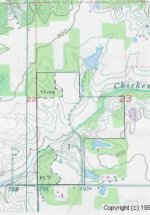
My ground according to the forester would more than likely qualify. I have about a 50 foot drop in elevation draining to the center of my property into a creek. See attached.

I am supposed to meet with FSA around the 27th to discuss this.
They all know I've owned the property less than a year (bought it in October 2005) but they still want to meet with me concerning the programs.... I don't know if there is a way that they can side step the one year issue.

Lee Nicholson
 

Attachments

  • 847432-scan0001 (3).jpg
    847432-scan0001 (3).jpg
    41.4 KB · Views: 117
   / Tree Planter #19  
The state forester came out and we did a survey of the property. He gave us a list of what trees would do well in our soil types in the two different plots. He also gave us a list of state approved foresters(private companies) that the state recommends. One of them happened to be a guy I went to high school with. We contacted the private forester and discussed the plan the state forester suggested. The private forester arranged to pick up the trees from a state tree nursery down in southern Indiana, brought them up to our property and used a small Ford 4WD tractor with a tree planter on the back. They marked out the field with some flags, then went down to our creek and filled their sprayer with water. Then his assistant drove up and down the marked rows while he sat on the back and planted trees. The planter opened ground in a continous slit. He'd stick in a tree every 8-10 feet and the planter would close the dirt around the tree and spray it. First the did every other row with white pines. Then they went back and did every other row with mixed hardwoods. It took about 4 hours to plant the 4 acres and two rows of a windbread about 300 yards long. They couldn't side spray the windrow, because the soil type was Adrian muck and it was near a creek. We have about 900 pines, 900 hardwoods and 150 firs in the windbreak. There are also 200 shrubs along the outside of the field in two rows for wildlife. Russian olive, crab apples, spice bushes and a few others. The hardwoods are mixed; 6 or 7 kinds of oaks, walnuts, poplar and cherry. A few weeks after it was done, the state forester came back out, inspected, and said OKEY DOKEY! A few weeks later we got the re-imbursement check from the state.

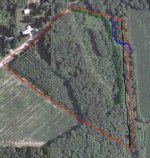
The attached picture shows the red outline is just outside our borders. The 4 acre field is on the left of the property. Pretty clear rows. The black line on the right is the actual property line; an old railroad grade. The blue line is a creek that goes under an old railroad bridge where it crosses the black line. The green line is the double line of firs. The trees were planted around 1991 or 92. The outside two rows in the fiels are shrubs followed by two rows of 2 yearold pines. The rest of the pines are seedlings, as were the firs. The pine trees in the field now average 30+ feet high and the bases of the trunks are 10+ inches in diameter. The pines grew fast, causing the hardwoods to reach for the sky. Nice and straight. /forums/images/graemlins/grin.gif Someday, my kids will harvest the hardwoods, or just leave it for a nice forest. There are deer, turkey, rabbits, foxes, you name it. Surprisingly, the deer did no damage to the trees, except for the bucks rubbing a few of the pines. The shrubs provided enough browse for them and they left the trees alone. We only lost maybe 10 trees at the most since the day they were planted. That's pretty good. The folks that planned it out for us really knew their stuff.

All-in-all, I couldn't be happier with the state program. They even gave us a nice folder with the plan in it. They also made some suggestions for woodlot improvement in the existing woods. You can see those in the picture as well. About 10 acres of mixed hard and soft wood. Maples, cherry, oak and locust are the dominant trees. As the locust will be thinned out for firewood and fence posts, the oaks will fill in.

Keep us informed of your plans. I am interested in the Classified Forest program and need to look into that.
 

Attachments

  • 847864-farm.jpg
    847864-farm.jpg
    28.1 KB · Views: 134
   / Tree Planter #20  
Great Job MossRoad! You are giving ALL of us a benefit from your planting.

Sounds like you had a very good planter considering the small percentage of loss you had. I just planted 900 seedlings a couple of weeks ago with a dibble - mainly because I could not get mechanical planter into areas I am trying to reforest.

I am sure you are already aware of the invasive potential of russian olive. Did you purchase these from your state forestry service program? You may want to reconsider having these on your property - here is a link www.umext.maine.edu/onlinepubs/htmpubs/2525.htm

I understand the wildlife benefit, but I also understand the invasive nature of these and would highly discourage anyone from planting these based on my land clearing experience. The thorns on the mature trees will penetrate tractor tires and do not decompose too quickly either, not to mention they are tough on everything else too. /forums/images/graemlins/blush.gif

I am getting rid of ALL the russian olive I have (hopefully) and replanting with other species of wildlife mix that I purchased thru the NCFS.


Tractor & Equipment Auctions

Dump Truck Body with Tarp System (A55851)
Dump Truck Body...
2016 John Deere 35G Mini Excavator (A55973)
2016 John Deere...
S/A Fuel Tank Trailer (A59231)
S/A Fuel Tank...
VOLVO ECR25 ELECTRIC EXCAVATOR (A60429)
VOLVO ECR25...
Year: 2019 Make: Jeep Model: Grand Cherokee Vehicle Type: Multipurpose Vehicle (MPV) Mileage: (A59231)
Year: 2019 Make...
Crown RM6025-45 4,500 LB Stand-On Electric Forklift (A59228)
Crown RM6025-45...
 
Top