welding rod question

   / welding rod question #41  
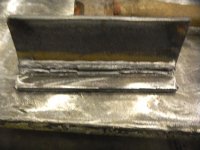
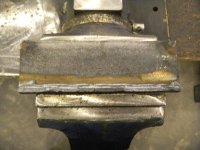
If I remember correctly, the "cold" 7018 rods were actually used right out of an opened box that had been left open for a good while, and still took 18 blows to break it.
And seems like you said that the weld with "hot" 7018 rods were beat down flat with 23 blows, and still didn't break completely. And you had to beat it back the other way to get it to come apart. :eek:
All true! But the one test that just floored me. Lincoln's L-56 Mig wire, 29-blows!:shocked:
 

Attachments

  • Weld.jpg
    Weld.jpg
    203.6 KB · Views: 135
  • 250.jpg
    250.jpg
    129.2 KB · Views: 119
  • Broke.jpg
    Broke.jpg
    198.9 KB · Views: 125
  • Bottom plate.jpg
    Bottom plate.jpg
    161 KB · Views: 123
  • Top plate.jpg
    Top plate.jpg
    139.3 KB · Views: 110
  • root.jpg
    root.jpg
    160.2 KB · Views: 120
   / welding rod question #42  
What will be the difference in using DC Will I need to learn all over again?

With alternating current (AC) the power from the transformer in the welder alternates from a max pos sinusoidally through zero then back up in the neg direction to max and back to zero to complete 1 cycle, 60 of which occur per second. The arc gets dim and shuts off many times per second. You don't realize it due to the rate of occurrence, but the weld knows it. So, the actual heat applied to your stick is turning on and off, flipping polarity, and is of a varying rate. What a mess.

With DC, the negatives are flipped on the pos side or vise versa. Polarity selected remains constant and with some materials polarity matters. Next the peaks and zeros are "integrated" into a more constant continuous current by the addition of a big coil, aka inductor in the DC mode of an ACDC unit. So the arc stays lit, is pretty much constant in heat intensity and remains one polarity. Gotta do a better/smoother job. The limitation with some of the smaller ACDC welders is that in the DC mode the current capacity/time on-time off usage rate is significantly reduced but that is probably a heat consideration for the rectifier diodes. If they had bigger heat sinks that would probably be reduced, but that takes up space and all and somewhere a line has to be drawn in the design.

That's the way it looks from here.

Mark
 
   / welding rod question #43  
and you are only getting that half the time.

That suggests a half wave rectification system rather than a full wave or FW bridge configuration. That may be the reason for the reduced performance. I haven't opened up my Miller Thunderbolt 200A ACDC to see how many diodes I have and how they are wired. Don't know why a designer would only use a half wave rectification system in a high current requirement system like a welder.....but I don't design welders!

Editing comment: I may just take my cover off and check it out. Using half wave means that the smoothing inductor has to be essentially twice the size for the same average current at a given setting. Diodes are cheap; magnetic parts of that size aren't. But I don't know till I look.

Mark
 
   / welding rod question #44  
All true! But the one test that just floored me. Lincoln's L-56 Mig wire, 29-blows!:shocked:

I noticed that on the Harbor Freight .030 solid MIG and .035 Flux MIG wire specs. Was impressed and tested it with my hammer. Brutal. Makes you (me) want to use it for everything....but I don't.

Mark
 
   / welding rod question #45  
Ole - I really am just a garage hack and poorly self-taught welder, and I mostly build recumbent bicycles out of 16 ga steel. 7014 is about the easiest rod I have tried, but it has so much slag that you can't see the puddle and just about have to weld blind. More than one pass, requires a lot of clean up between passes. I've recommended 7014 to guys on my bike building forum who have had so much trouble stick welding they gave it up. Self taught beginners often can't strike or hold an arc, even with 6013 at first. Several of them liked 7014 so much, they went back to stick from wire feeders (we don't really care how slow it is). The amazing thing is that after using 7014 many of them gained enough confidence that they were then able to use the less beginner friendly rods, such as 6010.

All that said, I have no idea whether 7014 is a good rod for thicker steel.
 
   / welding rod question #46  
7024 is just a 7014 with more iron powder and they are used on thick steel all the time. For ultimate strength, you'd probably want 7018 but for general stuff, thin or thick, 7014 would work just fine.
 
   / welding rod question #47  
7014 is all position though...7024, while a jet rod, and super fast just won't "hang" in there if you try overhead. If I remember right, it's only a 2F rod.2f or 2G depending upon the mfgr.
 
   / welding rod question #48  
7014 is all position though...7024, while a jet rod, and super fast just won't "hang" in there if you try overhead. If I remember right, it's only a 2F rod.2f or 2G depending upon the mfgr.
Correct, 7024 can only be ran flat or better flat with slight uphill slant to help keep the slag at bay.
As for 6013 comments, I didn't find it any easier to hold an arc with them than 6010 in fact worse due to the excess slag created. Unless I ran them (3/32 size) at amperage equivalent to a 1/8" 6010 the slag would cause an arc out. To me they are a pretty worthless rod.
 
   / welding rod question #49  
The question was whether 7014 could be used on thicker steel. That's why I said 7024 is basically the same type of rod. If they quit making 6013, I don't think anyone would mind. Just about everything else is a better rod unless it's damaged.
 
   / welding rod question #50  
The question was whether 7014 could be used on thicker steel. That's why I said 7024 is basically the same type of rod. If they quit making 6013, I don't think anyone would mind. Just about everything else is a better rod unless it's damaged.

They won't do that. 6013 is the standard for open root in Europe and Asian countries.
 
   / welding rod question #51  
As a rookie equipment mechanic working in a shop with only a Lincoln AC buzzbox. I learned with and used nothing but 7014 for the entire time I was at that dealership. I built and repaired a lot of stuff over those 6 years. I don't recall having to redo much after I welded it the first time. Beginner's luck maybe lol.

Brian
 
   / welding rod question
  • Thread Starter
#52  
When I posted this I had no idea how many replies I would get or how much controversy I may stir. As you can read in my post here I bought first 5 lbs of 7014 as well as 5lbs of 6011 I love the 7014 it does a fantastic job to weld and flow, but will never give up my 6011 for the old painted rusty metal. but now when I top weld over the 6011 it looks great.:cool2::drink:

THANKS FOR ALL THE HELP AND REPLIES!!!!
 
   / welding rod question #53  
I've heard that 7014 is called a "drag rod', you can literally drag it on your welds,
good for those who have hung-over shaking hands,,lol
Allot of good info here, thank's to all.
 

Tractor & Equipment Auctions

HYDRAULIC TILTING BUCKET FOR MINI EXCAVATOR (A58214)
HYDRAULIC TILTING...
Freightliner Tender Truck - Adams Tender (A56438)
Freightliner...
2006 TerraGator 8104 (A56438)
2006 TerraGator...
iDrive TDS-2010H ProJack M2 Electric Trailer Dolly (A59228)
iDrive TDS-2010H...
2003 TRAIL KING TRI-AXLE BELLY DUMP TRAILER (A58214)
2003 TRAIL KING...
24220 (A56859)
24220 (A56859)
 
Top