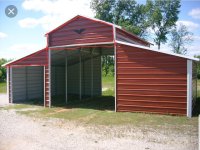
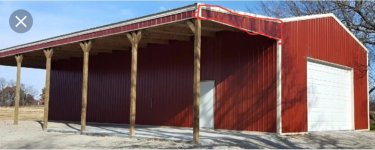
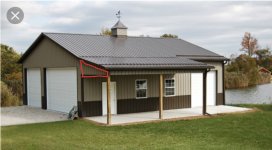
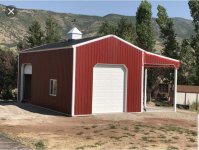
Why do some carports and lean-tos have panels half-way up?

   / Why do some carports and lean-tos have panels half-way up? #1  

strantor

Platinum Member
Joined
Jun 20, 2018
Messages
966
Location
Brazoria co., TX
Tractor
LS XR4140H
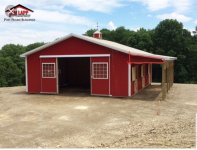
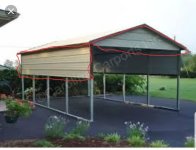
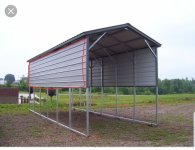
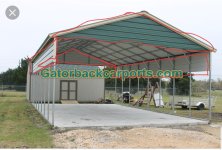
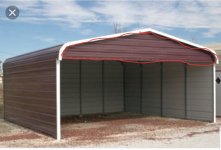
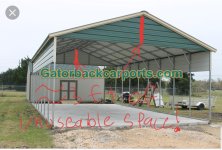
I'm building a lean-to onto the side of my workshop (metal building) and looking at pictures on the internet for ideas. I notice a trend of walls on the sides of carports that start at the roof and go only half way down, and a trend of enclosed roof gables on lean-tos as well as carports, where the "attic" space beyond is a free span, so that the gable alone limits the height of what can fit under the roof where otherwise the roof could accommodate a taller vehicle. I'm wondering what the reasons are for this. Here are some pictures to illustrate (sections circled in red):
20190309_212000.jpg20190309_212249.jpg20190309_212211.jpg20190309_212142.jpg20190309_212120.jpg20190309_212055.jpg20190309_210305.jpg20190309_212029.jpg20190309_211824.jpg20190309_212322.jpg

I have some of my own ideas but they don't fully explain what I'm seeing.
1. The closed gable of a carport gives some support against side winds. But not much support, and not all carports have them. And if that's the only reason, then why do some lean-tos have them as well?
2. The half-wall on a carport gives some support against winds front-to-back and allows the car door to open wider than the carport. But some of the half-walls come down further than a car door, and wind bracing could be done cheaper and easier with diagonal tight cables.
3. Aesthetically some people might find enclosed gables more pleasing. But at the cost of a few feet of unusable height?

Obviously there's something I'm missing. What is it?
 
   / Why do some carports and lean-tos have panels half-way up? #2  
I suppose some people don’t care about the extra height and find if visually appealing. I imagine it would add a little bit of structural integrity. I’ve always assumed the half sides help considerably with blocking direct sunlight and blocking rain while minimizing cost and wind profile.
 
   / Why do some carports and lean-tos have panels half-way up? #3  
Many people like the half sides for rv/motorhome storage. Keeps the direct sun and rain off the vehicles. These buildings are lightweight in the materials they use so you have to put added bracing in on the ends to tie it all together. Otherwise they would rack in various directions. They have their purpose for those who want an inexpensive cover for various things. You see more of these in the south where snow and ice is not a factor.
 
   / Why do some carports and lean-tos have panels half-way up? #4  
I suppose some people don’t care about the extra height and find if visually appealing. I imagine it would add a little bit of structural integrity. I’ve always assumed the half sides help considerably with blocking direct sunlight and blocking rain while minimizing cost and wind profile.


That's what I always thought.
 
   / Why do some carports and lean-tos have panels half-way up? #5  
Yes - blocking sunlight and added structural integrity.
 
   / Why do some carports and lean-tos have panels half-way up? #6  
I agree the partially enclosed areas better protect from direct sunlight. If you want to keep your stuff clean go fully enclosed. Partially enclosed areas allow dirt, dust, and pollen to get under them and everything will be just as dirty as it would if left outside. Probably more so since the rain doesn't ever rinse it off.
 
   / Why do some carports and lean-tos have panels half-way up? #8  
I agree the partially enclosed areas better protect from direct sunlight. If you want to keep your stuff clean go fully enclosed. Partially enclosed areas allow dirt, dust, and pollen to get under them and everything will be just as dirty as it would if left outside. Probably more so since the rain doesn't ever rinse it off.

I learned that with a 3 sided metal building for a carport. Dirt and weeds congregate there.
 
   / Why do some carports and lean-tos have panels half-way up? #9  
Here in my area there are tax implications, unless the walls go all the way to the ground the building can be considered temporary and not taxed. Or so I've been told by a real estate agent.
 
   / Why do some carports and lean-tos have panels half-way up? #10  
I have a 24 x 24 three sided pole shed with the walls ending about 2 feet from the ground. I also have a large brown vinyl tarp that runs across the front (door opening) that I can close in the winter. I ran a cable and attached the tarp to it with large key rings, like a giant shower curtain. This building is my tractor and implement shed.

As some have mentioned, the walls keep the sun and the elements out while allowing the wind to circulate air through the building keeping it free from condensation. The building is in a wooded area and the wind also blows the leaves out of the building. Sometimes a little help from a leaf blower is helpful.
 
   / Why do some carports and lean-tos have panels half-way up? #11  
The wall adds a huge amount of sheer strength to the building. If you just have the poles, then they would wobble. Adding diagonal bracing at the top of the pole will help strengthening the pole, but it's not going to be as strong as a panel will be. In houses, OSB or Plywood does the same thing. Used to be that every house had a diagonal board cut into the studs to sheer up the wall, then when plywood became more available, a sheet was used in each outside corner, which was a lot stronger. Now we use it on the entire exterior of a house for maximum strength in holding the studs in place, and keeping them for leaning over.
 
   / Why do some carports and lean-tos have panels half-way up?
  • Thread Starter
#12  
Here in my area there are tax implications, unless the walls go all the way to the ground the building can be considered temporary and not taxed. Or so I've been told by a real estate agent.

Mr. President is washing out my google search results on this topic. I'm trying to google things like "tax law on walls that go to the ground" and all the results I get are about the Trump border wall.

I'm in TX as well. If there's a substantial taxable difference between bringing my walls all the way to the ground or not, then I might consider making a change.

Do you happen to know if it makes a difference whether there are all-the-way-to-the-ground walls on 4 sides vs 3 sides vs 2 sides?

Any buzzword suggestions for further research would be appreciated. I'm notoriously bad at thinking of what specific words to search to get relevant results.
 
   / Why do some carports and lean-tos have panels half-way up?
  • Thread Starter
#13  
the walls keep the sun and the elements out while allowing the wind to circulate air through the building keeping it free from condensation.

Condensation has been discussed here a few times in other threads. I'm still baffled by it. My workshop (the structure this is being built up against) is insulated but not climate controlled. By most people's account, it should condense inside but it never has. I have my machine tools in there and they don't rust. I made the mistake of leaving the bay door open for a couple of days last week (effectively making it a 3-walled carport) and everything inside condensed badly. It took a whole day for me to scrub all the surface rust off my machines. So the idea that keeping my tractor implements inside a 3-walled barn would preserve them better than a 4-walled barn, does not fit in well with my experiences. I say this not be contrarian, but to highlight my ongoing failure to grasp the concept.
 
   / Why do some carports and lean-tos have panels half-way up? #14  
I am thinking about building a lean too. Like the pres. I want it to be "Powerful" . Steel AND concrete.

I think, I have pretty much wondered my whole life, when I saw a car port if that was just built that way for a cost saving measure. Are there really any other advantages?

In this climate of harsh sun to extreme cold and blowing snow, I am debated, whether to make walls. I am always amazed, how much warmer my GMC thermometer reads when parked in a closed unheated building, over outside temperature.

I have tons of surplus retaining wall stone, and since my proposed lean too is hemmed in by a hillside, I thought I would just build a small retaining wall, but if snow drifted in, against the inside of the wall, that would be a royal pain. Without experience, and with different wind directions, you never really know where the snow is going to end up.
 
Last edited:
   / Why do some carports and lean-tos have panels half-way up? #15  
With open space at the bottom of the sides to facilitate ventilation and reduce sweating.

Here in the north, I'd rather have a half-wall on the lower part to help keep out snow. Shouldn't make much difference as far as ventilation goes.
 
   / Why do some carports and lean-tos have panels half-way up? #16  
I will tell you my condensate story:. My building is fully enclosed, and NOT insulated. The floor is just gravel over the native dirt. When first built it would "rain" inside the building at times. Big huge drops of water on the inside of the roof falling down on the implements and tractor. I installed large louvered vents in each end one at the gable apex and one on the other end lower down. It solved the condensate problem almost 100%. Very little and only under extreme circumstances now.

When it was sealed up without any air flow, the hot days would make very high humidity inside and then as soon as darkness came and the sheet metal cooled down, the water formed on the roof and rained down. I suppose my vents let out a lot of that hot humid air and if there is any wind, it flows thru the building and exchanges the hot humid air with cooler less saturated air. The photo is before the vents were added.
 

Attachments

  • 090812 008.jpg
    090812 008.jpg
    937.4 KB · Views: 124
   / Why do some carports and lean-tos have panels half-way up?
  • Thread Starter
#17  
I am thinking about building a lean too. Like the pres. I want it to be "Powerful" . Steel AND concrete.

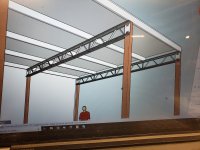
GMTA. What I'm calling a "lean-to" isn't really a lean-to at all. It's a pole barn built as close to my shop as possible, self-supported and not attached to the building at all. I had the building built by a licensed contractor who had it engineered and to withstand hurricanes and delivered with architect-stamped prints. Because I live near the coast in the wind zone, I'm operating a business out of it, it's full of expensive stuff, and I wanted to insure it. I don't know all the technicalities surrounding the insurance and what it takes to void that insurance, but I know that the building, as insured, is designed a certain way to withstand a certain load, and hanging stuff off the side of it in a way that it wasn't engineered to support, would likely be a pretty big nail in the coffin if it ever blew down.

So it won't be attached at all. I'll add some flashing under the existing roof panels to transition from one building to the other, but it won't be fastened to the addition. The addition will be free to flex in the wind without ripping the roof off the existing building. I have some concern about wind getting under that unfastened flashing and pulling it up (leading to pulling up on the roof panels) so I'm considering different methods to hold it down without fastening it down. I'm thinking some powerful magnets spaced every foot or so. Or maybe some tires thrown up on the roof LOL (seems to work in trailer parks).

But I'm trying to make it as robust as reasonably possible, to minimize any relative movement between the two buildings. I went with 4x6 poles spaced 90" apart, cemented 4ft into the ground. I was welding up lattice roof trusses with 12" web but they proved to be so labor intensive that they aren't worth the effort. I've abandoned them in favor of dual back-to-back 6" steel purlins. The extra cost is more than made up for in recovered man-hours even considering the $480 in steel I spent for the truss material.
 

Attachments

  • 20190227_180903.jpg
    20190227_180903.jpg
    4.3 MB · Views: 139
  • 20190226_181033.jpg
    20190226_181033.jpg
    5.2 MB · Views: 132
  • 20190301_160438.jpg
    20190301_160438.jpg
    4.7 MB · Views: 119
  • 20190306_163625.jpg
    20190306_163625.jpg
    4.1 MB · Views: 114
   / Why do some carports and lean-tos have panels half-way up? #18  
Looks ambitious. Shop looks like mine excpept you have WAY more free bench and floor space. lol
 
   / Why do some carports and lean-tos have panels half-way up?
  • Thread Starter
#19  
Looks ambitious. Shop looks like mine excpept you have WAY more free bench and floor space. lol

Shop space is like money or women's shoes. There's never enough, no matter how much you have. I could have a 50,000sf shop built today and have it too full to walk through in just a few years.
 
   / Why do some carports and lean-tos have panels half-way up? #20  
Mr. President is washing out my google search results on this topic. I'm trying to google things like "tax law on walls that go to the ground" and all the results I get are about the Trump border wall.

I'm in TX as well. If there's a substantial taxable difference between bringing my walls all the way to the ground or not, then I might consider making a change.

Do you happen to know if it makes a difference whether there are all-the-way-to-the-ground walls on 4 sides vs 3 sides vs 2 sides?

Any buzzword suggestions for further research would be appreciated. I'm notoriously bad at thinking of what specific words to search to get relevant results.
Did a little looking into it, it appears to be a county by county interpretation. So you may want to check with your local appraisal district to see what you can do.
 

Marketplace Items

CASE TV370B SKID STEER (A52706)
CASE TV370B SKID...
Ratchet Straps (A59230)
Ratchet Straps...
DEUTZ MARATHON 60KW GENERATOR (A55745)
DEUTZ MARATHON...
2009 Mariah SC23 23ft. Cabin Cruiser with T/A Boat Trailer (A59231)
2009 Mariah SC23...
VOGELE VISION 5103-2 ASPHALT PAVER (A60429)
VOGELE VISION...
(2) 330 GALLON POLY TOTES W/CAGES (A60432)
(2) 330 GALLON...
 
Top