<font color="blue"> However, I am curious what keeps the water level up once the pond is filled above the level of the water table. It seems to me that any water pumped in from a well would seep through the sand almost as fast as you pump it in. Obviously, with the research you have done, this is not the case (or is it?). Will your pump run daily (or several times a day) in order to keep the pond at the desired level? Short of this, I am having a difficult time understanding how your hole will hold water. </font>
Good question. I'm not sure I know the technical answer. One of my frustrations has been that I like to know how things work, and it's really difficult to find information about this type of pond. My guess is that it just works, and all the good ol' boys know it works, so they don't bother to explain it - at least in any accessible internet site I've been able to find.
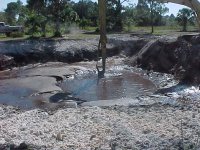
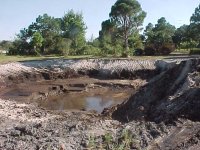
Here's my best guess. First of all, the level of the pond will never be below the level of the water table, and the water table never gets lower than the pond itself, as long as the pond is 6' deep or so. So, it doesn't "drain" out. Second, it seems to me that water would rather be in an open area than filtering through the sand, so it tends to find its way to the pond and mostly stay there. That's a seriously unscientific guess. All I know for sure is that my daughter and son-in-law next door have a small pond, not particularly well designed and not very imaginative (it's just a basic oval about 90' x 70'), and the water level in their pond is always a little higher than the water table itself. My pond is about 600' away and the substrata doesn't change; we hit water at about 6', but the level in their pond is down about 4' right now. Maybe someone with a knowledge of hydrodynamics can explain it.
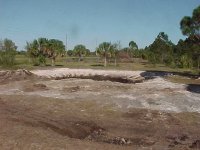
Finally, we do plan to keep the level in our pond constant, rather than let it vary with the water table. I can only give a broad description of this technique right now. We won't be implemeting it until the well and electricity is installed, and that can't be until after we pull a building permit, under our local codes. Basically, once I explained to my water guy what I wanted to do (supply water to the house, the barn, the pond, to an RV location for friends, to a hookup for my own RV, and to several locations on the property for irrigation), he said that he would install a 4" well with a submerged pump that would supply enough water for a small village (probably a slight exxageration on his part). He will also supply a float switch of some sort that will activate a valve, probably some sort of solenoid, that will replenish the pond until the float switch turns it off again. I've done some rough calculations based on how quickly my kids' pond can drop in a dry spell, and I suspect it may run for several hours every day in some seasons. I expect fairly serious loss (down to the natural level) in dry times. It will seep out through the sides of the pnd above the water level. Of course, it will jut settle back in and replenish the water table, so it isn't exactly going to waste.
At first, I was distubed by the expense of running a pump that long, but then, I compared it to the expense of running a pool circulation pump, which I have been doing for over 20 years. The pool pump runs 6 to 8 hours every day (all year round, in Florida) and doesn't break the bank, so I decided I could afford the pond pump expense. We'll also be running a small, separate pump to create an aeration fountain in the center of the pond. I was going to use an air stone for aeration, but the CFO really wants a pretty spray. If I get ambitious, I'll probably install some sort of light on the spray.
Keeping the pond at a constant level is really important from a mosquito control point of view, as it is changing water levels which hatch the pests. My real concern is not loss of water, but the potential of pond overflow when the rains fall in earnest. Without level control, the pond is usually lowest when the rains start. With the pond at a high level when the rains come, it is subject to flooding. I'm going to take two steps to avoid that. First, I'm going to build a low mound all around the pond, giving it just a little more room before it floods, and preventing any flooding of the surrounding area from flowing into the pond. There will be some runoff into the pond, as the land around the house will be even higher than the pond, and will slope to it. Second, I'm going to install a primitive standpipe in the pond that will direct overflow through the pipe and out into the drainage swale along the highway. This won't protect me against serious flooding caused by a hurricane-driven rainfall, but nothing can protect me against that, and the pond will prevent it from being as bad as it could be.
There's a certain amount of hope and faith in all of the above - the good ol' boys all assure me that it will work as I intend, and all I know is that anything will be better than what we had in the past several months. The only alternative would be to truck in enough fill to raise the entire property. The pond is a cheaper alternative that also happens to add aesthetic and monetary value to the property.
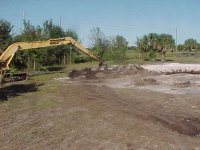
The contractor is also going to swing over to my kids' property next door and reshape their pond before he leaves. It has nearly vertical banks and is impossible to maintain (it was like that when they bought the place). He's going to reslope the banks, drag it to clean it out, and reshape a portion of the banks to a more appealing shape. They have a line of oak trees alongside their driveway that will prevent the excavator from working on that side of the pond, so the long boom of the excavator will actually be used to scoop dirt from the near side of the pond and "throw" it across to build up the far side to a more gradual slope. Should be interesting.