Trailer Sway

   / Trailer Sway #21  
My humble opinion is that weight distributing hitches are a crutch for those that can't or won't load their trailer with the proper percentage of tongue weight.

My truck handled much better with a weight distributing hitch even though the trailer was loaded properly and did not sway without the WDH. And the truck ratings allows you to tow much more weight when you use one. So I highly recommend them but still recommend loading your trailer properly.

Ken
 
   / Trailer Sway #22  
My humble opinion is that weight distributing hitches are a crutch for those that can't or won't load their trailer with the proper percentage of tongue weight.

I will agree, though this is a contrarian viewpoint to most folks. I too have a Powerstroke, a 94 F250 Supercab. I regularly tow my boat (21', total trailer weight around 4K), or a 16' flatbed, or my 25' travel trailer weighing 7K GVWR. I don't use a weight distributing hitch. Why should I?

The TT has about a 800 lb tongue weight. With an extra leaf on my rear springs, the trailer moves the rear of the truck down an inch. I did the math and it unloads the front end less than 100 lbs per tire. My truck weighs as much as the trailer. I have no sway.

Before everybody has a hissy fit, go look at a mobile home hauler. See any weight distributing or sway bars on there? And how big/heavy is a mobile home?
 
   / Trailer Sway #23  
Like the others said, back it on. Get the engine of the tractor over the axles if possible. You have plenty of truck. You may need a longer trailer to get the load right. I really do not think the tires are going to help you at all. Just make sure the ones that are on there are capable of holding 1750# each and are aired up to max psi listed on the tire.

Chris
 
   / Trailer Sway #24  
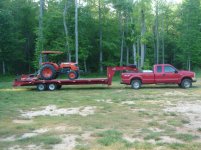
Not enough trailer. Kubota's website lists that tractor at 3,620 lbs. dry weight The front end loader on my TC-45 weights 900 lbs without the bucket, so we can assume somewhere in that ballpark. Let's assume 300 lbs for the FEL bucket and 300 lbs for the box blade. Grand total is 5120 lbs. Trailer capacity 7,000 lbs minus trailer weight 1,500 equals payload of 5,500 lbs. Only 380 lbs of margin. We haven't added fuel, chains and binders yet. Also factor in not enough room to move tractor fore or aft to balance the load.

I fought this problem for years until I bought a gooseneck. I'll never go back to hauling that much weight on a bumper pull trailer.

I tow set up in picture all over North Georgia and Eastern Alabama. Tows smooth as silk on the interstate at 65 to 70 mph.
 

Attachments

  • DSC01409.jpg
    DSC01409.jpg
    519 KB · Views: 246
   / Trailer Sway #25  
I second what everyone elts has said, more tongue weight, back it on get farther forward. Trailer looks to be almost not enough in length. Might be close weight wize but looks to be more tight on room.
 
   / Trailer Sway #26  
My humble opinion is that weight distributing hitches are a crutch for those that can't or won't load their trailer with the proper percentage of tongue weight.

Anti-sway is not the primary purpose of a weight equalizing hitch. It's purpose it to distribute some of the tongue weight onto the tow vehicle front wheels via the tow vehicles frame. For any old enough to remember the Oldsmobile Toronado, a 60's full sized luxury front wheel drive car, there used to be a hitch manufacturer's ad that featured the Toronado pulling (slowly) with it's rear wheels removed. Although WEH's have optional sway resistance components, they're not essential to weight equalization. Any tow vehicle carrying weight proportionally on front & rear wheels will be more sway resistant, i.e. a pickup loaded to capacity rear of the axle will be prone to sway whereas the same load at the headboard will be more stable. WEH functionally moves tongue weight forward achieving much the same result as a gooseneck. MikeD74T
 
   / Trailer Sway #27  
Anti-sway is not the primary purpose of a weight equalizing hitch. It's purpose it to distribute some of the tongue weight onto the tow vehicle front wheels via the tow vehicles frame. For any old enough to remember the Oldsmobile Toronado, a 60's full sized luxury front wheel drive car, there used to be a hitch manufacturer's ad that featured the Toronado pulling (slowly) with it's rear wheels removed. Although WEH's have optional sway resistance components, they're not essential to weight equalization. Any tow vehicle carrying weight proportionally on front & rear wheels will be more sway resistant, i.e. a pickup loaded to capacity rear of the axle will be prone to sway whereas the same load at the headboard will be more stable. WEH functionally moves tongue weight forward achieving much the same result as a gooseneck. MikeD74T

Why not just get a GN then
 
   / Trailer Sway #28  
As previously stated:

Balance the load. Inflate the tires to maximum. Also, make sure the hitch height makes the trailer tongue level when the trailer is loaded. If it is not, you'll be unloading the rear tires on the trailer, and loading the front tires making it more prone to sway.

Now some comments...I've pulled a variety of trailers over a 30 year period including enclosed trailers, large boats, and equipment trailers. My current towing vehicle is an F350 diesel crew cab dually with the Tow Boss package. I also have air lifts on the rear to level the vehicle if needed.


My humble opinion is that weight distributing hitches are a crutch for those that can't or won't load their trailer with the proper percentage of tongue weight.

If you haven't used a weight distributing hitch - your opinion is worth zero - no matter how "humble" it may be. I use a WDH on trailers as it helps bring the vehicle to level, provides better steering ability, and makes the trailer far more controllable in a cross wind. You may be as macho as you want about how to load a trailer, but, if you pull any kind of load or one with a high cross sectional area - the WDH makes driving a lot easier. My motto - don't work hard, work smart.


Why not just get a GN then

Makes a lot of sense for regular use, and little sense for occassional use. I pull my 18-foot deck equipment trailer only 5-6 times per year. I just pulled it on a 560 mile round trip with my JD 3320 with a loader and backhoe. The tractor has loaded front and rear tires - so my guesstimate is the weight is in the 6,000 pound area including the tool box, binders, chains, etc. The trailer is rated for 9,999 pounds but, is built on a 14K frame with 11K worth of axles and brakes on all 4 wheels.

On the return trip, there was a constant 25mph cross wind with gusts to 35mph. I set the cruise control on 72mph and had no trouble maintaining stability and control specifically because of the WDH. Everyone doesn't need a gooseneck.
 
   / Trailer Sway #29  
Yeah those mobile home toters better get a WD hitch then. They don't know what they're missing.
 
   / Trailer Sway #30  
Your picture preempted my usual suggestion, which is "weight too far back".
Here's something that MIGHT work;
Keep the tractor right where it is, but raise the height of the hitch ball.
This will increase the load on the ball AND increase the load on the REAR axle.
G_E_N_E_R_A_L_L_Y this will lead to a more stable trailer.

Many folk don't realize that the hitch load actually decreases as the truck springs compress, so what you might measure at 19 inches or so if you rig it up to check the load on the hitch won't be the load on the hitch when the truck has dropped 2 or 3 inches.
 
   / Trailer Sway #31  
Ooops, I guess I only glanced at the pic and ASSUMED that it WAS backed on, e.g. truck at left of picture.
Now I'm ASSUMING that your rear tires are loaded, that could make a 1,000 lb or more difference.
The way you have it, the box blade probably makes it worse too.
Yeah, get the C of G slightly ahead of the front axle, by backing it on or by folding the bucket differently.
CHECK the tongue load AT THE ACTUAL RIDING HEIGHT, as I said "where the truck squats to".
 
   / Trailer Sway #32  
you might try backing it on (as has been said) and/or putting the boxblade in the bucket, that will move some of the weight to the other end of the trailer and may be enough to even the load on the trailer. Just make certain you have it well tied down.

Aaron Z
 
   / Trailer Sway #33  
I tow bumper pull, tandem axle trailers a lot both equipment and RV.

1) A W/D system is almost always required for tractor towing since the standard receiver hitch on our pickups is only rated for 500 tongue/5000 trailer without one. The W/D system allows you to legally tow your trailer. If you had a better hitch, such as a mobile home hauler, then you could skip it.

2) A W/D hitch is not sway control. It is not intended to reduce sway and is not a crutch for sway. The W/D hitch simply distributes tongue weight to both axles of the tow vehicle. This is greatly helpful for steering, breaking, and comfort issues.

2a) They make a bandaid device that is a frcition sway control device that is intended to limit sway. The folks that use these devices are admitting defeat at not being able to properly set up their load.

3) A standard tandem axle trailer has a funky linkage between the two axles that compensates for the trailer being unlevel. Meaning it doesn't really matter if the tongue is high or low since each of the trailer axles will have the same weight on them. Of course, this is only within a reasonable range.

4) The OP's trailer has 5 lug wheels so is at most a 7000# trailer. The tractor looks heavy, my 30 HP tractor with loader and BB weighs 4500#. I can't imagine the OP's load being within the ratings of that trailer but maybe it is. Worth checking.

5) GN trailers suck at making tight corners. The trailer tires track way inside the truck's path. They are slow to react when backing as well. Can't haul big loads in the bed either. I hear that they are super smooth when cruising down the road though.

I recommend trying the load backed on. GO to a scale and verify that you can get 10-15% tongue weight. Also verify that the trailer is not overloaded. If that fails then get a longer trailer with two 5200# braking axles. If you are doing hauling this machine to side jobs and are underinsured then it would be wise to be conservative with your ratings.
 
   / Trailer Sway #34  
I tow bumper pull, tandem axle trailers a lot both equipment and RV.

1) A W/D system is almost always required for tractor towing since the standard receiver hitch on our pickups is only rated for 500 tongue/5000 trailer without one. The W/D system allows you to legally tow your trailer. If you had a better hitch, such as a mobile home hauler, then you could skip it.

2) A W/D hitch is not sway control. It is not intended to reduce sway and is not a crutch for sway. The W/D hitch simply distributes tongue weight to both axles of the tow vehicle. This is greatly helpful for steering, breaking, and comfort issues.

2a) They make a bandaid device that is a frcition sway control device that is intended to limit sway. The folks that use these devices are admitting defeat at not being able to properly set up their load.

3) A standard tandem axle trailer has a funky linkage between the two axles that compensates for the trailer being unlevel. Meaning it doesn't really matter if the tongue is high or low since each of the trailer axles will have the same weight on them. Of course, this is only within a reasonable range.

4) The OP's trailer has 5 lug wheels so is at most a 7000# trailer. The tractor looks heavy, my 30 HP tractor with loader and BB weighs 4500#. I can't imagine the OP's load being within the ratings of that trailer but maybe it is. Worth checking.

5) GN trailers suck at making tight corners. The trailer tires track way inside the truck's path. They are slow to react when backing as well. Can't haul big loads in the bed either. I hear that they are super smooth when cruising down the road though.

I recommend trying the load backed on. GO to a scale and verify that you can get 10-15% tongue weight. Also verify that the trailer is not overloaded. If that fails then get a longer trailer with two 5200# braking axles. If you are doing hauling this machine to side jobs and are underinsured then it would be wise to be conservative with your ratings.

Kinda/sorta;
WDH (More correctly a LOAD distributing hitch) does have some effect on sway;
As I said in my first post, a higher ball increases hitch load and trailer rear axle load.
The funky thing is called an equalizer.
Gooseneck trailers; Ahh, worth a chapter or two alone.
They're easier to back, ride better, can REALLY turn around tight - ultimately in the length of the trailer plus half the width of the truck, on and on.
If I can U turn the truck on a 2 lane highway the trailer will follow, can't do that with a tag-along.
To the subject of THIS thread, they just don't sway - well, it would take a LOT to provoke anything resembling sway.
 
   / Trailer Sway #35  
Gooseneck trailers.....
They're easier to back, ride better, can REALLY turn around tight .

Ditto

Once your past the initial learning curve a gooseneck is much easier to handle

1) A W/D system is almost always required for tractor towing .

Hardly


since the standard receiver hitch on our pickups is only rated for 500 tongue/5000 trailer without one. The W/D system allows you to legally tow your trailer. If you had a better hitch, such as a mobile home hauler, then you could skip it.

Why can't you just upgrade hitches? Why would you have to upgrade to a WDH? The OP said he is towing with a F250 IIRC so hopefully the hitch is rated for a little more than 5000#

Everyone doesn't need a gooseneck.

Did I say everyone did?

If you are that reliant on a WDH then a GN would be much better suited for the job, unless your towing with a SUV of course
 
   / Trailer Sway #36  
The fundamental cause of sway (assuming 10 - 15% tongue weight), is insufficient tire lateral (cornering stiffness). However, if you increase tire size, wheel width, or air pressure to increase cornering stiffness, you risk bending (cambering) the axle. AND, adding air pressure to carry the load DECREASES cornering stiffness after a certain pressure is reached (usually about 45 -50 psi) There can be substantial side forces developed when cornering at speed. These forces are in play even while driving straight, as perturbations in tow angle required tire force reactions to reduce it. If the forces aren't big enough or fast enough, sway or even jacknife occurs.

As a matter of fact, I am a rocket scientist, so I happen to know of these thangs. And was paid very well to splain it to MBA's. (Which I bought a lot of tractoring stuff with).
 
   / Trailer Sway #37  
The fundamental cause of sway (assuming 10 - 15% tongue weight), is insufficient tire lateral (cornering stiffness). However, if you increase tire size, wheel width, or air pressure to increase cornering stiffness, you risk bending (cambering) the axle. AND, adding air pressure to carry the load DECREASES cornering stiffness after a certain pressure is reached (usually about 45 -50 psi) There can be substantial side forces developed when cornering at speed. These forces are in play even while driving straight, as perturbations in tow angle required tire force reactions to reduce it. If the forces aren't big enough or fast enough, sway or even jacknife occurs.

As a matter of fact, I am a rocket scientist, so I happen to know of these thangs. And was paid very well to splain it to MBA's. (Which I bought a lot of tractoring stuff with).

But did you stay at a Holiday Inn Express?:p
 
   / Trailer Sway #38  
Check your hitches of you plan to tow without a Weight Distributing Hitch. No, this is not a "load distributing hitch" or some other name, the correct term is a Weight distributing hitch. You will notice on your OEM trailer hitch receiver that you are not allowed to tow very much weight at all without using one. My F350 requires a WDH to tow my little 30HP tractor.

One way to solve this is to use a WDH another is to upgrade to a heavier hitch which is possible only to a certain extent. If you do the hitch upgrade then you miss out on all of the other benefits of WDH such as weight on the front end of your truck.

This is just using proper equipment and following the rating of your hitch.

Duffster: You're wrong about WDHs. Obviously don't know what you're talking about in regards to bumper pull trailers.
 
   / Trailer Sway #39  
Duffster: You're wrong about WDHs. Obviously don't know what you're talking about in regards to bumper pull trailers.

Obviously :rolleyes:

You guys sure make a big deal out of towing little trractors, it is very entertaining
 
   / Trailer Sway #40  
I'm sorry duffster, that was rude. What I meant to say was that anyone who cares to actually know and respect their ratings will find that most trucks will require a WDH to tow even a medium weight bumper pull trailer. This is the case with full sized trucks too, even my one ton Ford. Nobody should dismiss this fact unless you are aware of the requirement and accept the liability of violating it. This is no different than overloading your tires.
 

Tractor & Equipment Auctions

iDrive TDS-2010H ProJack M2 Electric Trailer Dolly (A59228)
iDrive TDS-2010H...
2018 Chevrolet Tahoe SUV (A59231)
2018 Chevrolet...
Adams Tender / Magnolia Trailer (A56438)
Adams Tender /...
John Deere 6120M (A57148)
John Deere 6120M...
2009 JACK COUNTY KILL TRAILER (A58214)
2009 JACK COUNTY...
2014 Ford Fusion SE Sedan (A59231)
2014 Ford Fusion...
 
Top