At Home In The Woods

/ At Home In The Woods #902  
Make sure the window/door mfr instructions are followed, and that compatible weather sealing products are used. If there are any future problems the "incorrect" installation will be what the company reps claim as the reason.

Many well known window mfrs have been known to put out leaky windows, make sure to inspect every window for workmanship before it goes in.

Here on the coast window installation techniques are one of the most important issues to deal with during construction.
 
/ At Home In The Woods #903  
I went to a home show last week and spent some talking to the James Hardie rep about thier siding. While talking, he told me that they now sell house wrap. I didn't know this and he gave me a sample and explained why it is supperior to Tyvek and Dupont. Both are fine, but are fairly open weaves. The Hardi wrap is a very tight, thicker product that by looking at the two, I think is vasty supperior. He said it is about the same price as Tyvek, but I haven't bought it yet. The only supplier is an hour away, but I'll make the drive when I need house wrap to buy this over Tyvek in the future.

Eddie

I wonder if tyvek and dupont were just not doing the job for them behind the hardie cement fiber siding, and they came up with their own product?
Dave.
 
/ At Home In The Woods #904  
Obed, as said before find out how the manufacturer recomends installing the windows and insist your framer follows it to the letter. the extra time spent installing the windows and doors correctly will save big costs down the road that will not likely show up for years. I would suggest taking pictures of one window installed per manufacturers instructions just in case you have a problem down the road. if you are getting vinal windows check the corner "welds" as often times durring handeling they will crack, causing water to leak into the wall cavity.
taking pictures for the first one with your framer will help to insure that they do all of them correctly, in theory any ways.
 
/ At Home In The Woods #905  
Obed, as said before find out how the manufacturer recomends installing the windows and insist your framer follows it to the letter. the extra time spent installing the windows and doors correctly will save big costs down the road that will not likely show up for years. I would suggest taking pictures of one window installed per manufacturers instructions just in case you have a problem down the road. if you are getting vinal windows check the corner "welds" as often times durring handeling they will crack, causing water to leak into the wall cavity.
taking pictures for the first one with your framer will help to insure that they do all of them correctly, in theory any ways.
What brand of vinyl windows have you seen that often have cracked welds?
 
/ At Home In The Woods #906  
I don't think it is the brand of windows, more the rough handeling of them by the installers. one way to test the windows is to tape over the weep holes and fill the bottom track with water...if you find the water level goes down and it is not comeing out the weep holes ( poor tape job ), you have a problem. similar problem with aluminum windows only with them it is a problem with the thermal break materail shrinking over time, this makes a hole that allows water into the wall cavity.

not saying all windows suck, just that there are some flaws that one should be aware of. would not be hard to test the windows as I described above before the siding goes on...or just plan on them leaking and take steps to prevent the water from getting into the wall, IE: proper flashing and/or sill pans.
 
/ At Home In The Woods
  • Thread Starter
#907  
Most of our windows are Anderson vinyl clad. I read the installation instructions; they were extremely detailed with many steps. I'm thinking we may get a professional window company to install the windows.
 
/ At Home In The Woods #908  
I don't think it is the brand of windows, more the rough handeling of them by the installers. one way to test the windows is to tape over the weep holes and fill the bottom track with water...if you find the water level goes down and it is not comeing out the weep holes ( poor tape job ), you have a problem. similar problem with aluminum windows only with them it is a problem with the thermal break materail shrinking over time, this makes a hole that allows water into the wall cavity.

not saying all windows suck, just that there are some flaws that one should be aware of. would not be hard to test the windows as I described above before the siding goes on...or just plan on them leaking and take steps to prevent the water from getting into the wall, IE: proper flashing and/or sill pans.
I was just wondering because you said they would often crack.That hasn't been my experience. I use Simonton vinyl windows and have only had two (out of at least several hundred) of them crack near the welds. The way most windows are extruded if water somehow gets in it will run out the weep holes rather than leak into the wall unless the underside of the sill is cracked. The cracking you describe may be more of a problem with windows of lesser quality, or rough handling. I agree about aluminum windows. Those things are made to leak.
 
/ At Home In The Woods #910  
I'm thinking we may get a professional window company to install the windows.

Be very careful of the window companies. In my experience, some are great, and some are REALLY BAD.

What happens is a sales guy sells you the windows. He's good at sales, but that's all he does and all that he knows. Then a crew is sent out to install them. Who you get to do the install is always a mystery. Most of the time, there is one guy who knows what he's doing and a couple of younger guys who don't really care, but are there to collect a paycheck.

These are retrofit windows that I'm talking about, and not new construction.

They are fast and they are sloppy. I get called in because the windows leak, and the company is no longer answering their phone calls, or coming back when they said they would.

There are allot of ways to screw up a window install on an existing home. It might take me half a day, or it might take several days to do one window instead of an hour for each window. Prep work is the key, and speed is the enemy.

In your situation, it really is a simple task to put them in properly. Who you hire needs to be the type of person who takes his time and is willing to do them one at a time and not get into a rush. Having them bid it out means that the faster they go, the more they make. Paying by the hour means that they might dog the clock, but they might also take all the time they need to get it right.

The tape is expensive, but code in some areas, and it makes a big difference. Make sure they use it.

If you are going to hire it out, I'd be sure to talk to at least five contractors or companies. The biggest mistake everyone makes is to hire the firs guy they talk to, and they do so because of personality. If you make the decision before you start interviewing that you will not hire anybody until you talk to at least five, you will be able to make a much better decision on who to hire.

Personally, I'd look to hire a remodeler over a window company. A guy who is more detail oriented and does the work himself. Somebody that you can hire for other things down the road and develop a long term working relationship with. Someobdy who takes pride in everything he does and wants to make you a long term client. Word of mouth is the best way to find somebody, especially if it's somebody that you already know and trust. Never hire somebodies kid, husband or friend just because he's out of work and needs the money. Hire the guy who's busy and has allot of jobs lined up. There is a reason for this.

Good luck,
Eddie
 
/ At Home In The Woods #911  
Be very careful of the window companies. In my experience, some are great, and some are REALLY BAD.

What happens is a sales guy sells you the windows. He's good at sales, but that's all he does and all that he knows. Then a crew is sent out to install them. Who you get to do the install is always a mystery. Most of the time, there is one guy who knows what he's doing and a couple of younger guys who don't really care, but are there to collect a paycheck.

These are retrofit windows that I'm talking about, and not new construction.

They are fast and they are sloppy. I get called in because the windows leak, and the company is no longer answering their phone calls, or coming back when they said they would.

There are allot of ways to screw up a window install on an existing home. It might take me half a day, or it might take several days to do one window instead of an hour for each window. Prep work is the key, and speed is the enemy.

In your situation, it really is a simple task to put them in properly. Who you hire needs to be the type of person who takes his time and is willing to do them one at a time and not get into a rush. Having them bid it out means that the faster they go, the more they make. Paying by the hour means that they might dog the clock, but they might also take all the time they need to get it right.

The tape is expensive, but code in some areas, and it makes a big difference. Make sure they use it.

If you are going to hire it out, I'd be sure to talk to at least five contractors or companies. The biggest mistake everyone makes is to hire the firs guy they talk to, and they do so because of personality. If you make the decision before you start interviewing that you will not hire anybody until you talk to at least five, you will be able to make a much better decision on who to hire.

Personally, I'd look to hire a remodeler over a window company. A guy who is more detail oriented and does the work himself. Somebody that you can hire for other things down the road and develop a long term working relationship with. Someobdy who takes pride in everything he does and wants to make you a long term client. Word of mouth is the best way to find somebody, especially if it's somebody that you already know and trust. Never hire somebodies kid, husband or friend just because he's out of work and needs the money. Hire the guy who's busy and has allot of jobs lined up. There is a reason for this.

Good luck,
Eddie

Hey Eddie,

Didn't you say you needed to get away and focus your mind on something? See, I'm as good at spending other peoples time as well as their money. LOL Glad to see you about. :thumbsup:
 
/ At Home In The Woods
  • Thread Starter
#912  
Double top-plate interiror wall question
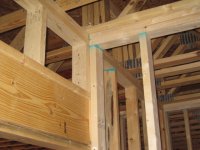
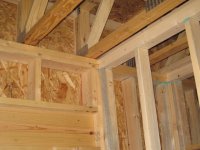
The framer has built several interior walls. I noticed some spots at the wall intersections that the double top-plates do not overlap but the dead wood is used to do the overlapping. Is this ok? If it is not ok, what issues will it cause?

Thanks, Obed
 

Attachments

  • IMG_3397.JPG
    IMG_3397.JPG
    111.8 KB · Views: 543
  • IMG_3400.JPG
    IMG_3400.JPG
    111 KB · Views: 520
Last edited:
/ At Home In The Woods #913  
In my opinion all top plates should overlap, but I don't know what code is. Just my opinion. I think it would make for stronger walls. Of course those look to be non-loadbearing walls.

Chris
 
/ At Home In The Woods #914  
Double top-plate interiror wall question
The framer has built several interior walls. I noticed some spots at the wall intersections that the double top-plates do not overlap but the dead wood is used to do the overlapping. Is this ok? If it is not ok, what issues will it cause?

Thanks, Obed

The way he did it is just fine and is the way I always did it. If you think about it, what is there to gain by crossing the double plate when you can cross the drywall nailer/backer like he did.
 
/ At Home In The Woods #915  
Technically, it is incorrect.
The reason for the over laping second top plate is so you can toe nail up threw
the opposite side of the perpendicular walls top plate and suck the two walls together. This is important on exterior wall corners, probably not as important on smaller interior walls.
That said, as long as the fit is tight and the backing plate is nailed on with more than two nails, its probably fine.
 
/ At Home In The Woods #916  
Double top-plate interiror wall question
The framer has built several interior walls. I noticed some spots at the wall intersections that the double top-plates do not overlap but the dead wood is used to do the overlapping. Is this ok? If it is not ok, what issues will it cause?

Thanks, Obed

If I am correct in assuming that you are talking about the space between the trusses and the top plate, If it wasn't more than 1 1/2inch I wouldn't worry about it. When you install the drywall, first to be installed will be the ceiling, when the walls are installed,they will be butted against the ceiling, holding up the ceiling drywall.
What I WOULD be concerned about is whether the trusses are sitting directly over the trimmer/wall studs to carry the load directly down to the foundation.
BTW I don't think it is good practice to try and "suck" up
any variation between framing members when one of them is a truss. What you might end up with is a wall portion being "hung" off a truss. Not a good idea IMHO.
 
/ At Home In The Woods #917  
I've never seen or heard of anybody not overlapping the top plates. It's such a basic rule of thumb that it goes beyond what I understand. Have you passed your framing inspection? I'd ask the inspector is it's ok and go with what he says.

Having said that, I would insist that he attach a blocking plate for the sheetrock on the ceiling at every corner just like he did in the dirt picture. It would provide the same strength as the overlapping top plates are designed to do, and also give your sheetrock on the ceiling a better fit.

With the movement of the walls during the life of the building, I don't know if I would want to rely on the studs holdling together without a top plate there to really lock them into place. It might be overkill, but then how hard is it to do it right the first time? or to add a third plate to the top and make sure it's secure?

Eddie
 
/ At Home In The Woods #918  
I'd say the way he did it is usually not acceptable. Overlapping the top plate will give you a stronger more stable structure. I would say its ok (but less than ideal) to not overlap the top plate as long as the end stud can be nailed into a stud on the perpendicular wall, or if he adds horizontal blocking between the studs on the perpendicular wall for the end stud to nail into.

What does your building inspector say about it? Although I've never seen anyone not overlap the top plate I'm sure the my local inspectors wouldn't pass it. That's pretty basic stuff. I'm amazed at the shortcuts some people take.
 
/ At Home In The Woods #919  
This is one of a number of things on this build that I've never seen done before.

I think you went with the cheapest bid.

Sometimes paying 10 -15% more gets you 50% more in quality.
 
/ At Home In The Woods #920  
It won't hurt to add scrap piece of 2 by you have laying around on the top and tie in the 2. a scrap piece 2 feet or so is better then nothing. I am sure you got some scrap pieces laying around. I doubt it the builder will take the time, but you are the owner so go around and start tieing the walls. makes for a stronger house in event of disaster.
 

Marketplace Items

UNUSED FUTURE ELECTRIC WET POLISHER (A60430)
UNUSED FUTURE...
2015 BMW 328i Sedan (A59231)
2015 BMW 328i...
2013 REITNOUER 48FT FLATBED TRAILER (A59905)
2013 REITNOUER...
UNUSED SDLANCH SDLGC100 ELECTRIC GOLF CART (A60430)
UNUSED SDLANCH...
UNUSED FUTURE AP680 HYD BREAKER HAMMER (A60432)
UNUSED FUTURE...
2-Row Peanut Inverter (Chain Drive, PTO, 3-Point Hitch) (A61307)
2-Row Peanut...
 
Top