You need balast or you will trash your front axle!!!! really?

   / You need balast or you will trash your front axle!!!! really? #161  
I ain't ended up in Oz yet but you never know. My manual states to have 1045 lbs on the back. How about yours? Well I think we use the same book?

yup!. Which is kind of interesting as your loader will pick up over 1000 lbs more than mine.
 
   / You need balast or you will trash your front axle!!!! really? #162  
As covered in several previous posts, the rear counter weight can not add weight to the front axle, but it can add to the forces experienced by the front axle when a heavy weight is carried forward of the front axle. The example would be "lifting" a heavy object with the FEL while rear counter weights are in place. Ballisted tires or add on wheel weights will do the same. It's all been covered over and over. Weight behind the axle is just another case of the same thing.

There is really no front or back in these considerations. If the tractor were completely symmetrical with a CoG located at the midpoint between the two axles, loads at one end would be reacted at the other in exactly the same way. Vis a Vis ;-)


Might be a handi piece of equipment ;-)

My Daddy always said "never play another man's game". :D

Using your much more eloquent description, there is a situation where adding rear ballast weight adds to the forces experienced by the front axle rather than lessening it.
 
   / You need balast or you will trash your front axle!!!! really? #163  
Okay, I can't stand it any longer. I'll take a stand on the skid steer example.

The loader arms on the skid steer must mount at the rear of such a compact machine to get arms long enough that it can raise the bucket to an acceptable height. If the length of the arms is mandatory and you hinged them at the front of the machine the bucket would be 5 feet farther forward from the machine. All practical design features would be lost.


That is the way it was explained to me years ago- Skid steers mount loader arms at rear and generally fairly high up to be able to lift loads high enough to be useful


With the SS bucket as close to the front tires as possible, and the hinge point as far rearward as possible, it can still stand on it's nose if the bucket is overloaded. Been there, done that many times. :)


That's 2 of us- have even stuck the bucket on the L778 under what ended up being pretty immovable and lifted the entire rear off the ground... and the old New Hollands had long wheel bases compared to most skid steers.
 
   / You need balast or you will trash your front axle!!!! really? #164  
I can usually tell in the tractor seat when I've reached the magic number. :D

I dunno.. Earlier in my tractor/loader career, When I chained a rock too big to fit in the Kubota bucket up to the FEL bucket, and took off uphill, I kept wondering why the rock seemed to be slowly getting closer to the ground, and about that time I noticed the wife was having some kind of fit off to my left side. She was trying to explain that my rear tires were 3 foot off of the ground. Yes I was headed backwards up hill. and the rock kept falling to earth, and I kept trying to raise it with the joystick.. I was puzzled for a second, but did have the presence of mind to operate the joystick to drop the rock on the ground gently and let the rears come back to earth slowly. Wow! that was fun. And that was with my 750 lb ballast on the back 3pt. I had not loaded the tires yet at that point though. I wound up dragging the rock uphill with a log chain..
 
   / You need balast or you will trash your front axle!!!! really? #165  
I dunno.. Earlier in my tractor/loader career, When I chained a rock too big to fit in the Kubota bucket up to the FEL bucket, and took off uphill, I kept wondering why the rock seemed to be slowly getting closer to the ground, and about that time I noticed the wife was having some kind of fit off to my left side. She was trying to explain that my rear tires were 3 foot off of the ground. Yes I was headed backwards up hill. and the rock kept falling to earth, and I kept trying to raise it with the joystick.. I was puzzled for a second, but did have the presence of mind to operate the joystick to drop the rock on the ground gently and let the rears come back to earth slowly. Wow! that was fun. And that was with my 750 lb ballast on the back 3pt. I had not loaded the tires yet at that point though. I wound up dragging the rock uphill with a log chain..

Well- I guess your front wheel drive is working well:D
 
   / You need balast or you will trash your front axle!!!! really? #166  
Of course you can still tip a skidsteer on it's nose. Nowhere did I say that ALL weight is transferred back. I just said, the further back the lift point the more the weight goes to the rear.

I agree ONE of the reasons the pivot point is way back is for lift height but let's assume that's not important.

Let's assume you only need to lift the bucket load, say 6 inches. Let's load a conventionally designed SS bucket with a load that barely allows the rear wheels to stay on the ground when lifted those 6 inches. But they DO stay on the ground. One pound more in the bucket and it would take a nose dive.

Now lets redesign the lift arms and cylinders so the lift cylinders attach just over the front axle and the lift pivot point is just a few inches behind that. Bucket is the same distance from the front axle as before.

With the same load in the bucket, what would happen if you tried lifting the load? Would the front axle have more load on it than before?

Btw, youse guys might all be nuts, but I'm enjoying discussing this with you bunch of cashews.
 
   / You need balast or you will trash your front axle!!!! really? #167  
Well- I guess your front wheel drive is working well:D

Yeah it was crawling up hill on its front tires, with the entire tractor weight, the ballast weight, and what ever that big ole rock weighed. All on the front axle. It is a wonder something didn't go POP.
 
   / You need balast or you will trash your front axle!!!! really? #168  
No, but you would have to add weight to make up for the weight lost in the shorter arms.
 
   / You need balast or you will trash your front axle!!!! really? #169  
The loader arms on the skid steer must mount at the rear of such a compact machine to get arms long enough that it can raise the bucket to an acceptable height. If the length of the arms is mandatory and you hinged them at the front of the machine the bucket would be 5 feet farther forward from the machine. All practical design features would be lost.

With the SS bucket as close to the front tires as possible, and the hinge point as far rearward as possible, it can still stand on it's nose if the bucket is overloaded. Been there, done that many times. :)

.......

I agree with this ^^^^^ need the loader arms as long as possible to get the higher lift height. It has nothing to do with placing more weight on the rear of the ss.
 
   / You need balast or you will trash your front axle!!!! really? #170  
I dunno.. Earlier in my tractor/loader career, When I chained a rock too big to fit in the Kubota bucket up to the FEL bucket, and took off uphill, I kept wondering why the rock seemed to be slowly getting closer to the ground, and about that time I noticed the wife was having some kind of fit off to my left side. She was trying to explain that my rear tires were 3 foot off of the ground. Yes I was headed backwards up hill. and the rock kept falling to earth, and I kept trying to raise it with the joystick.. I was puzzled for a second, but did have the presence of mind to operate the joystick to drop the rock on the ground gently and let the rears come back to earth slowly. Wow! that was fun. And that was with my 750 lb ballast on the back 3pt. I had not loaded the tires yet at that point though. I wound up dragging the rock uphill with a log chain..

I've done that soooo many times. When it really unnerves me is when it's on a steep side hill in the Grader. the lower end of the blade keeps digging in the ground, I keep raising it, it keeps digging, finally the "seat feeling" alerts me and I realize the upper rear wheels of the grader are off the ground!!!! :D
 
   / You need balast or you will trash your front axle!!!! really? #171  
Of course you can still tip a skidsteer on it's nose. Nowhere did I say that ALL weight is transferred back. I just said, the further back the lift point the more the weight goes to the rear.

I agree ONE of the reasons the pivot point is way back is for lift height but let's assume that's not important.

Let's assume you only need to lift the bucket load, say 6 inches. Let's load a conventionally designed SS bucket with a load that barely allows the rear wheels to stay on the ground when lifted those 6 inches. But they DO stay on the ground. One pound more in the bucket and it would take a nose dive.

Now lets redesign the lift arms and cylinders so the lift cylinders attach just over the front axle and the lift pivot point is just a few inches behind that. Bucket is the same distance from the front axle as before.

With the same load in the bucket, what would happen if you tried lifting the load? Would the front axle have more load on it than before?

Btw, youse guys might all be nuts, but I'm enjoying discussing this with you bunch of cashews.

If the bucket were in the same location, and dismissing the weight of the FEL structure, the tipping about the front axle would be exactly the same.
 
   / You need balast or you will trash your front axle!!!! really? #172  
Glade, its my understanding that if the tires didn't squat and there was no "give" in the luft arms ir frame . . that ground pressure would rise on the rear axle and reduce on thw front axle and that would cause the fel to lift some and the 3pt hitch pins to lower some . . Creating a smaller movement than if each side of the lever was the same length. Thus it supports your initial concept that with a very short distance of rear axle to 3pt lift arm pins and a very long distance from rear axle to fel front . . it takes a big difference in rear ballast for a smaller change in in front axle pressure. I also assume the tip of the fel bucket front edge moves upward more than does the 3 pt. Pins move downward in measurement
,,,,,,,,,No.
 
   / You need balast or you will trash your front axle!!!! really? #173  
If the bucket were in the same location, and dismissing the weight of the FEL structure, the tipping about the front axle would be exactly the same.

I concur. (Play that movie where Matt Damon was pretending to be a Doctor :) )
 
   / You need balast or you will trash your front axle!!!! really? #174  
If you move the loader arms back, the same amount of torque would remove less weight from the rear and add less weight to the front compared to the loader arms being more forward, because the torque has to act on a longer lever arm to the front axle (pivot point).

Bingo. Yep, cylinder pushes down, loader arm pulls. Look at the loader arm and cylinder like a big wrench. Push down on the wrench, rear axle gets lighter

Why can you still tip a skid steer?

Excellent point. using old pilgrams logic, if you overloaded a skidloader, it would tip over backwards, teh front would come up, thats not whats happens in real life
 
   / You need balast or you will trash your front axle!!!! really? #175  
Well, you guys can do what ever you want to do...but tractor manufacturers recommend rear ballast when using a loader for a reason.
And Deere (most others too, I'd wager) even put a ballasting chart in their manuals
 
   / You need balast or you will trash your front axle!!!! really? #176  
Of course you can still tip a skidsteer on it's nose. Nowhere did I say that ALL weight is transferred back.

If the "load" is forward of the front axle NONE of the load is transfered to the back. Regardless where the loader arms hook to the machine.

If the bucket were in the same location, and dismissing the weight of the FEL structure, the tipping about the front axle would be exactly the same.

:thumbsup:
 
   / You need balast or you will trash your front axle!!!! really? #178  
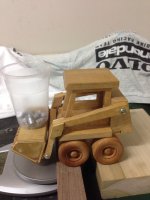
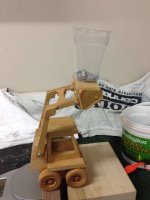
Here is another small scale test this time using a toy skid loader. The geometry of the arms on this loader aren't very good, BUT they still attach behind the rear axle. The weight distribution is also poor, but neither of those should matter for this test.


image-408890420.jpg


Unloaded front axle weight 12.6 oz
Unloaded rear axle weight 9.2 oz
Total machine weight 21.7 oz

Now I loaded the FEL with 5 oz.

Loaded front axle weight 22.6
Loaded rear axle weight 3.8 oz. this is with the arms all the way down.
Loaded rear axle weight with the arms 1/2 way up .3 oz.

I had to raise the arms to this position to get more weight on the rear axle VS the unloaded weight.

image-2117118671.jpg
 
   / You need balast or you will trash your front axle!!!! really? #179  
Of course you can still tip a skidsteer on it's nose. Nowhere did I say that ALL weight is transferred back. I just said, the further back the lift point the more the weight goes to the rear.

I agree ONE of the reasons the pivot point is way back is for lift height but let's assume that's not important.

Let's assume you only need to lift the bucket load, say 6 inches. Let's load a conventionally designed SS bucket with a load that barely allows the rear wheels to stay on the ground when lifted those 6 inches. But they DO stay on the ground. One pound more in the bucket and it would take a nose dive.

Now lets redesign the lift arms and cylinders so the lift cylinders attach just over the front axle and the lift pivot point is just a few inches behind that. Bucket is the same distance from the front axle as before.

With the same load in the bucket, what would happen if you tried lifting the load? Would the front axle have more load on it than before?

Btw, youse guys might all be nuts, but I'm enjoying discussing this with you bunch of cashews.

If you make the changes you state you have a forklift. :)
 
   / You need balast or you will trash your front axle!!!! really? #180  
Here is another small scale test this time using a toy skid loader. The geometry of the arms on this loader aren't very good, BUT they still attach behind the rear axle. The weight distribution is also poor, but neither of those should matter for this test.


View attachment 458428


Unloaded front axle weight 12.6 oz
Unloaded rear axle weight 9.2 oz
Total machine weight 21.7 oz

Now I loaded the FEL with 5 oz.

Loaded front axle weight 22.6
Loaded rear axle weight 3.8 oz. this is with the arms all the way down.
Loaded rear axle weight with the arms 1/2 way up .3 oz.

I had to raise the arms to this position to get more weight on the rear axle VS the unloaded weight.

View attachment 458427

NICE:thumbsup:
 

Tractor & Equipment Auctions

Caterpillar 928G Articulated Wheel Loader (A59228)
Caterpillar 928G...
43023 (A59228)
43023 (A59228)
2020 CATERPILLAR 320 GC EXCAVATOR (A60429)
2020 CATERPILLAR...
2013 Nissan Rouge SUV (A59231)
2013 Nissan Rouge...
JOHN DEERE 4450 TRACTOR (A59823)
JOHN DEERE 4450...
2016 Textron T/A 15 Ton Flatbed Equipment Trailer (A59230)
2016 Textron T/A...
 
Top