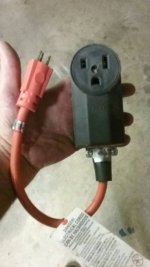
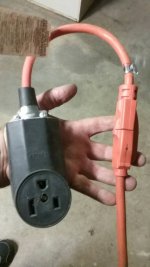
I need to make a 220 volt, 20 foot extension cord/ 3 to four prong converter

/ I need to make a 220 volt, 20 foot extension cord/ 3 to four prong converter #1  

Jstpssng

Epic Contributor
Joined
Aug 7, 2005
Messages
30,211
Location
Maine
Tractor
Kubota L3301
Ok that's not quite accurate, but close enough. I am bringing home an electric soil sterilizer and will be plugging it into a 4 prong dryer outlet. It draws 12 1/2 amps at 240 volts and the electrical rating is 3000 watts. I will be converting from 3 to 4 prong, but that's a pretty straightforward fix... as long as I follow the directions. (Hook 3 wires up the way the old ones were... ground the green to the appliance.) I do need the cord to be longer than a standard dryer cord though so am not sure what size wire to use; 20 feet will allow me to set it up in a trailer or the back of my pickup, and do multiple batches of soil.
My question is, can anyone tell me what wire to use; or send me to a chart which will give me the info I need?

Thank you in advance.
 
/ I need to make a 220 volt, 20 foot extension cord/ 3 to four prong converter #2  
Ok that's not quite accurate, but close enough. I am bringing home an electric soil sterilizer and will be plugging it into a 4 prong dryer outlet. It draws 12 1/2 amps at 240 volts and the electrical rating is 3000 watts. I will be converting from 3 to 4 prong, but that's a pretty straightforward fix... as long as I follow the directions. (Hook 3 wires up the way the old ones were... ground the green to the appliance.) I do need the cord to be longer than a standard dryer cord though so am not sure what size wire to use; 20 feet will allow me to set it up in a trailer or the back of my pickup, and do multiple batches of soil.
My question is, can anyone tell me what wire to use; or send me to a chart which will give me the info I need?

Thank you in advance.

12 amps is "chump Change", 14 ga wire will do. but because you are "outdoors", I would use 12 ga SJO cord.

Now you didn't say if you needed any 110 Volt service at the end of this "stretch". Dryers usually do, heaters usually don't. A four wire conductor is "Two hots, a neutral to return any 110V, and a ground"
So a red, a black, a white and a green. If your heater has no place for a white or neutral, either purchase two counductor SJO cord and tape the white conductor with red at both ends, and make no connection to the neutral. OR Use three conductor wire, (plus ground) but don't make a connection at the plug.

On line sources will detail any plug and cord caps you might want to use. At 12 amps, you have a wide selection.

Take a look! It's not hard. then high step down to your local hardware store and pick up the materials and devices.
 
/ I need to make a 220 volt, 20 foot extension cord/ 3 to four prong converter #3  
Hot to hot, hot to hot, ground to ground, leave the neutral disconnected in the wall end of the extension cord.
Then you can use a 3-wire extension cord rather than a 4-wire extension cord.
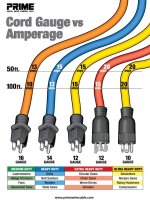
As for wire size, I believe you would want 12 gauge wire for up to 50 feet per this chart from: Cord Gauge vs Amperage - Prime Wire and Cable
cord%20gauge%20amp%20chart%20poster-sm.jpeg

Aaron Z
 
/ I need to make a 220 volt, 20 foot extension cord/ 3 to four prong converter #4  
Remember, #12 wire will burn before it trips the dryer 30A breaker. #12 will burn before the 30A dryer breaker trips on a overload, instead of an instant grounding. I would use #10 wire, 3 wire cord.

Ron
 
/ I need to make a 220 volt, 20 foot extension cord/ 3 to four prong converter #5  
First two replies are good. I just want to be clear, since your first post wasn’t, that the neutral is abandoned in a 2 wire 240v USA circuit. A 3 wire 240v USA circuit would have the neutral.

Your comment about taking the extra wire and grounding it to the machine isn’t technically the correct thing to do.
 
Last edited:
/ I need to make a 220 volt, 20 foot extension cord/ 3 to four prong converter #6  
Remember, #12 wire will burn before it trips the dryer 30A breaker. #12 will burn before the 30A dryer breaker trips on a overload, instead of an instant grounding. I would use #10 wire, 3 wire cord.

Ron

I’m pretty sure it’s against code to use a wire too small for the breaker. If this is a one time deal used in an application where a fire is unlikely I’d probably cut cost and use a smaller wire. If it’s in everyday service use the bigger wire or wire a new circuit.
 
/ I need to make a 220 volt, 20 foot extension cord/ 3 to four prong converter #7  
Hot to hot, hot to hot, ground to ground, leave the neutral disconnected in the wall end of the extension cord.
Then you can use a 3-wire extension cord rather than a 4-wire extension cord.
As for wire size, I believe you would want 12 gauge wire for up to 50 feet per this chart from: Cord Gauge vs Amperage - Prime Wire and Cable
View attachment 566817

Aaron Z

I don’t know where that ridiculous chart came from but usually you’re using dollar tree tools it’s wrong. It’s pretty stupid to make a generalized chart like that anyway. Making a chart based of wire gauge, length, and amp draw would be way better.
 
/ I need to make a 220 volt, 20 foot extension cord/ 3 to four prong converter #8  
Remember, #12 wire will burn before it trips the dryer 30A breaker. #12 will burn before the 30A dryer breaker trips on a overload, instead of an instant grounding. I would use #10 wire, 3 wire cord.

Ron

How much current can a 14 gauge wire carry for .03 seconds without "burning"

The rational of the above comment precludes plugging appliances into wall outlets.

Go figure....
 
/ I need to make a 220 volt, 20 foot extension cord/ 3 to four prong converter #9  
How much current can a 14 gauge wire carry for .03 seconds without "burning"

The rational of the above comment precludes plugging appliances into wall outlets.

Go figure....

Googling how long can 14 gauge carry 40 amps didn’t bring up anything. I’m guessing the load in .3 seconds on a dead short is a lot more than 30 amps.
 
/ I need to make a 220 volt, 20 foot extension cord/ 3 to four prong converter #10  
How much current can a 14 gauge wire carry for .03 seconds without "burning"

The rational of the above comment precludes plugging appliances into wall outlets.

Go figure....

Receptacle circuits and 15A outlets are predicated on that normal plug in devices are rated closer to 15A rather than 20A and there may be more than 1 device plugged in. Devices that require more than 15A have a 20A plug and you need to have a 20A receptacle to receive them. I always use 20A receptacles in my shop or areas where I may need a 20A plug in.

Ron
 
/ I need to make a 220 volt, 20 foot extension cord/ 3 to four prong converter #11  
Receptacle circuits and 15A outlets are predicated on that normal plug in devices are rated closer to 15A rather than 20A and there may be more than 1 device plugged in. Devices that require more than 15A have a 20A plug and you need to have a 20A receptacle to receive them. I always use 20A receptacles in my shop or areas where I may need a 20A plug in.

Ron

Yes, but the OP wants to power his dirt heater. It's a specific application! Wire to the task! Or pay more for internet conservatism. It's the OP's choice.
 
/ I need to make a 220 volt, 20 foot extension cord/ 3 to four prong converter #12  
Yes, but the OP wants to power his dirt heater. It's a specific application! Wire to the task! Or pay more for internet conservatism. It's the OP's choice.

Would you put 5000 pound rope on a 10000 pound winch even though you only planned on pulling 4500 pounds?
 
/ I need to make a 220 volt, 20 foot extension cord/ 3 to four prong converter #13  
Googling how long can 14 gauge carry 40 amps didn’t bring up anything. I’m guessing the load in .3 seconds on a dead short is a lot more than 30 amps.

So you are going to let the internet determine when the insulation will burn through and the fire will start?

You know those lines over head, those bare un insulated wires that carry the power to your house and all those around you. The are not so very large, but they carry thousands of volts and hundreds of amps. and they don't burn through. They are well "ventilated".

The electrical code is based on conductors that will burn through to open any short. That's right, the design is that the conductor will burn through in the event that the "protection" fails.

Size the wire to carry the load, Size the protection to protect the wire. Let the device burn if it will.

The OP may be advised to change the amp rating for the beaker that powers his soil heater.
 
/ I need to make a 220 volt, 20 foot extension cord/ 3 to four prong converter #14  
I didn't read all replies but this is what I made years ago for a Lincoln stick welder.
I rarely use it, but it's 10 gauge 25ft. 120v.
I cut the one plug about a foot from end, wired to a 220v female dryer outlet. The longer end wired to male 220v plug.
Now plugging the 120v ones together I have an 220v extension cord. Reversing I have a 120v one plugging dryer 220s together.
20180815_204324.jpeg20180815_204404.jpeg
 
/ I need to make a 220 volt, 20 foot extension cord/ 3 to four prong converter
  • Thread Starter
#15  
So you are going to let the internet determine when the insulation will burn through and the fire will start?

You know those lines over head, those bare un insulated wires that carry the power to your house and all those around you. The are not so very large, but they carry thousands of volts and hundreds of amps. and they don't burn through. They are well "ventilated".

The electrical code is based on conductors that will burn through to open any short. That's right, the design is that the conductor will burn through in the event that the "protection" fails.

Size the wire to carry the load, Size the protection to protect the wire. Let the device burn if it will.

The OP may be advised to change the amp rating for the beaker that powers his soil heater.

I've read through the responses, and have decided to have a licensed electrician replace the cord with a properly sized wire. The numbers I gave came directly from the specs in the manual, so I am going with what I have provided.

Thanks to everyone for the input.
 
/ I need to make a 220 volt, 20 foot extension cord/ 3 to four prong converter #16  
I知 pretty sure it痴 against code to use a wire too small for the breaker. .......................................

With few exceptions, that is true (when referring to permanent installations). For loads that are temporarily connected via plug and cord, things are different. A cord should be sized for the load. One example of this is the 18 gage cord on a table lamp that plugs into a 15 or 20 amp circuit.
 

Marketplace Items

2016 GENIE S65 TELESCOPIC BOOM LIFT (A60429)
2016 GENIE S65...
(1) 30"X7' ADS DRAIN PIPE (A60432)
(1) 30"X7' ADS...
GRID SHAPED BUCKET FOR MINI EXCAVATOR (A58214)
GRID SHAPED BUCKET...
2018 PRINOTH PANTHER T14R ROTATING CRAWLER DUMPER (A60429)
2018 PRINOTH...
2019 CATERPILLAR 326FL EXCAVATOR (A52709)
2019 CATERPILLAR...
2025 Safety Basket Forklift Attachment (A59228)
2025 Safety Basket...
 
Top