At Home In The Woods

/ At Home In The Woods
  • Thread Starter
#2,321  
Water Heater Question

We are going to put in a gas water heater. The plumber asked us if we want him to use flexible water connections to hook up the heater to the copper house plumbing or if we want him to connect the copper water pipes directly to the water heater.

Does anybody have any thoughts on pros/cons for either approach? I don't have a clue which would be better.

Thanks,
Obed
 
/ At Home In The Woods
  • Thread Starter
#2,322  
Obed,

Place is looking very nice.:thumbsup:

Did the tile work get grouted yet? I was wondering if you could take a picture of that tile design you have (carpet tile) with the grout finished? Please.. No rush

Does anyone know of other names for this type of tile work. I keep trying to find more on google but haven't had any luck.
Gord,
Here's a picture with the grout installed.

attachment.php


Obed
 

Attachments

  • IMG_0562.JPG
    IMG_0562.JPG
    79.7 KB · Views: 954
/ At Home In The Woods #2,323  
Water Heater Question

We are going to put in a gas water heater. The plumber asked us if we want him to use flexible water connections to hook up the heater to the copper house plumbing or if we want him to connect the copper water pipes directly to the water heater.

Does anybody have any thoughts on pros/cons for either approach? I don't have a clue which would be better.

Thanks,
Obed

The flexible lines would be easier to disconnect when you have to replace the water heater in the future. If you're good at sweating copper pipes then it doesn't matter.
 
/ At Home In The Woods #2,324  
Water Heater Question

We are going to put in a gas water heater. The plumber asked us if we want him to use flexible water connections to hook up the heater to the copper house plumbing or if we want him to connect the copper water pipes directly to the water heater.

Does anybody have any thoughts on pros/cons for either approach? I don't have a clue which would be better.

Thanks,
Obed

The flexible lines would be easier to disconnect when you have to replace the water heater in the future. If you're good at sweating copper pipes then it doesn't matter.

I agree with Dishpointer...
If you have the option, use the flexible.. not only would it be easier, but FASTER!!!! if you have to add any 90 deg or 45 deg or more pipe etc, it would be cheaper....

The only thing that I wonder about, is does the flex have any more leak risk?
I doubt it as you are not going to be flexing it on any kind of schedule....

Have you got a whole house water filter?

the sand in from the well, may "eat" a hole...


thoughts?


Jack
 
/ At Home In The Woods
  • Thread Starter
#2,325  
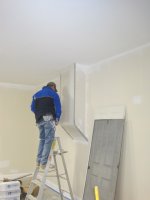
Today the H&A guy came and did some work. He raised the pipe that runs through the wall and will connect to the gas meter for about $150. That was much better than the 6 hours he muttered earlier. He connected the duct work to the kitchen range so we were able to have the drywall guy close in the duct work that is in the garage.

Painting work continued today. All the doors have been taken off the hinges and will be painted while they are not hung in the door frames. All the edges of the doors must be painted in order not void the manufacturer's warrantee. I assume that leaving any of the edges unpainted could all moisture inside the door that could lead to warping.
 

Attachments

  • IMG_0622.JPG
    IMG_0622.JPG
    58.4 KB · Views: 318
  • IMG_0619.JPG
    IMG_0619.JPG
    94.5 KB · Views: 259
  • IMG_0620.JPG
    IMG_0620.JPG
    79.8 KB · Views: 242
  • IMG_0621.JPG
    IMG_0621.JPG
    57.4 KB · Views: 233
/ At Home In The Woods
  • Thread Starter
#2,326  
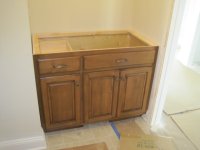
Here's the hall bath vanity. Notice which side the door closest to the toilet has the hinges. Can you figure out why we hinged the door that direction?
 

Attachments

  • IMG_0580.JPG
    IMG_0580.JPG
    76.3 KB · Views: 266
  • IMG_0578.JPG
    IMG_0578.JPG
    93.4 KB · Views: 203
/ At Home In The Woods #2,327  
To put the toilet paper roll holder on the inside of door.

I went to a friends place and didn't see the roll and it was in the cabinet he said it ended up there because the cats would unroll it.
 
/ At Home In The Woods #2,328  
Here's the hall bath vanity. Notice which side the door closest to the toilet has the hinges. Can you figure out why we hinged the door that direction?

It's either for quick access to another roll of TP when the one on the roller has 2 sheets left after your wife didn't change it out or so it wouldn't hit the bathroom door! Looking good Obed.
 
/ At Home In The Woods #2,329  
Water Heater Question

We are going to put in a gas water heater. The plumber asked us if we want him to use flexible water connections to hook up the heater to the copper house plumbing or if we want him to connect the copper water pipes directly to the water heater.

Does anybody have any thoughts on pros/cons for either approach? I don't have a clue which would be better.

Thanks,
Obed
Flexible for sure - much easier for the next water heater. Also I would have him install shut off valves on both legs so you don't have to drain down the system totally to replace the heater. This will be very important if you need to sweat new copper onto the pipes to reach the new water heater connections (nothing's ever the same on these). With valves on both legs, you shut them off, drain the last bit of pipe and go to work. Done in no time without fighting water in the lines. On mine I even put a crossover with a valve above the shutoffs, so all I need to do is shut off the 2 legs, and turn on the crossover valve, and I still have full water supply to the house, although no actual hot water. Makes life a little less annoying while it is down.

Tank water heaters only last 10-12 years, typically, so you will have to do this on an all-too-often basis. But a lot also depends on the water chemistry in your area. I assume you will have a whole house filter and softener since you will be on a well. The filters are critical to extending the life of the tank (removing sediment). They should be the first thing in the house, like right after the pressure tank.
 
/ At Home In The Woods
  • Thread Starter
#2,330  
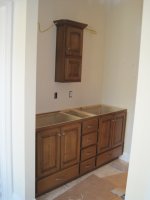
The master bath vanity is taller than the hall bath vanity. These days it is becoming more common for the vanities to be taller than they used to, I guess because people are taller now. We left the hall bath vanity the old standard height to make it easier for children to use. The master bath vanity has drawers at the bottom below the sink areas to maximize space usage.

The doors on the medicine cabinet on the wall above the master bath vanity each hinge different directions so that a person at each sink has easy access to one of the doors. The medicine cabinet sits a little too high on the wall for perfect ease of use. However, lowering the cabinet to just above the outlets makes the cabinet look a bit strange because of the crown moulding. We are trying to decide what to do with that cabinet. We took off the crown moulding and that made the medicine cabinet look too plain according to my wife. She has e-mailed the cabinet maker to see if there is a different type of trim that can be put at the top that is not as elaborate as the crown moulding.

One of the wires for the light above the far sink will need to be moved because it is not centered above the sink.
 

Attachments

  • IMG_0579.JPG
    IMG_0579.JPG
    60.4 KB · Views: 244
/ At Home In The Woods #2,331  
Gord,
Here's a picture with the grout installed.

attachment.php


Obed

Thanks Obed. I love the look.
I'm also looking at some kind of border pattern in hardwood for the new house. Nothing to fancy just a color change in one board.

Thanks again
Gord
 
/ At Home In The Woods
  • Thread Starter
#2,332  
Flexible for sure - much easier for the next water heater. Also I would have him install shut off valves on both legs so you don't have to drain down the system totally to replace the heater. This will be very important if you need to sweat new copper onto the pipes to reach the new water heater connections (nothing's ever the same on these). With valves on both legs, you shut them off, drain the last bit of pipe and go to work. Done in no time without fighting water in the lines. On mine I even put a crossover with a valve above the shutoffs, so all I need to do is shut off the 2 legs, and turn on the crossover valve, and I still have full water supply to the house, although no actual hot water. Makes life a little less annoying while it is down.

Tank water heaters only last 10-12 years, typically, so you will have to do this on an all-too-often basis. But a lot also depends on the water chemistry in your area. I assume you will have a whole house filter and softener since you will be on a well. The filters are critical to extending the life of the tank (removing sediment). They should be the first thing in the house, like right after the pressure tank.
Dave,
Thanks for the input. Having a shutoff valve on the hot water side makes a lot of sense.

We'll ask the plumber to put in a filter like you suggested. We don't plan on having a water softener. We've been in the camper with this water for a year and haven't noticed any issues with the quality of the untreated water. And being able to have water without added chemicals is a big reason we went to the expense of drilling a well instead of hooking up to city water at the street.

Obed

Obed
 
/ At Home In The Woods
  • Thread Starter
#2,333  
Thanks Obed. I love the look.
I'm also looking at some kind of border pattern in hardwood for the new house. Nothing to fancy just a color change in one board.

Thanks again
Gord
My granddad put a hardwood border in the living room in his house when he built it 60 or 70 years ago. It looked very nice. He used two or three narrow rows of walnut and cherry running around the outside of the room about 9 inches from the walls. My dad still has some of the extra walnut and cherry lumber that never got used. We are considering using that walnut and cherry lumber in our fireplace mantel because there is a story behind it.

Obed
 
/ At Home In The Woods #2,334  
We don't plan on having a water softener. We've been in the camper with this water for a year and haven't noticed any issues with the quality of the untreated water. And being able to have water without added chemicals is a big reason we went to the expense of drilling a well instead of hooking up to city water at the street.

Just a bit of info in case you don't understand what water softeners do. They don't do any sort of real "chemical treatment" to the water. It is just a simple ion exchange. Hard water is a problem because of the dissolved salts - mainly the +2 valence metals like calcium, magnesium, etc. Those are the ones that interfere with the action of detergents (soaps don't lather well) and precipitate out leaving hard water deposits. What a softener does is exchange "bad" salts for good salts. The +1 valence metals are far more friendly in water, so they exchange plain old NaCl (table salt) for the "bad stuff". No chemical treatments or anything nasty, just one salt for another.

You don't need to put one in, but it is wise to leave space to do it, if you find your water is hard down the road. Now since you have been living with this well for a year, perhaps you already know the answer to this, as you say.

As for the whole house filter - it is CRITICAL on a well, IMHO. You will pull in a lot of sediment, at least in the experience of people I know around here with wells. That will chew up valves and stuff like washing machines. Get one that has a clear housing so you can see what is going on. A lot of times they put in 2 of them in series - a coarse initial "rock catcher" and then a fine one after that. Water softener would go after the filters, if you do that.
 
/ At Home In The Woods
  • Thread Starter
#2,335  
Here's the cabinet in the laundry room. It will hold the laundry sink. This is the only cabinet in the laundry room. We went the minimalist route for cabinets in the laundry room. We'll put some shelves up and a rack for hanging clothes sometime after we get settled in the house.
 

Attachments

  • IMG_0577.JPG
    IMG_0577.JPG
    69 KB · Views: 200
/ At Home In The Woods #2,336  
Water Heater Question

We are going to put in a gas water heater. The plumber asked us if we want him to use flexible water connections to hook up the heater to the copper house plumbing or if we want him to connect the copper water pipes directly to the water heater.

Does anybody have any thoughts on pros/cons for either approach? I don't have a clue which would be better.

Thanks,
Obed

Flex lines(copper type) for sure in my opinion.I have used them for 20 years or more and they are dependable and leak free. They also act as a union if you need to swap out the tank.
 
/ At Home In The Woods #2,337  
Here's the hall bath vanity. Notice which side the door closest to the toilet has the hinges. Can you figure out why we hinged the door that direction?

If you need a spare roll, sure is easier to get out of the cabinet. Or maybe the door to the bathroom would hit it if the cabinet door was on the other side?
 
/ At Home In The Woods #2,338  
In our neck of the woods, our local code requires, flexible piping to the tank. A hot water tank expansion tank. A water heater pan beneath, and earthquake strapping to the wall studs behind. :thumbsup:
 
/ At Home In The Woods #2,339  
Expansion tanks are often required with city water connections as they require backflow preventers to stop you from contaminating the whole system in the event of an oddball accident. Those stop any water from pushing back into the city lines, so as the water in the closed system expands from heating, it has nowhere to go and can over pressurize the system. On a well, you typically have a pressure tank for the pump that acts as an expansion tank also (at least functionally enough so). A pan is a darn good idea if the HW heater is not in a basement area, but the preferred method here is in the basement with a floor drain nearby.

Not too many seismic codes in other parts of the country to worry about...
 
/ At Home In The Woods #2,340  
dstig1 is right on the money with both posts.

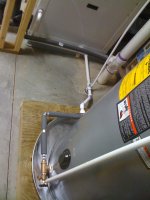
Our plumber (who I was not impressed with) used a flexible type of pipe on the hot water heater, here's a really bad cell phone picture of that. We are on city water, so we have the expansion tanks which you don't need since you are one well water and have the expansion tanks role done by your pressure vessel.

I put our water heater in a pan. I have gravity drains for the basement floor (in case of flooding from broken pipes) and run the condensate from the heat pump, the drain for the cold water line for the house (on a valve), and the drain from the pan with the hot water heater into it. Note that if you put the hot water heater in a pan now, even if you can't drain it you can someday put a water sensor in the pan and tie it into your automation system so you get an alert if there are problems.

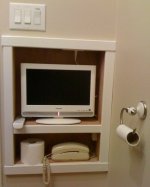
Good deal on the toilet paper access. Here's what I did on the downstairs half bath to hold the toilet paper and then some. This is what you face when you're on the throne. When our nephew goes in to use the facilities, we often don't see him again until the hour or half-hour :laughing:.

We only have "cat unraveling syndrome" if we put the paper on the spool the wrong way...

Pete
 

Attachments

  • hot_water_heater.jpg
    hot_water_heater.jpg
    226.1 KB · Views: 290
  • half_bath_storage.jpg
    half_bath_storage.jpg
    132.7 KB · Views: 282
  • water_heater_base.jpg
    water_heater_base.jpg
    273.2 KB · Views: 275

Marketplace Items

2009 CATERPILLAR AP1000D ASPHALT PAVER (A60429)
2009 CATERPILLAR...
2013 FREIGHTLINER CASCADIA (A55745)
2013 FREIGHTLINER...
2007 CHEVROLET 3500 DUALLY 4X4 DIESEL TRUCK (A59575)
2007 CHEVROLET...
405 (A52706)
405 (A52706)
2017 John Deere 5090GN (A53317)
2017 John Deere...
2017 Ford F-550 Service Truck (A59230)
2017 Ford F-550...
 
Top