Hilbilly
Veteran Member
The first one is more of a snow moving video.


Not sure why you said the video shows what happens when the snow is too deep for an inverted blower, since it worked very well. If you're referring to the time I stop, that was only to redirect the chute so I didn't blow snow all over the camera.Nice videos !
Yes the second video does a very good job of showing what happens when the snow is to deep for an inverted blower , that’s why I chose a regular blower that I have to blow going in reverse, if the snow is deep all I have to do is slow down and its very easy to control speed with a HST transmission , no worries about possibly getting stuck


Exactly.Nice videos !
Yes the second video does a very good job of showing what happens when the snow is to deep for an inverted blower , that’s why I chose a regular blower that I have to blow going in reverse, if the snow is deep all I have to do is slow down and its very easy to control speed with a HST transmission , no worries about possibly getting stuck
Well the first time watching it I thought the tractor wheels were spinning because of the deep snow but after watching it again I see I was wrong.Not sure why you said the video shows what happens when the snow is too deep for an inverted blower, since it worked very well. If you're referring to the time I stop, that was only to redirect the chute so I didn't blow snow all over the camera.
However to be fair, I was not blowing full depth snow. It was previously blown. I wait until there is a decent amount of snow (12" or less) before I blow that path so I can get around there with my side by side, to bring firewood to the basement. In heavy wet snow I would do it sooner.
I also have a rear facing blower that I used for 12 years. I still have it but I MUCH prefer driving forwards. Inverted blowers have their limitations but if they are suited to the conditions you experience, then they are definitely easier on the neck. I would only mount the rear facing blower, now, if there was no way I could complete the task with the inverted. One of the big drawbacks of the inverted blowers is their cost and for most people only moving short distances in reverse, looking over your shoulder for a short time is not a big deal. Do it for several hours at a time and you may reconsider, especially if you have an old neck attached to an old body, lol.
 www.thefreedictionary.com
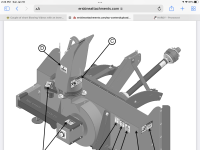
Because the input driveshaft is connected to the opposite side of the fan and the pto still turns in the same direction.Why would the fan need to turn opposite of a conventional rear mount blower?
I still have a Meteor rear push and now the Farm King inverted. The Meteor is definitely heavier construction on everything except for the 3PTH mount. The 3PTH mount is more than adequate, since it has stood the test of time. However it seems that Farm King put all the strength in to the mount rather than the rest of the blower. So far the Farm King has performed well, after getting a replacement for the first defective one. However I am sure I will end up having to beef up, reinforce or replace some parts on the FK before I am finished with it. I've already got a couple of small dents in the fan blade that would not have affected the Meteor because of the heavier construction on it. Still happy with the FK though, since I get to drive forward and it has completed each task I have asked of it, even blowing soaking wet sloppy snow.You're both right. If they didn't change the configuration or a rear push housing, and simply reversed it, then the fan would be running in reverse. However there are some other structural differences needed for a rear pull, so making a mirror image of the fan housing is no big deal.
I had a Meteor rear push, and now Meteor rear pull. The rear pull is a bit more robustly constructed, and the fan is deeper. I think sales volumes are the primary driver of the higher cost. I do think that if dealers stocked them and let people demo them, they would sell more, but they are creatures of habit.
Looks to me as if despite the Erskine's convoluted drive the fan still turns clockwise when viewed from behind the tractor looking forward and the discharge is to the left of the fan. Snow enters the fan from the front rather than the rear.Because the input driveshaft is connected to the opposite side of the fan and the pto still turns in the same direction.
I get all that. The discharge could also be moved to whatever side of the fan made sense from a driveline perspective when reversing the rotation of the fan would add complexity and cost.I edited my response to show I was referencing orientation in relation to the center line as you are looking at the business side of the snowblower.
If you tried to convert a push snowblower to a pull snowblower simply by rotating it 180 degrees and somehow connecting the PTO to the blower fan, it would run in the wrong direction, and the discharge chute would now be on the right side of the blower as determined by standing behind the tractor and looking forward. Again, this is not a design challenge for the manufacturer.