Well, I got around to putting the scale under the auger with the weights on and got 800# which is what I had originally calculated that it would be. It was too hot and I was too tired to take the weights off and measure without them today but I expect it to be around 200# or so. I will try to get this done on Thursday. The second Wednesday of each month I meet up with a crew of IBM retirees for BBQ in Elgin, TX so tomorrow in not a work day for me. I am picking up a Belltec Puff drill and toothbar for my loader bucket tomorrow on the way to Elgin.
You are using an out of date browser. It may not display this or other websites correctly.
You should upgrade or use an alternative browser.
You should upgrade or use an alternative browser.
Digging post holes
- Thread starter centex
- Start date
- Views: 28057
More options
Who Replied?
/ Digging post holes
#61

knucklehead
Platinum Member
I'd be interested in what the unweighted rig weighs at the auger. If it's 200#, as Don says, then there's 600# being applied by the 336# weights at the auger. 600/336=1.8, and if his top link is 15" long, or 1.25', then L1 = 11.25', and L2 = 6.25', and L1/L2 = 1.8.
Hopefully the numbers will balance out, and help show things more clearly. I'm fully prepared to argue for a localized change in gravity between Tuesday and Thursday, if they don't.
By the way, nice notcher pictures, guys.
Hopefully the numbers will balance out, and help show things more clearly. I'm fully prepared to argue for a localized change in gravity between Tuesday and Thursday, if they don't.
By the way, nice notcher pictures, guys.
I got around to measuring the unweighted rig today. It was 200# as I expected. I measured the lever arms on the tractor also. The long arm from the top link pivot point where the boom is attached is 117.5" and the distance from the top link pivot pin to the pivot pin on the PHD gear box is 64" so the ratio of these two arms is 1.83. The ratio of the weight added to the auger to the weights added to the boom is 1.78. I attribute the discrepancy in the ratios to the accuracy of the the weight measurements. My scale uses a 2.5" 1500# pressure gauge that is divided into 50# increments on the scale and I don't know it's accuracy but it is no better than 10%.
knucklehead
Platinum Member
Don
Just for the fun of it, how long is the top link? This may end up as one of those "close enough" deals, but if you want to know, then let's find out.
Just for the fun of it, how long is the top link? This may end up as one of those "close enough" deals, but if you want to know, then let's find out.
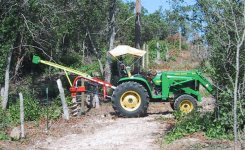
knucklehead, I am not sure what you mean by "how long is the top link?". The boom of the auger is attached to the bracket at the back of the tractor where the top link attaches so the top link is not being used. I have attached a picture of the unit in operation. The boom extention is painted yellow in this picture.
The key thing here is that the unit is working away digging a hole in this picture and I am just standing around taking pictures. Before I bought this auger and built the boom extention, I would have been standing there at the side of the hole beating on rocks with a bar and breathing diesel fumes while the tractor idled away waiting to clear out the rock chips that I made with the bar. Now I just start the machine and it does all the work. It is slow to be sure. It took over an hour to finish the hole in the picture to a depth of 4'. If I were doing it the old way I would have ended up with a post like the old one in the foreground of the picture. When they put these posts in they dug down as far as they could which was maybe a foot or so and then wired a large rock to the post to keep it in the ground. My posts are not going anywhere. Rhino sells a hydraulic down pressure kit for their largest auger for $300. My digger has the same boom as the larger one but if I bought it I would have voided the warranty on the gear box and besides I can appliy more weight with this setup and it only cost me about $20 for the scrap metal. I already had the weights. Everyone around here (the local dealers and the auger manufacturer)told me this auger would not work with a 3PT PDH but they were wrong. In fact they told me I would have to spend a minimum of $2000 for a hydraulic PHD to be able to use the auger.
The key thing here is that the unit is working away digging a hole in this picture and I am just standing around taking pictures. Before I bought this auger and built the boom extention, I would have been standing there at the side of the hole beating on rocks with a bar and breathing diesel fumes while the tractor idled away waiting to clear out the rock chips that I made with the bar. Now I just start the machine and it does all the work. It is slow to be sure. It took over an hour to finish the hole in the picture to a depth of 4'. If I were doing it the old way I would have ended up with a post like the old one in the foreground of the picture. When they put these posts in they dug down as far as they could which was maybe a foot or so and then wired a large rock to the post to keep it in the ground. My posts are not going anywhere. Rhino sells a hydraulic down pressure kit for their largest auger for $300. My digger has the same boom as the larger one but if I bought it I would have voided the warranty on the gear box and besides I can appliy more weight with this setup and it only cost me about $20 for the scrap metal. I already had the weights. Everyone around here (the local dealers and the auger manufacturer)told me this auger would not work with a 3PT PDH but they were wrong. In fact they told me I would have to spend a minimum of $2000 for a hydraulic PHD to be able to use the auger.
Attachments
knucklehead
Platinum Member
Centex, you're right to start that post with "knucklehead" for more than one reason /w3tcompact/icons/smile.gif. Not having a tractor (actually, I bought a '79 Ford 1710 today), I did not know that the PHD's pin directly to the top link bracket on the tractor. The person I bought the tractor from had a PHD, and I saw it, but it did not register that there was no need for a top link.
In looking at your picture with my highly accurate, adjustable eyelash calipers, it seems that if you measured right along the ground, or up level with the PHD top connection to the tractor (where the top link would be), that you would get a slightly shorter length from the PHD to the end of the weight bracket than from the PHD back to the tractor. That's the way to simplify the force diagram; because we are talking about forces in relation to gravity (weights are tending to drop straight down), and lever arms are measured perpendicular to the force (so horizontally in the case, and not along the bracket/PHD). It seems we are coming to the same thing from two directions. I was keeping this discussion going because I don't think measuring from the bottom lift ends (where the PHD attaches at the bottom) is accurate, and would make you think the pressure was greater than it really was, if you only calculated it. As I said, this is really a case of close enough, but a while back we started getting interested in the "math n' science" of it, so I thought I'd toss in my two cents.
The real thing I'm interested in is how is the earth you can stand what must be one hellacious racket while that bit chews through the rock. I'd also be interested in if you guys had any experience or thoughts about running that bit wet; whether it would aid or hinder cutting.
In looking at your picture with my highly accurate, adjustable eyelash calipers, it seems that if you measured right along the ground, or up level with the PHD top connection to the tractor (where the top link would be), that you would get a slightly shorter length from the PHD to the end of the weight bracket than from the PHD back to the tractor. That's the way to simplify the force diagram; because we are talking about forces in relation to gravity (weights are tending to drop straight down), and lever arms are measured perpendicular to the force (so horizontally in the case, and not along the bracket/PHD). It seems we are coming to the same thing from two directions. I was keeping this discussion going because I don't think measuring from the bottom lift ends (where the PHD attaches at the bottom) is accurate, and would make you think the pressure was greater than it really was, if you only calculated it. As I said, this is really a case of close enough, but a while back we started getting interested in the "math n' science" of it, so I thought I'd toss in my two cents.
The real thing I'm interested in is how is the earth you can stand what must be one hellacious racket while that bit chews through the rock. I'd also be interested in if you guys had any experience or thoughts about running that bit wet; whether it would aid or hinder cutting.
wroughtn_harv
Super Member
Don,
Are you using any water? Sometimes a little, not a lot helps in the limestone.
What I'm trying to do here in my own mind is figure out how to take the information you've provided and apply it to my situation.
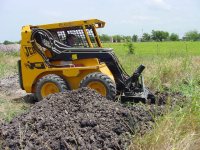
This picture is of Iris gettin' after it. After it is sometimes harder to get than others.
Are you using any water? Sometimes a little, not a lot helps in the limestone.
What I'm trying to do here in my own mind is figure out how to take the information you've provided and apply it to my situation.
This picture is of Iris gettin' after it. After it is sometimes harder to get than others.
Attachments
wroughtn_harv
Super Member
wroughtn_harv
Super Member
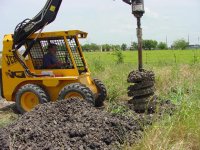
After It was in the bottom of a hole eight feet deep and two feet across.
But that was in regular old black clay, nothing special, just ugly dirt that that's harder than a bad girl's heart when it's dry and like roofing tar when it's wet.
What I'm thinking about now is how and where to attach some weight for those days when I need to fulfill the engineer's request for two feet into rock.
I can't run a boom like you have because the angle of the dangle changes with the position of the boom on Iris. She swings in an arc where the auger motor is closer at the top of her reach.
Yeah, to keep the hole straight I have to move in and out with Iris as I'm going up or down.
She (Iris is a girl, I checked) will only pick up about fifteen hundred pounds. So if I have two hundred and fifty pounds of auger motor and auger and a block of steel for weight of say six hundred that means I could only get it out a little bit from the front of the tractor before I'd have the auger stuck when you add the weight of the tailings from the hole.
So what I'm thinking about is how to have a weight of about four hundred pounds that I could rotate hydraulically (sp). That way I could have it between the tractor and the auger and it would only weigh four hundred, maybe a tad less. Then when I need the down force I could rotate it where it would hang out beyond the auger say four feet which would give me about twelve hundred pounds of down pressure since the auger point is only about thirty inches from the front tires.
Of course if I built the weight right I could have it supplying ballast on the back of the tractor when it's rotated back to rest position which would give me more lifting capability............the thicken plots..........
But that was in regular old black clay, nothing special, just ugly dirt that that's harder than a bad girl's heart when it's dry and like roofing tar when it's wet.
What I'm thinking about now is how and where to attach some weight for those days when I need to fulfill the engineer's request for two feet into rock.
I can't run a boom like you have because the angle of the dangle changes with the position of the boom on Iris. She swings in an arc where the auger motor is closer at the top of her reach.
Yeah, to keep the hole straight I have to move in and out with Iris as I'm going up or down.
She (Iris is a girl, I checked) will only pick up about fifteen hundred pounds. So if I have two hundred and fifty pounds of auger motor and auger and a block of steel for weight of say six hundred that means I could only get it out a little bit from the front of the tractor before I'd have the auger stuck when you add the weight of the tailings from the hole.
So what I'm thinking about is how to have a weight of about four hundred pounds that I could rotate hydraulically (sp). That way I could have it between the tractor and the auger and it would only weigh four hundred, maybe a tad less. Then when I need the down force I could rotate it where it would hang out beyond the auger say four feet which would give me about twelve hundred pounds of down pressure since the auger point is only about thirty inches from the front tires.
Of course if I built the weight right I could have it supplying ballast on the back of the tractor when it's rotated back to rest position which would give me more lifting capability............the thicken plots..........
Mark, sorry about the "knucklehead". I did not mean it that way. I measured the straight line distances from the top link pin to the pivot pin on the PHD gear box and from the top link pin to the center of the weights. I assume the lift pins play no part in this because when the PHD is in use digging the lift is not used except to pick the PHD up when the hole is finished. I don't claim that the weight measurements are very accurate because the scale I am using is very small and uses a 1 sq inch piston to create a reading on a pressure gauge. That way 1 pound on the scale equates to 1 a 1 psi reading on a pressure guage. It is very hard or I should say impossible for me to get the auger exactly centered on the scale and exactly perpendicular to the ground and if either of these conditions is not met then the reading will be off some. Also the granularity of the the guage readings is not small either.
The noise is horific especially if I keep the hole cleaned out. I did that on the first few holes I dug with the auger but now I don't do that as much and the noise is muffled some but it is still enough to be damaging to one's ears so I wear ear plugs and get off the tractor and stand back aways so the noise is not so loud. I put something between the interlock switch and the seat so the PTO still operates.
I don't think water would help with this bit since I am drilling solid rock. The bit just grinds the rock into a powder. It is so fine that it is sometimes hard to get out of the hole. I pick a load up with a manual PHD and it just falls out when I lift it. As suggested by Harv, I sometimes put a little water in the hole to help with this. The bits on the auger are bullet shaped carbide and they are supposed to rotate in their sockets sockets so that they wear evenly. I would be afraid that water would create a grinding paste that would get into the sockets and grind them away so that the bits would not stay in. The dealer told me I should put oil in the sockets periodically so that they stay free to rotate but I have not done so for the same reason. I check that they are free to rotate every time I remove the auger from a hole.
The noise is horific especially if I keep the hole cleaned out. I did that on the first few holes I dug with the auger but now I don't do that as much and the noise is muffled some but it is still enough to be damaging to one's ears so I wear ear plugs and get off the tractor and stand back aways so the noise is not so loud. I put something between the interlock switch and the seat so the PTO still operates.
I don't think water would help with this bit since I am drilling solid rock. The bit just grinds the rock into a powder. It is so fine that it is sometimes hard to get out of the hole. I pick a load up with a manual PHD and it just falls out when I lift it. As suggested by Harv, I sometimes put a little water in the hole to help with this. The bits on the auger are bullet shaped carbide and they are supposed to rotate in their sockets sockets so that they wear evenly. I would be afraid that water would create a grinding paste that would get into the sockets and grind them away so that the bits would not stay in. The dealer told me I should put oil in the sockets periodically so that they stay free to rotate but I have not done so for the same reason. I check that they are free to rotate every time I remove the auger from a hole.
Harv,
I am not using water for the reason I mentioned in another post today but maybe I will try it if I get a difficult hole. Mainly, I am satisfied with the way it is working now.
It looks like Iris is what I really needed. It seems that you should be able to apply a lot of down pressure with this setup.
I assume that when you say the machine will only lift 1500# that that it can also apply the same down force. I think if you tried to do something like I did with this machine that you would end up lifting the back of the machine if you put a whole lot of weight out past the auger. If you get the weight out very far you will have a lever tring to lift the rear of the machine. It looks like it was designed to transfer the weight on the loader to the front wheels and allow the overall weight of the machine to be relatively low. I think that would limit how much additional down force you could provide.
I am not using water for the reason I mentioned in another post today but maybe I will try it if I get a difficult hole. Mainly, I am satisfied with the way it is working now.
It looks like Iris is what I really needed. It seems that you should be able to apply a lot of down pressure with this setup.
I assume that when you say the machine will only lift 1500# that that it can also apply the same down force. I think if you tried to do something like I did with this machine that you would end up lifting the back of the machine if you put a whole lot of weight out past the auger. If you get the weight out very far you will have a lever tring to lift the rear of the machine. It looks like it was designed to transfer the weight on the loader to the front wheels and allow the overall weight of the machine to be relatively low. I think that would limit how much additional down force you could provide.
micromike
Silver Member
Just curious. I'm wondering approximately what RPM your PHD is running while digging rock. Is it significantly slower than digging dirt and also different from digging dirt with rocks. TIA.
Mike
Mike
I'm wondering approximately what RPM your PHD is running while digging
rock. Is it significantly slower than digging dirt and also different from digging dirt with
rocks.
I run the PTO at about 240 rpm in rock. I did not measure the actual auger rpm but it looks like about maybe 48 rpm at this PTO speed. This is faster than I run it in dirt but not much. For my PHD the manufacturer says that the unit should not be run faster than 300 rpm (PTO rpm). The hardest thing to handle is dirt with rocks because of the shock loads.
rock. Is it significantly slower than digging dirt and also different from digging dirt with
rocks.
I run the PTO at about 240 rpm in rock. I did not measure the actual auger rpm but it looks like about maybe 48 rpm at this PTO speed. This is faster than I run it in dirt but not much. For my PHD the manufacturer says that the unit should not be run faster than 300 rpm (PTO rpm). The hardest thing to handle is dirt with rocks because of the shock loads.
wroughtn_harv
Super Member
<font color=blue>It seems that you should be able to apply a lot of down pressure with this setup.</font color=blue>
Actually Don you can't. Skid steers are designed for lifting. So they have a lot of weight on the back end to give them that ability.
They ain't worth squat for pushing down.
That's why I'm so interested in the way you're applying weight to your auger.
With the short wheelbase they can be exciting to operate. When I first got it I had a load of galvanized square tubing delivered to the yard. The load was on top of a load of chainlink materials for some other company.
I couldn't lift the bundle up because I was at my max lift. But I was able to tilt it back which allowed me to pick up the bundle and spin the tractor around so very carefully. I started the boom down. It was about six feet off the ground when I stopped, gently. But not gently enough as the boom operates in an arc. That height I stopped was at the furtherest point from the tractor. And the action of stopping was just enough of an enertia boost to overload the the tip over capacity of the tractor.
She did a nose dive. I froze. When the angle was right the load came off the forks. We went backwards. Then forwards. Then backwards. About then it got to be fun. But it still took awhile for the heart to find it's proper place in my chest cavity.
I've seen where others have put arms that go out from the back of the machine to put more weight on the front of the machine when it lifts up when applying down pressure. That looks great. But like I said my boom operates in an arc. So not only do I have to deal with additional hydraulics to operate the rear arms I have to coordinate that with the back and forth movement of the tractor as I go in and out of the hole.
There are skid steers that operate in a straight up and down motion. But they don't have the side door like the JCB has. I want the side door. I like being able to get in and out of the machine comfortably.
So right now I'm leaning towards using leverage to increase my down pressure.
Actually Don you can't. Skid steers are designed for lifting. So they have a lot of weight on the back end to give them that ability.
They ain't worth squat for pushing down.
That's why I'm so interested in the way you're applying weight to your auger.
With the short wheelbase they can be exciting to operate. When I first got it I had a load of galvanized square tubing delivered to the yard. The load was on top of a load of chainlink materials for some other company.
I couldn't lift the bundle up because I was at my max lift. But I was able to tilt it back which allowed me to pick up the bundle and spin the tractor around so very carefully. I started the boom down. It was about six feet off the ground when I stopped, gently. But not gently enough as the boom operates in an arc. That height I stopped was at the furtherest point from the tractor. And the action of stopping was just enough of an enertia boost to overload the the tip over capacity of the tractor.
She did a nose dive. I froze. When the angle was right the load came off the forks. We went backwards. Then forwards. Then backwards. About then it got to be fun. But it still took awhile for the heart to find it's proper place in my chest cavity.
I've seen where others have put arms that go out from the back of the machine to put more weight on the front of the machine when it lifts up when applying down pressure. That looks great. But like I said my boom operates in an arc. So not only do I have to deal with additional hydraulics to operate the rear arms I have to coordinate that with the back and forth movement of the tractor as I go in and out of the hole.
There are skid steers that operate in a straight up and down motion. But they don't have the side door like the JCB has. I want the side door. I like being able to get in and out of the machine comfortably.
So right now I'm leaning towards using leverage to increase my down pressure.
knucklehead
Platinum Member
Don! No offense taken! I was just being "humble". I should have put one of those smileys in there, when I said that. I've had a great experience here at TBN, and not encountered anything but good natured ribbing between other, more seasoned veterans. I know you were just addressing me by "name" , and I was jabbing myself. Thanks for being concerned, it just fortifies my opinion of the kind of people here, especially you.
Something I should have said before is that having the top of the PHD frame mounted directly in the tractor's top link bracket should make it easier to visualize the axle as the fulcrum, but maybe we're not interested in that anymore /w3tcompact/icons/grin.gif, and I should stop beating that horse /w3tcompact/icons/tongue.gif.
Why I am sticking to this thread so closely is that I am interested in the PHD's, and I know I'm gonna get into rocks sooner or later. Most of ours are granite & other type fragments (glacial till, as the smart guys say), and I am going to be into the old breaker bar routine. I could not imagine laying out a series of holes for a pole barn and having them all fall in some sort of regular order with rocks laying there waiting to mess with my nicely planned grid. I have wondered if the PHD could twist them out, or if it would be a sort of cat n' mouse game, where I'd have to set over, set over, set over, etc.. I couldn't imagine anyone building a straight fence line in this area w/o a lot of hand work, until I started reading your thread.
You guys seem to have mountains of knowledge about PHD's so I haven't even searched for info on them elsewhere, yet. Maybe you'll want to suggest I do, but I am wondering about how they handle smaller rocks, such as softball to basketball size. I assume the bit will tend to slide around them and auger them to the surface, if the hole allows wiggle rooom. This is probably one of those deals where a little experience would answer all of my questions, but I'm wondering whether to gamble on the few hundred it would cost for a PHD. I don't actually think I'd be into the high dollar bits up front, so I guess I'm more interested in info on operation of a medium duty unit with around a 6-8" auger. I also would like to take a crack at building or modifying an auger.
I know you guys are into the rock stuff in this thread, but I hope you don't mind a few new-guy questions.
Something I should have said before is that having the top of the PHD frame mounted directly in the tractor's top link bracket should make it easier to visualize the axle as the fulcrum, but maybe we're not interested in that anymore /w3tcompact/icons/grin.gif, and I should stop beating that horse /w3tcompact/icons/tongue.gif.
Why I am sticking to this thread so closely is that I am interested in the PHD's, and I know I'm gonna get into rocks sooner or later. Most of ours are granite & other type fragments (glacial till, as the smart guys say), and I am going to be into the old breaker bar routine. I could not imagine laying out a series of holes for a pole barn and having them all fall in some sort of regular order with rocks laying there waiting to mess with my nicely planned grid. I have wondered if the PHD could twist them out, or if it would be a sort of cat n' mouse game, where I'd have to set over, set over, set over, etc.. I couldn't imagine anyone building a straight fence line in this area w/o a lot of hand work, until I started reading your thread.
You guys seem to have mountains of knowledge about PHD's so I haven't even searched for info on them elsewhere, yet. Maybe you'll want to suggest I do, but I am wondering about how they handle smaller rocks, such as softball to basketball size. I assume the bit will tend to slide around them and auger them to the surface, if the hole allows wiggle rooom. This is probably one of those deals where a little experience would answer all of my questions, but I'm wondering whether to gamble on the few hundred it would cost for a PHD. I don't actually think I'd be into the high dollar bits up front, so I guess I'm more interested in info on operation of a medium duty unit with around a 6-8" auger. I also would like to take a crack at building or modifying an auger.
I know you guys are into the rock stuff in this thread, but I hope you don't mind a few new-guy questions.
bgott
Veteran Member
Try mounting a hydraulic cylinder on the rear pointing down and putting a foot on it. Better yet, put a reciever on each corner facing to the rear and mount a couple of two or three foot hydraulically operated pads like on a backhoe. Not only would that keep you from tipping over backwards but you could use them to give you a little extra oomph going downhole. Clear as mud? 
Good morning Harv,
This is the third time I have tried to respond to you. Windows has crashed both times before so I am stating over. Maybe it is good because my responses keep getting shorted and more concise each time.
You will be limited in how much you can extend the boom and how much weight you can add by the weight of the rear end. This limitation will occur when the auger is raised off the ground. In this case the boom extention will act like a pry bar trying to raise the rear with the front wheels as a fulcrum.
When you apply down pressure with your set up what you are doing is transfering the weight of the front of the tractor to the boom. You can think of this a hydraulic cylinder from the boom to the front wheels trying to lift them. What you really need is to add more weight to the front of the machine and let the hydraulics take care of transfering this extra weight to the boom. I would look at your earlier suggestion to me and build a platform out in front of the machine attached on which you could add weight. You might need to put castor wheels under the platform. This is much better than having a lot of weight up in the air like I do. I did not talk much about the problems with my setup but there are some. When the boom is raised I cannot add or remove weights so I have either do this while the auger is still in the last hole or remove the auger so I can lower the boom. I have to avoid trees and other obstructions and when the boom is raised I have a lot of weight way up in the air so there are some safety concerns.
The other thing you ought to consider is building yourself something similar to Belltec's TM48 tractor drilling attachment. You would have something that would solve your problems and also bring a lot of other advantages like being able to replace a post without taking down a fence and it would not have the problem of something sticking way out in front of the PHD to hit trees or other obstructions. One could build a similar machine for a whole lot less than Belltec asks for theirs. If you made this attach to your skid steer you could transfer as much as the entire weight of your tractor to the auger. If I had to dig holes for the long run that is what I would do. It would just take some scrap channel iron and hydraulic cylinders allong with you hydraulic PHD unit. You would need to come up with a way to mount the PHD rigidly if you wanted to take advantage of the designs ability to guarantee holes that are perpendicular to the ground.
Well this did not end up short and concise after all.
This is the third time I have tried to respond to you. Windows has crashed both times before so I am stating over. Maybe it is good because my responses keep getting shorted and more concise each time.
You will be limited in how much you can extend the boom and how much weight you can add by the weight of the rear end. This limitation will occur when the auger is raised off the ground. In this case the boom extention will act like a pry bar trying to raise the rear with the front wheels as a fulcrum.
When you apply down pressure with your set up what you are doing is transfering the weight of the front of the tractor to the boom. You can think of this a hydraulic cylinder from the boom to the front wheels trying to lift them. What you really need is to add more weight to the front of the machine and let the hydraulics take care of transfering this extra weight to the boom. I would look at your earlier suggestion to me and build a platform out in front of the machine attached on which you could add weight. You might need to put castor wheels under the platform. This is much better than having a lot of weight up in the air like I do. I did not talk much about the problems with my setup but there are some. When the boom is raised I cannot add or remove weights so I have either do this while the auger is still in the last hole or remove the auger so I can lower the boom. I have to avoid trees and other obstructions and when the boom is raised I have a lot of weight way up in the air so there are some safety concerns.
The other thing you ought to consider is building yourself something similar to Belltec's TM48 tractor drilling attachment. You would have something that would solve your problems and also bring a lot of other advantages like being able to replace a post without taking down a fence and it would not have the problem of something sticking way out in front of the PHD to hit trees or other obstructions. One could build a similar machine for a whole lot less than Belltec asks for theirs. If you made this attach to your skid steer you could transfer as much as the entire weight of your tractor to the auger. If I had to dig holes for the long run that is what I would do. It would just take some scrap channel iron and hydraulic cylinders allong with you hydraulic PHD unit. You would need to come up with a way to mount the PHD rigidly if you wanted to take advantage of the designs ability to guarantee holes that are perpendicular to the ground.
Well this did not end up short and concise after all.
wroughtn_harv
Super Member
Morning Don,
Sorry about all the glass you'll have to clean up. Darn windows, they don't make them like they used to.
All of the pros I know just shake their heads and tell me I have find a way to get more crowd (down pressure). I understand that but I want to keep the flexibility of my tractor.
The arms out the back or jacks at the rear come from the little ministeers you see like Dingo. They have some arms that stick out the back so you can get down pressure. But since my machine operates in an arc that really isn't an option unless it's done in coordination with the other controls.
Putting just weight up there also isn't a real option because it limits the lift of my tractor.
Of course I could just throw my hands up in the air in frustration and leave things be. But that isn't my nature. I want what I want and I usually don't stop until I don't want it anymore or I have it.
I've thought about using the liquid transfer principle with the water and the drums like I suggested to you. But the very volume of the material needed makes it unusable for me. Now if there was something like mercury......but that presents it's own set of hazards.
I've also considered the option of having a fixed weight, piece of steel about six hundred pounds, and having it movable via hydraulics or winch in and out for added weight.
I imagine my final product will be a combination of a better cutting edge for the auger itself and a weight transfer system.
I do appreciate your input.
Sorry about all the glass you'll have to clean up. Darn windows, they don't make them like they used to.
All of the pros I know just shake their heads and tell me I have find a way to get more crowd (down pressure). I understand that but I want to keep the flexibility of my tractor.
The arms out the back or jacks at the rear come from the little ministeers you see like Dingo. They have some arms that stick out the back so you can get down pressure. But since my machine operates in an arc that really isn't an option unless it's done in coordination with the other controls.
Putting just weight up there also isn't a real option because it limits the lift of my tractor.
Of course I could just throw my hands up in the air in frustration and leave things be. But that isn't my nature. I want what I want and I usually don't stop until I don't want it anymore or I have it.
I've thought about using the liquid transfer principle with the water and the drums like I suggested to you. But the very volume of the material needed makes it unusable for me. Now if there was something like mercury......but that presents it's own set of hazards.
I've also considered the option of having a fixed weight, piece of steel about six hundred pounds, and having it movable via hydraulics or winch in and out for added weight.
I imagine my final product will be a combination of a better cutting edge for the auger itself and a weight transfer system.
I do appreciate your input.
Mark,
I understood your intention and was just calling attention to my faux pas. All questions are welcomed.
I was an engineer for so many years that I don't get excited by solving engineering problems anymore just the results. I am afraid if I look at this too long I will find that I am overstressing something that will break and then be afraid to use it. I would rather live in the ignorant bliss of knowing it works for me.
It is hard to tell what you could get away with in your soil. There is granite about 30 miles to the west of my place but only limestone where I am at. I think granite is more uniform and hard than limestone although there are some limestone formations that are much harder and more unform than others. I have some that just makes sparks when you hit it with a steel bar. With this the only options are a jack hammer or a rock drill. I have dug a number of holes that had baseball size loose rock and these were not much harder to dig than dirt and probably much easier than hard clay. I think you could dig these with a light/medium duty PHD/auger combination. When you get to basketball size rocks or larger it becomes a problem for a light duty PHD/auger. What you end up doing is having rocks at the edge of the hole and they become a shock load on the machine and you will break shear bolts and bend the augers on light duty equipment.
I have both a light duty and a heavy duty PHD. The differences are in the gear boxes and the booms. To protect the light duty gear box a small shear pin (5/16") is used. I went through 40 or 50 shear pins on just a few holes with loose rocks between football and basketball size. The heavy duty and medium duty PHD's seem to use 3/8" shear pins and these are much less likely to break with sizeable loose rock. My heavy duty unit uses this size shear pin and I have broken only three on a lot of holes in rock. It made a big difference.
There are super heavy duty units that use even larger shear pins. My PHD is made by Rhino in Sequin, TX and they have four 3PT PHD's. The only difference in their medium duty and heavy duty units are the boom. The heavy duty unit that I have has a larger diameter boom that is also used with their super heavy duty unit. I bought this unit because I planned to add down pressure which adds stress to the boom.
Augers are not all the same. I first heard of Belltec augers on this forum and when I called the Rhino dealer and asked for a heavy duty auger he sold me a Belltec auger. These are truely heavy duty augers and the difference between them and the light duty augers is a whole lot more than the price difference. For example I have a light duty 6" auger that cost $90. It is made of 1/8" steel for both the tube and the flighting. For $180 I got a Belltec 6" auger that is made from 3/8" steel. It is far more than twice the auger for twice the money and the cutting bits are industry standard Pengo bits that cost $4 each and are stocked by the dealer. For the light duty unit the cutting edges are special order at $20 and they are poor quality to begin with. Look at this before you buy an auger. If you dig in rock you could easily eat up any saving in the cost of the auger with replacement bit costs. Digging in soil with larger loose rock will bend and wear the flighting on light duty augers. The vertical angle of the auger changes as it digs and the fighting will hit the rocks left at the sides of the hole.
For solid rock you will either have to spend a lot of money on equipment, rent, or hire the work done. The last option will probably be the lowest cost route. My problem with renting is that the rental rates are at least 10% of the cost of the item and you are responsible for damage so if you rent for many days you end up spending the cost of the equipment or more and you still don't have it. Ditto for damage. I am amazed at the rental prices at Home Depot especially for low cost items. Now for one time use of 4 hours or a day it makes sense to rent but for more I just don't see it. Of course I always forget the cost of expanding the workshop periodically when the tool collection overflows the available space.
As for the size of the augers, most people seem to use a 9" auger for general digging. You need some room around your post so if you are using 4-5" posts a 6" auger is cutting it pretty close and if you use larger than 6" posts it will not work. Round fence posts are tapered and the size they are identified by the smallest diameter. The large end goes in the ground so a 6" post will not fit in a 6" hole. Sometimes if not most the auger will walk a little when it starts and the PHD is on a boom and makes an arc when it lowers so the hole may end up slanted a little. A larger auger will allow room to adjust the position of the post without more digging by hand. A 9" auger will not break too many shear bolts but a 12" auger will make a dramatic difference if you have rock. 6", 9", and 12" are standard sizes for augers. The in between sizes appear to be specialty sizes with specialty part prices.
If you can weld and have the time you could probably save a lot of money building your own augers. The ideal auger in my estimation for dirt and loose rock would have a thick walled center tube with 5/16 or 3/8 flighting and a cast iron head for drive in Pengo bits. This give you a lot of options for bits to use as Harv showed in his posts to this thread. You could also add hardfacing easily to the thick flighting and also to the head to make them more durable in rock by using hard facing welding rods. This is what Belltec does to their rock augers.
I am not sure how you would dig deep holes if needed for a pole barn using equipment like mine. I know they make longer augers (54" vs 48") and they also make extentions but what puzzles me is once you get then hole dug how do you get the auger back out of the ground since the PHD can only lift a little more than 4' and an auger loaded with soil is very heavy. My tractor has 2500" lift capacity at the hitch and this is reduced at the auger because it is out on a lever but it is still a lot of force. At times the tractor strains awful hard to pull the auger out so I can't see how you get one out that has an extention unless you have to remove the extention with the auger in the ground. I would not want to do that too many times.
I understood your intention and was just calling attention to my faux pas. All questions are welcomed.
I was an engineer for so many years that I don't get excited by solving engineering problems anymore just the results. I am afraid if I look at this too long I will find that I am overstressing something that will break and then be afraid to use it. I would rather live in the ignorant bliss of knowing it works for me.
It is hard to tell what you could get away with in your soil. There is granite about 30 miles to the west of my place but only limestone where I am at. I think granite is more uniform and hard than limestone although there are some limestone formations that are much harder and more unform than others. I have some that just makes sparks when you hit it with a steel bar. With this the only options are a jack hammer or a rock drill. I have dug a number of holes that had baseball size loose rock and these were not much harder to dig than dirt and probably much easier than hard clay. I think you could dig these with a light/medium duty PHD/auger combination. When you get to basketball size rocks or larger it becomes a problem for a light duty PHD/auger. What you end up doing is having rocks at the edge of the hole and they become a shock load on the machine and you will break shear bolts and bend the augers on light duty equipment.
I have both a light duty and a heavy duty PHD. The differences are in the gear boxes and the booms. To protect the light duty gear box a small shear pin (5/16") is used. I went through 40 or 50 shear pins on just a few holes with loose rocks between football and basketball size. The heavy duty and medium duty PHD's seem to use 3/8" shear pins and these are much less likely to break with sizeable loose rock. My heavy duty unit uses this size shear pin and I have broken only three on a lot of holes in rock. It made a big difference.
There are super heavy duty units that use even larger shear pins. My PHD is made by Rhino in Sequin, TX and they have four 3PT PHD's. The only difference in their medium duty and heavy duty units are the boom. The heavy duty unit that I have has a larger diameter boom that is also used with their super heavy duty unit. I bought this unit because I planned to add down pressure which adds stress to the boom.
Augers are not all the same. I first heard of Belltec augers on this forum and when I called the Rhino dealer and asked for a heavy duty auger he sold me a Belltec auger. These are truely heavy duty augers and the difference between them and the light duty augers is a whole lot more than the price difference. For example I have a light duty 6" auger that cost $90. It is made of 1/8" steel for both the tube and the flighting. For $180 I got a Belltec 6" auger that is made from 3/8" steel. It is far more than twice the auger for twice the money and the cutting bits are industry standard Pengo bits that cost $4 each and are stocked by the dealer. For the light duty unit the cutting edges are special order at $20 and they are poor quality to begin with. Look at this before you buy an auger. If you dig in rock you could easily eat up any saving in the cost of the auger with replacement bit costs. Digging in soil with larger loose rock will bend and wear the flighting on light duty augers. The vertical angle of the auger changes as it digs and the fighting will hit the rocks left at the sides of the hole.
For solid rock you will either have to spend a lot of money on equipment, rent, or hire the work done. The last option will probably be the lowest cost route. My problem with renting is that the rental rates are at least 10% of the cost of the item and you are responsible for damage so if you rent for many days you end up spending the cost of the equipment or more and you still don't have it. Ditto for damage. I am amazed at the rental prices at Home Depot especially for low cost items. Now for one time use of 4 hours or a day it makes sense to rent but for more I just don't see it. Of course I always forget the cost of expanding the workshop periodically when the tool collection overflows the available space.
As for the size of the augers, most people seem to use a 9" auger for general digging. You need some room around your post so if you are using 4-5" posts a 6" auger is cutting it pretty close and if you use larger than 6" posts it will not work. Round fence posts are tapered and the size they are identified by the smallest diameter. The large end goes in the ground so a 6" post will not fit in a 6" hole. Sometimes if not most the auger will walk a little when it starts and the PHD is on a boom and makes an arc when it lowers so the hole may end up slanted a little. A larger auger will allow room to adjust the position of the post without more digging by hand. A 9" auger will not break too many shear bolts but a 12" auger will make a dramatic difference if you have rock. 6", 9", and 12" are standard sizes for augers. The in between sizes appear to be specialty sizes with specialty part prices.
If you can weld and have the time you could probably save a lot of money building your own augers. The ideal auger in my estimation for dirt and loose rock would have a thick walled center tube with 5/16 or 3/8 flighting and a cast iron head for drive in Pengo bits. This give you a lot of options for bits to use as Harv showed in his posts to this thread. You could also add hardfacing easily to the thick flighting and also to the head to make them more durable in rock by using hard facing welding rods. This is what Belltec does to their rock augers.
I am not sure how you would dig deep holes if needed for a pole barn using equipment like mine. I know they make longer augers (54" vs 48") and they also make extentions but what puzzles me is once you get then hole dug how do you get the auger back out of the ground since the PHD can only lift a little more than 4' and an auger loaded with soil is very heavy. My tractor has 2500" lift capacity at the hitch and this is reduced at the auger because it is out on a lever but it is still a lot of force. At times the tractor strains awful hard to pull the auger out so I can't see how you get one out that has an extention unless you have to remove the extention with the auger in the ground. I would not want to do that too many times.
Harv, I've done some more thinking on this using a pencil and paper and I am convinced that the solution to your problem is as I said to add more weight to the front of your tractor. If you cantilever the added weight out in front you can use less extra weight. Since you have 1500# of hydraulic lift capability you should be able to apply the same as down pressure as long as you don't lift the front of the tractor. I would put the weight as far forward as possible without it getting in the way and then add weight until you cannot lift the front tires with the boom.


