Electric Sub-Panel Installation

/ Electric Sub-Panel Installation #21  
There are many wiring methods that are "permitted" in the NEC, however the code sets the "minimum" safety and fire prevention standards. I prefer to exceed the minimum standard permitted in many situations, feeder circuits from your home's service panel to a feeder panel in a detached structure being one of those situations.

Now, its your barn and your choice and if you are satisfied it is safe and you have satisfied the code and the AHD then that is all that is required. Don't worry. Be happy. /forums/images/graemlins/smile.gif

FYI, go to the front of your NEC, just after the table of contents, and read the titles of the people who make up the 20 or so panels that determine the content of the code. There are people there from all aspects and sectors of the electrical industry from IBEW to electrical inspectors to electrical manufacturers. Each has their own agenda concerning what to add or delete from the current code cycle. There are many safety items that are voted down from a code cycle for various reasons, from cost issues to manufacturer interests etc. Ground Fault Current Interupters were proposed through several code cycles before they were adopted into the code. It was simply a cost issue, but what is the cost of one lost life? The point here is to reinforce the fact that the code is the bare minimum safety requirements for American electrical installations. You can always choose to exceed the minimum.

Sorry to be long winded and hi-jack the original thread. (Run your conductors from top & bottom like everybody else already suggested /forums/images/graemlins/grin.gif) I just enjoy the occaisional electrical discussion. Never know what I might learn.
 
/ Electric Sub-Panel Installation #22  
</font><font color="blueclass=small">(
You are also permitted to run a 3-wire feed the the detached structure. The grounded conductor(neutral) must be connected to a grounding electrode and bonded to the panel cabinet. All of this applies if you have no continous metallic paths between the 2 structures, such as metal water lines, metal conduit, etc.

The above information is based on the NEC® and may be different if local codes are in effect. )</font>


As Inspector and I have talked about this before, this is not allowed here in OKC per my local Inspector.

Now on my own or my family's country places I have and will continue to do so!
 
/ Electric Sub-Panel Installation #24  
Most citys do not adopt the newer books until there about six years old, around here most places we are still working off of 1999's book.

Some cities like Nichols Hills hands out its own rules they want you to follow and all cities reserve the right to better the code in there own eyes. /forums/images/graemlins/smirk.gif

Going to CE at the end of this month and have not spent more than 10 Min. in my 2005 but that will change then. /forums/images/graemlins/wink.gif
 
/ Electric Sub-Panel Installation #25  
"When it comes time to run your sub-panel supply wire, if you are running 220-volts, run four wires. Two hot legs, one neutral leg and one ground (or bonding) leg. The reason I mention this is that my pole barn has the three legs running from the main and I would be more comfortable if I had the ground (or bonding ) leg running back to my main panel. "

Running only 3 wires for a sub panel is against the national electric code. You must pull all 4 and the ground and neutral must not be bonded in the sub panel as they are in the main panel. Putting in a ground rod at the barn only will not draw enough current to trip a 15 amp breaker but it will draw enough current to kill you.

No disrespect but if you are un sure of what you are doing....hire a professional, A few hundred dollars spent could just save your life
 
/ Electric Sub-Panel Installation #26  
</font><font color="blue" class="small">(

Running only 3 wires for a sub panel is against the national electric code. )</font>

Celtrac, seems in the 2005 that may be a change. Inspector and I have touched on this on another thread, and when I get a chance I will look for myself.

You might want to read back through this thread.
 
/ Electric Sub-Panel Installation #27  
Cletrac,
The existing three wires were run about 7 years ago by a licensed electrician. The wires are direct burial. I have consulted a licensed electrician since the electrical inspector made me do the nerutral and secondary ground bonding at the sub panel and he said that is code for our county. Yes, I do have 220 volts in my barn. I would love to have the fourth wire running from the main but that is not possible at this time. I am quite sure of what I am doing but question the local code and local licensed electricians.
 
/ Electric Sub-Panel Installation #28  
Farwell when contracting if I were to work on your wiring I would have to replace your wire with four wire or remove it for good, that is what is expected. (IN MY AREA BY THE FORCES THAT BE)

The code and its enforcers do not care what you think you can do or afford!

My new house on my forty acres will be like I want it, no permits, no inspections no one to tell me what to do, but my garage and the rest of my place will be four wire.
 
/ Electric Sub-Panel Installation #29  
Farwell, if the inspector made you do it forget about and move on, I posted above that I do the same when I am not in a city limits. Grounding as you have done is alot better than a 3W sub panel with no ground or bond.

Most panels I see that are not installed by electricans are not bonded.
 
/ Electric Sub-Panel Installation #30  
Farwell

If I read all your posts correctly you have three wires run out to the barn, neutral and ground bonded at the sub and tied to grounding rods. If so than that meets NEC and is the way your inspector wanted it done. I don't see a problem.
 
/ Electric Sub-Panel Installation #31  
Hi Sparkkky!

Grounding seems to stir up more controversy than most subjects doesn't it? I'm curious, have you ever ohmed out the earth ground systems you installed to ensure it is 25 ohms or below per the code? I don't know of any inspector anywhere that has ever required that resistence be verified, even with single driven electrode systems. In my area, the AHD requires two rods be driven and calls it a day. The fact is, even though the two driven electrodes meet the code, in most cases, the resistence will still be 100 ohms or more, especially in sandy, dry or rocky soils. The bottom line is that the driven electrode system is the least effective grounding method, but it is the cheapest and hence the most widely used. Yes, I am guilty of this as well, especially when re-wiring an old house when expense to the home owner prevents better options.

So, what is the most effective grounding system? Some might say a metal underground water pipe, but widespread use of PEX & PVC piping have just about eliminated that. Article 250.81 lays out several preferred grounding systems. Note article 250.83 states that if none of the electrodes specified in 250-81 are available, then the electrician may resort to "made" electrodes. Well, most electricians go straight to the inferior methods, usually the driven rod as the primary choice. And in most cases, (all cases in my experience) the AHD says you have met the code.

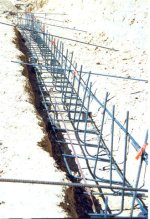
For my money, the concrete encased electrode specified in article 250-81-c fits the bill perfectly. See attached photo. Now, which system would you really rather have? A 5/8" x 8' rod protecting your home, or a 200' x 12" concrete encased system?

Now, please understand that my intent is not to criticize anyone. My intent is to show that there are far better ways to ground your home and protect you, your family and your appliances from power surges & ground faults. Meeting the minimum standards passes inspections and moves you to the next phase of construction, but it is not the best protection available in many cases.

I hope I haven't bored you folks too terribly, as I find grounding discussions more stimulating than most folks. /forums/images/graemlins/laugh.gif
 

Attachments

  • 692695-basement7 (Small).jpg
    692695-basement7 (Small).jpg
    40.9 KB · Views: 409
/ Electric Sub-Panel Installation #32  
Another shot of the concrete encased electrode conductor in the poured footer. Note in the first picture before the pour, the electrode is in direct contact with the steel re-bar.
 

Attachments

  • 692698-basement4 (Small).jpg
    692698-basement4 (Small).jpg
    34.5 KB · Views: 297
/ Electric Sub-Panel Installation #33  
sparkkky
Yep, we have discussed this a few times in the past. I will be the first to agree that different areas of the country/world see things differently. And I am not saying the way we look at it is the best either. We just follow the current edition of the NEC® as it is written.

<font color="blue"> seems in the 2005 that may be a change </font>
Actually that was a huge change in the 2002 NEC®
 
/ Electric Sub-Panel Installation #34  
Cletrac,

<font color="blue"> Running only 3 wires for a sub panel is against the national electric code. You must pull all 4 and the ground and neutral must not be bonded in the sub panel as they are in the main panel. Putting in a ground rod at the barn only will not draw enough current to trip a 15 amp breaker but it will draw enough current to kill you. </font>

You are "permitted" by the NEC® to run 3 wires to a SEPARATE BUILDING and install a made electrode there if no other metallic paths exist. Your GROUNDED conductor is used as the return path in this case and is permitted by the NEC®. Your electrode and the grounded conductor must be bonded together. This is one of the few cases you can do that. Your main service only has 3 wires, the neutral/grounded conductor is still the return path to ground.
 
/ Electric Sub-Panel Installation #35  
CityboyFarmer,

<font color="blue"> I don't know of any inspector anywhere that has ever required that resistence be verified, even with single driven electrode systems. </font>

We actually own several Ground Resistance testers. Are they used much anymore? No. We found that less than .5% of the made elctrodes did not test lower than 25 ohms.

Other areas of the country/world with different soil conditions will measure differently.
 
/ Electric Sub-Panel Installation #36  
<font color="blue"> seems in the 2005 that may be a change </font>
Actually that was a huge change in the 2002 NEC®


Missed that in CE class but I know that as late as last month per a talk with my local AHJ officer that they still require the 1999.


Funny that there is sometimes a double standard on what in the newer book is ok, like when the change said no more than one grounding conductor under one screw, but then that does not directly go aganist a prior code.

CBF, thats why I ask when I can what the inspector wants. The thing about rebar is it must be planed on from the first and doing mostly service with some new construction its not a choice.

In cites like Edmond, OK it is required to stub up rebar in the slab inspection.
 
/ Electric Sub-Panel Installation #37  
</font><font color="blue" class="small">(
We actually own several Ground Resistance testers. Are they used much anymore? No. We found that less than .5% of the made elctrodes did not test lower than 25 ohms.

Other areas of the country/world with different soil conditions will measure differently. )</font>

It is good to hear that ground resistance is tested in some places. Have you ever gone back and retested after a year or two? I know that resistance can be decreased with rock salt and water, and that the electrode must be re-treated periodically. What about during drought cycles?

As you can see from my photos, the soil under my house is sandy. No way I would trust a driven rod alone to protect my home, plus it doesn't cost much more for 20' of bare copper conductor in a concrete footer. I put 50' of 1/0 bare copper in mine. Small price to pay for peace of mind IMO.
 
/ Electric Sub-Panel Installation #38  
</font><font color="blue" class="small">( CBF, thats why I ask when I can what the inspector wants. The thing about rebar is it must be planed on from the first and doing mostly service with some new construction its not a choice. )</font>

Me too Sparky. When I would do re-wires, I would call the inspector for the area I was servicing and find out exactly what he was looking for. Makes life a lot easier that way.

You are right about the planning. Not too many general contractors ever think about bringing the electrician in when the footing is being dug. In most cases the electrical bids have not yet even been given in the foundation phase.
 
/ Electric Sub-Panel Installation #39  
I agree that the re-bar electrode is far superior in some areas of the country. AND it is now required in the 2005 NEC® if re-bar in the footings exist.
 
/ Electric Sub-Panel Installation #40  
I'm curious about your way of making wiring and installation. Sorry for, for you maybe, stupid questions. I am electric engineer, living in Europe, and don't understand what are you talking about.
You have 220V, 60Hz single phase network. Why you need more then 3 conductors? Can somebody draw a diagram to explain me, please?

We have here either single or 3 phase network in houses, using Line, Neutral and Protective Earth conductors, or 3xLine+N+PE.
Neutral wires in installation are connected to the common busbar, and are connected to the neutral of utility overhead network, separated from ground. Neutral is grounded by the utilities.
PE is connected to the house grounding (either in basement on new biolt houses, or bar or pipe type grounding).
Switchboard circuit breakers switch just a phase conductor, and neutral is not switched.
In French or Italy are in use 2 or 4pole breakers, and they disconnect neutral, too.
Protection of insulation fail is provided by earth leakage switches/circuit breakers.
Are we that far in technology /forums/images/graemlins/confused.gif
 

Marketplace Items

CASE IH STEIGER 400 HD TRACTOR (A58375)
CASE IH STEIGER...
2016 KOMATSU PC138USLC-10 EXCAVATOR (A62129)
2016 KOMATSU...
2017 KINZE KNOTCHED SINGLE DISK FERTILIZER OPENER FOR 3000/3500 SERIES PLANTERS (6 ROWS) (A55315)
2017 KINZE...
SEMI AUTOMATIC QUICK CHANGE FOR MINI EXCAVATOR (A58214)
SEMI AUTOMATIC...
Tandem Axle Rear Trailer Frame (A55851)
Tandem Axle Rear...
2021 Polaris Ranger Electric Utility Bed UTV (A56859)
2021 Polaris...
 
Top